It’s the question every new parent eagerly asks: “When will my baby start talking?” The exciting milestone of that first real word—like ‘mama’ or ‘dada’—typically happens somewhere between 10 and 14 months old. But the truth is, your baby’s journey toward language started long before that, with their very first cries.
Your Baby’s First Words: An At-A-Glance Timeline

Watching your little one go from gurgles to actual words is easily one of the most magical parts of being a parent. It’s a path filled with tiny, yet incredibly important, steps. When you know what these steps are, you can appreciate every sound and gesture as a piece of the bigger communication puzzle.
Think of it like building a tower. Those first coos and babbles are the foundation. Next come imitation and gestures, which form the middle layers. Finally, those precious first words are placed right on top.
Every child’s timeline is unique. While milestones provide a helpful guide, they are not a rigid schedule. The goal is to see steady progress, not to compare your child’s journey with another’s.
The Progression From Sounds To Sentences
This whole process is a fascinating mix of physical development (like strengthening their mouth and tongue) and cognitive growth (realizing that sounds actually mean something). From day one, your baby is a little sponge, soaking up the rhythm, tone, and patterns of your voice.
Speech is also deeply connected to other areas of growth, like motor skills and social awareness. For instance, a baby who learns to point is using a powerful form of pre-verbal communication. For a bigger picture of how all these skills fit together, you can explore this guide on child development stages by age.
To help you track this amazing journey, we’ve put together a quick reference table. This chart breaks down what you can expect to hear as your baby finds their voice, giving you a clear look at each stage.
Baby’s Speech and Language Milestones At a Glance
This table outlines the typical developmental stages of speech, from early sounds to first words and phrases, providing a quick reference for parents.
| Age Range | What to Listen For (Typical Milestones) | Examples |
|---|---|---|
| 0-3 Months | Makes cooing and gurgling sounds. Cries differently for different needs. | “ooh,” “aah,” soft vowel sounds |
| 4-6 Months | Babbles with different sounds, including consonants like ‘p,’ ‘b,’ and ‘m.’ Responds to their name. | “bababa,” “papapa,” raspberries, squeals |
| 7-12 Months | Uses more complex babbling (jargon) that sounds like speech. Imitates sounds and gestures. | Waving “bye-bye,” “mamama,” “dadada” (non-specific) |
| 12-18 Months | Says first meaningful words with intent. Uses one-word questions and points to objects. | “Mama,” “Dada,” “Up,” “More,” “Ball” |
| 18-24 Months | Vocabulary expands rapidly (around 50 words or more). Begins putting two words together. | “More juice,” “My teddy,” “Go car” |
This table serves as a general map, but remember that every baby’s adventure into language is their own. Keep listening, keep talking, and enjoy every new sound along the way.
How Babies Learn To Talk From Coos to Conversations

Watching a baby learn to talk is a bit like seeing a masterpiece come together, one tiny piece at a time. It doesn’t begin with a perfectly formed “mama” or “dada.” Instead, it starts with a rich foundation of sounds, expressions, and gestures that are every bit as important as their first real words.
Long before they can speak, babies are already experts at communicating. Their cries—distinct for hunger, discomfort, or tiredness—are their first attempts at using their voice to get a response from you. It’s the very first turn in a lifelong conversation.
Those early cries soon soften into more musical sounds, kicking off the pre-linguistic stage. This is a crucial period where your baby simply plays with their voice, setting the scene for all the speech that will follow.
The Foundation: Coos and Gurgles
Somewhere between two to four months, you’ll start hearing those wonderful coos and gurgles. These are usually simple vowel sounds, like “aaah” and “oooh.” Your baby isn’t just making noise for the sake of it; they’re figuring out how their voice box works and learning to control the tiny muscles in their mouth and throat.
When you coo back, you’re doing something incredibly powerful. You’re teaching them the back-and-forth rhythm of conversation—what experts call “serve and return.” These simple exchanges are one of the best ways to nurture their budding language skills.
As they get the hang of it, you’ll hear them experiment with squeals, growls, and even raspberries. Think of this as vocal gymnastics. They’re strengthening their abilities and warming up for the much more complex sounds ahead.
Every interaction is a language lesson in disguise. When you respond to your baby’s sounds and gestures, you reinforce the idea that their voice matters and has the power to connect with others.
The Framework: Babbling and Gestures
Around six to nine months, the coos start to transform into babbling. This is when consonants get into the mix, producing repetitive chains of sound like “bababa” or “mamama.” While a “dada” at this age might just be a happy accident rather than a name, it’s a massive leap. Your baby is now practicing the specific phonetic sounds of your language.
At the same time, their non-verbal communication skills explode. Pointing, in particular, is a huge milestone. When a baby points at the cat and babbles, they’re essentially asking, “What’s that thing over there?” They’re learning to share your attention and link a sound to an object.
Other key gestures to watch for include:
- Waving: Copying “bye-bye” shows they understand and can repeat social rituals.
- Clapping: A physical response to excitement, connecting an emotion with an action.
- Reaching: An unmistakable, non-verbal way of saying, “Pick me up!”
The First Words: The Holophrastic Stage
Then, usually between 10 and 14 months, it happens: your baby says their first word with clear intent. This kicks off the holophrastic stage, a fascinating time when a single word does the work of an entire sentence.
For example:
- “Up!” might mean, “Please pick me up right now!”
- “Ball?” could be asking, “Where did my ball go?”
- “More!” is a clear demand for another cracker.
This stage proves your child now understands that words are powerful symbols that get real results. As their vocabulary expands, they’ll soon enter the telegraphic stage, stringing two words together into mini-sentences like “more milk” or “go car.”
Understanding these building blocks helps you appreciate and support your child’s unique pace. If you’re curious about how these developmental stages are nurtured in a professional setting, you can learn more about the programs at our early childhood center.
How to Spot Speech Delay Red Flags with Confidence
As a parent, you’re constantly taking a mental snapshot of your child’s growth. Is she crawling on time? Is he eating enough? So, it’s perfectly normal to find yourself wondering, “Is my child’s speech on track?”
The truth is, every child develops at their own pace. But that little voice in your head—your parental instinct—is incredibly powerful. Knowing what to look for can turn that vague worry into confident awareness, so you know exactly when and how to act if needed.
No one knows your child better than you. If you have a persistent feeling that something isn’t quite clicking with their communication, listen to it. That gut feeling is often the very first sign that it’s time to dig a little deeper.
Key Milestones to Watch By Age
So, what are the concrete things to watch for? Think of these milestones not as a rigid checklist to stress over, but as helpful guideposts. A single, small deviation is rarely a big deal. What we’re really looking for is a pattern of missed milestones, as that’s a much stronger signal to consult a professional.
By 12 Months:
Your one-year-old should be a little communication engine. You’d want to see them babbling with different sounds (“mamama,” “bababa”) and starting to use gestures to interact, like waving bye-bye or pointing to the dog. A lack of these early, non-verbal attempts to connect is a flag to watch. Also, notice if they don’t seem to respond when you call their name.
By 16-18 Months:
This is usually a time of exciting vocabulary growth. A conversation with a specialist is a good idea if your toddler:
- Hasn’t said their first real words by 16 months (like “mama” or a clear word for a pet).
- Doesn’t point to show you things they find interesting.
- Seems to tune out simple requests like, “Give me the ball.”
By 24 Months:
By age two, their communication skills should be taking a noticeable leap forward. The biggest red flags at this age include:
- Having a vocabulary of fewer than 50 words.
- Not putting two words together to form simple phrases (“more juice,” “go car”).
- Struggling to follow simple, two-step directions (“Pick up your teddy and bring it to me”).
Beyond Words: The Social Side of Communication
Sometimes the most telling clues aren’t about vocabulary at all. Language is built on a foundation of social communication—the simple desire to connect with others. It’s the back-and-forth of a smile, a shared giggle, or the drive to show you their favorite toy.
Most parents of typically developing babies in the AE region get to celebrate those first words around the 10-12 month mark. For children with autism or other speech delays, that timeline often looks different. Research shows that by 18-24 months, only about 50% may have started combining words into phrases like ‘want milk.’ In the AE region, where early detection is improving, starting intervention before 24 months can make a huge difference in language outcomes. If you notice your child isn’t pointing or trying to imitate you by 18 months, taking action early is key. You can learn more about how intensive therapy helps accelerate language acquisition on appleabacare.com.
When Your Own Concern Is the Biggest Sign of All
At the end of the day, you can put away the checklists. Your own intuition is one of the most reliable indicators there is. Study after study has confirmed that when a parent is concerned, there’s often a good reason.
If you find yourself constantly worrying, comparing your child to their cousins or friends, or making excuses for their quietness (“Oh, he’s just shy,” or “His older sister talks for him”), that’s your sign. Reaching out for an evaluation doesn’t mean you’re committing to a diagnosis. It’s simply a proactive step to get clear answers and, if needed, find the right support to help your child connect with the world.
Simple and Fun Ways to Encourage Your Baby to Talk

The great news is that you have a huge role to play in helping your baby learn to talk. You don’t need special flashcards or pricey gadgets to do it, either. The best way to encourage speech is by creating a home environment that’s buzzing with language, and it all happens through connection and play.
Some of the most powerful language lessons are woven right into your daily routine—cuddles, diaper changes, and walks around the block. These simple, loving moments are what truly build the foundation for communication.
Talk, Talk, Talk
One of the easiest things you can do is just talk through your day with your baby. Think of yourself as a sportscaster for your life. As you move through your routine, narrate what you’re doing, seeing, and feeling.
For instance, when getting your baby dressed, you can say, “Okay, let’s put on these soft, blue socks! One sock for your left foot… and another for your right foot!” This constant chatter exposes them to new words, the rhythm of conversation, and how sentences are put together. It’s a real-time lesson connecting words to objects and actions.
Sure, it might feel a little strange at first, like you’re just talking to yourself. But your baby is a little sponge, soaking it all in. They’re learning that words have meaning long before they can say them back.
Use Parentese
Ever notice how your voice naturally goes up a few octaves and gets a bit sing-songy when you talk to a baby? That’s parentese, and research shows it’s fantastic for their language development. This isn’t the same as gibberish “baby talk.” With parentese, you’re using real words and correct grammar, just with a slower tempo and more exaggerated, melodic tone.
Parentese is like a spotlight for words. The higher pitch and slower pace capture a baby’s attention, making it easier for their developing brain to tune into the sounds of language and distinguish individual words.
That animated way of speaking really helps babies stay engaged and makes the different sounds in speech stand out. So go ahead and embrace that sing-song voice—it’s one of the most powerful teaching tools you have.
Make Reading A Daily Ritual
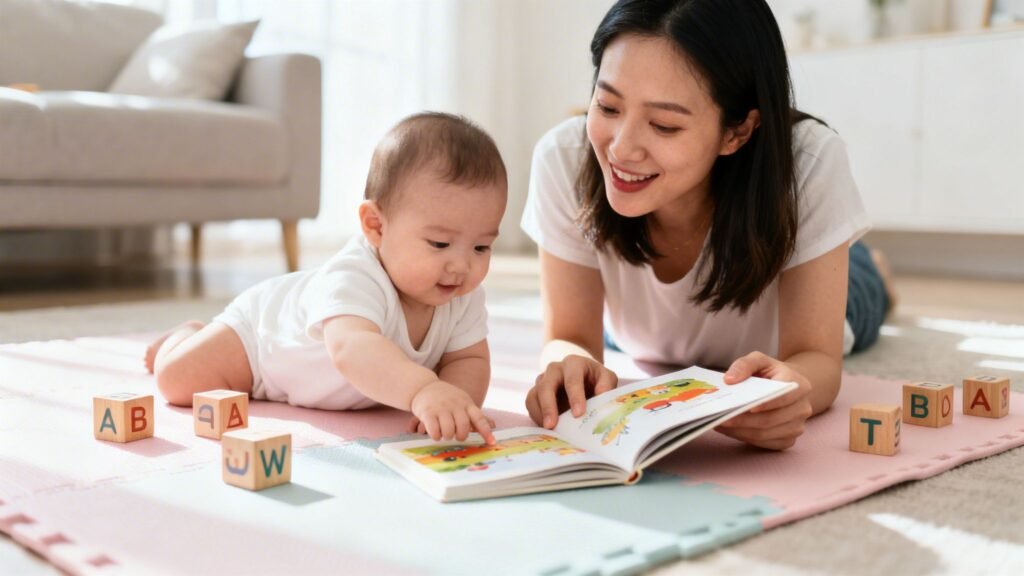
Reading together is a wonderful way to build vocabulary and spark a lifelong love for stories, even if it’s just for a few minutes each day. Start with sturdy board books filled with big, colorful pictures and simple text. You don’t even have to read every word.
Let your baby lead the way. Point to the pictures and name what you see: “Look! A big, red bus!” Make the sounds of the animals on the page. Let them grab the book, turn the pages (or try to!), and even chew on the corners. It all makes reading an interactive, sensory experience.
Classics like “The Wheels on the Bus” or “Mary Had a Little Lamb” are perfect because the rhyme and rhythm help cement new words. If you’re looking for good options to get started, exploring different nursery rhymes books can be a great way to kick off your daily reading sessions.
Sing Songs and Use Gestures
Music and movement are absolute powerhouses for learning language. The rhythm and repetition in simple songs and nursery rhymes are brilliant for helping babies pick up language patterns.
Bring the songs to life by adding simple gestures and actions:
- Clap your hands when you sing “If You’re Happy and You Know It.”
- Wiggle your fingers for “Twinkle, Twinkle, Little Star.”
- Make a habit of waving “bye-bye” when someone leaves.
Pairing a physical action with a word helps lock its meaning into your baby’s brain. In fact, gestures like pointing are a crucial stepping stone to talking, acting as a bridge between understanding a word and finally being able to say it.
By weaving these simple activities into your day, you create a fun, supportive space that naturally encourages your little one to find their voice. For more ideas, especially for those days you’re cooped up inside, you can find some wonderful indoor activities for kids at home.
How Early Intervention Creates A Personalized Path Forward

Realizing your child might need some extra help can feel overwhelming. I get it. But deciding to get an assessment isn’t admitting defeat—it’s the first, most powerful step you can take. Early intervention isn’t about a generic fix; it’s about creating a truly personalized plan that plays to your child’s unique strengths while tackling their specific challenges head-on.
Think of it this way: you wouldn’t use a standard key for a custom-built lock. Your child’s brain and development are just as unique. A personalized plan, designed by a team of specialists, acts as the custom key, built from the ground up to unlock their specific communication potential.
This collaborative effort is what makes early intervention work. It brings different experts to the table, with each one contributing a vital piece to the puzzle of your child’s development.
The Team Behind Your Child’s Success
No single professional holds all the answers. Real, lasting progress almost always comes from a team of specialists who look at your child’s needs from different—but equally important—angles. This synergy ensures that every facet of their communication journey is supported.
Your child’s team might include a few of these key players:
- Speech-Language Pathologists (SLPs): These are the architects of communication. They work directly on helping your child produce sounds, form words, understand grammar, and navigate social conversations.
- Occupational Therapists (OTs): OTs are the crucial link between the brain and the body. They help with sensory processing issues, fine-tune the motor skills needed for clear speech, and improve the physical coordination needed for learning through play.
- Applied Behavior Analysis (ABA) Therapists: Think of ABA therapists as skill-building strategists. They use evidence-based, play-centered methods to build foundational abilities like imitation, attention, and social back-and-forth—all of which language depends on.
- Educational Psychologists: These specialists look at the big picture. They assess your child’s cognitive profile to make sure the therapy plan aligns perfectly with how their unique mind works and learns best.
The guiding principle of early intervention is individualization. Because no two children are the same, no two therapy plans should be. Goals are built around your child’s personality, their interests, and your family’s dynamic—not just a diagnosis.
A Story Of A Personalized Path
Let me share a story. Imagine a bright, loving little boy, let’s call him Adam. At 2.5 years old, he was completely non-verbal, and his parents were, understandably, deeply concerned. The bridge to communicating with their son felt like it was missing.
Following a comprehensive assessment, his new team created a multi-layered plan. His occupational therapist worked on his sensory needs, which helped him feel more settled and able to focus. His ABA therapist tapped into his love for toy cars to build his attention and imitation skills. Only then did the speech therapist step in, using those brand-new skills to introduce sounds, and finally, words.
By age 4, Adam wasn’t just saying words; he was speaking in full sentences. His journey shows the incredible power of a plan that didn’t just target the “not talking” part but built the foundation he needed for language to emerge naturally. You can learn more about how our expert teams provide top-tier speech therapy in Dubai.
The Lifelong Impact Of Early And Individualized Support
The potential for growth doesn’t end in toddlerhood. Many autistic children experience a ‘language burst’ between ages 5 and 8, which can be truly transformative. In fact, studies show that nearly half (47%) of children who were non-verbal at age 4 go on to achieve fluent speech.
At Georgetown, our plans are designed to harness this potential. Speech therapists intensify phrase-building, ABA therapists use pretend play (linked to 50% better outcomes), and OTs help refine articulation. It’s a concerted effort. We also know from research that 70% of late talkers catch up and use phrase speech by age 8, a result heavily influenced by the quality and intensity of their early support. You can discover more about how intervention timelines impact speech on speechblubs.com.
This is precisely why starting early is so important. An individualized plan equips your child with the right tools at the exact moment their brain is most ready to learn, turning worry into a clear, hopeful, and effective path forward.
Common Questions Parents Ask About Their Baby’s Speech
As a parent, you’re charting a course into new territory, and it’s completely natural to have questions as you watch your child’s speech unfold. Wondering if everything is on track is a sign of a caring, attentive parent. Let’s walk through some of the most common questions we hear from families just like yours.
Does Being a “Late Talker” Mean There Is a Problem?
That term, “late talker,” can certainly be nerve-wracking. The good news is that many toddlers who start talking a bit later than their peers do eventually catch up all on their own. The tricky part? There’s simply no crystal ball to tell us which child will catch up and which one might need a little help.
This is why we always recommend a proactive approach. An assessment is the only real way to understand what’s going on. It can distinguish between a child who is simply developing on their own timeline and one who could truly benefit from early support. Getting that clarity brings incredible peace of mind.
Trust your gut. That parental instinct is a powerful tool. If you feel like something isn’t quite right with your child’s communication, it’s always worth looking into. An early assessment can provide answers and, if needed, get support started when it makes the biggest difference.
How Is a Speech Delay Different From Autism?
This is a big one, and it’s a question we get all the time. Think of it this way: a simple speech or language delay is almost entirely about the words themselves—either trouble understanding them or difficulty producing them. A child with a straightforward speech delay usually still has strong social skills. They’ll still make eye contact, share a smile with you, and try to get your attention to show you something cool.
A speech delay related to autism, however, is part of a much bigger picture. The delay in words is connected to broader differences in social communication. For example, a child may not respond when you call their name, might not point to things they want or find interesting, or may seem more content in their own world. The focus isn’t just on the lack of words, but on the drive to connect and share experiences with others.
My Toddler Talks a Lot, but I Cannot Understand Them
First off, this is incredibly common! A toddler’s mouth is learning a complex new motor skill, coordinating the tongue, lips, and jaw. It’s no surprise that a lot of their speech sounds like charming gibberish at first. For a typical two-year-old, it’s expected that even a stranger would only understand about 50% of what they’re saying.
The time to pay closer attention is around age three. If you and other close family members are still having a hard time understanding the majority of what your child is trying to say, it might point to a challenge with articulation (making the sounds) or phonology (the sound patterns of language). This is the perfect time to get a speech therapist’s opinion.
What Is the First Step if I Am Worried?
If you’re feeling concerned about your child’s talking or any other part of their development, the path forward is refreshingly simple.
Your first stop should be your pediatrician. Share your observations and ask for their perspective. From there, your next step is to contact an early intervention center for a full, comprehensive assessment. Taking these two steps ensures you get expert answers and a clear, personalized plan to help your child thrive.
At Georgetown early intervention center, we know that every child’s journey is one-of-a-kind, and their therapy should be too. Our collaborative team of educational psychologists, speech therapists, and occupational therapists works together to build a roadmap designed specifically for your child’s success. Learn how our individualized plans can support your family by visiting us at https://www.georgetownuae.com.