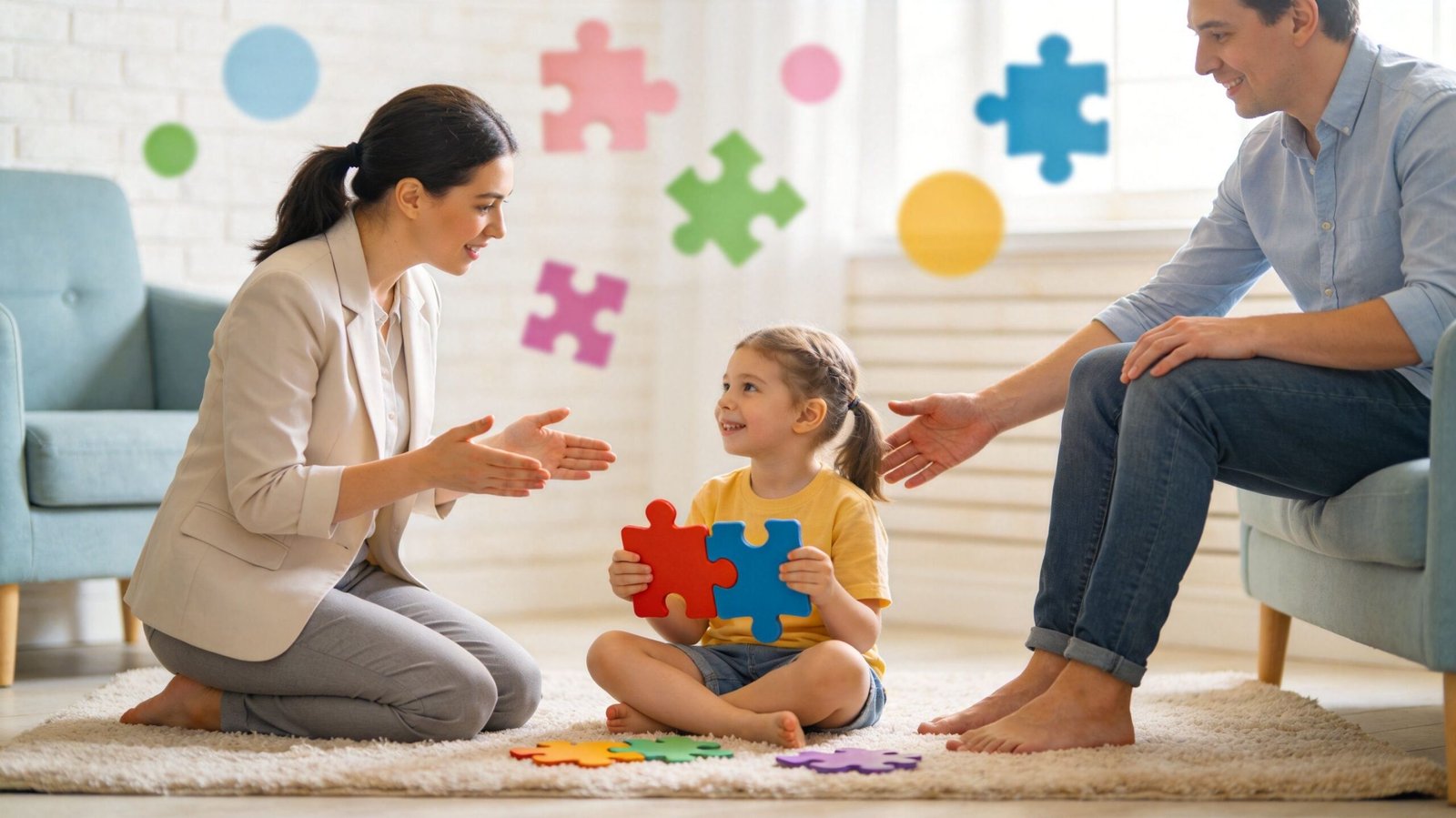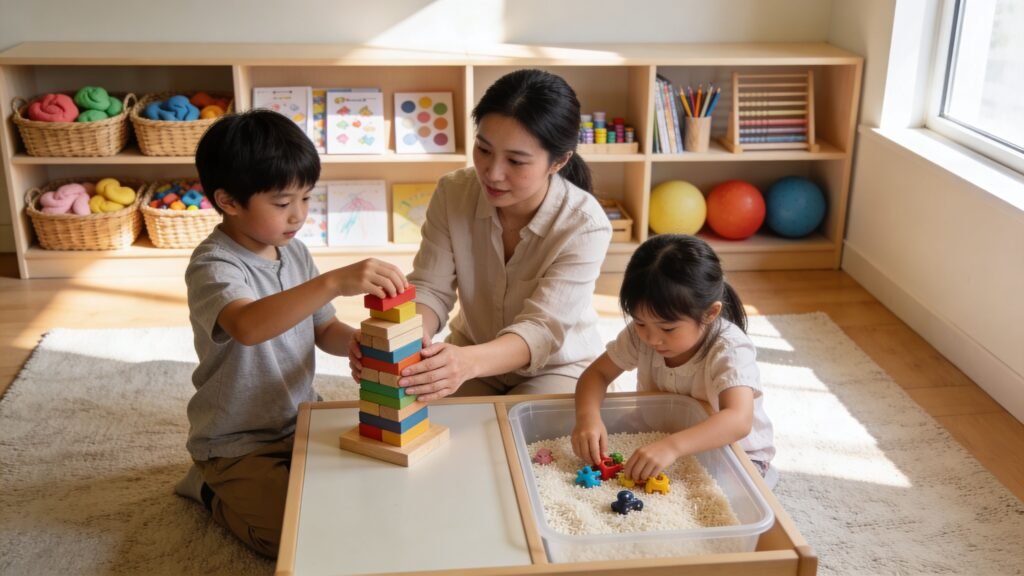
A rainy afternoon can turn quickly. The playdate is cancelled, your child is already restless, and the ideas that usually buy 20 minutes stop working by lunch. Parents often tell me the hardest part is not finding indoor activities. It is choosing one that fits their child’s regulation, communication, and learning needs that day.
That pressure is common for families managing autism, speech delays, sensory differences, attention needs, and school readiness concerns at the same time. In practice, I see the same pattern again and again. A child refuses an activity that looked perfect on paper, and the parent assumes it was the wrong choice. More often, the activity was fine but the setup was off. The sensory load was too high, the language demands were too complex, or the expectations lasted too long.
At Georgetown, we treat play as a daily opportunity to support development, not just pass time. An occupational therapist may look at posture, hand strength, motor planning, and sensory regulation. A speech therapist may build requesting, vocabulary, comprehension, and conversation from the same activity. ABA strategies can support turn-taking, waiting, transitions, and reinforcement. An educational psychologist may focus on attention, sequencing, early reasoning, and learning readiness. That integrated view is what makes home activities more useful. One simple setup can target several goals at once.
Parents do not need to deliver formal therapy at home. They do need a practical plan. Start small, keep the materials manageable, and watch how your child responds. If an activity falls apart, adjust one variable first: shorten the task, reduce the sensory input, add a visual cue, or model the language more clearly. Families who need more help choosing activities for regulation can also explore sensory play strategies for children in Dubai.
The ideas below are designed to help you choose with more confidence and adapt with less guesswork.
1. Sensory Play Bins and Exploration Activities
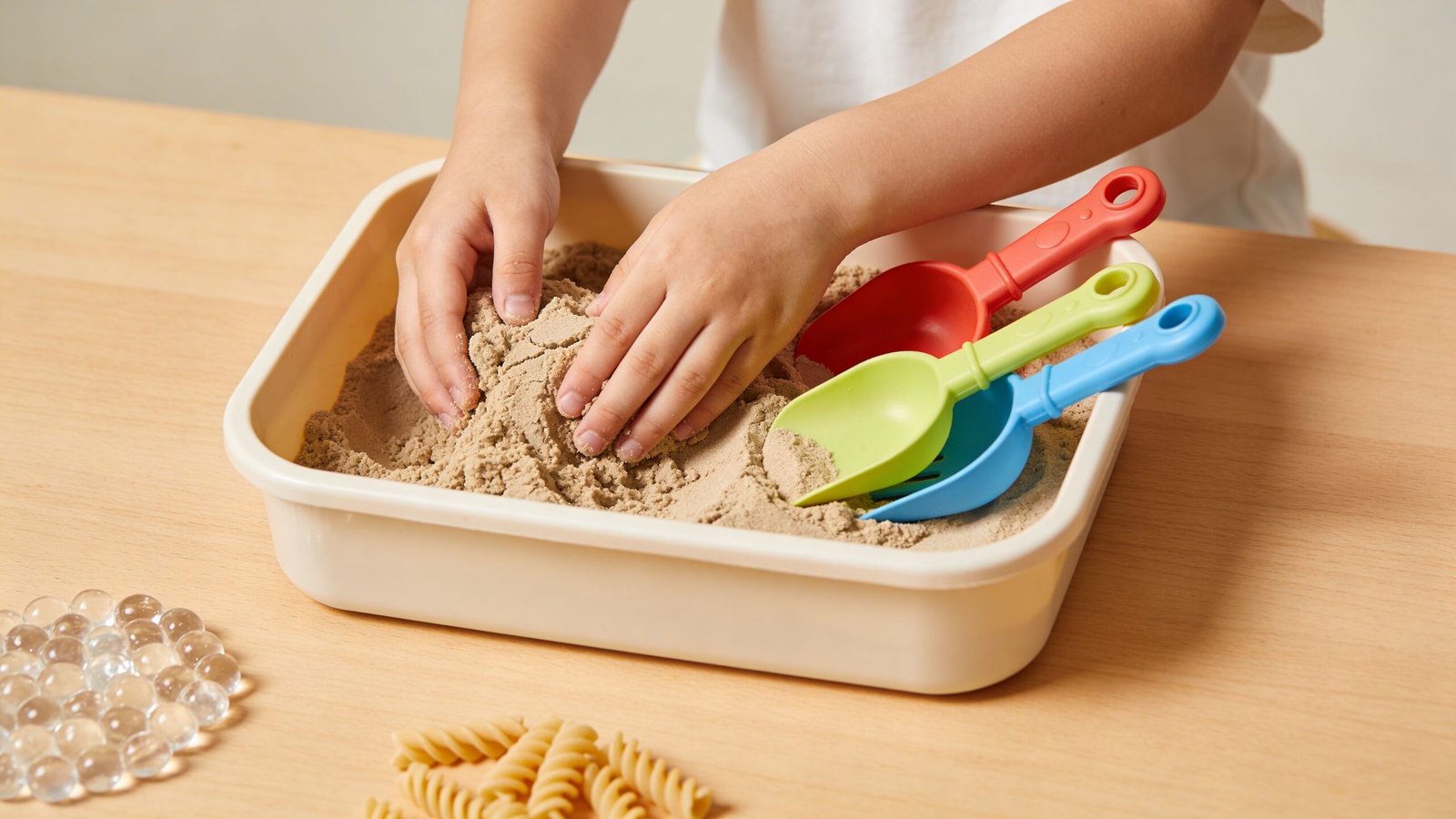
Sensory bins work because they give the child a job for the hands and a manageable amount of sensory input. A shallow plastic tray with kinetic sand, dry pasta, rice, pom-poms, scoops, cups, and small hidden objects is enough. You do not need a Pinterest version.
For some children, this is calming. For others, it is overwhelming if you start with too many textures at once. That trade-off matters. A child who avoids messy play may do well with dry materials first. A child who craves input may stay longer with heavier scooping and pouring.
How different therapies fit into one bin
An OT may use the bin for grasp strength, bilateral coordination, and tactile tolerance. A speech therapist can turn the same activity into a language lesson by modelling words like “full”, “empty”, “dig”, “hide”, “soft”, and “more”. ABA principles help with short turns, waiting, and cleaning up. An educational psychologist may add simple sorting, matching, or “find three red items” directions.
Try real household versions:
- Rice and measuring cups: Scoop, pour, and compare “full” versus “empty”.
- Dry pasta with hidden buttons or blocks: Ask your child to find one object at a time.
- Kinetic sand with moulds: Press, squeeze, flatten, and make shapes.
- Bean bin with spoons and tongs: Build hand strength while moving items from one bowl to another.
A useful adjustment is to keep one clear rule. Hands stay in the tray. That single boundary often prevents the whole activity from becoming stressful.
If a sensory bin becomes throwing practice, the child is telling you the input is either too stimulating or too hard to organise. Reduce materials, shorten the session, and give a clearer motor task.
Parents who want more sensory-specific guidance can explore sensory play support in Dubai.
2. Picture-Based Communication and Social Stories
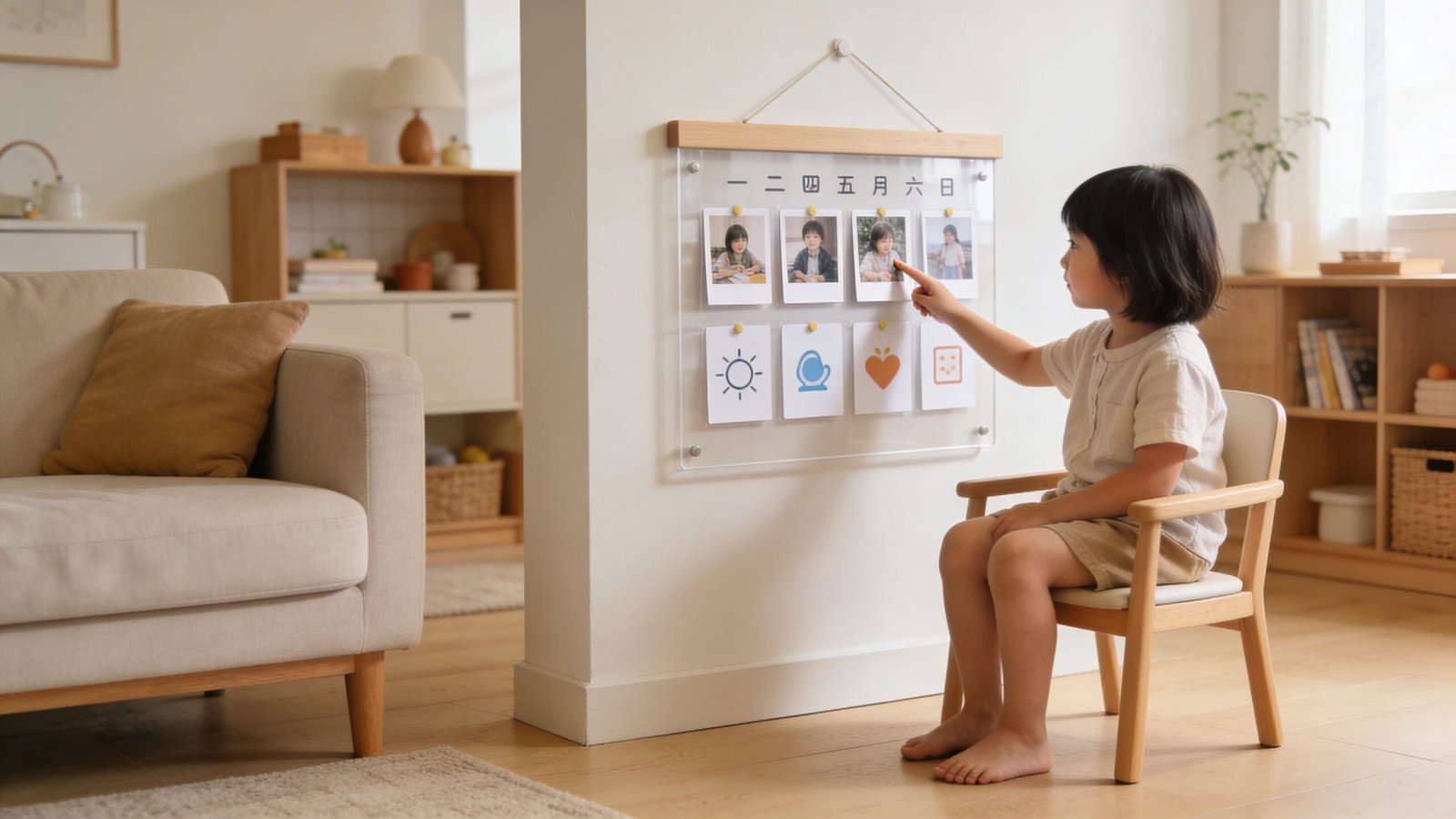
It is 5:30 p.m., your child is tired, you say “bath first, then dinner,” and the room falls apart within seconds. For many children, the problem is not refusal. It is that spoken language disappears too fast. A picture stays in place long enough for the child to process it.
Picture-based supports and short social stories work well for children with autism, speech delays, language processing differences, or uneven receptive and expressive skills. They also help children who speak but struggle during transitions, waiting, or unfamiliar routines.
The most effective visuals are functional. Use photos of your child’s own items if possible: their cup, toothbrush, shoes, tablet, favourite snack, the front door. Real images are often easier for young children to understand than a crowded page of symbols.
Three formats tend to work best at home:
- Choice board: Offer two to four pictures for snacks, toys, or activities.
- Mini visual schedule: Show a short sequence such as “toilet, wash hands, snack.”
- Social story strip: Use a few pictures and simple words to show what happens before, during, and after a hard routine like hair washing, doctor visits, or guests arriving.
An integrated therapy approach helps families make better choices. A speech therapist focuses on communication intent. If your child points to “bubbles,” you say “bubbles” and respond right away so communication has a clear result. ABA strategies help you prompt, pause, and fade support without turning the board into another adult-led demand. OT input matters too. Pictures need to be placed where the child can reach and see them easily, with a layout that does not overload visual attention. Educational psychology adds sequencing, prediction, and simple cause-and-effect thinking.
I usually tell parents to start smaller than they think. One board. Two choices. One daily routine.
A “first, then” card is often the best place to begin. First pack away blocks, then trampoline. First toilet, then iPad. It reduces negotiation because the expectation and the payoff are both visible. That matters for children who do not hold verbal directions well under stress.
The common mistake is making the system too large, too abstract, or too decorative. A wall full of symbols may look organised to an adult and still be unusable for a child. Fewer pictures, clearer language, and consistent placement usually get better results.
If your child ignores the visuals, do not assume they “cannot use pictures.” Check the setup first. The pictures may be too small, introduced too quickly, or only presented after the child is already upset. In practice, visuals work best when they are taught during calm moments and then used the same way each day.
Families who need help choosing the right level of support can get guidance through occupational therapy for visual supports and daily routines in Dubai.
3. Fine Motor Skill Activities
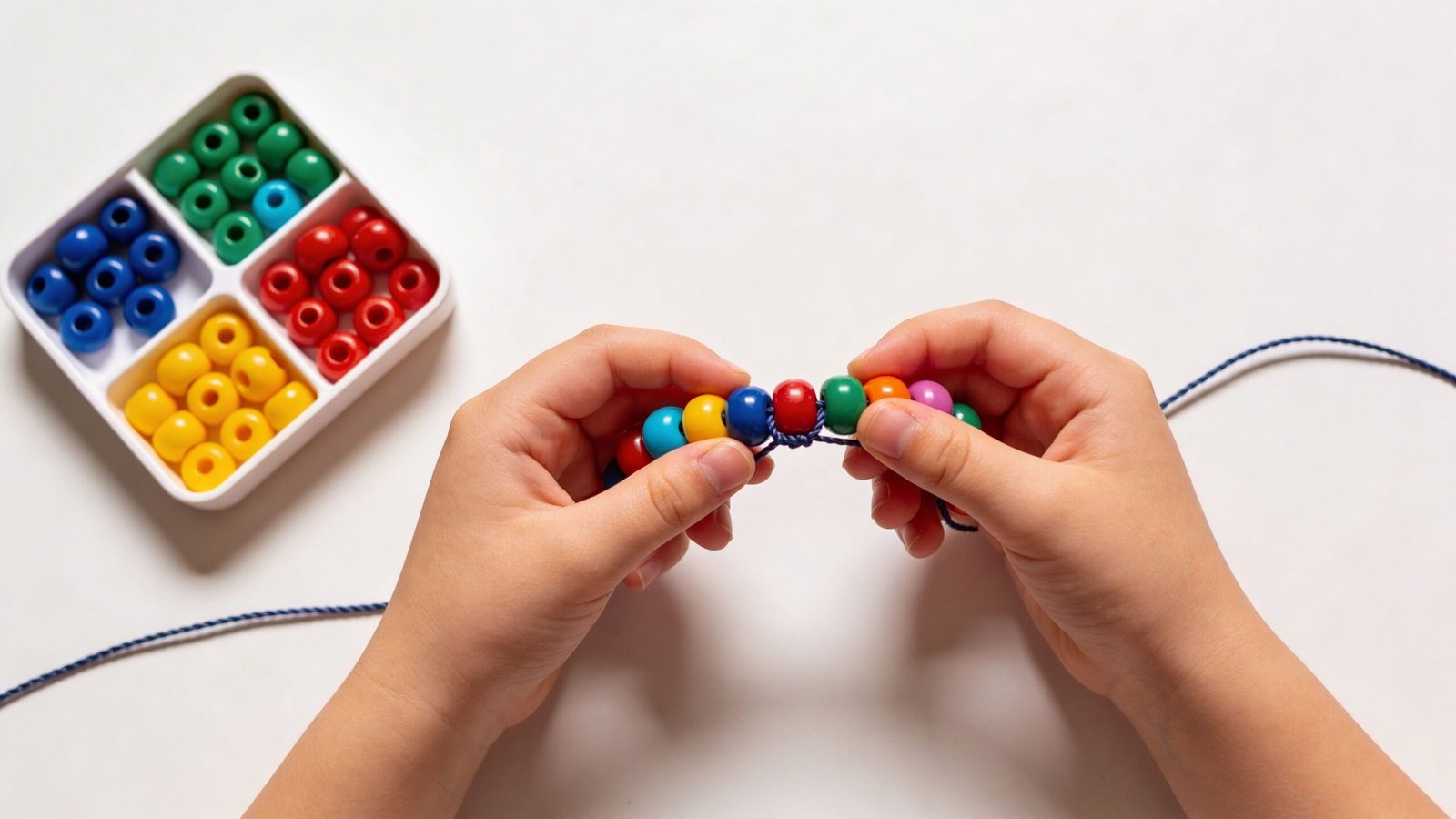
Beading, threading, puzzles, pegboards, stickers, tongs, and playdough look like simple play. They are also some of the most useful indoor activities at home for kids who need better hand strength, finger isolation, visual motor control, and frustration tolerance.
The mistake parents often make is choosing an activity that is two steps too hard. If threading tiny beads causes tears, switch to large wooden beads and a stiff lace. If a 24-piece puzzle stalls, drop to a chunky inset puzzle with clear pictures.
What to set up on your table
A strong fine motor station might include:
- Large beads and string: Better for children who need more control and visual success.
- Lacing cards or shoe-lacing boards: Good for bilateral coordination.
- Chunky wooden puzzles: Useful for matching and spatial awareness.
- Playdough with tools: Rolling pins, cookie cutters, and child-safe scissors build hand strength.
- Peg puzzles or pom-poms with tongs: Great for precision without heavy writing demands.
Occupational therapists often build from these exact foundations. Fine motor work supports classroom skills such as managing fasteners, holding a crayon, and using utensils. Families seeking structured support can learn more about occupational therapy in Dubai.
There is also a behavioural side to this. Keep the task short enough that your child can finish. Completion teaches persistence better than prolonged struggle.
Give just enough help for success. Hand-over-hand can be useful at the start, but fade quickly. A child who feels every task is “done to” them often stops trying.
You can also fold in speech and learning targets without making the activity feel clinical. Ask for colours, count pieces, describe “in”, “out”, “turn”, and “push”, or sort by size. That turns one tray of beads into a multi-skill session.
4. Play-Based Speech and Language Activities
It is 5:30 pm, your child wants the bubbles, and all you get is pulling, whining, or a single sound. That moment can become a speech session without turning your home into a clinic.
Play works because communication has a clear purpose inside it. A child asks for the car to move, protests when the doll falls, labels the animal, or waits for “ready, set, go.” Speech therapists use that motivation on purpose. ABA supports help create a reason to request or take turns. OT helps regulate attention and body readiness so the child can stay in the interaction. Educational psychology reminds us that children learn language better when the demand matches their current level.
Create one play routine and repeat it well
Set up one simple activity your child already likes. Good options include a farm set, toy kitchen, car ramp, doll bath, ball tower, or a song with actions. Keep the materials limited so the language target stays clear.
Then change how you join the play.
Comment more. Ask fewer questions. Hold back a key item for a second. Pause after a familiar phrase. Those small changes create a communication opportunity without pressure.
A practical sequence looks like this:
- Model one useful word or phrase: “open,” “help,” “go,” “my turn,” “baby sleep.”
- Pause for 3 to 5 seconds: Give time for a sound, word, sign, gesture, or picture response.
- Accept the attempt: Count approximations if they are meaningful for your child’s level.
- Expand once: If your child says “juice,” model “more juice” or “want juice.”
- Repeat the same routine several times: Repetition builds understanding and confidence.
This is the part many parents miss. More prompts do not always produce more language. Children often speak more when adults reduce the verbal load and make the next turn predictable.
For children in bilingual homes, mixed language exposure does not cause a speech disorder. It can, however, make it harder for families to judge what is a normal difference and what needs assessment. The American Speech-Language-Hearing Association explains that milestones should be considered across the child’s full language system, not judged by one language alone in isolation. If you want direct guidance on expressive language, speech sounds, or social communication, Georgetown’s speech therapy in Dubai uses this same play-based model.
A few home setups work especially well because they target more than one developmental area at once:
- Pretend café: Builds requesting, greetings, turn-taking, and simple sequencing. Good for speech goals and ABA targets such as waiting and reciprocal exchange.
- Toy farm or animal rescue: Builds vocabulary, action words, categories, and early pretend sequences. Useful for speech and cognitive organization.
- Bubbles or wind-up toys: Builds “open,” “more,” “go,” “again,” and shared attention. Helpful when a child is not yet using many words.
- Sing-and-stop games: Supports imitation, anticipation, joint attention, and regulation. Many children tolerate these better than direct flashcard work.
- Story baskets with figures and props: Supports narrative language, comprehension, and symbolic play. This often gives educational psychologists and speech therapists better information than rote naming tasks.
Correction needs restraint. If every word gets repaired on the spot, play loses its value and the child may stop initiating. A better rule is model first, then repeat the activity so the child hears the stronger version in context.
Seek extra support if your child rarely initiates, loses skills they once used, struggles to understand simple directions, or becomes frustrated so quickly that play breaks down every time. Those are the cases where home practice helps most when it sits inside a clear therapy plan.
5. Structured Movement and Gross Motor Activities
By late afternoon, many parents can see the pattern. Their child is bouncing off the couch, crashing into cushions, arguing during transitions, or melting down the moment a seated task starts. In that moment, movement is not just a way to burn energy. It can be a therapy tool when it is set up with a clear goal.
A home obstacle course works well because it pulls together several developmental systems at once. Occupational therapy principles guide the sensory and body-awareness pieces. Speech therapy fits into the directions, action words, and turn-taking language. ABA strategies help with sequencing, waiting, and finishing a short routine. Educational psychology adds the learning piece by matching the level of challenge to your child’s attention, planning, and frustration tolerance.
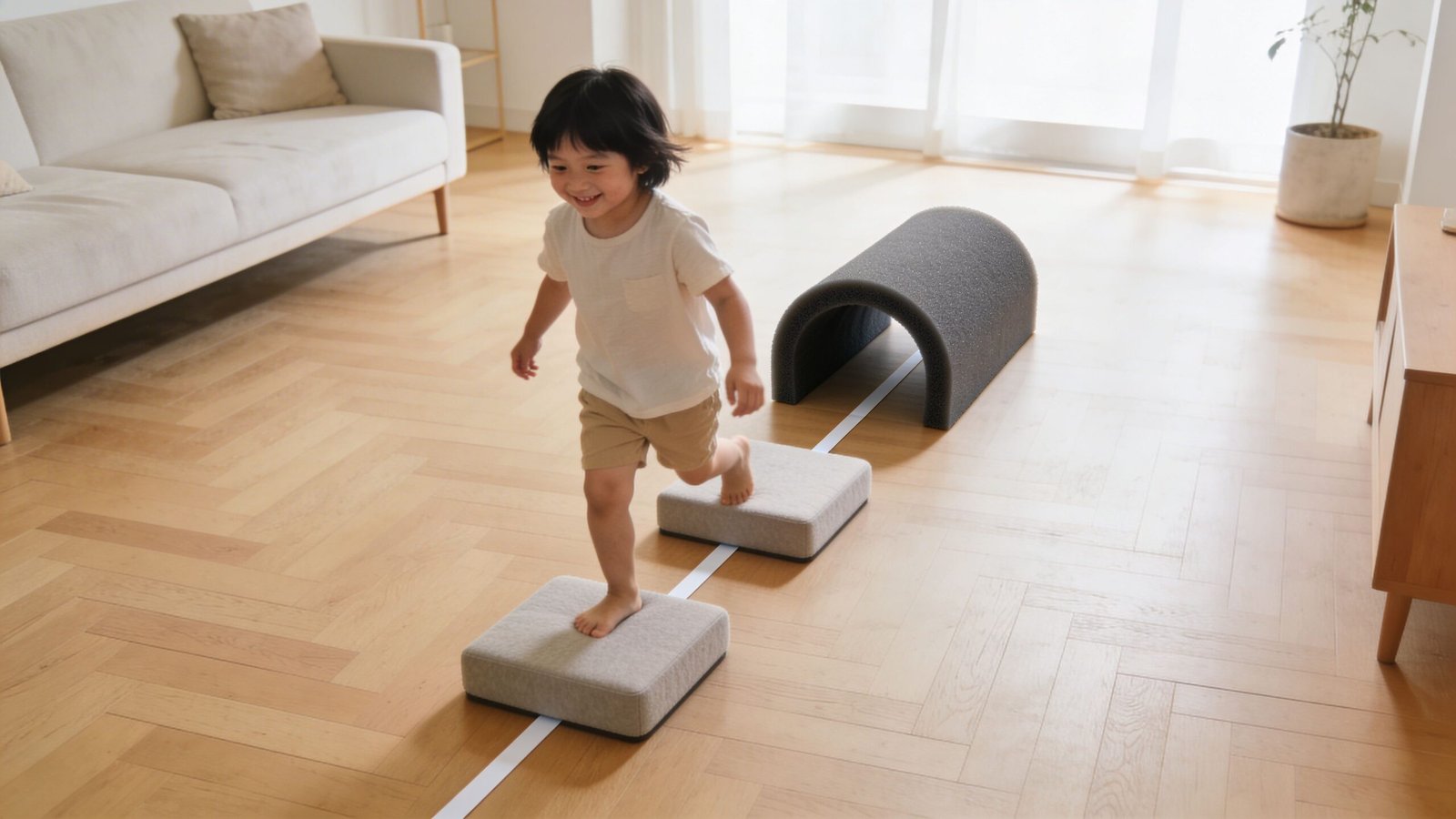
Pillows on the floor, masking tape lines, laundry baskets, tunnels made from chairs and blankets, and a few simple movement cards are usually enough.
Build a course with a purpose
Choose one regulation goal, one motor goal, and one communication goal before you set anything up. That keeps the activity from turning into random high-energy play.
A simple course might include:
- Crawl under a blanket tunnel
- Jump over a taped line
- Carry a cushion to a basket
- Balance along a tape path
- Crash safely into pillows
Each step can target something different. Crawling supports shoulder strength and motor planning. Carrying cushions adds heavy work, which helps some children feel more organized. Balancing on tape builds postural control and attention. You can layer in speech by using phrases like “go under,” “jump over,” “my turn,” or “one more.” For children working on behavior goals, a visual “first-then” card often helps. First obstacle course, then water break or a short round of board games for 4 year olds.
The trade-off is stimulation level. Some children regulate better after movement. Others get more dysregulated if the course is fast, noisy, or too long. I usually suggest starting with three stations and watching what happens after the activity, not just during it.
If your child gets more wound up, change the input rather than dropping movement altogether. Replace repeated jumping with slower animal walks, wall pushes, yoga poses, or pushing a loaded laundry basket. Those choices often give better sensory feedback with less escalation.
A practical marker of success is the next transition. If your child can move from the course to a book, snack, or simple table task with less resistance, the plan likely matched their needs. If transitions still fall apart every time, or your child avoids movement, falls often, seems unusually fearful, or cannot follow even a very short motor sequence, it is worth asking an OT, speech therapist, ABA clinician, or educational psychologist for a more individualized plan.
6. Structured Play with Toys and Objects
Many children have plenty of toys but do not yet know how to use them flexibly. They may line up cars, spin wheels, dump pieces, or move quickly from one toy to another without building a play idea. That does not mean they are “playing wrong”. It means they may need more structure to expand play.
Structured toy play starts with functional actions. Push the car. Feed the doll. Stack the blocks. Then it moves toward symbolic play. The doll is hungry. The bus is going to school. The doctor helps the bear.
Expand play without fighting the child’s interests
If your child loves trains, use trains. If they love washing machines, build around that theme. Motivation matters more than variety at first.
Try these combinations:
- Vehicles and blocks: Build a bridge, park, crash, repair, repeat.
- Dolls and household props: Eat, bathe, sleep, wake up.
- Toy animals and boxes: Farm, zoo, hide-and-seek, sorting by habitat.
- Kitchen set: Cooking, serving, requesting, waiting, cleaning up.
A helpful model is “copy, then add”. First join the child’s existing play. Then add one new action. If they roll the car back and forth, you can add “car in garage” or “car wash”.
Board games can also support this kind of structured interaction, especially for turn-taking and early rule-following. If you want simple options for younger children, board games for 4 year olds can be a useful starting point.
Educational psychology adds sequencing and flexible thinking. Speech therapy adds commenting, requesting, and narrative language. ABA adds turn-taking and expanding play duration. OT adds posture, grasp, and sensory support so the child can stay with the activity.
What does not help is rotating toys constantly in the hope that novelty will solve engagement. Many children benefit more from fewer toys used in deeper, repeated ways.
7. Visual Supports and Environmental Organization Systems
A common home scene goes like this. A parent says, “Clean up, then get ready for bath.” The child keeps playing, then melts down when the toys are moved. The problem is often not refusal. The child may not know what “clean up” looks like, what comes after, or how long the transition will take.
Visual supports make those expectations visible. They reduce language load, support predictability, and help a child act more independently. At home, that can be as simple as labelled bins with photos, a first-then board, a visual timer, a short routine strip, and a clear place for work, play, and calming.
The goal is not a picture-perfect playroom. The goal is a space that answers the child’s questions before stress builds.
Set up the room so the child can succeed
Useful systems usually answer five questions:
- Where do I go?
- What am I doing?
- How much do I need to do?
- When is it finished?
- What happens next?
At home, good examples include a red bin with a puzzle photo on the front, a toothbrush picture taped near the sink, a two-step bedtime strip, or a “finished” basket on the table. A visual timer often works better than repeated verbal warnings because the child can see the activity ending instead of having to hold that information in working memory.
Different therapies often overlap clearly here. OT looks at whether the space supports regulation, posture, and access to materials. Speech therapy uses visuals to improve understanding and reduce processing demands. ABA uses them to clarify routines, strengthen independence, and reduce escape behavior during transitions. Educational psychology adds sequencing, planning, and executive function support.
Start with one friction point.
For many families, that is transitions, cleanup, homework setup, or getting ready routines. A small system used every day works better than a wall full of symbols no one follows. Too many charts, colors, and icons create visual noise and can increase avoidance, especially for children who are already overwhelmed.
I usually recommend one mini-plan: choose one routine, define the steps with pictures, teach it with adult support for a week, then fade prompts. If the child still becomes distressed despite a clear visual system, or if rigid behavior is disrupting daily life across settings, that is a good point to seek support from OT, speech, ABA, or a psychologist who can identify what is driving the breakdown.
8. Craft and Creative Art Activities with Therapeutic Goals
It is 4:30 p.m., your child is tired, and a simple craft can go one of two ways. It can become a power struggle over glue, mess, and mistakes, or it can turn into one of the easiest ways to build regulation, communication, and motor skills at home. The difference is usually not the craft itself. It is how well the activity matches the child’s sensory profile, language level, and frustration tolerance.
Art gives children a way to show ideas before they can fully explain them. It also gives parents a clear window into skills that are easy to miss during free play. You can watch how your child starts a task, uses both hands together, requests help, handles a change in plan, and recovers from small errors. That makes craft time useful across disciplines, not just for creativity.
Start by adjusting the task so your child can succeed with some effort, not constant correction. A child who avoids sticky or wet textures may do better with stickers, stamps, or dry collage materials first. A child with weaker hand strength often manages broken crayons, short markers, sponge painting, or thicker tools better than thin pencils and detailed colouring pages. If attention is short, use a clear stopping point such as three stickers, five stamps, or one page.
A few home activities work especially well because they are easy to grade up or down:
- Sticker trails and dot markers: support finger isolation, visual tracking, and simple direction-following.
- Torn paper collage: builds bilateral coordination and hand use, especially when the child stabilizes paper with one hand and tears with the other.
- Playdough shapes or people: strengthens the small muscles of the hands while creating chances for pretend play and vocabulary.
- Stamping and printing: helps children who benefit from immediate, predictable cause and effect.
- Simple painting with limits: one colour, one tool, one page can reduce overload and increase follow-through.
The therapeutic value comes from the coaching around the activity. OT targets posture, grasp, hand strength, motor planning, and sensory tolerance. Speech therapy can work on requesting, commenting, action words, describing, turn-taking, and answering simple questions about the finished project. ABA principles help with sitting, waiting, asking for materials appropriately, and persisting through small mistakes. Educational psychology adds planning, sequencing, flexible thinking, and task completion.
Keep the demand level honest. A model can help some children understand what to do, but copying it exactly often turns a regulating activity into a performance task. I usually recommend offering a loose visual example and then praising the process you want to grow: “You kept going,” “You asked for help,” or “You tried a new texture.” That is often more useful than praising whether the craft looks “right.”
If crafts regularly trigger distress, refusal, or perfectionism that affects daily routines, pause and look at the mismatch. The problem may be sensory discomfort, motor difficulty, language load, or rigid expectations rather than “bad behaviour.” That is a good point to seek support from OT, speech, ABA, or a psychologist who can sort out which demand is causing the breakdown.
9. Reading and Literacy-Based Interactive Activities
It is 6:30 p.m., your child is tired, and a full storybook is already too much. That is usually the wrong moment to aim for quiet listening and “finish the book.” It is a good moment for shared reading with a job to do.
Interactive reading works best when the child is part of the story. A short book with repetition, clear pictures, and predictable language gives you more chances to build communication than a longer book your child only half follows. For many younger children and many neurodivergent children, touch-and-feel books, flap books, photo books, and familiar repeated stories hold attention better than text-heavy pages.
Turn story time into active learning
Give your child one simple role at a time. Pause before a familiar word and wait. Let them fill it in with a sound, gesture, sign, picture, or word. Ask them to point to a character, turn the page, find “big” or “small,” or act out one part with a toy. If language is limited, use choice-making instead of open-ended questions: “Is the dog sleeping or running?” An integrated therapy lens helps parents keep the activity focused. Speech work can target vocabulary, commenting, answering simple questions, and combining words. OT can support sitting posture, page turning, visual tracking, and regulation for a quieter task. ABA strategies can shape waiting, attending, and returning to the book after a brief break. Educational psychology adds sequencing, recall, prediction, and early comprehension.
One of the most useful trade-offs to understand is this: fewer pages often leads to better learning. Parents sometimes worry that re-reading the same short book is “not enough.” Repetition is often the point. Repeated books reduce processing load and free up attention for memory, participation, and expressive language.
You can also build literacy without staying glued to the couch. After reading, send your child to find a real object from the story, bring something that matches a picture, or act out “under,” “on,” “fast,” or “sleeping.” That keeps reading connected to movement, listening, and real-world meaning instead of treating books as a separate school task.
What usually breaks down is not reading itself, but mismatch. The book may be too long, the questions too hard, the sensory demand too high, or the expectation for sitting too rigid. If your child regularly leaves, scripts the same line without understanding it, or becomes upset during books, lower the load first. Shorter text, more visuals, more participation, and clearer prompts usually help. If reading time consistently triggers distress or feels far below your child’s language, attention, or regulation needs, it is worth getting input from speech, OT, ABA, or a psychologist to work out which part is blocking success.
10. Behavior-Based Reinforcement Activities and Token Systems
It is 5:15 p.m., dinner is half-started, and your child melts down when you ask for one small task like putting socks in the hamper. In that moment, the problem is usually not “bad behavior.” The task may be too vague, the payoff too delayed, or the skill still too new to hold without support. A reinforcement system gives the child a clear path to success.
Used well, this is not about handing out rewards for everything. It is a way to teach. ABA contributes the structure: define the behavior, prompt it, reinforce it quickly, and fade support over time. Occupational therapy helps you judge whether the task is realistic from a sensory and motor standpoint. Speech support helps children understand what is being asked and how to ask for help or a break. Educational psychology helps match the demand to attention, working memory, and frustration tolerance.
The biggest trade-off is this: the more meaningful and immediate the reward, the easier it is to get early success, but the more carefully you need to fade it so the system does not become the only reason a child participates. Parents often get stuck at one of two extremes. The system is so loose that it means nothing, or so elaborate that nobody can run it consistently.
Build the plan around one specific behavior at a time. “Good behavior” is too broad. “Put one block in the bin,” “sit for one minute,” or “use words to ask for help” gives the child a target they can hit.
A few setups work well at home:
- First-then board: First socks on, then blocks.
- Token strip: Earn three stars for three clean-up actions.
- Choice reward board: Work, then choose swing, snack, song, or toy.
- Mystery reward bag: Useful for children who are motivated by novelty.
For many children, active reinforcement works better than verbal reminders alone. A short movement game, one turn with a favorite toy, bubbles, music, or a crunchy snack can all function as reinforcement if the child wants it and can earn it quickly. An integrated approach matters here. A speech target might be “say or point to help,” an OT target might be “tolerate two minutes at the table,” and an ABA target might be “complete two prompted steps before reinforcement.” One home activity can serve all three.
Consistency matters more than creativity. If one adult gives a token for one small step and another waits for perfect compliance, the child is being trained on two different systems. New skills also need fast reinforcement. If the child has to wait through five more demands before accessing the reward, many children will drop the behavior before it becomes stable.
Then fade the system on purpose. Move from reinforcement after every step to reinforcement after two or three steps. Shift from tokens toward praise, choice, completion, and natural outcomes. If your child becomes more distressed, dependent on the board, or aggressive when reinforcement is delayed, the plan may be too hard, too abstract, or poorly matched to regulation needs. That is a good point to get input from ABA, OT, speech, or psychology so the system teaches independence instead of becoming another struggle.
10-Item Comparison: Indoor Activities for Kids
| Intervention | Implementation Complexity 🔄 | Resource & Setup ⚡ | Expected Effectiveness ⭐ | Typical Results / Impact 📊 | Quick Tips 💡 |
|---|---|---|---|---|---|
| Sensory Play Bins and Exploration Activities | Low–Moderate: simple setup, needs supervision | Low cost; reusable materials, minimal training | ⭐⭐⭐ (strong for regulation & motor skills) | Improved tactile tolerance, fine motor control, reduced anxiety | Start simple, observe responses, supervise closely |
| Picture-Based Communication & Social Stories | Moderate: initial customization and training | Low–Moderate: cards/apps, lamination, consistency across settings | ⭐⭐⭐⭐ (high for communication support) | Increased independence, reduced frustration, clearer routines | Use consistent images across settings; pair with speech |
| Fine Motor Skill Activities (Threading, Beading, Puzzles) | Low–Moderate: graded activities, occasional hand-over-hand | Low cost; small parts require supervision | ⭐⭐⭐⭐ (effective for hand function & school readiness) | Strong gains in dexterity, pencil grip, self-care skills | Start with larger items; progress difficulty gradually |
| Play-Based Speech & Language Activities | Moderate–High: requires skilled facilitation | Low: toys/materials; clinician skill and planning matter | ⭐⭐⭐⭐ (excellent for generalization & engagement) | Better spontaneous language, pragmatic skills, carryover | Follow child’s lead; document targets within play |
| Structured Movement & Gross Motor Activities | Moderate: space, safety planning, supervision | Moderate: space, optional equipment (mats, props) | ⭐⭐⭐ (good for regulation & motor planning) | Improved balance, coordination, body awareness, regulation | Use visuals, break movements into steps, supervise for safety |
| Structured Play with Toys & Objects (Symbolic/Functional) | Moderate: scaffolding from concrete to symbolic play | Low–Moderate: varied toys/props, caregiver facilitation | ⭐⭐⭐ (supports cognitive & social play) | Growth in symbolic play, imagination, peer interaction | Model actions, narrate play, accept and expand unconventional play |
| Visual Supports & Environmental Organization Systems | Moderate: initial setup and caregiver training | Low cost: labels, schedules, consistent placement | ⭐⭐⭐⭐ (high for independence and behavior reduction) | Greater independence, fewer confusion-related behaviors, smoother routines | Use real photos, keep supports at child’s eye level, train caregivers |
| Craft & Creative Art Activities with Therapeutic Goals | Low–Moderate: prep and cleanup, sensory adaptations | Variable cost: basic to high-quality supplies; supervision | ⭐⭐⭐ (strong for expression and fine motor gains) | Enhanced self-expression, fine motor practice, emotional regulation | Offer sensory-friendly options and celebrate finished work |
| Reading & Literacy-Based Interactive Activities | Low: book selection and scaffolding | Low: books and props; occasional interactive materials | ⭐⭐⭐⭐ (strong evidence for language/literacy) | Vocabulary growth, comprehension, pre-literacy skills | Repeat high-interest books; pause to elicit responses |
| Behavior-Based Reinforcement Activities & Token Systems | Moderate: design, data tracking, consistency needed | Low: tokens/charts; time for preference assessment | ⭐⭐⭐⭐ (very effective for motivation & behavior change) | Increased task completion, reduced problem behaviors, taught delays | Identify true preferences, reinforce contingently, fade systematically |
Your Partner in Your Child's Unique Journey
It is 4:30 p.m. Your child is tired, dinner is not started, and the activity that worked yesterday falls apart in two minutes today. That does not mean the plan failed. It usually means the support did not match the moment.
Home programs work best when they are practical, repeatable, and tied to a clear developmental goal. A bin of dry rice, a short picture schedule, couch cushions for jumping, or the same puzzle used again and again can do more for progress than a table full of new supplies. Repetition helps children build motor planning, language, confidence, and tolerance for frustration. Familiar activities also make it easier for adults to notice what is helping and what is getting in the way.
Parents are often told to keep children busy. That is not the same as helping them develop. The better question is, “What skill is this activity building right now?” A sensory bin can target regulation, requesting, turn-taking, and sorting. A simple snack routine can target sequencing, following directions, imitation, and expressive language. A movement game can support body awareness first, then attention, then participation in a quieter task.
That is the value of an integrated approach. Occupational therapy looks at regulation, sensory processing, posture, and motor demands. Speech therapy looks at how the child understands, requests, labels, comments, and takes conversational turns. ABA looks at motivation, prompting, reinforcement, and how to shape participation step by step. Educational psychology looks at learning readiness, working memory, task persistence, and whether the demand matches the child’s developmental level. One well-planned home activity can draw from all four.
The trade-off is that not every activity fits every child on every day. A child who is over-responsive to sound or touch may need fewer materials and more predictability. A child who avoids seated tasks may do better with a two-minute movement routine before books or crafts. A child with limited spoken language often participates more successfully when pictures, choices, and repeated phrases are built in from the start. Parents usually do not need a harder activity. They need a better fit.
Screen-free play helps because it asks for action, not passive watching. Puzzles, obstacle courses, pretend play, matching games, and shared reading create chances for problem-solving and back-and-forth interaction. They also let adults model language, wait for a response, and adjust support in real time. That is hard to do with a device doing the pacing for you.
Home support still has limits.
If your child has frequent meltdowns around transitions, rarely initiates communication, cannot stay with play for more than a brief moment, or seems either constantly under-aroused or constantly overwhelmed, a general activity list is not enough. Those patterns call for an individual plan. Professional guidance can help determine whether the main barrier is sensory regulation, language load, motor planning, cognitive demands, reinforcement history, or a combination of factors. It can also help families avoid a common mistake. Asking for communication or table work when the child is not regulated enough to succeed.
Progress at home is rarely linear. Some days a child asks for help, follows the routine, and stays engaged. On another day, the same child refuses the materials or leaves after one turn. That variability is common, especially in young children and in children with developmental differences. What matters is the pattern over time, not a single difficult afternoon.
Families do not need to turn home into a clinic. They need a plan they can use. The strongest plans are simple, specific, and coordinated across disciplines so that one activity supports regulation, communication, learning, and behavior at the same time.
If you want help turning these ideas into an individual plan, Georgetown early intervention center can help. Our team includes educational psychologists, occupational therapists, speech therapists, and play-based ABA therapists who work together to match activities to your child’s unique strengths, challenges, and goals.