
You may be in that familiar moment. Your child wants something, looks at you, makes a sound, then gets upset because the words still won't come out the way they want. You replay every conversation with family, every milestone chart, every well-meaning comment, and you start asking the same question over and over. Is this just a phase, or is my child telling me they need more help?
That worry is real. It can also feel confusing when someone suggests occupational therapy for speech delay, because many parents naturally think, “Wouldn't speech therapy be the obvious answer?” Speech therapy is often a central part of support. But for some children, speech doesn't sit in isolation. It sits on top of sensory processing, body awareness, motor planning, regulation, attention, feeding, and play.
That's why an integrated approach matters. For many children, occupational therapy helps build the body-based and sensory foundations that make communication easier to learn and use. And you're far from alone in looking for answers. According to NIDCD national speech and language statistics, 1 in 14 children aged 3 to 17 experienced a voice, speech, or language disorder in the past 12 months, and prevalence was 10.8% among ages 3 to 6.
Understanding Your Child's World Beyond Words
Parents often notice the speech piece first. Fewer words. Unclear words. Frustration. Silence in group settings. Trouble following language, or trouble using it. What's harder to spot is everything happening underneath those visible signs.
A child may understand more than they can say, but struggle to organise their body well enough to imitate sounds. Another child may want to speak, but their nervous system is so overwhelmed by noise, movement, texture, or transitions that communication drops away the moment stress rises. A third child may have good ideas, but poor body awareness and weak motor planning make speech feel like trying to write with a shaky pencil.
Why speech delay can feel bigger than speech
Children don't develop skills in separate boxes. Speech grows alongside movement, play, attention, sensory processing, and relationships. If one foundational area is wobbly, communication can become harder than it looks from the outside.
That's one reason parents can feel puzzled. They came looking for answers about words, but clinicians start asking about sleep, feeding, meltdowns, play, transitions, climbing, chewing, or messy play. Those questions aren't random. They help reveal the whole pattern.
Practical rule: If your child's speech concerns appear alongside sensory sensitivities, movement difficulties, or big emotional reactions, it's worth looking beyond speech alone.
You are not overreacting
When parents raise concerns early, they're often trying to protect their child from frustration, not rushing to label them. That instinct matters. Early support gives children more chances to practise communication in the everyday places where it matters most, like meals, bath time, play, nursery, and family routines.
Occupational therapy can be part of that support. Not instead of speech therapy, but beside it. OT asks a different question. Instead of only asking, “How do we get more words?” it also asks, “What does this child's body and nervous system need so words can happen more easily?”
What Is Occupational Therapy Really
The word “occupational” throws many parents off. It sounds adult. It sounds like office work or recovery after an injury. In paediatrics, it means something much simpler.
A child's main occupations are playing, learning, moving, eating, connecting, and joining in daily life. Occupational therapy helps children do those things with more comfort, skill, and confidence.
Think of OT as foundation work
If speech therapy often works on communication directly, occupational therapy often works on the systems that support communication. I sometimes explain it like a house.
A house needs more than lovely paint and furniture. It also needs a strong foundation, safe wiring, and plumbing that works. If the foundation shifts, even beautiful rooms become hard to use. In the same way, a child may need stronger sensory processing, body awareness, posture, coordination, and regulation before higher-level communication can come together smoothly.
OT looks at the child as a whole person, not a list of symptoms.
What OTs are often looking for
An occupational therapist may explore areas like these:
- Sensory processing: How your child takes in and responds to sound, touch, movement, taste, and other sensory input.
- Motor planning: How your child figures out, sequences, and carries out actions.
- Postural control: How well your child stabilises their body during sitting, play, eating, and speaking.
- Self-regulation: How your child gets calm, alert, organised, and ready to learn.
- Participation: How all of this affects daily routines like meals, dressing, group time, and play.
These areas can influence speech more than parents expect. A child who's constantly seeking movement may struggle to stay organised enough to attend to spoken language. A child with oral sensitivity may avoid certain textures, dislike toothbrushing, and also have difficulty coordinating the mouth for speech sounds. A child who melts down during transitions may lose access to communication the moment stress rises.
OT is about the why
That's the essential shift. OT doesn't only ask what your child can't do yet. It asks why it's hard.
Sometimes the most helpful question isn't “Why isn't my child talking more?” It's “What's making talking harder than it needs to be?”
When you understand that difference, occupational therapy for speech delay starts to make sense. It's not a side topic. For the right child, it's part of the core support plan.
The Hidden Connection How OT Builds a Foundation for Speech
Speech looks effortless when it's working well. It isn't. It requires the brain and body to process sensory information, plan movements, regulate attention, coordinate breathing, and control tiny mouth movements with precision. OT often supports those hidden building blocks.

Sensory motor foundations
Start with the body's internal GPS. Children need to know where their body is, how it's moving, and how to adjust in space. Sensory processing helps the brain sort that information. When this system is disorganised, the child may appear clumsy, constantly on the go, avoid movement, or struggle to copy actions.
That matters for speech because speech is movement. The jaw, lips, tongue, breath, and posture all need timing and coordination. If the brain is having difficulty organising movement generally, it may also struggle with the fine motor sequencing needed for clear speech.
A study on integrated sensory therapy found strong changes in speech performance. Children receiving the OT-led intervention had mean speech ability scores rise from 0.13 to 20.87 in 8 sessions, while the control group changed from 0.23 to 3.13, according to the integrated sensory therapy study on functional speech delay.
That doesn't mean every child with speech delay needs the same sensory programme. It does show why sensory-motor work can be much more than “extra play.”
Oral motor skills
Parents sometimes hear “oral motor” and imagine drills that look disconnected from real talking. The better way to understand it is a workout for the mouth within meaningful activity.
Speech requires the mouth to stabilise, grade force, and move quickly. The jaw needs steadiness. The lips need closure and shaping. The tongue needs control for different sounds. If these movements are effortful, speech can sound unclear, delayed, or inconsistent.
An OT may support these foundations through play that encourages:
- Blowing and breath control through bubbles, whistles, or cotton ball races
- Lip and cheek activation through straws, thick drinks when appropriate, and playful facial imitation
- Jaw stability through crunchy textures when feeding goals and safety allow
- Tongue awareness through silly face games and mouth imitation tasks
The goal isn't to force performance. It's to make the body more organised and responsive.
Attention and regulation
A child must be available for learning before they can apply their knowledge. Regulation matters for this reason.
Think of regulation like tuning a radio. If the station is full of static, the message doesn't come through clearly. Some children are under-aroused and drift away from language. Others are so over-aroused that their body is in survival mode. In both cases, speech and learning often drop.
An OT helps children find the “just right” level of alertness through movement, sensory input, routine, and environmental supports. Sometimes that means a calming rhythm. Sometimes it means heavy work. Sometimes it means reducing sensory clutter so the child can focus on one task.
A regulated child doesn't always look perfectly still. A regulated child looks organised enough to connect, respond, and learn.
Play based strategies
Children don't build speech foundations best through pressure. They build them through play with purpose.
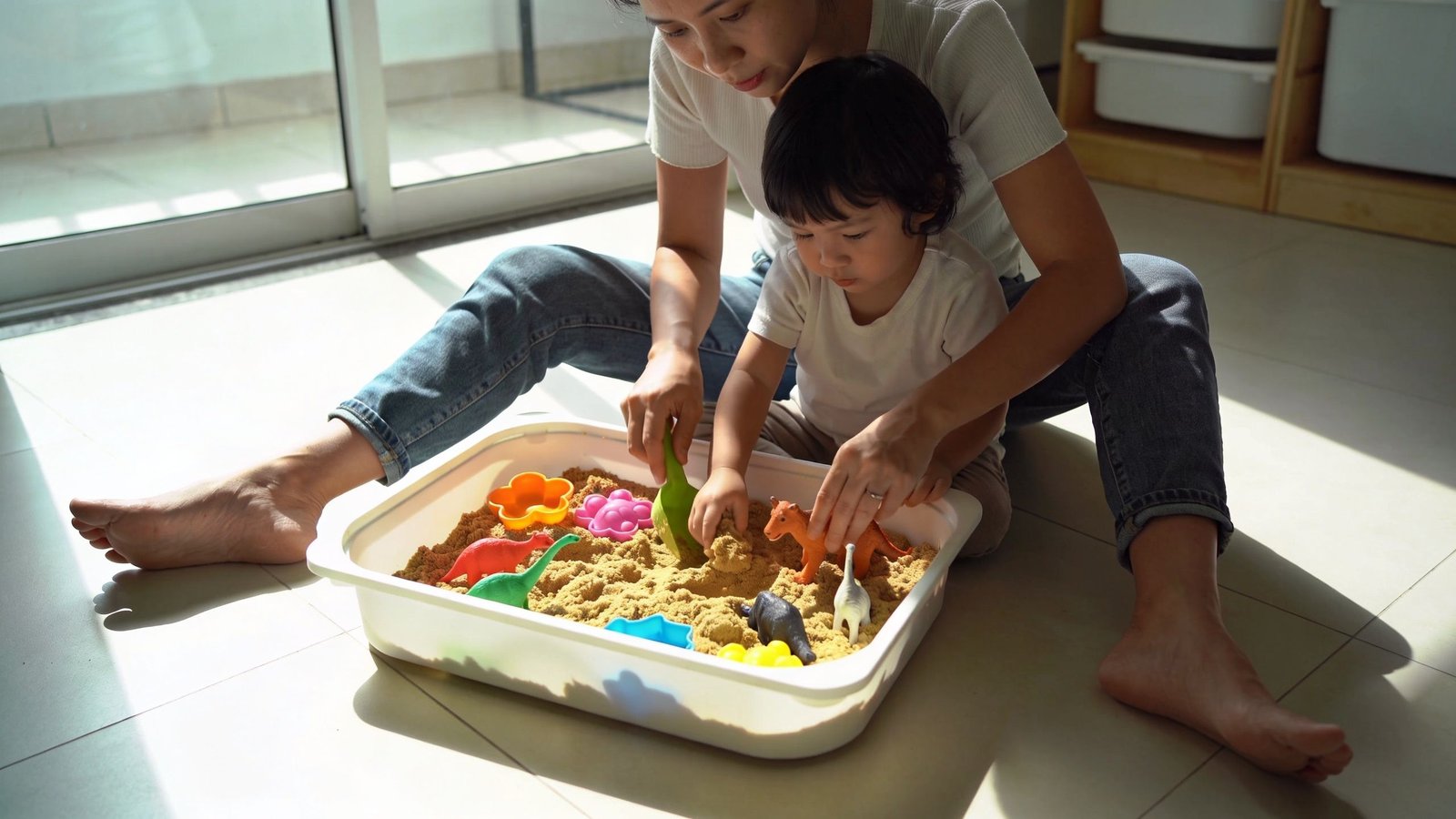
In OT, play is not filler. It's the therapy room's laboratory. Swinging can support vestibular processing and regulation. Obstacle courses can build motor planning and body awareness. Pretend play can expand sequencing, imitation, and shared attention. Sensory bins can reduce avoidance and increase tolerance for textures that also affect feeding and oral experiences.
Children learn fastest when they feel safe, interested, and successful. A therapist may look like they're “just playing”, but every choice has a reason. Which position helps the child breathe and vocalise more easily? Which movement input helps them attend? Which game invites imitation without pressure? Which sensory supports reduce frustration enough for communication to emerge?
Why this feels different from speech therapy alone
Speech therapists target communication directly. That's vital. Occupational therapists often support the child's readiness to benefit from that direct communication work.
For some children, speech therapy alone may be enough. For others, progress picks up when the child's body becomes more organised first. That's why parents sometimes notice a change that sounds like this: “He didn't just start saying more. He seemed calmer, more connected, and more able to try.”
That difference is the hidden connection.
Signs Your Child Might Benefit from an OT Evaluation
Parents often ask, “How do I know whether this is a speech issue only, or whether OT should be involved too?” The clearest clues usually show up in ordinary routines.
You might notice your child isn't just having difficulty with words. They may also seem uncomfortable in their body, unusually reactive to sensory input, or quick to become overwhelmed. Those patterns don't prove anything on their own, but they can signal that an occupational therapy evaluation would be helpful.
Everyday clues worth noticing
Here are some common signs that often sit alongside speech concerns:
- Eating is a struggle: Your child is very selective with textures, gags easily, refuses toothbrushing, or gets upset by certain foods.
- Movement seems awkward or extreme: They crash into furniture, seek constant spinning or jumping, avoid climbing, or look less steady than peers.
- Messy play is a battle: Paint, sand, slime, grass, or sticky hands cause strong distress.
- Big reactions happen fast: Small changes lead to huge meltdowns, and it's hard for your child to recover.
- Attention comes and goes quickly: They want to engage, but can't seem to stay with an activity long enough to imitate or practise.
- Daily routines feel hard: Dressing, sleeping, transitions, bath time, and group settings seem harder than expected.
- Imitation is limited: Your child has trouble copying simple movements, gestures, or actions during songs and play.
What these signs can mean
A child who avoids certain foods may be showing oral sensory sensitivity. A child who bumps into things may have poor body awareness. A child who melts down in noisy rooms may be overwhelmed by sensory input before language ever has a chance.
This is why occupational therapy for speech delay can be so useful. It helps identify whether the child's nervous system and motor systems are making communication harder.
Helpful lens: Don't treat these behaviours as “bad habits” first. Treat them as information.
What an OT evaluation usually looks like
An OT evaluation for a young child rarely feels like a formal exam. It usually looks like guided play, observation, parent conversation, and structured activities chosen to reveal how your child processes sensory input, plans movement, regulates emotion, and participates in daily routines.
You may be asked about:
- Pregnancy and early development
- Feeding and sleeping patterns
- Play interests and frustrations
- Responses to sound, touch, movement, and transitions
- What communication looks like at home, nursery, and in the community
The therapist may watch how your child sits, moves, reaches, explores, responds to new tasks, handles changes, and uses their hands and mouth during play or snack activities.
The goal of the evaluation
The aim isn't to fit your child into a label. The aim is to find the missing pieces.
A good evaluation helps answer questions like these. Does this child need more support with regulation before communication goals can take hold? Is oral sensory processing affecting speech and feeding together? Are motor planning difficulties making imitation harder? Would the child benefit from OT working alongside speech therapy?
When parents understand the “why,” the path forward feels much less overwhelming.
A Collaborative Team How OT Works with Other Therapies
No single therapy explains every part of communication. Children do best when the right professionals work like a coordinated pit crew, each focusing on a different system while sharing the same goal.
Occupational therapy often supports the engine and body of the car. Speech therapy supports the communication system itself. ABA can help shape learning, participation, and consistent use of new skills in daily routines. When those professionals work in silos, progress can feel patchy. When they collaborate, therapy becomes far more coherent for the child and family.
Different jobs, shared goal
Research supports OT's complementary role. In one controlled study, OT accounted for 6.5% to 6.7% of variance in visuomotor skills linked to speech foundations, and OT intensity of over 10 hours per quarter showed an effect size of 0.45 for motor-speech composites, working alongside speech therapy's more direct phonological focus, as described in this study on preschool intervention and developmental outcomes.
That's a useful reminder. OT is not trying to replace speech therapy. It strengthens areas that often make speech therapy more effective.
Comparing therapy roles in speech development
| Therapy Type | Primary Focus | Example Activities |
|---|---|---|
| Occupational Therapy | Sensory processing, regulation, motor planning, posture, oral-motor readiness, participation in daily routines | Swinging for regulation, obstacle courses, heavy work, sensory play, oral-motor support during play and feeding routines |
| Speech Therapy | Understanding language, using words, articulation, social communication, sound production | Sound imitation, vocabulary building, turn-taking, requesting, comprehension tasks, structured communication games |
| ABA Therapy | Learning patterns, behaviour support, reinforcement, participation, generalising new skills | Building attention, increasing requests, shaping communication attempts, supporting transitions, strengthening routine-based learning |
A parent doesn't need to choose between these based on labels alone. The better question is, “What does my child need right now to communicate more successfully?”
What collaboration looks like in real life
True collaboration is practical. The therapists share observations, not just reports. If the OT notices the child communicates more after vestibular input or heavy work, the speech therapist can build language targets into that more regulated state. If the speech therapist notices the child avoids oral imitation after certain textures, the OT can explore oral sensory support. If the ABA therapist sees that communication falls apart during transitions, the whole team can adjust routines and reinforcement.
That integrated approach often leads to better carryover at home too. Parents don't receive three separate plans that compete with each other. They get one coordinated direction.
If you'd like to understand the direct communication side more clearly, this overview of speech therapy for children helps explain what speech-language work typically targets.
Collaboration works best when everyone is solving the same problem from a different angle, not defending their own discipline.
A simple way to think about it
OT asks, “Is the child's body and nervous system ready to support communication?”
Speech therapy asks, “How do we build and refine communication itself?”
ABA asks, “How do we increase learning, consistency, and use of those skills across settings?”
Together, those questions create a far fuller picture than any one therapy can provide alone.
Practical OT Strategies You Can Try at Home Today
Home support doesn't need to look like homework. In fact, children usually respond best when adults turn therapy ideas into playful routines. The aim is to help your child feel more organised, engaged, and ready to communicate during ordinary moments.
Heavy work for calmer bodies
“Heavy work” means activities that wake up muscles and joints. Many children feel more settled and attentive after this kind of input.
Try options like these:
- Laundry basket pushes: Have your child push a basket across the floor. This can support body awareness and regulation before a sitting task.
- Carrying jobs: Let them carry groceries, books, or cushions. Keep it safe and playful.
- Animal walks: Bear walk, crab walk, or frog jumps across the room. Add sounds or simple words as you go.
These activities can help children feel more grounded before language-based play, meals, or story time.
Oral motor play that feels fun
Children often practise best when they don't realise they're practising.
A few easy ideas:
- Blow bubbles and pause expectantly so your child can request “more” with a sound, gesture, or word.
- Use straws in playful ways when appropriate and safe, such as moving tiny paper pieces across the table.
- Make funny faces in the mirror. Try lip pops, big smiles, fish faces, and tongue-out faces.
If your child enjoys visual supports, simple printables can help you turn sound imitation into a game. Some parents like using guided speech practice for students as a structured but low-pressure way to support repetition.
Sensory play with a purpose
Sensory play can reduce avoidance, improve tolerance, and create rich opportunities for communication.
You could offer:
- Kinetic sand or play dough: Hide small toys inside and ask your child to find them.
- Water play: Pouring, squeezing, scooping, and splashing can support hand skills and shared attention.
- Dry sensory bins: Rice, beans, or pasta with spoons and cups can become a language activity with words like in, out, full, empty, find, and more.
If your child avoids messy textures, don't force it. Start with tools, gloves, or brief exposure. Curiosity grows better than pressure.
Keep the demand low and the interaction warm. Connection does more for communication than repeated correction.
Build speech into daily routines
You don't need an extra hour in the day. Use what already happens.
At meals, model one useful word or phrase again and again. During bath time, use action words like pour, wash, splash. During dressing, pause before handing over socks or shoes and wait for a look, sound, gesture, or attempt. During movement play, pair actions with words like go, stop, up, again.
Fine motor play also supports attention, coordination, and participation. If you want more ideas for hands-on home activities, this guide to fine motor play ideas for children gives practical options you can adapt to your child's level.
One reminder that matters
You don't have to do everything. Pick one or two activities your child enjoys and repeat them consistently. Small, familiar routines often work better than a perfect plan that nobody has energy to follow.
How Georgetown Creates Your Child's Unique Path to Success
Meet Alex. He's a fictional child, but his story will feel familiar to many families.
Alex was bright, curious, and active. He loved spinning wheels, lining up toys, and running from one room to another. His parents were worried because he had very few clear words, became upset when routines changed, and often covered his ears in busy places. Mealtimes were difficult too. He accepted only a small range of foods and refused anything messy on his hands.

Looking beyond the missing words
If you looked only at Alex's speech, you'd miss half the picture. He needed help with communication, yes. But he also needed support with regulation, sensory processing, transitions, and play skills. Once those areas were understood, his speech difficulties made more sense.
An integrated team would map out how those pieces interacted. The occupational therapist might notice that Alex became more available for interaction after movement activities and deep pressure input. The speech therapist might see that he tried more sounds during motivating play than in table tasks. The behaviour therapist might identify routines and reinforcement that helped him stay engaged long enough to practise communication.
A plan that matches the child
That's where individual planning matters. Children don't benefit from generic therapy packages built around a diagnosis alone. They benefit from support matched to their exact pattern of strengths and barriers.
For a child like Alex, a coordinated plan might include:
- OT support for sensory regulation and oral sensory needs
- Speech therapy for imitation, expressive language, and understanding
- ABA or play-based behaviour support for attention, transitions, and generalisation
- Parent coaching so strategies work at home, not only in sessions
The point is not to overwhelm the child with services. It's to align the services around one shared understanding.
What makes progress more likely
Families usually feel most supported when the process is clear. Good centres explain what they're seeing, why it matters, and how each therapy connects to real life goals like mealtimes, nursery participation, play, and communication.
A centre with occupational therapists, speech therapists, behaviour therapists, and educational psychologists can build that broader picture more easily because the professionals can compare notes in real time. Parents who are exploring that kind of support can learn more about working with an occupational therapist in Dubai.
The best therapy plan is not the busiest one. It's the one that fits the child well enough that progress becomes usable in daily life.
When families feel seen and the team works from the same map, hope becomes practical. You stop chasing isolated techniques and start building a pathway.
Starting the Conversation About Communication
Speech delay can look like a word problem. Often, it's also a body, sensory, and regulation problem. That's why occupational therapy for speech delay can play such an important role. It helps children build the foundations that communication rests on.
If your child is struggling, that doesn't mean you've missed something or done something wrong. It means your child may need a clearer path, and there are professionals who know how to help find it. The most useful support often starts with careful observation, a broad evaluation, and a team willing to work together instead of separately.
Parents don't need to become therapists. They do need good explanations, realistic strategies, and a plan that matches their child rather than forcing their child to fit a standard plan. That's where progress usually begins. Not in pressure, but in understanding.
If your instincts have been telling you there's more going on beneath the surface, it's worth listening to them. Asking questions early is a caring step. It gives your child more chances to connect, play, learn, and be understood.
If you're ready to talk through your child's communication, sensory, or developmental concerns, Georgetown early intervention center offers a multidisciplinary team that includes occupational therapy, speech therapy, educational psychology, and play-based behaviour support. Their approach centres on individual plans because each child is unique, and their therapy plan should be too.