
Finding meaningful things to do with kids at home can feel like a constant challenge, particularly when your child has unique developmental needs. The pressure to provide activities that are not only entertaining but also supportive of their specific therapy goals can be immense. This guide moves beyond generic craft ideas to offer a curated list of ten powerful, play-based activities, drawing upon insights from educational psychologists, occupational therapists, and speech-language pathologists.
This comprehensive resource is designed to transform your living space into a haven of growth and fun. We provide a structured yet flexible framework for activities that target crucial developmental areas, including sensory regulation, speech and language, fine and gross motor skills, and school readiness. Each suggestion is more than just an idea; it’s a complete toolkit. You’ll find detailed step-by-step instructions, lists of simple materials, and practical tips for modifying tasks to suit your child’s individual abilities and needs.
We will explore how to set up sensory play bins that calm and engage, create picture communication games to expand vocabulary, and design motor skill stations that build strength and coordination. Furthermore, we delve into using social stories, structured play, and even cooking activities as therapeutic tools. At Georgetown Early Intervention Centre, we champion the principle that every child’s plan should be as unique as they are. This philosophy is woven into every activity, empowering you to create a supportive, engaging, and individualised environment right in your own home, turning everyday moments into powerful opportunities for progress.
1. Sensory Play Bins
Sensory play bins are containers filled with tactile materials designed to stimulate a child’s senses of touch, sight, and sound. They provide a focused, hands-on play experience that is both engaging and therapeutic, making them a fantastic option for things to do with kids at home. By exploring materials like kinetic sand, rice, pasta, water beads, or beans, children develop crucial skills in a natural, play-based setting.
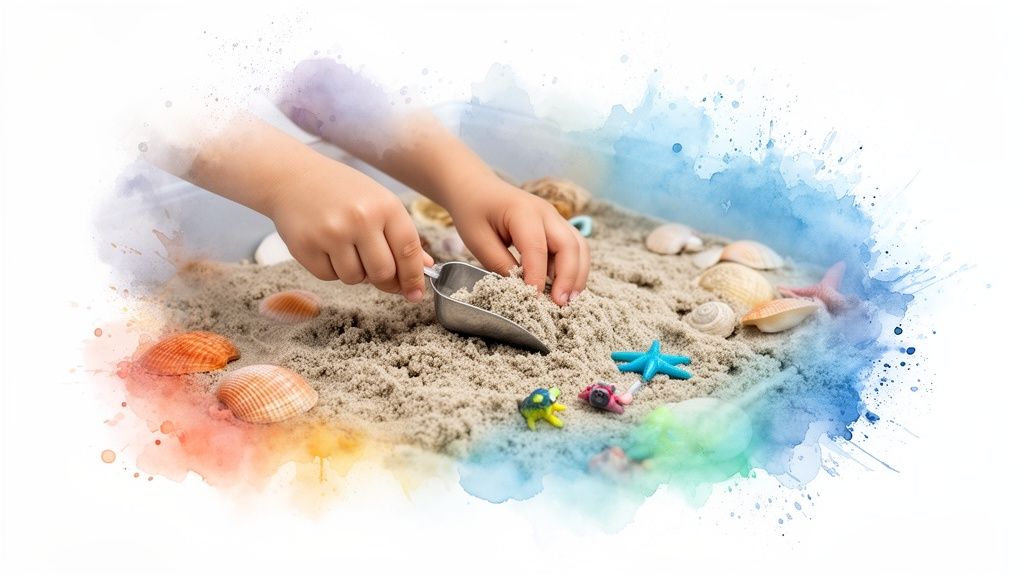
This activity supports fine motor skills as children scoop, pour, and grasp objects. It also enhances sensory processing and hand-eye coordination. For children with autism or sensory sensitivities, the tactile input from a sensory bin can be incredibly calming and organising, helping them to regulate their responses to the environment.
How to Implement Sensory Bins
Therapists frequently use sensory bins to achieve specific goals. For instance, an occupational therapist might recommend a kinetic sand bin to improve a child’s tolerance to different textures, while a speech therapist could use a farm-themed bin to build vocabulary around animals and sounds. Likewise, in ABA therapy, time with a favourite sensory bin can serve as a powerful positive reinforcement for completing a task.
Actionable Tips for Success
To get the most out of this activity, consider these practical tips:
- Create Themed Bins: Match the contents to learning goals. An “ocean” theme with blue water beads, shells, and sea creatures can be paired with speech activities about marine life. A “dinosaur dig” using sand and plastic fossils can support school-readiness topics.
- Prioritise Safety and Containment: Use shallow, wide bins for easy supervision and access. Place the bin on a large tray, mat, or old sheet to contain any mess, making clean-up far less stressful.
- Incorporate Tools: Add scoops, funnels, tongs, and measuring cups. These tools encourage the development of fine motor skills, bilateral coordination, and early mathematical concepts.
- Maintain Novelty: Rotate the base materials and themed items monthly to keep the activity fresh and engaging, which helps maintain your child’s interest over time.
2. Picture Communication and Vocabulary Building Games
Picture communication games are structured activities that use visual aids like cards, charts, and boards to foster language development. This approach transforms vocabulary acquisition into an engaging and interactive experience, making it an ideal choice for things to do with kids at home. By using images to represent objects, actions, and concepts, children can learn to express their needs, make choices, and build sentences in a low-pressure, supportive environment.
This method is particularly effective for children with speech delays, autism, or other communication challenges. It supports both receptive language (understanding words) and expressive language (using words). Using visuals provides a concrete link between a word and its meaning, which can significantly reduce frustration and improve functional communication skills during daily routines.
How to Implement Picture Communication
Therapists often integrate picture-based systems to target specific communication goals. For example, a speech therapist might use the Picture Exchange Communication System (PECS), developed by Lori Frost and Andy Bondy, to teach a non-verbal child how to request a desired item. An ABA therapist could use a visual schedule to help a child with autism understand and transition smoothly between activities, reducing anxiety and problem behaviours. These games make abstract language tangible and accessible.
Actionable Tips for Success
To get the most out of this activity, consider these practical tips:
- Start with High-Interest Items: Begin with a small set of 5-10 picture cards representing your child’s favourite toys, foods, or activities. This high motivation ensures initial engagement and success.
- Pair Pictures with Real Objects: Initially, present the picture card alongside the actual item. This helps concrete learners make a strong connection between the 2D image and the 3D object.
- Laminate for Durability: Children learn best through hands-on interaction. Laminating the cards makes them durable enough for repeated use in various settings, from the playroom to the dinner table.
- Integrate into Daily Routines: Incorporate picture cards naturally throughout the day. Use them during mealtimes to offer choices, during playtime to label toys, or at bedtime to follow a routine.
3. Fine Motor Skill Building Stations
Fine motor skill building stations are dedicated areas with activities designed to strengthen hand muscles, improve dexterity, and enhance hand-eye coordination. These stations use engaging tasks like threading beads, using clothespins, manipulating playdough, or practising with scissors to build the small muscle control essential for daily life. Organising these activities is one of the most productive things to do with kids at home, as it lays a crucial foundation for both academic and self-care skills.
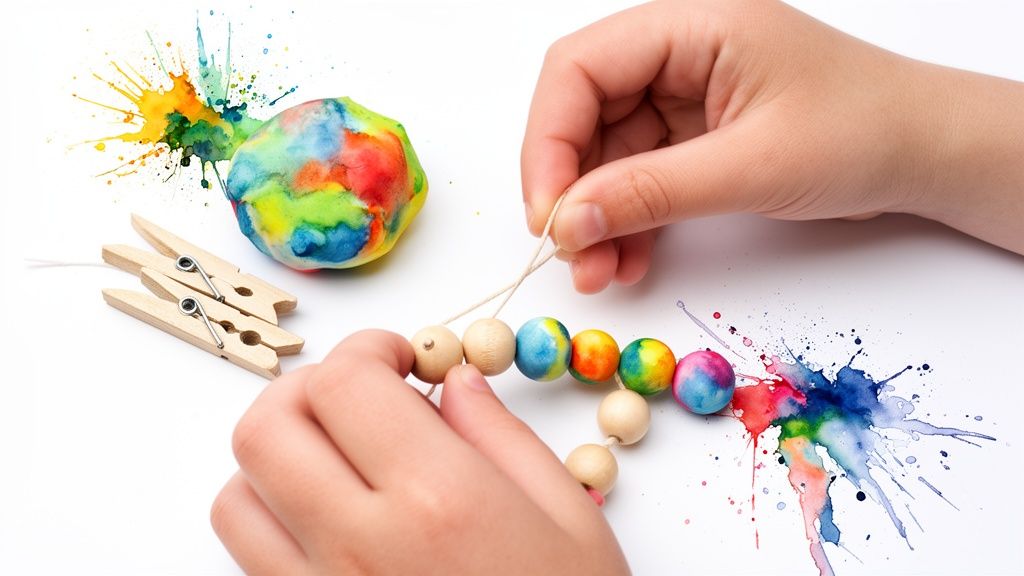
This focused practice directly supports a child’s ability to write, button clothes, use cutlery, and zip up a jacket. For children working on school readiness, these skills are paramount. Similarly, for those with developmental delays, building fine motor strength can be a key goal, as it promotes independence and reduces frustration with tasks requiring precision.
How to Implement Fine Motor Stations
Therapists often integrate these stations into their plans. An occupational therapist might design a home programme with specific clothespin and threading tasks to build pincer grasp strength. In an ABA therapy session, completing a fine motor activity, like placing stickers on a line, could be used as a positive reinforcer or as a structured table-time task to improve focus and task completion. These activities are versatile and easily adapted to therapeutic goals.
Actionable Tips for Success
To effectively set up and manage fine motor skill stations, consider these tips:
- Organise for Independence: Store each activity (beads and string, playdough and tools, etc.) in a separate, clearly labelled container. This makes it easy for the child to select a task and helps with clean-up.
- Demonstrate and Guide: Initially, model how to complete each activity. Provide gentle guidance as needed but allow plenty of time for independent practice to build confidence and mastery.
- Provide Adaptive Tools: If a child struggles, offer support. Use tools like loop scissors for those who have difficulty with standard ones, or pencil grips to encourage a proper grasp.
- Gradually Increase Complexity: As skills develop, make the tasks more challenging. Move from large beads to smaller ones, or from snipping paper edges to cutting along straight lines. You can discover more advanced fine motor skills activities to keep the challenge appropriate.
- Rotate Activities: Keep engagement high by rotating between three or four different stations. This prevents boredom and allows the child to practise a variety of movements.
4. Social Stories and Role-Playing Scenarios
Social stories and role-playing are powerful tools for teaching social skills, expected behaviours, and emotional responses in a structured way. This method uses personalised narratives, often with visual aids, to explain social situations and provide clear instructions on how to navigate them. It is one of the most effective things to do with kids at home to prepare them for real-world interactions, especially for children with autism who benefit from explicit social instruction.
This activity helps reduce anxiety around new or challenging situations by making them predictable. By repeatedly reading a story about an upcoming event, like a dentist visit, a child learns what to expect and what is expected of them. Pairing these stories with role-play allows the child to practise these skills in a safe, supportive environment, building confidence and reinforcing positive behaviours.
How to Implement Social Stories and Role-Playing
Therapists across disciplines utilise this strategy to meet specific developmental goals. An ABA practitioner might create a story and role-play scenario to teach turn-taking during a game, while an educational psychologist could develop a narrative to ease a child’s transition to a new classroom. Speech therapists often use social stories to model conversational skills, such as asking questions or staying on topic, directly linking language to social context.
Actionable Tips for Success
To effectively use social stories and role-playing, consider these practical tips:
- Personalise the Content: Use first-person language (“I will wait my turn”) and include photos of your child, your home, or the actual location (e.g., the doctor’s office) to make the story highly relevant and concrete.
- Keep It Short and Focused: For younger children or those with shorter attention spans, limit stories to a few simple pages. Focus on one specific skill or situation at a time to avoid cognitive overload.
- Practise with Role-Play: After reading the story, act out the scenario. Use toys or family members to practise the expected behaviours. For instance, use dolls to practise sharing before a playdate.
- Create a Story Library: Build a collection of stories for common situations like going to the supermarket, handling frustration, or welcoming a visitor. To further enhance creativity and engagement, you can even learn how to make a storybook with AI, providing endless opportunities for tailor-made social stories.
5. Gross Motor Movement and Yoga Activities
Gross motor movement and yoga activities are physical exercises designed to engage large muscle groups, improving a child’s coordination, strength, balance, and body awareness. These activities are essential things to do with kids at home because they provide vital vestibular and proprioceptive input, which helps with self-regulation. By participating in structured movements like yoga poses, dance, or obstacle courses, children develop foundational motor skills in a fun and engaging way.

This type of play directly supports motor development, which is crucial for everyday tasks like walking, running, and climbing. For children with sensory processing differences or autism, the focused movements in yoga or the heavy work of pushing a large ball can be incredibly grounding. These activities offer a structured way to release energy, reduce anxiety, and improve focus, making them a cornerstone of many therapeutic programmes.
How to Implement Gross Motor Activities
Therapists frequently integrate gross motor work to meet specific developmental goals. An occupational therapist might set up an obstacle course to improve motor planning and sequencing, or recommend “heavy work” tasks like carrying a stack of books to provide calming proprioceptive input. Similarly, in ABA therapy, a short movement break with animal walks or jumping jacks can serve as a positive reinforcer and help a child reset before returning to a structured learning task.
Actionable Tips for Success
To effectively incorporate these activities into your routine, consider these practical tips:
- Establish a Dedicated Space: Designate a safe, open area for movement. A yoga mat can create a clear visual boundary for activities, helping your child understand where the exercises take place.
- Use Visual Supports: Create or download cards showing different yoga poses or a sequence of movements. This visual aid helps children understand expectations and follow along independently.
- Incorporate Child’s Interests: Make movement fun by connecting it to their favourite themes. Encourage “superhero poses” for strength or “animal walks” (like crab walks or bear crawls) to keep them engaged.
- Provide Regulatory Input: Integrate “heavy work” activities, such as pushing against a wall, carrying a laundry basket, or rolling on a large therapy ball. This provides deep pressure input that helps calm the nervous system.
6. Structured Play-Based Learning with ABA Principles
Structured play-based learning uses the core principles of Applied Behaviour Analysis (ABA) to intentionally teach new skills within natural, enjoyable activities. This method embeds systematic instruction and positive reinforcement into playtime, making it one of the most effective things to do with kids at home to build communication, social, and academic abilities. By using motivating toys and activities, children learn foundational skills without feeling like they are in a formal lesson.
This approach breaks down complex goals, such as tying shoes or taking turns, into small, manageable steps. Each successful step is immediately reinforced, which builds a child’s confidence and motivation to continue learning. For children who benefit from clear expectations and routines, this method provides a predictable framework for skill acquisition during everyday interactions, from mealtimes to playing with building blocks.
How to Implement Structured Play with ABA
Therapists and Board Certified Behavior Analysts (BCBAs) design home programmes that integrate ABA techniques into a child’s daily life. For instance, a speech therapist might use Natural Environment Teaching (NET) during snack time to encourage a child to request items using words or signs. Similarly, a task analysis for handwashing can be taught step-by-step with praise and a favourite activity as reinforcement, making a routine task a successful learning opportunity. To understand more about the foundational concepts, you can explore the key principles of ABA for autism.
Actionable Tips for Success
To effectively integrate this approach at home, consider these tips:
- Start with High-Priority Skills: Work with a BCBA to identify and focus on two or three crucial goals, such as functional communication or tolerating “no,” before expanding.
- Use Visual Supports: Employ visual schedules, first-then boards, and picture cards to provide clarity, reduce anxiety, and promote independence during learning sessions.
- Track Progress Consistently: Use simple data tracking methods, like tally sheets or apps, to monitor your child’s progress. This data is vital for making informed adjustments to the programme.
- Generalise Skills: Ensure skills learned in a structured session are practised with different people (e.g., siblings, grandparents) and in various settings (e.g., at the park, in the car) to promote real-world application.
7. Speech and Language Play Activities
Speech and language play activities are interactive games designed to target specific communication skills in a natural, engaging context. Instead of structured drills, these activities embed opportunities for speech sound production, vocabulary building, and conversational practice into playtime, making them a highly effective choice for things to do with kids at home. By using familiar toys and games, children can practise articulation, phonemic awareness, and storytelling skills without feeling pressured.
This approach transforms therapy goals into fun. For example, a simple game of ‘I Spy’ can be adapted to focus on a target sound like /s/, while playing with dolls can become a rich exercise in narrative development and pragmatic language. These play-based interactions provide a low-stress environment for children to build confidence and generalise their communication skills from the therapy room to everyday life.
How to Implement Speech and Language Play
Speech-language pathologists (SLPs) champion play-based learning because it aligns with how children naturally acquire language. An SLP might suggest using rhyming songs to enhance a child’s phonemic awareness or using a toy farm to work on animal sounds and initial sound production. To specifically target verbal communication skills, incorporating various conversation games can be highly beneficial for speech and language development. This method allows for high-repetition practice in a meaningful and motivating way. For parents seeking to support their child’s progress, understanding the principles of child speech therapy can provide valuable insights.
Actionable Tips for Success
To get the most out of speech and language play, consider these practical tips:
- Align with Therapy Goals: Coordinate with your child’s SLP to focus on current targets. If they are working on the /k/ sound, choose activities like playing with cars, cats, or cooking pretend meals.
- Keep it Short and Sweet: Aim for short, frequent sessions of 10-15 minutes. This helps maintain high engagement and prevents burnout for both you and your child.
- Model, Don’t Correct: Gently model the correct sound or word without demanding immediate imitation. For instance, if a child says “tat” for “cat,” you can respond with, “Yes, a fluffy cat! The cat says meow.”
- Use Visual Supports: Incorporate picture cards or storybooks to aid comprehension and provide visual cues for sounds and vocabulary, especially for children who benefit from multi-sensory input.
8. Emotional Regulation and Calming Strategies
Emotional regulation involves teaching children to recognise, understand, and manage their feelings in healthy ways. For many children, especially those with autism or sensory sensitivities, big emotions can be overwhelming. Introducing specific calming strategies provides predictable, tangible tools they can use to self-soothe, making this one of the most vital things to do with kids at home to build resilience and emotional intelligence.
This practice helps reduce the frequency and intensity of meltdowns by equipping a child with proactive coping mechanisms. Techniques like deep pressure from a weighted blanket or focused breathing with bubbles help regulate the nervous system. Using visual aids like emotion thermometers gives children a concrete way to communicate their internal state before it escalates, fostering self-awareness and communication.
How to Implement Calming Strategies
Therapists often integrate these strategies to support broader goals. An occupational therapist might recommend a dedicated ‘calm corner’ with sensory tools to help a child manage sensory overload. An ABA therapist could use a visual schedule to prompt a child to use a calming strategy, like shaking a glitter jar, as a replacement behaviour for hitting or yelling, reinforcing positive coping skills.
Actionable Tips for Success
To effectively build these skills, consider these practical tips:
- Create a Dedicated ‘Calm Corner’: Designate a quiet, comfortable space with soft pillows, a weighted blanket, and a few preferred sensory tools. This creates a predictable safe haven for self-regulation.
- Teach During Calm Moments: Introduce and practise new strategies like “bubble breathing” or using a feelings chart when your child is relaxed and receptive, not in the middle of a meltdown.
- Use Visual Supports: Employ emotion thermometers or feeling wheels to help your child identify and label their emotions. Visuals make abstract concepts like feelings much more concrete and understandable.
- Model the Behaviour: Actively use calming strategies yourself and narrate your process. Saying, “I feel frustrated, so I am going to take three deep breaths,” normalises these techniques and shows your child how to apply them.
9. Structured Cooking and Kitchen Activities
Structured cooking and kitchen activities transform meal preparation into a powerful learning experience, blending life skills with therapeutic goals. These activities use the natural context of the kitchen to help children follow multi-step directions, develop motor skills, and explore sensory information. From simple no-bake recipes to more complex baking projects, cooking provides a motivating and functional setting for growth, making it one of the most practical things to do with kids at home.

This hands-on approach builds confidence and independence while targeting key developmental areas. Stirring batter strengthens gross motor skills, measuring ingredients introduces early maths concepts, and following a recipe enhances executive functioning. For children with sensory sensitivities or picky eating habits, taste-testing and exploring food textures in a low-pressure environment can expand their palate and reduce mealtime anxiety.
How to Implement Cooking Activities
Therapists often incorporate cooking to make learning functional and engaging. An occupational therapist might use kneading dough to improve bilateral coordination and hand strength, while a speech therapist can use the activity to target sequencing, vocabulary (naming ingredients), and following directions. In an ABA therapy context, completing steps in a recipe can be broken down into manageable tasks, with each successful step earning positive reinforcement.
Actionable Tips for Success
To ensure your kitchen sessions are productive and enjoyable, try these tips:
- Use Visual Recipes: Create or find recipe cards with clear pictures for each step. This visual support helps children with language or processing challenges understand the sequence independently.
- Start with Simple Tasks: Begin with no-cook recipes like making a sandwich or a fruit salad. Focus on 2-3 step tasks, such as tearing lettuce or mixing ingredients, before moving to more complex activities.
- Adapt Your Tools: Provide child-sized, adaptive utensils like non-slip bowls, plastic knives, or easy-grip spoons. This makes tasks more accessible and reduces frustration.
- Focus on the Process, Not Perfection: Embrace the mess by using aprons and covering surfaces. Celebrate your child’s effort and participation in each step, regardless of the final outcome.
10. Visual Supports and Environmental Structure
Visual supports and environmental structure involve using pictures, labels, timers, and organized spaces to make a child’s world more predictable and understandable. This strategy reduces cognitive load and anxiety by clearly communicating expectations and routines, making it one of the most effective things to do with kids at home, especially for children with autism or processing difficulties. By providing a clear visual roadmap, you empower children to navigate their day with greater independence and confidence.
This approach, popularized by the TEACCH program, directly supports executive functioning skills like planning, organization, and task initiation. It provides a concrete, non-verbal way to communicate, which can prevent frustration and challenging behaviors that arise from a misunderstanding of verbal instructions. For children struggling with transitions, a visual schedule or a “First/Then” board can make shifting from one activity to the next a smooth and predictable process.
How to Implement Visual Supports
Therapists across disciplines use visual supports to structure sessions and teach new skills. An ABA therapist might use a “First/Then” board to show that completing a non-preferred task (like homework) is followed by a preferred one (like tablet time). A speech therapist could use a picture-based communication system to help a non-verbal child express their wants and needs, while an occupational therapist might use a task analysis board to break down the steps of getting dressed independently.
Actionable Tips for Success
To get the most out of this activity, consider these practical tips:
- Personalize and Laminate: Use real photographs of your child, home, and belongings to make the supports more meaningful. Laminate all materials for durability so they can be used repeatedly.
- Place at Eye-Level: Position visual schedules, rule charts, and labels where your child can easily see and interact with them. Accessibility is key to promoting independent use.
- Use First/Then Boards: This simple tool, showing “First [task]” and “Then [reward],” is incredibly powerful for motivating children through less-preferred activities and easing difficult transitions.
- Introduce Gradually: Start with a single, simple support, like a morning routine schedule. Once your child is comfortable with that, you can introduce others, like labeled toy bins or a visual timer.
Comparison of 10 At-Home Activities for Kids
| Activity | 🔄 Implementation Complexity | ⚡ Resource Requirements | 📊 Expected Outcomes | 💡 Ideal Use Cases | ⭐ Key Advantages |
|---|---|---|---|---|---|
| Sensory Play Bins | Low — easy setup, supervise and rotate materials | Low — bins, fillers, tray; storage space | Improved sensory regulation, fine motor, attention | Calming input, sensory integration, independent play | ⭐ Multi-sensory, low-cost, highly customizable |
| Picture Communication & Vocabulary Games | Moderate — initial customization and updates | Low–Medium — picture cards, laminator, optional AAC | Growth in expressive/receptive language, functional communication | Speech delays, AAC/PECS introduction, vocabulary building | ⭐ Directly aligned with speech goals; promotes generalization |
| Fine Motor Skill Building Stations | Moderate — design progressive stations, supervise practice | Medium — beads, clothespins, adaptive tools, storage | Improved dexterity, pencil grip, bilateral coordination | OT home programs, school-readiness, pre-writing practice | ⭐ Targets OT goals with graded difficulty and measurable gains |
| Social Stories & Role-Playing | Moderate–High — personalized writing and rehearsal time | Low (materials) but high time investment for personalization | Reduced anxiety, clearer social expectations, rehearsal of skills | Transitions, new situations, teaching emotional responses | ⭐ Explicit social instruction; supports rehearsal before real events |
| Gross Motor Movement & Yoga | Low — routines easy to learn; may need adaptation | Low — space, mat, minimal props | Better balance, body awareness, regulation, motor planning | Energy regulation, vestibular/proprioceptive input, transitions | ⭐ Whole-body regulation with mindfulness and fitness benefits |
| Structured Play-Based ABA | High — training, data collection, program design | Medium–High — BCBA consultation, materials, time for data | Measurable skill acquisition across communication, social, academic domains | Intensive behavior goals, individualized learning plans | ⭐ Evidence-based, data-driven, highly individualized outcomes |
| Speech & Language Play Activities | Moderate — align to SLP goals; parent coaching helpful | Low–Medium — games, books, visual supports | Improved articulation, pragmatics, narrative and phonemic skills | Carryover of therapy goals, increased practice frequency | ⭐ Fun, naturalistic practice that promotes generalization |
| Emotional Regulation & Calming Strategies | Moderate — teach & practice strategies consistently | Low–Medium — calm kits, visual supports, heavy-work items | Increased self-soothing, fewer escalations, better transitions | Emotion dysregulation, sensory-sensitive children, meltdown prevention | ⭐ Concrete, portable tools for both prevention and acute regulation |
| Structured Cooking & Kitchen Activities | Moderate–High — safety planning and step sequencing | Medium — kitchen access, utensils, supervision, ingredients | Life skills, sequencing, fine/gross motor, math and language practice | Independent living skills, mealtime routines, sensory feeding work | ⭐ Functional, motivating (edible outcomes); multi-domain learning |
| Visual Supports & Environmental Structure | Moderate — initial setup and ongoing maintenance | Low–Medium — printing, laminating, labels, storage | Reduced anxiety, greater independence, smoother transitions | Daily routines, classroom/home structure, behavior supports | ⭐ Broadly applicable; reduces verbal load and enhances predictability |
Integrating Purposeful Play into Your Daily Routine
Navigating the landscape of child development can feel overwhelming, but as this comprehensive guide has demonstrated, your home is a powerful and effective therapeutic environment. We’ve explored a wide array of things to do with kids at home, moving far beyond simple entertainment to create a blueprint for purposeful, goal-oriented play that supports every facet of your child’s growth.
The true strength of these activities lies not in their complexity, but in their consistency and adaptability. Your role as a parent or caregiver is pivotal; you are the architect of your child’s daily experiences. By intentionally weaving these strategies into your routine, you transform ordinary moments into extraordinary opportunities for learning and connection.
From Activities to Integrated Habits
The transition from a list of ideas to a sustainable daily practice is where the most significant progress occurs. The goal isn’t to schedule every minute with a structured activity, but to recognise the inherent therapeutic potential in what you already do.
- Sensory Play Bins aren’t just for a scheduled 30-minute slot; they can be a go-to calming activity after a stimulating outing.
- Picture Communication principles can be applied during snack time, bath time, and while getting dressed, reinforcing vocabulary and functional communication throughout the day.
- Fine Motor Stations can be set up in a corner of the living room, inviting your child to engage independently while you prepare dinner.
The key is to view your home through a new lens, one that sees opportunities for skill-building in every room and every routine. By doing so, you create a supportive ecosystem where learning is natural, not forced.
Key Takeaway: The most effective intervention is not a single, isolated activity, but the seamless integration of therapeutic principles into the fabric of your family’s daily life. Consistency creates predictability, which in turn fosters security and a greater willingness to learn and explore.
Actionable Next Steps: Building Your Home-Based Plan
Feeling inspired is the first step; taking targeted action is what creates lasting change. Don’t try to implement everything at once. Instead, choose a focused approach that aligns with your child’s most immediate needs and your family’s capacity.
- Identify One Primary Goal: Review the activities and select one or two that directly address a key therapy goal, whether it’s improving pincer grasp with fine motor activities or expanding expressive language with speech-focused games.
- Prepare the Environment: Gather the necessary materials and set up a dedicated, organised space. As we discussed with Visual Supports and Environmental Structure, a predictable and accessible environment reduces frustration and encourages engagement.
- Schedule and Practice: Dedicate a specific, short block of time each day to this new activity. Consistency is more important than duration. Even 15 minutes of focused, positive interaction can yield remarkable results.
- Observe and Adapt: Pay close attention to your child’s reactions. Are they engaged, frustrated, or bored? Use the modification tips provided for each activity to adjust the difficulty and keep the experience positive and successful.
Mastering this approach is invaluable because it empowers you. You move from being a passive recipient of therapeutic advice to an active, informed, and confident partner in your child’s development. You learn to read your child’s cues, celebrate small victories, and provide the precise support they need in the moment they need it. This not only accelerates their progress towards specific goals but also deepens your bond, building a foundation of trust and mutual understanding that will benefit them for a lifetime. Your home becomes more than just a place to live; it becomes a sanctuary of growth, acceptance, and achievement.
If you’re looking for expert guidance to create a more individualised and structured plan based on these things to do with kids at home, our team is here to support you. The specialists at Georgetown early intervention center can partner with you to build a comprehensive therapy programme that bridges the gap between clinical goals and daily family life. Explore our services and learn how we can help you maximise your child’s potential at Georgetown early intervention center.