
You may be in that uncomfortable space where something feels off, but you can't yet name it.
Your child may be bright, curious, funny, and loving, but nursery drop-off is hard, group time falls apart, language isn't coming easily, or simple routines feel bigger than they should. Maybe a teacher has mentioned attention, behaviour, social interaction, or school readiness. Maybe you've heard the words assessment, support plan, or educational psychologist and felt your stomach tighten.
That reaction is completely understandable. Parents often worry that seeing an educational psychologist means someone is looking for a label or a problem. In reality, the role is much more supportive than many families expect. When parents ask me what does an educational psychologist do, I usually give a simple answer first. We try to understand how a child learns, what gets in the way, and what will help.
I often think of the role as a learning guide, and sometimes as a learning detective. We look for patterns. We listen carefully. We gather clues from home, school, play, communication, behaviour, and daily routines. Then we help turn those clues into practical steps that make learning more manageable and more successful.
For some families, it also helps to understand that children don't all learn in the same way. If your child seems to respond better to pictures, routines, and visual prompts, Tutorial AI's visual learning guide gives a useful plain-language overview of one common learning style. If you're exploring broader support, an early intervention programme can bring together psychology, speech, occupational therapy, and behavioural support in one plan.
Your Child's Journey and the Role of a Learning Guide
A parent usually notices the need before anyone else does.
It might be the child who melts down every time a routine changes. It might be the child who speaks at home but freezes in class. It might be the child who knows more than they can show, or the child who seems lost during group instructions even though they're trying hard. These moments can feel confusing because the difficulty isn't always obvious from the outside.
Why the role matters
An educational psychologist helps make sense of that confusion. We don't just ask, “What is the problem?” We ask better questions.
- How does this child take in information
- What happens when demands increase
- Which settings go well, and which ones don't
- Is the challenge mainly about learning, communication, emotional regulation, behaviour, or a mix of several things
That difference matters. A child who avoids table work may not be “refusing to learn”. They may be overwhelmed by language, unsure what to do first, struggling to stay organised, or anxious about getting it wrong.
A helpful way to think about it: an educational psychologist doesn't only look at the child. We also look at the match between the child and the learning environment.
The first reassurance many parents need
Assessment is not a punishment, and it isn't a judgement on your parenting.
It's a structured way of understanding your child more accurately. Once you understand the pattern, support becomes more targeted. That often reduces stress for everyone involved, including the child.
Parents are sometimes relieved to hear that they don't need to figure everything out on their own. You can bring your observations, your questions, and even your uncertainty. Those are not obstacles. They're useful starting points.
The Core Mission of an Educational Psychologist
An educational psychologist is a bit like an architect for a child's learning journey. An architect doesn't only point at a crack in the wall. They study the whole structure, work out why the problem is happening, and design a safer, more workable plan.
That's how I think about this role. We don't stop at identifying difficulty. We try to understand the child's learning profile and build a blueprint for support.
In the United States, the Bureau of Labor Statistics defines school psychologists as professionals who “diagnose and implement individual or schoolwide interventions or strategies” to address issues affecting educational performance, and notes that their training in statistics and research design supports test interpretation, programme evaluation, and evidence-based instruction in schools, as described in the BLS occupational profile for school psychologists.
Looking at the whole child
Most parents first meet us because of one concern. Reading. Attention. Speech delay. Autism. Emotional outbursts. School refusal. But children don't experience life in neat categories, so we can't assess them that way either.
We usually think across three connected areas.
How your child learns
This includes things like attention, memory, problem-solving, processing language, pre-academic skills, and how easily a child understands instructions. A child may have solid thinking skills but struggle to show them when tasks involve too much verbal information or too many steps at once.
For example, a child might know colours, shapes, and numbers during play, but fall apart in a classroom activity because they can't process group instructions quickly enough.
How your child behaves in learning situations
Behaviour gives information. It isn't random.
Avoidance, restlessness, shutdown, clinginess, refusal, and repetitive behaviour can all be ways a child communicates that something is too hard, too unclear, too stimulating, or too emotionally demanding. The educational psychologist tries to understand what the behaviour is doing for the child.
Practical rule: behaviour is often a clue before it is a problem.
That's especially important for children with autism or developmental delays. What looks like non-compliance may be confusion, sensory overload, a communication barrier, or difficulty coping with transitions.
How your child feels
Emotional wellbeing affects learning every day.
A child who feels anxious, ashamed, frustrated, or socially unsure may not be able to access learning even if they have the core ability. Some children become very controlling when they feel unsafe. Others go quiet, copy peers, or avoid tasks that expose their difficulties.
When we understand the emotional side, we can make support kinder and more effective. Instead of asking a child to “try harder”, we create conditions where trying feels possible.
Beyond testing
Families are often surprised by this. The role is not just writing reports.
An educational psychologist can help identify barriers, shape strategies, guide classroom accommodations, support planning, and help adults around the child respond more consistently. The aim is not to prove that a child is struggling. The aim is to help that child succeed.
Inside the Toolkit How a Psychologist Gathers Information
The assessment process often sounds more intimidating than it really is. Parents hear words like testing and imagine a formal exam room, a worried child, and a report full of technical language. Good assessment shouldn't feel like that.
In many early intervention settings, educational psychologists act as assessment-and-intervention specialists who combine observations, interviews, and standardised tests to tell the difference between a skill acquisition problem and a performance problem, as explained in this overview of the educational psychologist's role. That distinction matters. If a child hasn't learned a skill yet, support looks different from support for a child who has the skill but can't use it reliably.
If you're considering a fuller picture of your child's needs, comprehensive assessment services in Dubai can help families gather information across learning, behaviour, and development.
Observation in real life
Observation is one of the most valuable tools because children tell us a great deal through what they do.
A psychologist may watch your child in a classroom, therapy room, playgroup, or structured activity. We're not only looking at whether they complete a task. We're watching how they approach it.
A few examples of what we might notice:
- Attention patterns. Does your child start well and then drift, or do they struggle from the first instruction?
- Response to support. Do they improve when an adult uses pictures, repetition, modelling, or a quieter space?
- Social behaviour. Do they join peers, copy peers, avoid peers, or become overwhelmed by group demands?
- Transitions. Is the hard part the learning task itself, or the shift from one activity to another?
This helps us see the child in context, not just in a one-to-one testing session.
Interviews that fill in the missing pieces
Parents sometimes underestimate how important their voice is. In reality, your observations often explain patterns that no test can capture on its own.
A psychologist may ask about early development, current routines, language use, play, behaviour at home, sleep, strengths, worries, and what tends to trigger distress or success. Teachers and therapists may also share what they see in structured settings.
These conversations help answer questions such as:
- Why does the child cope better at home than in class?
- Why are speech skills stronger during play than during group time?
- Why does behaviour worsen in busy settings?
- Why do adults around the child seem to have different impressions?
Sometimes the most important clue is not what happens, but where it happens and with whom.
Standardised assessments without the fear
This part worries many families most, especially when they hear names of tests.
Standardised assessments are not pass-or-fail exams. They are tools that help compare a child's performance across different tasks so we can spot patterns of strength and need. Depending on the child's age and concerns, psychologists may use structured measures of thinking, language-related learning, readiness, memory, or achievement.
For a parent, it may look like puzzles, questions, matching tasks, picture-based prompts, short problem-solving activities, or tasks involving listening and responding. A skilled psychologist adjusts pace, gives breaks when needed, and notices not only scores but behaviour during the task.
What a child's day might look like
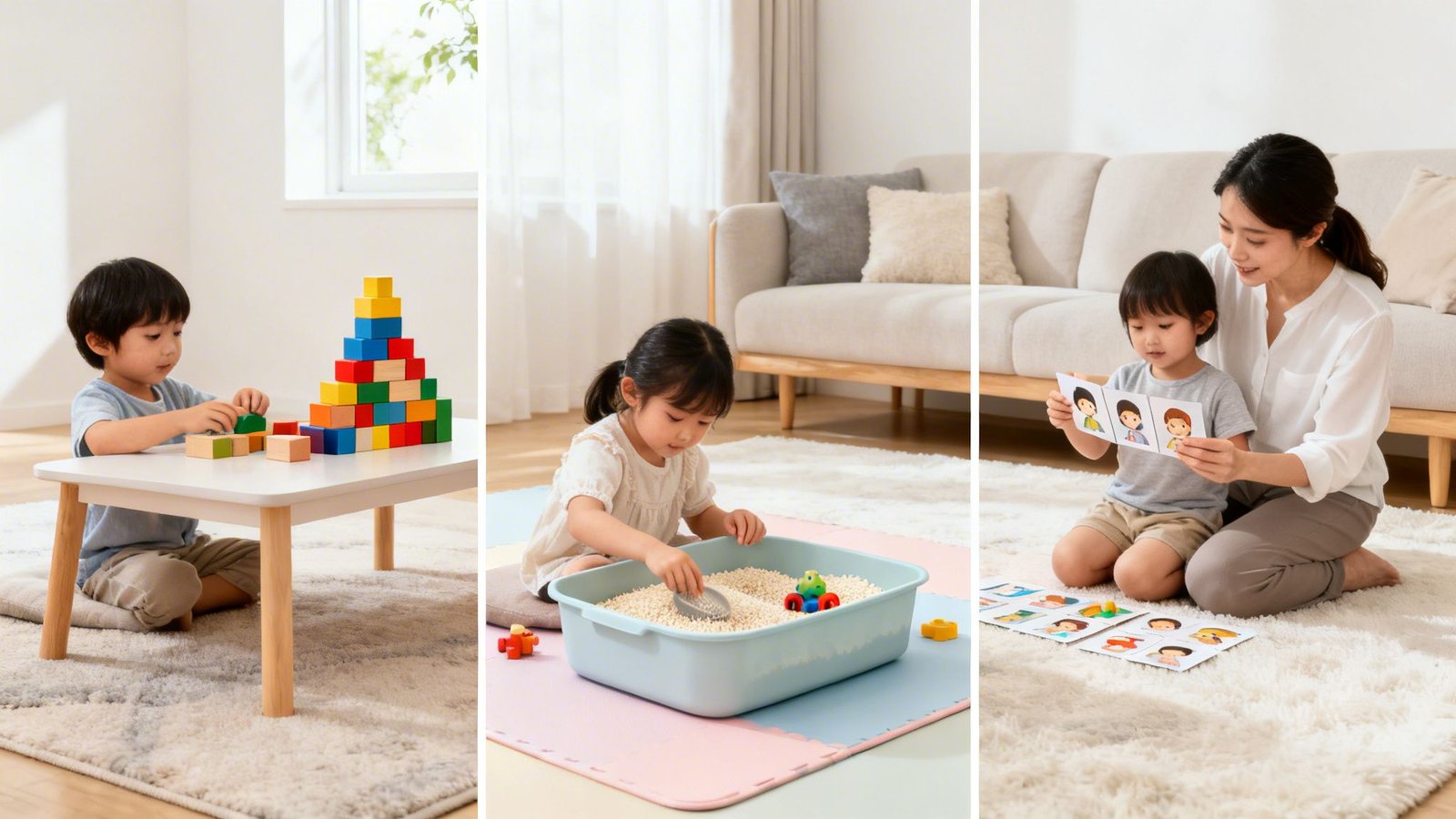
A young child with suspected school readiness difficulties may come in for a session that feels more like guided activities than formal testing. They might sort pictures, follow verbal directions, answer simple questions, complete visual tasks, and move between table work and play-based moments.
A child with autism might show good understanding in one part of the session but struggle when language becomes less predictable or when flexibility is required. A child with speech delay may understand much more than they can express. A child who appears inattentive may be losing track because the instructions are too language-heavy.
That's why no single test tells the whole story. The true value comes from putting the pieces together.
From Insights to Action Creating Reports and Interventions
The report should never feel like a file that explains your child to professionals while leaving you confused.
A good educational psychology report turns complex information into a practical roadmap. It explains what was seen, what it likely means, and what adults should do next. It should help parents, teachers, and therapists move in the same direction.

A core function of educational psychologists is programme and outcome evaluation. They use data to monitor whether a plan is producing measurable gains in areas such as pre-academic readiness or classroom participation, and if change isn't happening, they help the team work out why and adjust the strategy, as described by the APA Division 15 overview of educational psychology.
What goes into a useful report
A strong report usually includes more than test findings.
It often brings together:
- Observed strengths such as curiosity, visual learning, persistence, or strong response to routine
- Key barriers such as language processing, emotional regulation, attention control, inflexibility, or difficulty generalising skills
- A working explanation of why the child is struggling in certain settings
- Recommendations that adults can use at home, in class, and in therapy
The best reports don't sound like they were written for a filing cabinet. They sound like they were written for the child.
What intervention looks like in real life
Parents often ask what happens after the report. The answer should be concrete.
For a child with autism, the educational psychologist may recommend supports such as visual schedules, first-then boards, simpler language during transitions, reduced waiting time, and a more predictable group routine. If the child becomes distressed during unstructured moments, the plan may include adult preparation before change and clearer visual cues about what is coming next.
For a child with school readiness concerns, recommendations might focus on pre-academic foundations rather than pushing formal tasks too early. That can include turn-taking games, activities that build listening and working memory, simple sequencing tasks, and structured play that strengthens early executive functioning.
For a child with speech delay, the plan may reduce language load in teaching, increase visual support, and coordinate closely with speech therapy so the same communication strategies appear across settings.
A report is most helpful when it answers three questions clearly. What is hard for this child, why is it hard, and what should adults do differently tomorrow morning?
When a plan needs changing
This part matters just as much as the initial recommendations.
Sometimes a child has support in place but progress is limited. That doesn't always mean the child is resistant or that the goal was wrong. It may mean the support wasn't implemented consistently, the task was still too difficult, the skill didn't generalise beyond therapy, or a more basic foundation was missing.
That's why intervention isn't static. It needs review. If the child improves in one setting but not another, the plan has to account for that. If a strategy works only with one adult, the team needs to build carryover.
This is one place where a centre such as Georgetown early intervention centre may fit for families who want coordinated input across psychology, speech, occupational therapy, and behaviour support within an individualised plan.
The Power of Teamwork How Psychologists Collaborate
Parents are often told their child may need speech therapy, occupational therapy, ABA, or psychological support. That can sound like a list of separate services, each in its own lane. For children, it rarely works that neatly.
Professional guidance shows that educational psychologists do more than test. They also support consultation, collaborative planning, and training to improve learning and inclusion, as outlined in the British Psychological Society job profile for educational psychologists. In everyday terms, that means the psychologist often helps the adults around the child understand the same child in the same way.
The psychologist as a translator across the team
An occupational therapist may identify sensory or motor barriers. A speech therapist may focus on communication and understanding. An ABA therapist may work on behaviour, learning, and skill-building. The educational psychologist helps connect these pieces to learning access and school participation.
For example, a child may struggle in speech sessions not because they can't learn language, but because sitting still, coping with demand, and processing verbal instructions together is too much. Another child may seem behaviourally avoidant when the deeper issue is that group learning places heavy demands on language and emotional regulation at the same time.
That joined-up understanding helps the team choose better targets.
Your Child's Support Team at Georgetown
| Therapist | Primary Focus | Example Goal |
|---|---|---|
| Educational Psychologist | Learning profile, school access, emotional and behavioural understanding, recommendations for support | Help a child follow group instructions by adjusting task demands, visuals, and classroom strategies |
| Occupational Therapist | Sensory processing, fine motor skills, body regulation, daily functional participation | Help a child sit for short table tasks and use tools needed for pre-writing activities |
| Speech and Language Therapist | Understanding language, expressing needs, speech clarity, social communication | Help a child request help, answer simple questions, and understand classroom language |
| ABA or behaviour play-based therapist | Behaviour support, skill teaching, routines, learning through structured practice | Help a child transition between tasks with less distress and more independence |
If you want help making sense of which professional to see first, a parent consultation can be a useful starting point.
Why collaboration changes outcomes
When professionals work in isolation, families often get advice that sounds good but clashes in practice. One person may ask for more independence while another is still building the regulation skills needed to cope with that demand.
A collaborative team can ask better questions:
- What is the child ready for right now
- Which support should come first
- How can the same strategy appear across home, therapy, and school
- What does progress look like for this child
The child shouldn't have to adapt to four separate plans. The adults should build one plan that fits the child.
Key Signs Your Child May Need Psychological Support
Parents often worry about overreacting. They don't want to pathologise normal development, but they also don't want to wait too long. I usually encourage families to think in terms of signals, not red flags.
Educational psychologists are often the bridge between a child's developmental profile and the school environment, especially when concerns involve behaviour, emotional regulation, or access to learning, as described in this guide to what an educational psychologist is. If the main question is not only “What therapy does my child need?” but also “Why is school or group learning so hard?”, psychological support may be useful.
Signals related to school readiness
Some children need help because the gap appears when learning becomes more structured.
You may want support if your child:
- Struggles with multi-step directions and needs each step repeated one by one
- Avoids sitting tasks such as drawing, matching, early writing, or teacher-led activities
- Finds transitions very hard even when the routine is familiar
- Needs much more adult support than peers to join group activities or complete simple tasks
Signals related to learning and performance
Parents often say, “I know my child can do it, but it doesn't show.”
You might notice:
- Uneven skills. Your child does something at home but not at school
- A mismatch between understanding and output. They seem to know more than they can express
- Difficulty generalising. A skill appears in therapy, but disappears in a different setting
- Inconsistent task performance. Some days are fine, other days fall apart with no obvious reason
These patterns often need a closer look because they can point to language processing, anxiety, attention, flexibility, or task demands that are not obvious at first glance.
Signals related to emotions and behaviour
Behaviour is often the door through which families arrive.
Consider support if your child:
- Has intense reactions to small changes
- Becomes distressed when they can't predict what comes next
- Avoids school, group time, or social situations
- Seems easily overwhelmed, shuts down, or becomes very rigid under pressure
If behaviour regularly disrupts learning, friendships, or participation, it's worth asking what the behaviour is communicating.
Signals related to attention and organisation
Not every attention difficulty means the same thing.
A child may need psychological support if they:
- Seem bright but can't organise themselves well enough to show what they know
- Lose track of instructions quickly
- Start tasks but don't know how to continue
- Need constant prompting to remain engaged
When these patterns keep showing up, the question isn't whether your child is trying hard enough. The better question is whether the environment and support match the way your child learns.
Your Appointment and Frequently Asked Questions
The first appointment should feel like the beginning of clarity, not the start of something frightening.
For many families, the hardest part is making the appointment. Once you're there, the process is usually much more conversational and collaborative than expected.

What to bring to a first appointment
You don't need to arrive with a perfect summary of your child. Bring what you have.
Useful items often include:
- Previous reports from speech therapy, occupational therapy, paediatricians, or psychologists
- School or nursery feedback including teacher comments or learning concerns
- Samples of work such as drawings, writing attempts, or classroom tasks if relevant
- Your own notes on what worries you, what goes well, and which situations are hardest
Parents sometimes apologise for bringing “too much”. That's rarely a problem. Patterns often become clearer when we can compare what happens across settings.
What usually happens first
The first meeting often begins with conversation. You may be asked about your child's development, strengths, concerns, daily routines, learning history, communication, and behaviour.
If your child is present, the psychologist may spend time observing how they enter the room, separate from you, explore materials, respond to directions, and cope with change. Even small moments can be informative.
A good first appointment also includes goal-setting. Not a generic goal such as “improve behaviour”, but something more meaningful. For example, helping your child cope with group activities, follow classroom instructions, join peers, tolerate transitions, or become more ready for school routines.
Parents are not passive recipients in this process. Your knowledge of your child shapes the plan from the start.
Frequently asked questions
How long does a full assessment take
That depends on the child's age, stamina, communication style, and the questions being asked. Some assessments can be completed in a small number of sessions. Others are best spread out so the child isn't overloaded. The right pace is the one that gives useful information without exhausting the child.
Is an assessment only about diagnosis
No. Sometimes diagnostic questions are part of the picture, but educational psychology is also about understanding learning access, emotional regulation, behaviour, and school participation. Many parents seek support because they want practical guidance, not only a label.
Will the report be useful to teachers and schools
A well-written report should be useful because it translates observations and findings into concrete recommendations. The most effective reports help teachers know what to change in the environment, how to present work, what accommodations may help, and which strategies support participation.
What is the difference between a school psychologist and one in a private centre
The setting changes the referral pathway and context, but the core concern is still the child's learning and development. In a school setting, support may focus more directly on that school's systems and interventions. In a private centre, there is often more scope for multidisciplinary assessment and coordination with therapists across services.
Will my child be pushed too hard during assessment
A skilled psychologist watches carefully for fatigue, frustration, avoidance, and overload. Assessment works best when the child feels safe enough to show their real profile. That means pacing matters. Breaks matter. Rapport matters.
How involved will I be after the assessment
Very involved. Parents are central to carryover, consistency, and decision-making. You may help prioritise goals, share feedback on what works at home, and support routines that align with therapy and school recommendations.
What if I'm still not sure whether this is the right step
That uncertainty is common. You don't need to have everything figured out before asking for help. If your child's difficulties are affecting learning, participation, or emotional wellbeing, an initial conversation can help you decide what kind of support makes sense.
If you're a parent who has been wondering what does an educational psychologist do, the simplest answer is this. We help turn worry into understanding, and understanding into a plan.
If you'd like guidance for your child's next step, Georgetown early intervention center offers support for families looking at learning, communication, behaviour, school readiness, and coordinated therapy planning. A first conversation can help clarify what your child may need and which professional input fits best.