
You’ve probably landed here after typing “pediatric occupational therapy near me” late at night, with a mix of worry and hope.
Maybe your child avoids certain clothes because the seams feel unbearable. Maybe buttons, crayons, mealtimes, or playground games seem much harder than they should. Or maybe your paediatrician, teacher, or nursery staff mentioned OT, and now you’re trying to work out what that means for your child.
That uncertainty is normal.
Parents often tell me the hardest part isn’t just finding a clinic nearby. It’s understanding whether occupational therapy is the right fit, what happens in sessions, and how to choose support that doesn’t leave them juggling separate advice from different professionals. When a child has needs in more than one area, such as sensory regulation, communication, behaviour, and school readiness, fragmented care can feel exhausting.
This guide is here to make the process clearer. I’ll walk you through what pediatric OT really is, the signs to look for, what therapy usually involves, how to search wisely, and why coordinated care often makes life easier for both children and parents.
What Is Pediatric Occupational Therapy Really
A lot of parents hear the word occupational and think, “But my child doesn’t have a job.”
That makes sense. In pediatric OT, the word occupation means the everyday activities of childhood. Playing. Dressing. Eating. Holding a pencil. Joining group time. Climbing. Coping with noise. Following routines. In simple terms, an occupational therapist is a life skills coach for kids.

What OT helps with in real life
If a child can’t tolerate hair brushing, OT may look at sensory processing and routine support. If a child struggles to use scissors or fasten a zip, OT may work on hand strength, coordination, and motor planning. If a child melts down every time the classroom gets noisy, OT may help them build regulation strategies and adjust the environment around them.
The aim isn’t to make children look “perfect.” It’s to help them function with more comfort, confidence, and independence.
Here’s a simple way to separate therapies in your mind:
- Occupational therapy helps with daily living, play, regulation, fine motor skills, and participation.
- Physical therapy focuses more on larger body movement, strength, balance, and mobility.
- Speech therapy supports communication, language, understanding, and sometimes feeding.
These therapies often work best together, because real life doesn’t come in neat boxes.
Why early support matters
California’s early intervention framework, including the Lanterman Act, helped shape access to developmental services and regional support systems. In one San Diego source, OT utilisation increased by 22% post-COVID due to sensory and motor regressions, and 75% of San Diego children in therapy programmes met developmental milestones 6 to 12 months earlier than they would have otherwise according to San Diego Occupational Therapy.
That doesn’t mean every child needs the same path. It does mean waiting and hoping a struggle will disappear isn’t always the best plan.
Practical rule: If a challenge is affecting daily life at home, in nursery, at school, or in the community, it’s worth asking for an OT evaluation.
OT often looks like play because that’s how children learn
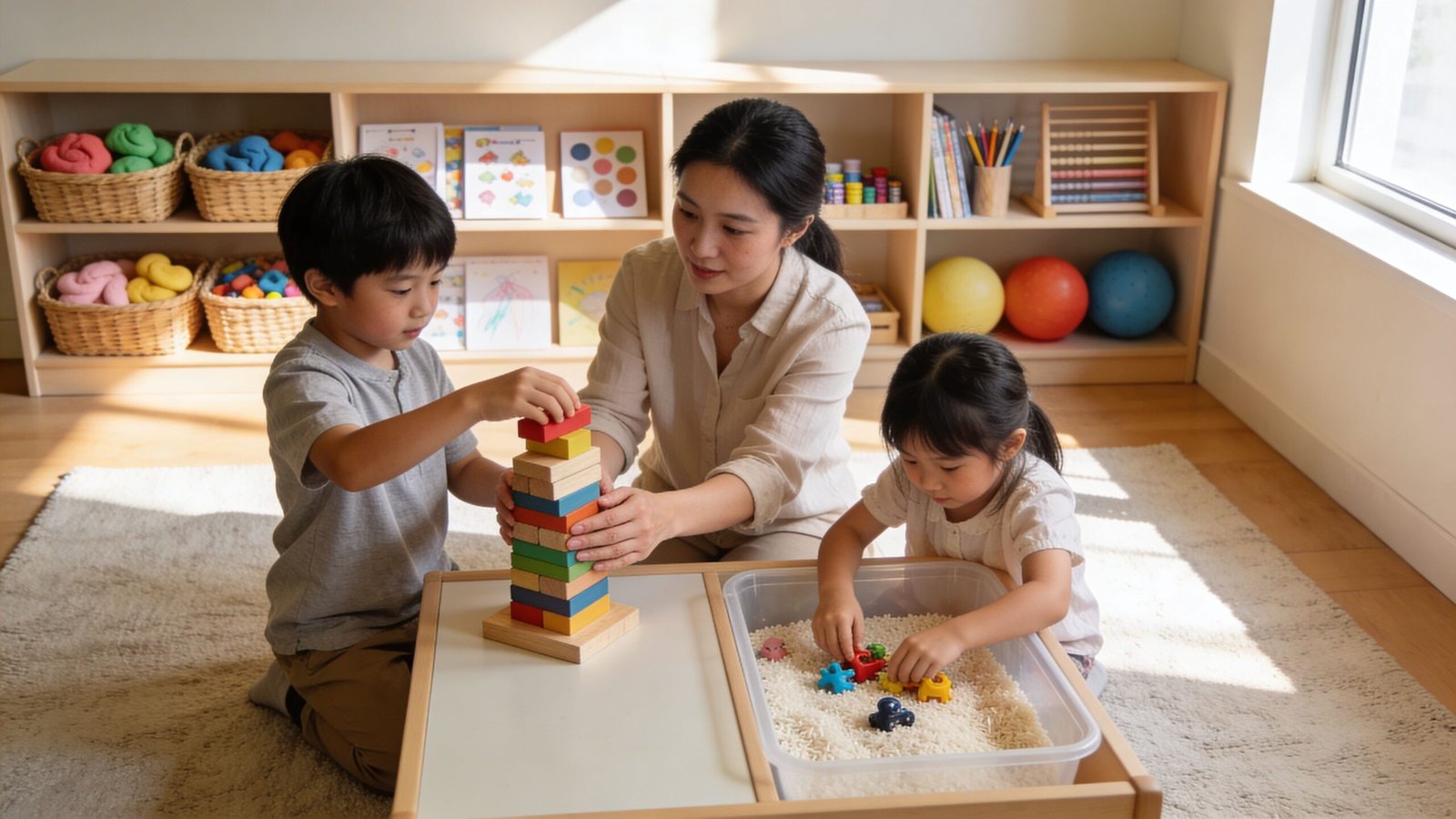
To adults, a session may look like swinging, climbing, squeezing putty, building block towers, or doing an obstacle course. But each activity has a purpose. A swing may support balance and body awareness. Putty may help hand strength. A block game may build planning, grasp, and frustration tolerance.
If you want a simple way to understand why this matters, this guide on the importance of hands-on learning gives a helpful picture of why children build skills through active, sensory-rich experiences rather than just verbal instruction.
Key Signs Your Child Might Benefit from OT
Parents usually don’t come in saying, “My child has poor sensory modulation” or “I suspect praxis difficulties.”
They say things like, “Every morning is a battle,” or “She cries when I cut her nails,” or “He’s bright, but writing is so hard.” Those everyday moments matter. They’re often the clues.

Fine motor signs
Some children understand what they want to do, but their hands can’t keep up.
You might notice:
- Fast frustration with small tasks such as zips, buttons, beads, Lego, or opening lunch containers
- Avoidance of drawing or colouring because holding tools feels tiring or awkward
- Very messy handwriting that doesn’t improve much with practice
- Using too much or too little pressure on pencils and crayons
A child in this situation may look careless to others, but often they’re working very hard.
Sensory processing signs
This is one of the biggest areas of confusion for parents. Sensory issues aren’t just about disliking loud sounds. They can affect the whole day.
A child might:
- cover their ears in busy places
- refuse certain food textures
- seek constant movement by jumping, crashing, spinning, or climbing
- become upset by clothing tags, socks, tooth brushing, or hair washing
- seem “on edge” in supermarkets, birthday parties, or assemblies
Some children are sensory sensitive. Others are sensory seeking. Some are both, depending on the situation.
A child who runs, crashes, or chews constantly isn’t always “misbehaving.” Sometimes they’re trying to organise their nervous system the best way they know how.
Coordination and body awareness signs
You may notice your child seems clumsy, avoids bikes or climbing frames, or struggles to copy movements in action songs and games. They might trip often, bump into furniture, or hesitate on stairs.
This can affect confidence quickly. A child who feels unsure in their body may avoid play with peers, not because they don’t want friends, but because keeping up feels stressful.
Self-care signs
OT also supports the routines families deal with every single day.
Look for challenges with:
- Dressing such as putting clothes on the wrong way, managing fasteners, or tolerating certain fabrics
- Feeding including limited textures, weak utensil skills, or tiring quickly during meals
- Toileting routines where sequencing, body awareness, or sensory discomfort gets in the way
- Brushing teeth or washing when the routine leads to distress every time
Emotional regulation and participation signs
Sometimes the concern isn’t “skills” at first glance. It’s coping.
A child may have:
- frequent meltdowns during transitions
- difficulty waiting or taking turns
- strong reactions when plans change
- trouble settling in group settings
- a pattern of avoiding tasks that seem too demanding
That doesn’t automatically mean OT is the only answer. But if those reactions are tied to sensory input, motor difficulty, or daily routine demands, OT can be part of the solution.
Your Child’s OT Journey What to Expect
Once you decide to call, many parents worry they’re stepping into something clinical, cold, or complicated. In reality, a good OT journey should feel structured, clear, and collaborative.
In San Diego County, OT is included in 25 to 30% of early intervention plans for children aged 3 to 5 for motor and sensory goals, according to Kids on the POINT OT. The same source cites a 2021 Rady Children’s Hospital study in which 78% of participants improved fine motor scores by 20 to 40% after 12 weeks. Those numbers are reassuring, but the day-to-day process matters just as much to families.
The first step is the evaluation
An OT evaluation is not a pass or fail test.
The therapist usually gathers information from you first. You may be asked about pregnancy and birth history, early milestones, feeding, sleep, play, nursery or school concerns, sensory preferences, and home routines. Then the therapist observes your child through play and structured tasks.
They’re watching for things like:
- how your child uses both hands
- posture and balance
- attention during activities
- transitions between tasks
- motor planning
- sensory responses
- independence with age-expected routines
Some therapists use formal assessment tools. Others combine this with observation and parent interview. The point is the same. They’re trying to understand both strengths and barriers.
Goals should feel personal, not generic
A useful therapy plan doesn’t say, “Improve fine motor skills.”
It says things like:
- put on a T-shirt with less help
- tolerate tooth brushing with less distress
- use scissors safely
- sit and engage in table tasks for longer
- manage school readiness routines with more confidence
That’s why parent input matters so much. You know where daily life gets stuck.
If you’d like examples of home activities that support hand use, this collection of fine motor skills activities can help you picture the kinds of playful tasks therapists often recommend between sessions.
The best goals solve real problems your family faces every week.
What a session often looks like
A typical session may not look like therapy in the adult sense. Your child might climb through a tunnel, balance on stepping stones, pull objects from therapy putty, build with pegs, practise opening containers, or do a short dressing routine.
To a child, it feels like play. To the therapist, each task is carefully chosen.
Here’s what purposeful play might target:
- Swinging or climbing can support balance, body awareness, and regulation.
- Putty, tongs, pegs, and tweezers can build hand strength and finger control.
- Obstacle courses can help with planning, sequencing, and coordination.
- Craft tasks can improve bilateral coordination and visual motor skills.
- Dressing or feeding practice brings therapy directly into daily life.
Progress is reviewed, not guessed
Good therapists don’t just keep doing the same activities forever. They watch what’s changing.
You might see progress in small but meaningful ways. Mornings become smoother. Pencil grip improves. Your child joins playground play instead of hanging back. Mealtimes feel less tense. A skilled OT notices when to increase challenge, when to simplify, and when to shift goals because your child is ready for the next step.
How to Find the Right Local OT Provider
Typing “pediatric occupational therapy near me” is a start. It isn’t the finish line.
The nearest clinic isn’t always the best fit. The nicest website isn’t proof of the right expertise. Parents need a short list built on practical details, not just convenience.

Start with a smarter search
Be specific with your search terms. Instead of only typing the main keyword, try adding your child’s likely needs.
Useful searches include:
- pediatric occupational therapy near me sensory processing
- child OT near me feeding
- pediatric OT with sensory gym near me
- occupational therapist for handwriting child near me
- OT for autism school readiness near me
Google Maps can help, but don’t stop there. Look at clinic photos, service pages, and whether the provider talks clearly about paediatric care rather than general rehabilitation.
Ask people who see your child in real settings
Some of the best referrals come from professionals or parents who’ve watched your child function day to day.
Consider asking:
- Your paediatrician if they know therapists experienced with your child’s concerns
- Nursery or school staff if they’ve seen local providers communicate well with educators
- Speech therapists or psychologists if your child already works with another professional
- Other parents who can tell you what the experience felt like, not just whether the clinic looked good online
If you want a simple reference point for what a local children’s OT service may offer, this page on an occupational therapist in Dubai shows the kind of support families often look for, such as help with regulation, motor development, and daily independence.
Read reviews like a detective
Don’t just count stars. Read patterns.
Look for repeated comments about:
- Communication. Do parents feel informed and included?
- Child engagement. Do children enjoy attending?
- Practical progress. Are families noticing life at home gets easier?
- Organisation. Are sessions consistent, punctual, and well managed?
Be cautious if reviews sound vague or only mention décor and friendliness. Those things matter, but they aren’t enough.
A good clinic should be able to explain how it assesses, plans, communicates, and adjusts therapy. If that sounds unclear on the first call, it usually won’t become clearer later.
Think beyond distance alone
Travel matters. Busy families need realistic logistics. But sometimes a slightly longer drive is worth it if the provider fits your child better, involves parents well, and coordinates with school or home routines.
The right choice is usually the one that feels both clinically sound and sustainable for your family.
Essential Questions to Ask Your Potential Therapist
A first call with a therapist can feel rushed if you don’t know what to ask. Parents often focus on availability first, then realise later they forgot the questions that determine outcomes.
What you want is a provider who can explain their reasoning in plain language, without making you feel dismissed or overwhelmed.
Key Questions for Your OT Provider Consultation
| Category | Question to Ask | Why It’s Important |
|---|---|---|
| Experience | What kinds of children do you work with most often? | You want to know whether they regularly support challenges similar to your child’s. |
| Assessment | How do you evaluate a child’s strengths and needs? | This shows whether their process is thoughtful and individualised. |
| Therapy approach | Is your therapy play-based, sensory-based, skills-based, or a mix? | Different therapists work differently. The approach should match your child. |
| Parent involvement | How are parents included in goal setting and follow-up? | Home carryover matters, and you shouldn’t be left guessing what to do between sessions. |
| Goals | How do you decide what goals to prioritise first? | Good goals should improve daily life, not just test performance. |
| Progress | How do you measure progress and when do you update the plan? | You need to know how they track change over time. |
| Communication | Do you coordinate with schools, speech therapists, or other providers? | Children often need support across more than one setting. |
| Practical details | How long are sessions, and how often do children usually attend? | This helps you judge whether the recommendation is realistic for your family. |
| Sensory needs | If my child struggles with transitions or regulation, how do you handle that during sessions? | The answer tells you a lot about the therapist’s flexibility and child understanding. |
| Fit | Can I visit the space or have a consultation before starting? | The environment matters, especially for children with sensory or anxiety needs. |
What a strong answer sounds like
A strong therapist doesn’t need to sound fancy. They should sound clear.
You’re listening for answers that are specific, calm, and centred on your child’s participation in daily life. If the therapist can explain what they do and why they do it, that’s a good sign. If every answer feels vague, overly technical, or one-size-fits-all, keep looking.
Teletherapy or in-person care
Some families prefer in-person sessions because the therapist can work directly with movement, equipment, and hands-on support. Others need teletherapy because of transport, scheduling, or access.
A useful way to compare them is this:
- In-person may suit children who need movement-based input, hands-on prompting, specialised equipment, or help adjusting to a therapy environment.
- Teletherapy may suit families who want support in the home setting, coaching during real routines, or more flexible access.
A 2025 to 2026 UCSF Benioff study of 1,200 Bay Area children with developmental delays found that telehealth OT improved school readiness skills such as fine motor control for handwriting by 45%, according to CSLOT occupational therapy information.
That doesn’t mean teletherapy is best for every child. It means it can be effective, especially when the therapist knows how to coach the adult supporting the session.
Some children do best with a hybrid approach. A clinic session builds the skill, and a remote or home-based session helps carry it into real life.
The Advantage of Integrated Multidisciplinary Care
This is the part many “near me” articles miss.
A child may need help with sensory processing, emotional regulation, communication, behaviour, play, and school readiness at the same time. If each therapist works in isolation, parents often become the messenger. You repeat the same story, carry reports from one clinic to another, and try to connect the dots yourself.

Why fragmented care can slow things down
Let’s say one provider is working on attention, another on speech sounds, and another on behaviour. If they don’t coordinate, goals can clash. A child may be pushed in different directions without a shared plan.
Parents feel this quickly:
- appointments pile up
- advice overlaps or contradicts
- no one sees the full picture
- progress is harder to interpret
What integrated care looks like
A multidisciplinary model brings professionals together around one child, one set of priorities, and one coordinated plan. For many children, that may include OT, speech therapy, ABA or behaviour support, and educational psychology.
The clinical reasoning behind this matters. For conditions such as autism, occupational therapists work with speech-language pathologists, ABA specialists, and educational psychologists to support a whole-child approach rooted in models that address sensory processing, emotional regulation, and adaptive skills in a coordinated way, as described by Pediatric Care Collective providers.
That kind of teamwork reduces the burden on families and often creates more consistent support for the child.
What parents should look for
When comparing services, ask whether the clinic or centre can:
- share goals across disciplines
- hold team discussions about your child
- align recommendations for home and school
- adjust one therapy plan based on what another therapist observes
If your child needs support across several areas, an early intervention programme is often easier for families than piecing together separate services on their own.
A coordinated plan doesn’t just save time. It helps the child experience therapy as one joined-up support system instead of several disconnected demands.
Frequently Asked Questions About Pediatric OT
What’s the difference between school-based OT and private OT?
School-based OT usually focuses on what helps a child access and participate in education. Private OT often has more room to address home routines, sensory needs, feeding, dressing, play, and broader daily living goals. Both can be helpful. They serve different purposes.
How long will my child need therapy?
There isn’t one standard answer. Some children need short-term support around a specific goal. Others benefit from longer care because their needs affect several parts of daily life. A good therapist should review progress regularly and explain why therapy is continuing, changing, or ending.
What can I do at home to help?
The most effective home support is usually simple and consistent. Follow the therapist’s recommendations, build practice into regular routines, and focus on small wins. That may mean practising dressing during calm times, using sensory strategies before transitions, or adding playful hand-strength tasks during the week.
Do I always need a doctor’s referral?
Not always. This depends on where you live, the provider, and your insurance plan or funding route. It’s best to ask the clinic directly before booking.
Is OT only offered in clinics?
No. According to Exploration Kids Therapy, pediatric OT is commonly covered by Medicaid, private insurance, and public school systems, and services may include clinic-based sessions, home and school consultations, and telehealth evaluations. That flexibility matters because children often learn best across the environments where they live, play, and learn.
What if my child is shy or doesn’t “perform” in the evaluation?
That’s very common. Skilled paediatric therapists expect it. They don’t rely on one perfect performance. They look at observation, parent report, play, regulation, and how the child responds over time.
If you’re looking for coordinated support rather than piecing therapies together on your own, Georgetown early intervention center offers multidisciplinary care with occupational therapy, speech therapy, educational psychology, and play-based behaviour support. Their team builds an individual plan for each learner, because every child’s strengths, challenges, and pace are different.