
When parents hear the term "occupational therapy," it's easy to get the wrong idea. It has nothing to do with jobs or careers. For children, it’s all about helping them master the daily "occupations" of life—things like playing, learning, and simply growing up. If you're a parent looking into occupational therapy in Dubai, think of it as a personal coach who helps your child navigate the game of daily living with more ease and confidence.
Understanding Occupational Therapy for Children in Dubai

At its heart, occupational therapy (OT) acts as a bridge, connecting your child to the world and helping them participate in it fully. In a busy city like Dubai, where life can sometimes feel overwhelming for little ones, OT provides the tools they need to overcome developmental hurdles and build real-world skills.
A pediatric occupational therapist’s main job is to support a child's ability to engage in their most important daily activities. In childhood, these "occupations" look a lot like fun:
- Play and Leisure: Figuring out how to share with a friend, diving into imaginative games, or joining in on the playground.
- School Activities: Learning to hold a pencil, staying focused during story time, or remembering to pack their school bag.
- Self-Care Routines: Buttoning a shirt, using a fork and knife, or mastering their morning routine.
The Foundation of Purposeful Play
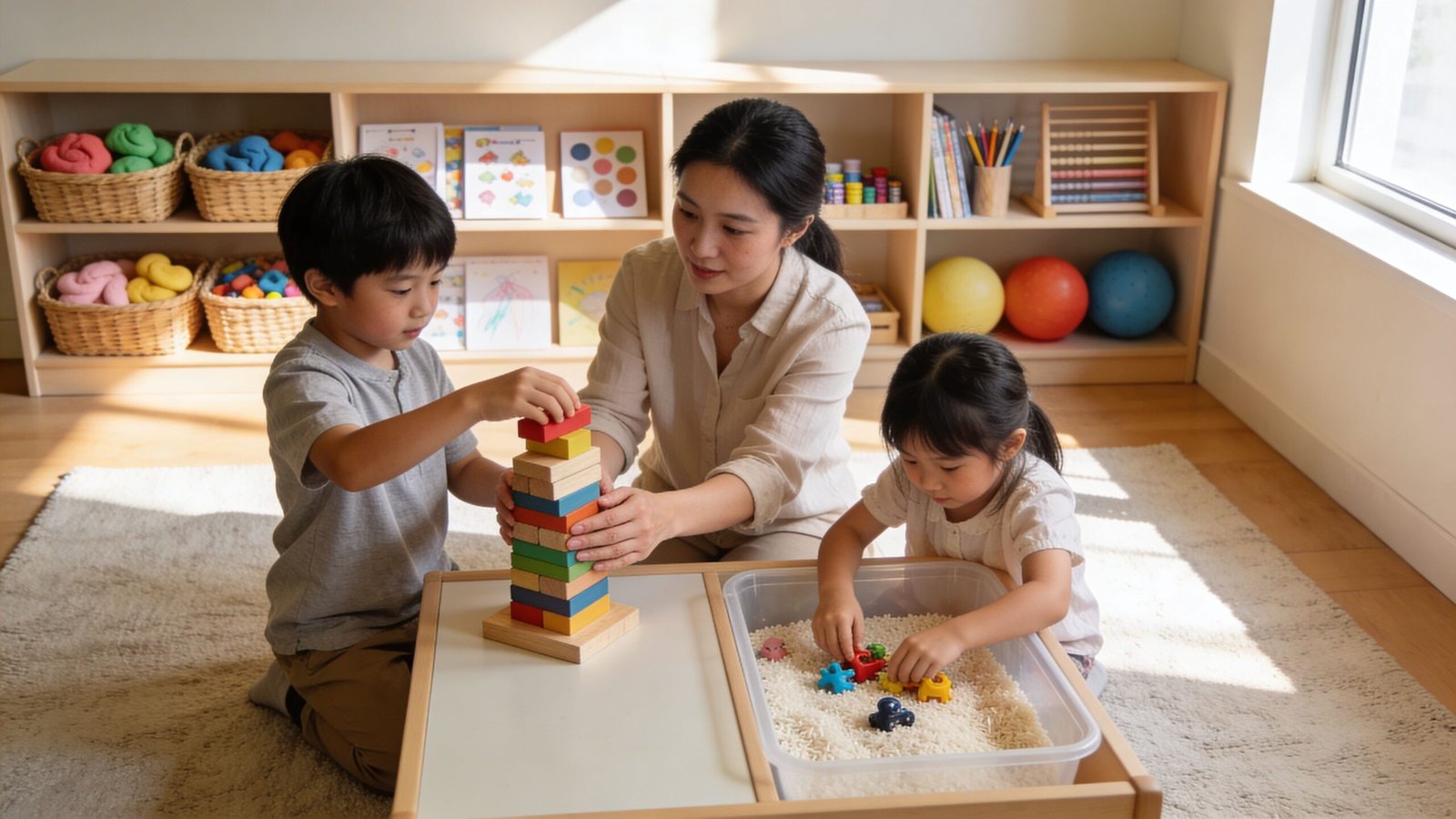
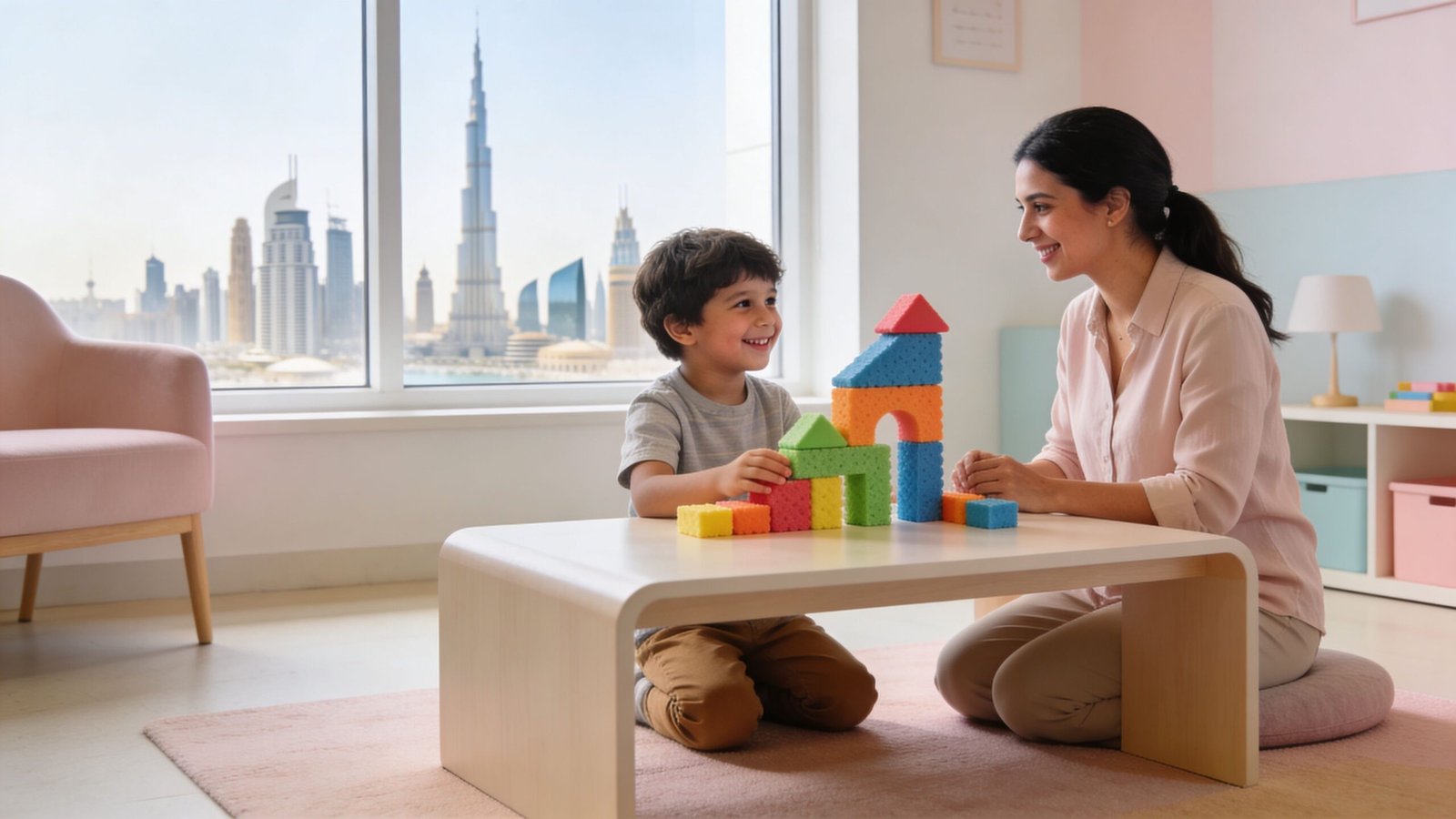
To an outsider, an OT session might just look like playtime. You'll see kids building with blocks, working on puzzles, or even swinging from special equipment. But there's a specific purpose behind every single activity. This is what we call purposeful play.
For example, a therapist might suggest stringing beads. It seems simple, but it's actually building the fine motor control and hand-eye coordination essential for learning to write. An obstacle course isn't just for burning off energy; it’s teaching body awareness and motor planning, skills that help a child feel more confident in sports or even just navigate a crowded mall.
An occupational therapist’s first question isn’t, "What’s wrong with this child?" It’s, "What’s getting in the way of this child doing the things that are important to them and their family?" That focus on the whole family is what makes the therapy truly effective.
The Growing Importance of OT in the UAE
The field of occupational therapy has taken huge strides in the UAE. Key milestones, like the founding of the Emirates Occupational Therapy Working Group (EOTWG) in 2024 and its admission to the World Federation of Occupational Therapists in 2026, underscore this professional growth. This global alignment means families in Dubai can trust they are receiving care that meets high international standards.
Tracking progress is a critical part of making sure therapy is working. This depends on consistent and clear outcome measurement to see what's effective and what needs adjusting. At Georgetown Early Intervention Center, we know that no two children are the same, which is why we build individualized plans from the ground up. You can see how we put this philosophy into practice at our occupational medical clinic.
Key Signs Your Child Might Need an Occupational Therapist

You know your child better than anyone. That gut feeling you have as a parent—when something seems a little harder for them than for their peers—is powerful. But it can be tough to put a name to why everyday tasks feel like a constant battle.
Figuring out if your child could benefit from occupational therapy in Dubai isn’t about labeling them or looking for flaws. It’s about understanding their unique needs and giving them the right tools to build confidence. The signs are often hiding in plain sight, showing up as behavioral quirks or daily frustrations.
Let's walk through what those signals look like in the real world.
Difficulties with Motor Skills
So much of childhood is about doing—building, running, drawing, and exploring. When the physical skills for these activities don't come naturally, it can be incredibly frustrating for a little one. An occupational therapist helps children fine-tune these abilities using activities that just feel like play.
Watch for challenges in two key areas:
- Fine Motor Skills: These are all about the small, precise movements of the hands and fingers. You might see a child struggle to button their school uniform, hold a crayon correctly, use scissors, or manage small LEGO pieces. They might also seem generally clumsy when handling smaller toys.
- Gross Motor Skills: This involves the large muscles that control the arms, legs, and torso. Signs can include an uncoordinated running style, trouble catching a ball, avoiding playground climbing frames, or having poor balance.
These motor skill gaps are more than just physical. They can make a child hesitant to join in games or feel left behind in class activities.
An easy way to think about it: If a child’s hands aren’t yet strong and coordinated enough to hold a pencil, asking them to write their name is like trying to build a house on an unfinished foundation. OT helps build that strong base first, so the bigger tasks become possible.
Sensory Processing Challenges
Every person processes the world through their senses, but some children experience sights, sounds, and textures much more—or much less—intensely than others. This is often related to sensory processing, a core area where a skilled occupational therapist can make a huge impact.
A child's sensory responses might look like this:
- Over-Responsive (Hypersensitive): These children can feel easily bombarded by their surroundings. They might cover their ears at the loud sounds in a Dubai mall, despise the feeling of seams in their socks, be an extremely picky eater who avoids certain food textures, or refuse to get their hands messy with paint or sand.
- Under-Responsive (Hyposensitive): On the other end, some children constantly seek more sensory input to feel regulated. This might look like crashing into sofas on purpose, a love for spinning, seeming to have a very high tolerance for pain, or not noticing they have food all over their face.
These reactions aren't "bad behavior." They are simply the brain's attempt to organize incoming information and feel balanced. Therapy gives children practical strategies to manage these sensory needs, making the world feel like a much safer and more comfortable place.
The table below breaks down some of these common challenges to help you see where occupational therapy can provide targeted support.
Common Developmental Challenges Addressed by Occupational Therapy
| Developmental Area | Example Challenges for a Child | How Occupational Therapy Helps |
|---|---|---|
| Fine Motor Skills | Struggling to hold a pencil, use scissors, button clothes, or stack blocks. | Builds hand strength and coordination through targeted games, crafts, and tool use. |
| Gross Motor Skills | Appears clumsy; has trouble with balance, jumping, catching a ball, or climbing. | Improves body awareness, coordination, and balance with fun, movement-based activities. |
| Sensory Processing | Is easily overwhelmed by noise or touch; or constantly seeks intense movement like crashing and spinning. | Creates a “sensory diet”—a personalized plan of activities that helps regulate the nervous system. |
| Self-Care Skills | Has difficulty with feeding, dressing, or brushing teeth independently. | Breaks down tasks into manageable steps and develops the motor and sequencing skills needed for independence. |
| Play & Social Skills | Doesn’t know how to play with toys, struggles with imaginative play, or has trouble sharing. | Teaches play sequences, turn-taking, and social cues within structured, therapist-guided play sessions. |
By addressing these underlying issues, occupational therapy doesn’t just improve a single skill; it helps build a more confident, capable, and resilient child.
Struggles with Daily Routines and Play
A child’s “occupation” is to learn, play, and grow more independent. When they hit roadblocks in these fundamental areas, it’s a clear sign they could use some extra support. This often shows up in daily self-care routines, like feeding themselves without a major mess, getting dressed in the right order, or managing toothbrushing.
Pay attention to how your child plays, too. Do they find it hard to start an imaginative game? Do they get frustrated and give up easily when a toy doesn’t work perfectly on the first try? An occupational therapist is an expert at breaking down these complex life skills into smaller, achievable steps, building both the physical ability and the emotional resilience to tackle them.
How OT Supports Autism and School Readiness

As a parent in Dubai, two big concerns often come to the forefront: how to best support a child with autism, and how to make sure your little one is ready for that first big day of school. Occupational therapy is a key piece of the puzzle for both, offering practical tools that build not just skills, but true confidence and independence.
Rather than getting stuck on a diagnosis, a good OT zeros in on the specific, real-world challenges a child is facing. They connect the dots between what’s happening inside a child’s brain and body and their ability to successfully join in with the world around them.
Bridging the World for Children with Autism
For a child on the autism spectrum, the world can feel like a constant sensory assault. A bustling Dubai mall or a noisy classroom isn’t just a little distracting—it can be completely overwhelming. An occupational therapist acts as a translator, helping the child learn to organize and respond to all that sensory information in a healthier way.
One of the main ways they do this is with a personalized “sensory diet.” This isn’t about food; it’s a carefully chosen menu of activities designed to regulate their nervous system. The goal is to “feed” the brain the right kind of sensory input so the child feels calm, centered, and organized.
For example, a therapist might teach your child to use a weighted blanket for a “sensory break” before a big family outing to dial down anxiety. Or they might use a structured game to practice taking turns—a fundamental skill for building friendships. OT essentially translates the world’s confusing social and sensory rules into a language a child with autism can understand and use.
Occupational therapy for autism is not about “fixing” a child. It’s about honoring their unique neurotype and giving them the adaptive tools to thrive in a world that wasn’t built for their sensory system. The goal is independence and self-advocacy.
And the support goes far beyond just sensory management. Therapists also focus on:
- Building Routines: Using visual schedules to make daily transitions, like moving from playtime to dinner, feel predictable and safe.
- Developing Play Skills: Teaching the sequence of imaginative play, helping a child learn how to pretend with toys or join a game with their friends.
- Enhancing Daily Living Skills: Breaking down tasks like brushing teeth or tying shoelaces into small, manageable steps to build independence.
All of these strategies are designed to empower your child, giving them a greater sense of control and reducing the challenging behaviors that so often spring from feeling overwhelmed.
Building the Foundation for School Readiness
Getting “school ready” starts long before a child ever sets foot in a classroom. It’s built on a complex set of skills that go way beyond knowing the ABCs and 123s. A skilled occupational therapy dubai practitioner is an expert at laying this essential groundwork.
Think of it like building a house. You can’t put up the walls and roof before you’ve poured a solid foundation. For school, that foundation includes fine motor control, attention, and the ability to regulate emotions.
An OT will work on critical pre-academic skills, including:
- Handwriting and Fine Motor Skills: This is about more than just holding a pencil. It’s developing the hand strength and coordination needed to use scissors, button a shirt, and form letters. This is often done through fun, playful activities like using therapy putty, drawing on a vertical easel, or stringing beads.
- Attention and Focus: Improving a child’s ability to sit still and listen to a teacher. For many kids, learning how to sit correctly is a physical skill that directly impacts their ability to focus and participate in class.
- Visual-Motor Skills: This is the brain-hand connection. It’s the skill that allows a child to see what the teacher writes on the board and copy it down, or to space words correctly on a page.
Beyond academics, a huge part of being ready for school is being emotionally and socially prepared. OTs help children learn how to manage frustration, follow multi-step directions, and get along with their classmates.
They also work on self-care independence, which is a huge confidence booster at school. This means mastering tasks like opening a lunchbox, using the toilet independently, and putting on their own shoes and jacket. When a child can handle these personal tasks, they can focus their energy on what really matters in the classroom: learning and making friends. To see how purposeful activities can support these goals, you can learn more about the power of sensory play in our dedicated guide.
Your Family’s Occupational Therapy Journey Explained

Starting therapy can feel like stepping into a completely new world. If you’re like most parents, the whole process can seem a bit mysterious, leaving you wondering what actually happens behind those clinic doors. Our goal is to pull back the curtain on that journey, turning any anxiety you have into confidence by showing you just how collaborative and positive every step can be.
Believe it or not, it all starts with a simple conversation. From that first phone call to your child’s ongoing sessions, the process is built to support your entire family, not just your child.
The First Step: The Initial Assessment
Let’s be clear: the initial assessment for occupational therapy in Dubai isn’t a test your child can pass or fail. It’s much more like a friendly investigation, where the therapist acts as a detective to piece together a complete picture of your child’s world. This process is a blend of their professional observation and your invaluable insights as a parent.
Your role here is absolutely vital. You’re the expert on your child. You know their strengths, their biggest frustrations, and what a truly “good day” looks like for them. The therapist will want to hear all about your concerns and goals. Are you hoping your child can finally tie their shoelaces, make a friend at the park, or just get through dinner without a meltdown? No goal is too big or too small.
During this time, the therapist will invite your child to play. These aren’t just random games, though. Each activity is carefully chosen to see specific skills in action in a natural, low-stress way.
- Standardized Assessments: These are specific tools that help the therapist see how your child’s skills in areas like fine motor control or visual perception compare to standard developmental milestones.
- Clinical Observations: This is where the therapist’s trained eye comes in. They’ll watch how your child moves, solves problems, and interacts with new things. Do they shy away from certain textures? How do they handle a tricky task?
- Parent/Caregiver Interview: This is where your expertise takes center stage. You provide the real-life context that no clinical test can capture, helping the therapist understand the full story.
All of these pieces come together to create a holistic view, which becomes the foundation for a therapy plan that is truly built for your child.
Your insights as a parent are the most important part of the assessment. The therapist brings the clinical expertise, but you bring the expertise on your child. Together, you form a team dedicated to your child’s success.
What Happens Inside a Therapy Session
If you’re picturing a sterile, quiet clinic, think again. A modern pediatric therapy session looks more like the ultimate playroom. It’s a vibrant, dynamic space designed for “play with a purpose.” When you peek inside, you’ll likely see swings, huge colorful balls, obstacle courses, and tables full of puzzles and craft supplies.
Every single piece of equipment and every activity is there for a reason.
- A swing isn’t just for fun; it gives the body sensory input (vestibular input) that can help a child feel calm and organized.
- Squeezing and rolling therapy putty is a fantastic way to strengthen the small hand muscles needed for writing and buttoning.
- Climbing through an obstacle course helps build motor planning—the ability to think of and carry out a sequence of movements.
So, while your child just thinks they’re having a great time playing, the therapist is skillfully guiding the activities to work on their specific goals. They will gently increase the challenge—a technique called scaffolding—to help your child build new skills without getting overwhelmed. The session becomes a delicate dance of play, challenge, and success, all aimed at mastering the skills needed for everyday life.
This commitment to continuous learning is a hallmark of the best therapy centers. Dubai’s occupational therapy community is buzzing with educational opportunities, highlighted by a number of specialized conferences scheduled for 2026. Events like the International Conference on Paediatrics and Child Health (ICPCH) and the International Conference on Mental Health and Occupational Therapy (ICMHOT) draw experts from around the world. This ensures that local therapists are always up-to-date on the most effective, evidence-based strategies, giving your child access to the best support available.
Choosing the Right Occupational Therapy Centre in Dubai
Let’s be honest—choosing a therapy centre for your child feels like a monumental decision. It is. You’re not just looking for a service; you’re searching for a team that will become an extension of your family, a place where your child feels seen and celebrated. In a city with so many options for occupational therapy in Dubai, it’s easy to feel overwhelmed. But knowing what to look for can make all the difference.
The goal isn’t just to find a qualified therapist. It’s about finding a place that feels right—a place where your child is excited to go, and where you, as a parent, feel supported and understood.
Core Qualities of a Top Therapy Centre
As you start your search, try to look beyond the glossy brochures and websites. The real magic happens in the day-to-day interactions and the underlying philosophy of the centre. The best providers all have a few things in common.
A Play-Based Philosophy: Great therapy should look and feel like play. The most effective centres build their sessions around fun, engaging activities that your child will love, but each one is cleverly designed to target specific skills. The atmosphere should be warm and inviting, not clinical or cold.
Family-Centred Care: You know your child better than anyone. A top-tier centre recognizes this and makes you a central part of the team. They won’t just work with your child in a vacuum; they’ll give you practical strategies for home and celebrate every milestone right alongside you.
A Multidisciplinary Team: Often, a child who needs help in one area can benefit from support in others. Having a team of specialists—like speech therapists, educational psychologists, and behavior therapists—all working together under one roof creates a truly holistic plan. This collaborative approach ensures no stone is left unturned in supporting your child’s development.
Key Questions to Ask Any Potential Provider
Once you’ve narrowed down your list, it’s time to dig a little deeper with some specific questions. Their answers will tell you a lot about how they operate and whether they’re the right fit for your family.
The relationship you build with your child’s therapy team is founded on trust and open communication. Never hesitate to ask all your questions until you feel completely at ease. Your peace of mind is essential.
Here’s a checklist of questions to get the conversation started:
- What are the qualifications and experience of your therapists? Ask about their certifications, but also about their specific experience with your child’s unique needs, whether it’s sensory processing, autism, or something else.
- How do you create and review therapy goals? This should be a team effort. A good therapist will insist on your input from day one to make sure the goals are meaningful and relevant to your family.
- Can I observe sessions or get regular updates from the therapist? Transparency is key. You should feel like a partner in the process, not a bystander.
- How do you support families from different cultural or linguistic backgrounds? Dubai is a global city. It’s crucial that a centre is culturally aware and can communicate clearly with families from all walks of life.
The level of expertise required for this specialized work is reflected in the profession itself. In Dubai, the average salary for an occupational therapist is around AED 13,091 per month. This competitive compensation helps attract highly skilled therapists from around the world, bringing a wealth of diverse experience to the city’s families. You can see more details about OT salary trends in the UAE at Payscale.com/Salary).
At Georgetown, we champion this kind of collaborative, transparent, and family-focused care. We build every plan from the ground up, designed around the unique personality and needs of each child. You can learn more about our philosophy and what makes us different by visiting our Georgetown Early Intervention Center.
So, What Comes Next?
Taking in all this information about child development can feel like a heavy responsibility, but by reading this far, you’ve already done so much. You now have a real understanding that occupational therapy is much more than just play—it’s play with a purpose. You’re also better equipped to spot the signs that your child might need a little extra support and know what to look for in a quality occupational therapy provider in Dubai.
The path forward from here is unique to every family, and it’s built around one simple truth: your child is one of a kind. That’s why a “one-size-fits-all” approach just doesn’t work. The right support is always a collaborative journey, designed around your family’s goals, whether that’s helping your child master handwriting, feel more comfortable in social situations, or find ways to manage a world that feels too loud or bright.
Taking the first step is often the hardest part of any journey. Reaching out for information is not a commitment to therapy; it is a commitment to understanding your child’s needs more deeply.
Taking Action with Confidence
Making the best decisions for your family starts with feeling informed, not overwhelmed. If you’re wondering whether professional support is the right move, getting answers is probably more straightforward than you think. It all begins with a simple conversation.
Here’s how you can get the clarity you need:
- Book a Consultation: Arrange a no-obligation meeting with a specialist. It’s the perfect, low-pressure way to ask your questions, talk about what you’re seeing at home, and get a genuine feel for the centre’s environment and team.
- Speak with a Specialist: Sometimes, all it takes is a quick phone call to find the reassurance you’re looking for. Our team is here to listen to your family’s specific situation and offer honest, practical guidance.
At Georgetown Early Intervention Center, our mission is to empower you as a parent. We see ourselves as your partners, working with you to create a personalized plan that celebrates your child’s unique strengths while supporting their development. If you’re ready to learn more about how we can help your child find their footing and flourish, we hope you’ll reach out to our team today.
Your Questions About OT in Dubai, Answered
When you’re looking into occupational therapy for your child, a lot of practical questions naturally come to mind. It’s a new world for many families. Let’s walk through some of the most common queries we hear from parents in Dubai, so you can feel clear and confident about your next steps.
How Much Does Occupational Therapy Cost and Is It Covered by Insurance?
In Dubai, a single occupational therapy session typically costs between AED 350 and AED 600. The exact price can depend on the centre you choose, the therapist’s specific expertise, and the length of the session, which is usually around 45 to 60 minutes.
When it comes to insurance, the good news is that many premium plans in the UAE do cover occupational therapy. This is especially true when it’s part of a treatment plan for a diagnosed condition like Autism Spectrum Disorder (ASD) or another developmental delay.
Your first call should always be to your insurance provider to get the specifics. Be sure to ask them about your coverage limits, any co-payment you might have, and if you need pre-authorization before the sessions begin. The administrative staff at your therapy centre are usually very experienced with this and can be a great resource for helping you figure out the insurance side of things.
How Long Will My Child Need Occupational Therapy?
This is probably the most common question we get, and the honest answer is: it truly depends on your child. There’s no set timeline. The length of therapy is completely shaped by your child’s individual needs and the specific goals you establish with their therapist.
For some children, OT might be a shorter-term engagement. Maybe they need a few months to get the hang of a specific skill, like holding a pencil correctly or learning to feed themselves without frustration. For others with more complex or ongoing challenges, therapy might be a longer-term partnership that supports them as they grow and encounter new developmental hurdles.
A great occupational therapist regularly reviews your child’s progress with you and is transparent about when goals are being met. The ultimate aim is always to equip your child with lasting skills for independence, not to create a long-term dependency on therapy.
What Is the Difference Between Occupational Therapy and ABA Therapy?
It’s easy to get OT and Applied Behavior Analysis (ABA) therapy confused, as they are often recommended together. While they can both be incredibly helpful, they work on different things.
- Occupational Therapy (OT) is all about helping children succeed in the “jobs” of daily life—their occupations. Think of it as a hands-on approach using purposeful play to improve motor skills, manage sensory input, and master self-care tasks like dressing or eating.
- Applied Behavior Analysis (ABA) is a highly structured therapy focused on improving specific behaviors. It uses a data-driven system to teach and reinforce positive skills in areas like communication, social interaction, and learning.
In top-tier multidisciplinary centres, these two types of therapists don’t work in silos. They collaborate closely, ensuring that the strategies used in OT sessions are reinforced in ABA, and vice versa. This teamwork gives your child well-rounded, consistent support.
Does My Child Need a Formal Diagnosis to Start OT?
No, you absolutely do not need a formal diagnosis to start occupational therapy. OT is not about treating a label; it’s about supporting a child’s function.
If you’ve noticed your child is struggling with age-appropriate tasks—whether it’s getting overwhelmed by loud noises, having trouble on the playground, or finding it difficult to use a fork and knife—an OT evaluation is a perfect next step. It can offer incredible insight into why they’re struggling and give you a clear plan to help them.
At Georgetown Early Intervention Center, we believe in building a plan that is as unique as your child. Our team of specialists is ready to partner with you to unlock your child’s full potential. To learn more about our individualised approach, contact us today.