
You may be reading this because something feels a little off, even if you can't quite name it yet. Your baby may dislike turning their head one way. Your toddler may still seem unsteady on stairs. Your child may run, jump, and play, but somehow not quite like other children their age. That uneasy feeling can sit with a parent for weeks before they decide to ask for help.
That step matters.
Parents often worry that seeking support means something is “wrong”. In practice, paediatric physiotherapy dubai is usually about understanding how your child moves, where they may need support, and how to help them build skills with confidence. It isn't about labels first. It's about function, comfort, participation, and progress.
In Dubai, families can access paediatric physiotherapy from infancy through adolescence, and the best care feels less like a cold medical process and more like a guided partnership. A good therapist does more than work on exercises. They observe, listen, teach, and help the whole family understand what the child's body is trying to do.
Your Child's Journey and How Physiotherapy Can Help
It often starts with a small moment. Your baby isn't rolling yet. Your child trips more than expected. Nursery staff mention posture, balance, or stamina. You tell yourself children develop at different rates, and that's true, but it's also true that early support can make daily life easier.
That's where paediatric physiotherapy can help.
A paediatric physiotherapist looks at how a child moves through everyday tasks such as lying, rolling, sitting, crawling, standing, walking, climbing, and playing. They don't only ask, “Can your child do this?” They also ask, “How are they doing it?” That second question is important because movement quality affects comfort, energy, confidence, and future skill building.
What parents usually need first
Most parents don't need complicated theory at the beginning. They need clarity.
A first physiotherapy conversation usually helps answer questions like:
- Is this a true delay or just a variation? Some differences are part of normal development. Others suggest a child may benefit from support.
- Will my child be pushed too hard? Good paediatric therapy is child-friendly, paced carefully, and built around trust.
- What can I do at home? Parents are part of the process, not people sitting on the side-lines.
The earlier we understand a child's movement pattern, the easier it is to support it in a practical, gentle way.
From worry to action
The most helpful mindset is this. Don't wait for panic. Look for understanding.
Physiotherapy gives you a map. It can show why your child avoids certain positions, why balance looks harder than expected, or why everyday activities such as dressing, playground play, and getting up from the floor feel more effortful. Once you understand the “why”, the next steps become much less frightening.
For many families, the biggest relief is simple. Someone is finally looking closely, taking their concern seriously, and offering a plan.
Understanding Paediatric Physiotherapy
Think of a paediatric physiotherapist as a movement coach for childhood development. Not a coach in the strict, sporty sense, but a professional who helps children build the physical foundations they need for everyday life.
That may mean helping a baby learn to tolerate tummy time, helping a preschooler improve balance, or helping an older child move more efficiently after injury or surgery. In Dubai, some providers serve children from birth through 18 years and may use approaches such as Neurodevelopmental Treatment (NDT), Dynamic Neuromuscular Stabilization (DNS), and 3D Schroth Therapy for selected needs, including movement disorders, developmental delays, and neuromuscular scoliosis, as described by King's College Hospital Dubai's paediatric physiotherapy service.

What physiotherapy is really building
Children don't develop movement in isolated pieces. Strength affects posture. Posture affects balance. Balance affects confidence. Confidence affects participation.
A physiotherapist may work on:
- Core stability so a child can sit upright, reach, and play without collapsing into awkward positions
- Balance reactions so they can recover when they wobble rather than falling immediately
- Coordination so movements look smoother and less effortful
- Mobility skills such as crawling, standing, walking, stair climbing, jumping, or running
- Endurance for daily life so a child can keep up with school and play
It's not only for injuries
Many parents associate physiotherapy with sports injuries or recovery after an operation. That's only part of the picture.
Paediatric physiotherapy also supports children with developmental delays, neurological conditions, low muscle tone, asymmetrical movement patterns, and difficulties with body control. Some children need short-term help. Others benefit from longer support as they grow and new motor demands appear.
Parents often also want practical guidance between sessions. Simple developmental play ideas, supportive routines, and realistic home activities can make a difference, especially in the early years. Resources such as KeaBabies developmental gear and advice can help families think about movement opportunities in ordinary daily life.
Practical rule: If a child can do a task only with strain, compensation, or frustration, that still deserves attention.
For families trying to understand how movement support fits into broader child development, it can help to read about therapy services in the UAE in one place. Seeing physiotherapy alongside speech, occupational therapy, and behavioural support often makes the process feel more coherent.
Common Conditions Paediatric Physiotherapy Addresses
Parents often come in with observations, not diagnoses. That's normal. You may notice head tilting, frequent falls, poor coordination, delayed walking, toe walking, unusual posture, or difficulty joining in with other children. Physiotherapy helps translate those observations into a plan.
Dubai clinics commonly address a wide range of musculoskeletal, neurological, developmental, orthopaedic, and post-surgical needs. One leading hospital describes paediatric physiotherapy care for children aged 0 to 16 years, with support across over 20 distinct categories of conditions, including scoliosis, ankle sprains, cerebral palsy, spinal muscular atrophy, torticollis, plagiocephaly, developmental support for ex-premature infants, and sports-related injuries, as outlined by Mediclinic City Hospital's paediatric physiotherapy service.
Paediatric Conditions and Physiotherapy Focus Areas
| Condition | Common Signs a Parent Might Notice | Primary Physiotherapy Focus |
|---|---|---|
| Gross motor delay | Late rolling, sitting, crawling, standing, or walking | Building movement foundations, transitions, strength, balance, and practice of milestones |
| Torticollis | Head tilt, preference for looking one way, difficulty feeding on one side | Neck range of motion, symmetrical positioning, handling advice, play-based movement |
| Plagiocephaly | Flattening on one side of the head, persistent head preference | Positioning, tummy time support, symmetry in movement and posture |
| Coordination difficulties | Clumsiness, frequent tripping, poor ball skills, difficulty with stairs | Balance, motor planning, body control, timing, and confidence in movement |
| Cerebral palsy | Stiffness, asymmetry, delayed gross motor skills, difficulty with posture | Postural control, functional movement practice, tone management strategies, mobility |
| Autism spectrum disorder with motor challenges | Delayed motor milestones, poor body awareness, difficulty imitating movement, avoidance of playground tasks | Body awareness, motor planning, core strength, regulation through movement, functional participation |
| Neuromuscular conditions | Fatigue, weakness, slower movement, difficulty keeping up with peers | Energy-efficient movement, strength support where appropriate, positioning, functional access |
| Scoliosis and postural concerns | Uneven shoulders, leaning, discomfort, visible spinal asymmetry | Postural alignment, trunk control, breathing support, movement efficiency |
| Sports injuries and sprains | Limping, pain, return-to-play concerns | Recovery of strength, balance, control, and safe return to activity |
| Post-surgical rehabilitation | Stiffness, weakness, reduced confidence in movement after procedures | Gradual rebuilding of mobility, endurance, and safe functional movement |
Some conditions need earlier attention
Infant concerns such as torticollis and plagiocephaly often respond best when addressed early. That's because babies' movement habits become stronger over time. If a baby always turns one way, spends little time in tummy time, or shows asymmetry during reaching and rolling, those patterns can influence later motor development.
For older children, the issue may be less obvious. They may have enough strength to move, but not enough control to do it efficiently. These children often tire quickly, avoid climbing, sit in awkward positions, or struggle to keep up in PE.
Autism and movement
Motor difficulties in autistic children are sometimes missed because attention goes first to communication, behaviour, or sensory needs. Yet movement is part of participation. A child who has trouble balancing, climbing onto a chair, crossing midline, or coordinating their body may also find classroom routines and play more demanding.
Physiotherapy can support these children by improving body awareness, movement planning, and confidence in active play. The aim isn't to make movement look “perfect”. It's to make daily life easier, safer, and more enjoyable.
Inside a Play-Based Physiotherapy Session in Dubai
A lot of parents worry that therapy will feel clinical or stressful. In good paediatric practice, the opposite is usually true. The room often has mats, wedges, steps, therapy balls, toys, puzzles, and sensory equipment. To a child, it may look like a playroom. To the therapist, every item has a purpose.
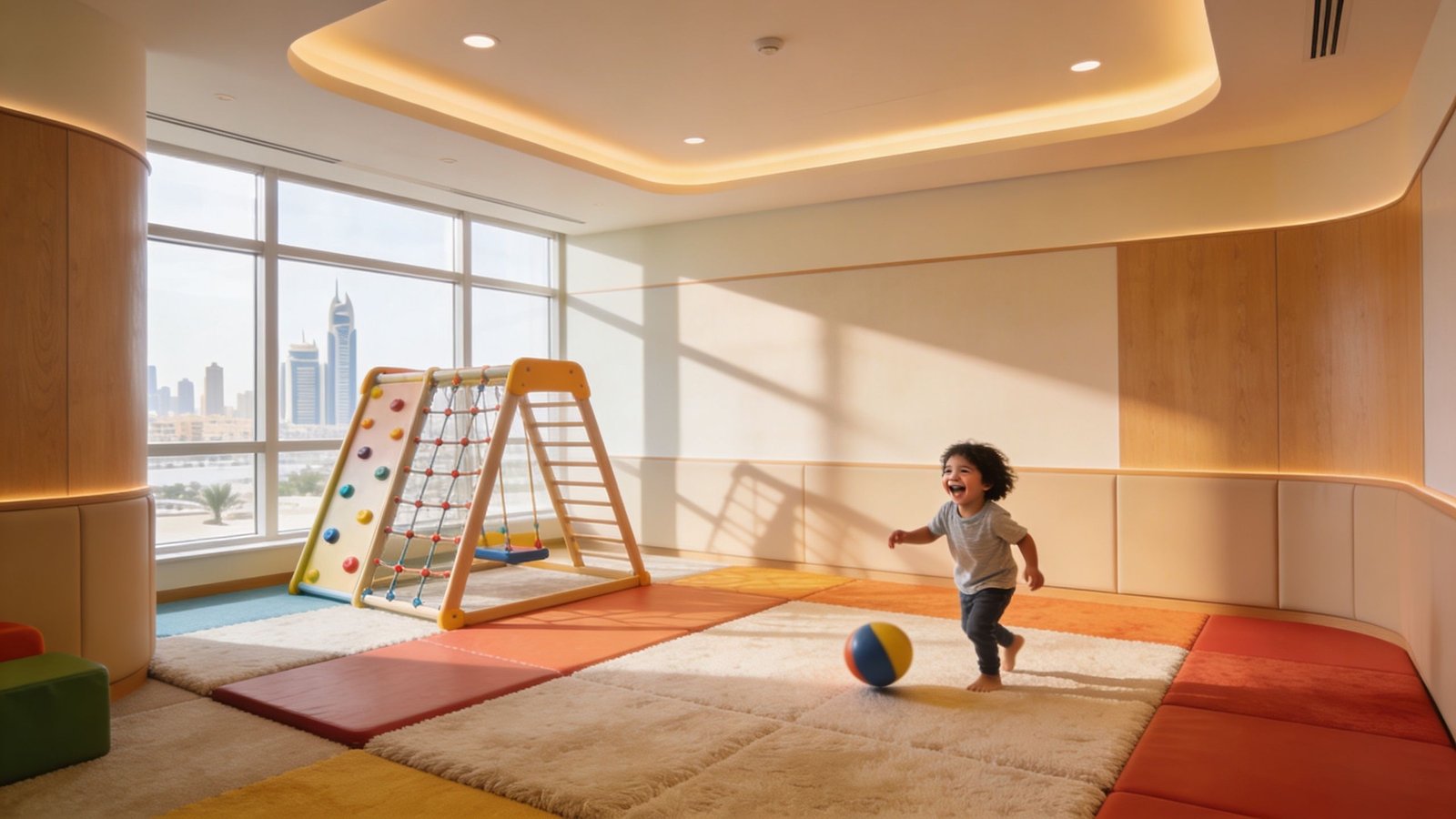
Leading facilities in Dubai often provide 45-minute paediatric physiotherapy sessions, with frequency decided after an individual assessment and with strong family partnership, according to Mediclinic City Hospital's paediatric physiotherapy guidance. That detail matters because enough time is needed to settle the child, work on key goals, and coach the parent without rushing.
What a session may look like
A typical session rarely starts with “do this exercise”. It usually starts with connection.
The therapist may first watch how your child enters the room, moves towards toys, gets down to the floor, and shifts between positions. Those small moments often reveal more than a formal test.
Then the session might move into a sequence like this:
Settling and regulation
Some children need movement to feel organised. A bounce on a therapy ball, deep-pressure game, or simple obstacle path can help them engage.Targeted play activities
Core work may become reaching for toys while kneeling. Balance practice may become crossing a “bridge” made from cushions. Weight shifting may happen while rescuing toy animals from different corners of the mat.Functional practice
The therapist works on a real-life skill such as floor-to-stand, stair climbing, jumping, or safer walking patterns.Parent coaching
Before the end, the therapist usually shows you what to repeat at home and how to fit it into routines like dressing, bath time, or play at the park.
Why play works so well
Children learn movement best when they're engaged. Play gives them a reason to repeat hard tasks without feeling drilled.
If your child is hesitant, the therapist adapts. If they love cars, the whole session may involve ramps, garages, and “parking” tasks. If they seek movement, swings and rolling games may become the route into balance and posture work. Ideas around nurturing creativity through adventurous play often align beautifully with this way of thinking because children persist longer when the activity feels meaningful.
A good session doesn't look random. It looks playful on the surface, but each game has a movement goal underneath.
Families who want to understand how sensory-rich activities can support participation may also find it useful to explore sensory play ideas in Dubai. Many children move better when they first feel calmer, more alert, or more organised.
The Georgetown Advantage A Fully Integrated Team
For children with developmental delays, physiotherapy works best when it doesn't sit alone.
A child doesn't use movement in isolation. They use it to communicate, play, learn, follow routines, regulate themselves, join peers, and manage the school day. That's why multidisciplinary care matters so much. If one therapist is working on standing balance, another may be using that same skill to support dressing, classroom readiness, turn-taking, or communication.

This is especially important in autism and developmental delay. Autism affects approximately 1 in 94 children in the UAE, and 70% have co-occurring motor delays. A 2025 study also found that only 25% of Dubai's early intervention centres offer full physio-ABA-OT integration, which can lead to 40% slower milestone achievement, according to Anatomy Rehabilitation's summary of the Dubai paediatric physiotherapy landscape.
What integrated care looks like in real life
Parents sometimes hear the phrase “multidisciplinary team” and imagine separate professionals writing separate notes. True integration is more active than that.
A coordinated team may work like this:
- The physiotherapist helps the child rise from the floor with more control.
- The occupational therapist uses that postural stability during table work, dressing practice, and sensory regulation tasks.
- The speech therapist builds communication opportunities while the child is in a better seated or standing position.
- The ABA or play-based behaviour therapist reinforces the movement goal inside structured routines, transitions, and motivation systems.
The child experiences one joined-up plan instead of four disconnected ones.
Why siloed therapy slows progress
When therapies are isolated, children often work harder for less carryover. A child may practise standing in one room, then collapse into poor posture during learning tasks in another because nobody aligned the strategies. Or a therapist may target a skill that looks good in session but doesn't transfer to home or nursery because daily supports weren't coordinated.
Integrated teams reduce that gap. They agree on priorities, use similar prompts, and build goals into the child's real environment. That matters for children who need repetition across contexts.
Family insight: Progress often becomes more visible when every adult around the child is reinforcing the same few priorities.
The benefit for parents
Parents also feel the difference.
Instead of repeating the same history to multiple professionals, you receive a more coherent picture. You understand which skill comes first, which one supports another, and how to use home practice without overwhelming your child.
A coordinated model also protects against mixed messages. If one therapist says “encourage independence” while another says “give more physical support”, the family can feel stuck. Team-based planning creates consistency. Consistency helps children learn.
For many children, especially those with autism, developmental delay, sensory needs, or mixed motor and communication challenges, this joined-up approach is not an extra. It's the structure that makes therapy more effective.
Proven Therapy Methods and Measuring Progress
Parents deserve to know not just that therapy is happening, but how it works and how progress is judged. Good paediatric physiotherapy combines clinical reasoning with very practical goals.
One of the best-known approaches in paediatric neurodevelopment is Neuro-Developmental Treatment, often shortened to NDT. In simple terms, NDT helps the therapist understand how a child's tone, posture, and movement patterns affect what they can do. The therapist then uses handling, positioning, and carefully chosen activities to guide more efficient movement.
What NDT looks like in practice
NDT isn't a child passively being moved around. It's a structured way of helping the child experience a better movement pattern so they can begin to use it themselves.
For example, if a child always pushes backwards when trying to sit, the therapist may adjust the child's base of support, guide weight shift forward, and create a play task that rewards reaching in the new position. The body learns through repetition, success, and gradually reduced support.
Evidence from UAE-based clinics shows that 12-week NDT programmes can improve Gross Motor Function Measure (GMFM-66) scores by 15-25% in children aged 4 to 8, with gains linked to sustained improvements in mobility and school readiness, as described in The Speech Clinic's NDT-related FAQ content.
Progress should be visible in daily life
Formal measures have value. They help therapists compare a child's abilities over time and identify whether intervention is working. But parents usually notice progress in ordinary moments first.
That may look like:
- Smoother floor transitions instead of struggling to get upright
- Better sitting posture during meals or tabletop activities
- More confidence on playground equipment
- Less fatigue during nursery or school routines
- Improved participation with siblings and peers
How therapists usually track change
A strong therapist won't rely on memory alone. Progress is often measured using a mix of observation and structured review.
Common methods include:
- Baseline assessment of posture, mobility, balance, and transitions
- Goal tracking based on functional outcomes that matter to the family
- Video comparison to show movement changes over time
- Parent feedback about home and school participation
- Review of carryover to see whether a skill appears outside the therapy room
Sometimes the most meaningful progress is not a new milestone. It's the child doing familiar tasks with less effort, less frustration, and more confidence.
Other proven approaches
Depending on the child's needs, therapists in Dubai may also use methods such as DNS, scoliosis-specific work, strengthening through play, balance training, mobility practice, and post-surgical rehabilitation principles. The exact method matters less than the match between the method and the child.
Parents don't need to memorise therapy terminology. What matters is that the therapist can explain why a technique is being used, what the child is working towards, and how success will be measured in a way you can recognize at home.
How to Choose the Right Paediatric Physiotherapy Center in Dubai
Choosing a clinic can feel overwhelming because many websites use the same reassuring language. The difference often becomes clearer when you ask practical questions.
One important area is whether the centre keeps up with modern methods. A 2026 survey noted that emerging methods such as VR therapy can boost motor gains 35% faster in some children compared with traditional methods, although success often depends on integration with OT and ABA support, as noted by High Hopes Dubai's discussion of current paediatric physiotherapy approaches. That doesn't mean every child needs VR. It means thoughtful centres stay open to tools that may help selected children.
Questions worth asking on your first call
Use the conversation to understand the clinic's thinking, not just its availability.
- How do you assess children? Ask what the first appointment looks like and whether parents are involved in goal setting.
- Do you work with a multidisciplinary team? If your child has developmental needs, this question matters as much as the physiotherapy itself.
- How do therapists communicate with one another? You want shared goals, not parallel tracks.
- What experience do your physiotherapists have with my child's profile? A toddler with torticollis needs different expertise from a school-age child with autism or cerebral palsy.
- How do you give home guidance? The best plans are realistic and fit daily routines.
- How do you measure progress? Look for concrete answers, not vague reassurance.
- Do you offer or understand modern options such as VR or aquatic approaches? Not as a gimmick, but as part of a thoughtful clinical toolbox.
What to look for during a visit
Trust your instincts, but look beyond décor.
A strong centre usually shows these signs:
The therapist speaks to your child and to you.
Respect for both matters.The goals sound functional.
“Climb stairs with more control” is more useful than broad promises.The plan feels individualised.
Your child shouldn't sound like a template.You leave understanding the next step.
Good therapy reduces confusion.
If you're exploring broader developmental support alongside movement, it can help to review what an early intervention centre in Dubai should offer so you can compare options with a clearer checklist.
Frequently Asked Questions From Parents
Is paediatric physiotherapy covered by insurance in Dubai
Sometimes, but it depends on your insurer, your policy, the diagnosis, and whether the provider is within your network. Ask the clinic for the exact service description used for billing, then ask your insurer whether pre-approval, a referral, or a medical report is needed.
What does treatment usually cost
Costs vary widely by provider, therapist experience, location, and whether the session is clinic-based or home-based. It's best to ask for a written breakdown of assessment fees, follow-up session fees, cancellation policies, and any charges for reports.
How long will my child need therapy
There isn't one standard timeline. Some children need a short block of support to build one missing skill. Others benefit from longer-term therapy because their condition affects development over time. The right question is not “How many sessions?” but “What goals are we working towards, and how will we know whether this plan is still the right one?”
What can I do at home while waiting to start
Keep it simple. Encourage floor play, reaching across the body, climbing over cushions, supported kneeling at a low surface, and outdoor play that involves pushing, carrying, and balancing. Avoid turning home into a drill session. Children learn better through repeated small opportunities than through pressure.
Should I wait and see
If a concern has stayed on your mind, it's reasonable to ask for an assessment. Getting an opinion doesn't commit you to long-term therapy. It gives you information.
Will therapy upset my child
A skilled paediatric therapist works through connection, play, pacing, and adaptation. Some children need time to warm up, and that's fine. Distress shouldn't be the main method.
What should I bring to the first appointment
Bring any relevant reports, your child's medical history, videos of movement concerns if you have them, and your own observations. Often the most useful information is what happens at home, in the nursery, or on the playground.
If you're looking for coordinated support rather than isolated appointments, the Georgetown early intervention center brings together an educational psychologist, occupational therapist, speech therapist, and play-based behaviour therapist so each child can have an individual plan built around their unique needs.