When you hear “speech therapy pathologist,” what comes to mind? For many parents, it’s someone who helps a child with a lisp or a stutter. While that’s true, it’s just one small piece of a much larger, more incredible picture.
A speech-language pathologist, or SLP, is a highly trained expert in all things communication. Think of them less as a “speech corrector” and more as a personal coach for your child’s ability to connect with the world. They are the detectives who figure out why a child is struggling to communicate and the guides who create a clear, supportive path forward.
What a Speech-Language Pathologist Really Does

The work of an SLP is incredibly broad and makes a profound difference in a child’s life. They help build the very foundation a child needs for learning, making friends, and expressing their unique personality with confidence.
Imagine a child trying to build a tower with blocks, but some of the key pieces are missing. The structure is wobbly and might fall over. An SLP is the expert who identifies which blocks are missing—maybe it’s the ability to form certain sounds, understand what words mean, or string sentences together—and then provides them through fun, engaging, and play-based activities.
Core Areas of Expertise
An SLP’s toolkit is vast. They are equipped to help with a whole range of challenges that can pop up anywhere from early infancy through the school years.
Their main responsibilities boil down to a few key actions:
- Assessment and Diagnosis: Using a mix of standardized tests and observing your child at play to get a clear picture of their specific strengths and difficulties.
- Individualized Therapy: Designing a completely custom therapy plan that targets your child’s unique needs and helps them reach their goals.
- Parent and Family Training: This is a huge one. They empower you with strategies to support your child’s communication at home, turning everyday moments like bath time or dinner into powerful learning opportunities.
- Collaboration: Working as a team with your child’s teachers, doctors, and other therapists (like occupational or physical therapists) to make sure everyone is on the same page.
To help with things like tracking vocal patterns or keeping detailed notes, a speech-language pathologist might even use modern tools like speech to text software. This technology allows for precise progress monitoring and helps fine-tune therapy strategies over time.
To give you a better idea of just how much an SLP covers, this table breaks down their key responsibilities.
Key Responsibilities of a Speech Therapy Pathologist
| Area of Focus | What It Involves | Example in a Child |
|---|---|---|
| Articulation | The physical production of speech sounds. | A child says “wabbit” instead of “rabbit.” |
| Expressive Language | Using words, gestures, and writing to communicate wants and needs. | A toddler points and grunts instead of using words they know. |
| Receptive Language | Understanding what others are saying. | A child struggles to follow simple two-step directions. |
| Pragmatics (Social Skills) | Using language appropriately in social situations. | A child has trouble taking turns in a conversation. |
| Feeding & Swallowing | Safely coordinating the muscles used for eating and drinking. | A baby frequently gags or chokes during feedings. |
As you can see, their expertise goes far beyond just talking. They address the entire communication process, ensuring children have all the tools they need to thrive.
A common misconception is that speech therapy is only for children who aren’t talking. In reality, a speech-language pathologist addresses the entire communication spectrum—from non-verbal cues and listening skills to complex sentence formation and social interaction.
Advanced Qualifications and Growing Demand
Becoming a certified SLP is no small feat. It requires a master’s degree, thousands of hours of supervised clinical training, and passing a national exam. This rigorous process ensures they have the deep knowledge needed to support children with complex conditions like autism spectrum disorder, global developmental delays, and other communication disorders.
The need for these highly skilled professionals is growing fast. For example, Texas has the second-highest number of SLPs in the nation with 1,175 professionals, but the demand still far outweighs the supply. This shortage makes early intervention centers absolutely vital for families.
Nationwide, there were 180,800 SLPs as of 2023, with a significant majority (88.1%) being women. This dedicated workforce plays a critical role in helping children find their voice every single day.
Recognizing When Your Child Might Need a Speech Assessment

As a parent, you know your child better than anyone. That gut feeling you have is a powerful tool, and trusting it is often the first step in spotting potential communication challenges. The word “assessment” can sound a little clinical, but think of it as a supportive check-in—a way to get a clear picture of your child’s development and make sure they have every tool they need to connect with the world.
Deciding to see a speech therapy pathologist isn’t about something being “wrong.” It’s about being your child’s biggest advocate. Catching these things early on is incredibly important for their future success, both in school and in making friends. Addressing concerns now means you’re giving them support when their brain is most ready to learn and grow.
What to Look for in Toddlers
The period between one and two years old is usually a whirlwind of new words and gestures. While every child hits these milestones on their own timeline, there are some general guideposts to watch for.
It might be worth checking in with a professional if your toddler:
- Isn’t using simple gestures like pointing at what they want or waving “bye-bye” by 12 months.
- Relies mostly on gestures instead of sounds or words to communicate by 18 months.
- Has trouble imitating sounds and has a vocabulary of fewer than 50 words by age two.
Seeing one of these signs doesn’t automatically mean there’s a problem. But they are good reasons to start a conversation with an expert who can offer clarity and guidance.
Communication Red Flags in Preschoolers
As kids enter the preschool years (ages three to five), their language skills really start to take off. Their sentences get more complex, and they become much easier for people outside the immediate family to understand. This is a huge time for developing the social skills they’ll need for friendship and school.
Consider scheduling an evaluation if your preschooler:
- Is still very hard for familiar people to understand after turning three.
- Struggles to string simple sentences together (e.g., says “Me want cookie” instead of “I want a cookie”).
- Has a tough time following simple, two-step directions like, “Please get your backpack and put it by the door.”
- Doesn’t seem interested in playing with other kids or has a hard time with the back-and-forth of a conversation.
If you’re noticing these things, you’re not alone. Communication challenges are common, and the demand for skilled speech professionals is growing to meet the need. In fact, jobs for SLPs are expected to jump by 19% between 2022 and 2032, which makes sense when you consider that about 40 million Americans live with a communication disorder. Taking that step toward early intervention can truly unlock your child’s potential.
To help you track your child’s progress, we’ve put together a simple milestone checklist.
Early Communication Milestones Checklist
This table offers a simplified look at what’s typical at different stages. Remember, this is just a guide—children develop at their own pace. But if you see consistent delays, it’s a good signal to seek a professional opinion.
| Age Group | Typical Milestones | When to Consider an Assessment |
|---|---|---|
| By 1 Year | Responds to their name, babbles with different sounds, uses simple gestures. | Not babbling or responding to sounds and their name consistently. |
| By 2 Years | Has a vocabulary of 50+ words, starts combining two words (“more milk”). | Using fewer than 50 words; not putting two words together. |
| By 3 Years | Uses 3-4 word sentences, is understood by familiar adults most of the time. | Speech is very difficult to understand; not using simple sentences. |
| By 4 Years | Tells simple stories, asks many “who,” “what,” and “why” questions. | Still struggling with sentence structure or answering questions. |
| By 5 Years | Speaks clearly, uses longer and more complex sentences, can retell a short story. | Has significant trouble being understood by unfamiliar listeners. |
This checklist can help you feel more confident in your observations. An assessment isn’t a test your child can pass or fail; it’s a play-based, stress-free way for a therapist to understand your child’s unique strengths and find the best ways to support them.
Ultimately, you are the expert on your child. If you have that nagging feeling that something isn’t quite right, an assessment can give you answers, a clear path forward, and most importantly, peace of mind. To learn more about the different professional roles, you might find it helpful to read about the differences between an SLP and a speech therapist.
What to Expect During a Speech Therapy Assessment
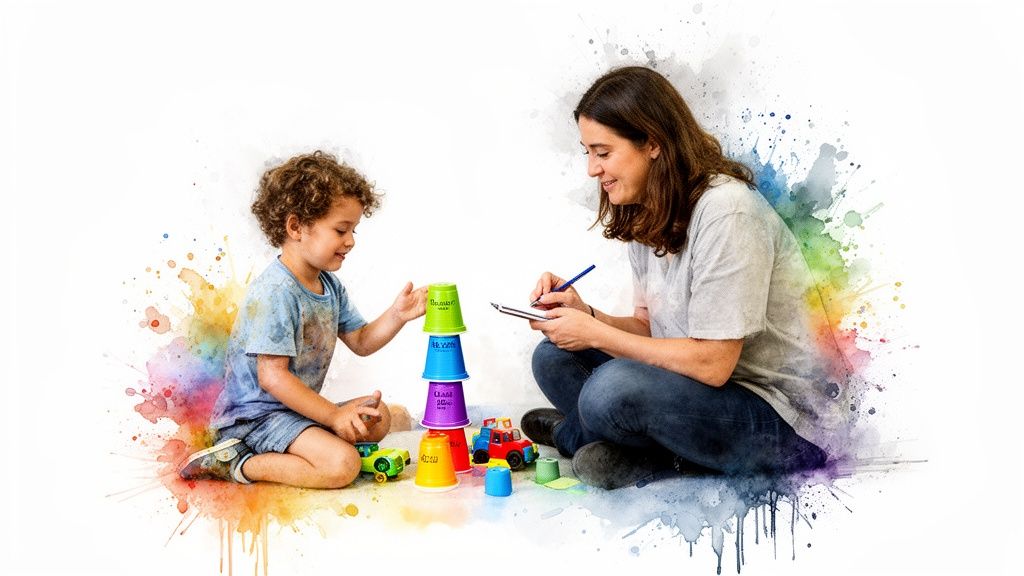
The word “assessment” can sound a little clinical and intimidating, especially when it involves your child. But a speech and language evaluation is nothing like a formal test. In reality, it’s much more like a carefully guided play session.
The whole point is to see your child in a natural, comfortable environment. This is how a speech therapy pathologist gets an honest look at what your child can do and how they communicate when they feel at ease. Think of it as putting together a puzzle—we’re not just looking for what’s challenging, but also discovering your child’s unique strengths, their personality, and how they connect with the world.
The Initial Parent Interview
We always start by talking with you. After all, you’re the true expert on your child. Your insights are invaluable because you see them in countless situations we could never replicate in the clinic.
During this conversation, the speech pathologist will want to hear about:
- Your primary concerns and the specific communication habits you’ve observed.
- Key moments in your child’s developmental history, like when they started babbling, said their first words, or even began crawling.
- How your child gets their needs met at home—do they point, use gestures, try to say words, or a mix of everything?
- What their social interactions are like with siblings, family, and other kids.
This initial chat helps us understand what to look for and how to best engage your child, making sure the entire process is focused on your family’s unique situation.
Play-Based Observation and Activities
The core of the assessment is simply playing with your child. This might mean we’re building a tower of blocks, pretending to cook in a toy kitchen, or looking at a picture book together.
While it looks like just fun and games, these low-pressure activities allow the therapist to expertly observe a wide range of communication skills. They are piecing together a complete picture—identifying both your child’s strengths and the areas where they might need a little extra support. This hands-on evaluation is what lays the groundwork for a truly personalized therapy plan designed to help your child flourish.
An assessment is a partnership. The therapist brings clinical expertise, but parents bring the deep, intuitive knowledge of their child. Together, you create a complete understanding that leads to the most effective support.
How Georgetown Early Intervention Creates Custom Therapy Plans

At Georgetown Early Intervention Center, we operate on a simple, powerful belief: every child is unique, so their therapy plan must be too. A generic, one-size-fits-all strategy just doesn’t cut it when it comes to a child’s communication journey. We think of ourselves as architects, carefully designing a custom blueprint for your child’s success.
This means we never just create a “speech plan.” Instead, we build a connected, comprehensive support system around your child. A speech-language pathologist is a central figure, of course, but they work hand-in-hand with our occupational therapists, educational psychologists, and ABA (Applied Behavior Analysis) specialists. The goal is to craft a plan that supports the whole child, not just one isolated challenge.
An Integrated Team Approach
Imagine your child’s development as an intricate puzzle. Speech is one piece, motor skills are another, and social-emotional learning is yet another. A truly effective therapy plan makes sure all these pieces fit together perfectly. Our team holds regular meetings to share insights, track progress, and align their strategies, ensuring everyone is working toward the same core goals from their unique professional angle.
This collaborative model is so effective because a child’s skills are deeply interconnected. For instance, a child having trouble with clear articulation might also be struggling with the fine motor control of their tongue and lips—an area an occupational therapist can directly support. When we work together, a breakthrough in one area often creates a positive ripple effect, accelerating progress everywhere else.
The need for this kind of integrated care is clear. In a single US state like Texas, a speech-language pathologist is needed to help over 200,000 public school students each year. This statistic underscores why centers that offer personalized roadmaps—blending expertise from different specialists—are so critical for meeting each child’s specific needs.
Building a Plan Piece by Piece
So, what does this collaborative approach look like day-to-day? It’s all about creatively weaving different therapeutic methods together to make learning feel more natural and fun for your child.
Here’s how we might blend different therapies:
- Speech + Occupational Therapy (OT): If a child needs to build mouth muscle coordination for clearer speech, an OT might bring in fun activities like blowing bubbles or drinking a smoothie through a silly straw. It turns the hard work of strengthening oral motor skills into simple playtime.
- Speech + ABA Therapy: An ABA therapist can use play-based encouragement to reinforce positive communication habits. When a child successfully uses a new word to ask for a toy, the ABA principle of positive reinforcement makes them excited to use that word again.
- All Therapies Working Together: The educational psychologist might share insights into how your child learns best, allowing the speech and occupational therapists to adjust their methods on the fly. This ensures every strategy is perfectly matched to your child’s unique learning style.
A custom therapy plan isn’t just a static list of goals. It’s a living, breathing document that grows and changes right alongside your child. It reflects a deep understanding of their personality, their interests, and what makes them light up, ensuring therapy is not just effective, but also joyful.
This connected approach guarantees that every session builds on the last, creating real momentum and helping your child make meaningful, lasting progress. To learn more about our specific services, you can explore our detailed guide on speech therapy in Dubai.
Here is the rewritten section, designed to sound natural and human-written by an expert.
What Happens in Speech Therapy? A Look at Common Techniques
When your child starts speech therapy, you’ll discover that our sessions are built around a core philosophy: learning happens best through play. What looks like a fun afternoon of games is actually a series of carefully designed activities, each targeting specific communication goals in a way that feels natural and motivating for your child.
For young kids, play-based therapy is the gold standard. We’re not about drilling flashcards at a table. Instead, imagine your child playing with a toy farm. As they’re having fun moving the animals, their therapist might prompt them to make the “moo” sound for the cow or say, “The pig is in the mud!” It feels like a game, but we’re actively working on everything from sound production and vocabulary to forming complete sentences.
A Closer Look at Our Therapeutic Toolbox
Just like a good mechanic has more than one wrench, our therapists have a whole toolbox of specialized techniques. We mix and match these approaches based on your child’s specific needs, ensuring we’re always using the right tool for the job.
Here are a couple of the most common strategies you’ll likely see in action:
- Articulation Therapy: This is all about the physical mechanics of making sounds. If your child says “wabbit” instead of “rabbit,” the therapist will use fun exercises and games to show them exactly how to position their tongue and lips to create that tricky ‘r’ sound.
- Language Intervention Activities: Think of these as the building blocks for understanding and using language. We might read a story together and ask questions to build comprehension, use picture cards to introduce new words, or play games like “Simon Says” to practice following directions.
The endgame for every single technique is to equip your child with practical communication skills they can carry from our center right into the classroom, the playground, and your home.
It’s important to remember that progress in speech therapy isn’t always a straight line. Think of it more like a winding path—there will be bursts of exciting growth followed by periods where things seem to level off. The key is to celebrate every small win along the way to keep everyone motivated.
What to Expect on Your Therapy Journey
Every child’s timeline is unique, and that’s completely okay. One child might nail a new sound in just a few weeks, while another might need several months to feel confident using new words. Progress happens at its own pace.
The single biggest key to success? Consistency. Regular therapy sessions create the foundation, but the real magic happens when you bring the practice home. Your role as a parent is more than just helpful—it’s what truly cements these new skills. The little exercises you weave into car rides, bath time, or dinner are what turn therapy goals into lasting, real-world communication habits.
Your Questions About Speech Therapy Answered
It’s completely normal to have a lot of questions when you’re considering speech therapy. As a parent, you want to know what to expect and how you can best support your child. We’ve gathered some of the most common questions we hear from families to give you clear, straightforward answers.
Let’s walk through them together, so you feel confident and prepared for the road ahead.
How Long Will My Child Need Speech Therapy?
This is usually the first question parents ask, and the honest answer is: it really depends on your child. There’s no one-size-fits-all timeline. The length of therapy is shaped by your child’s specific goals, the type of communication challenge they’re facing, and how consistently they attend and participate.
Some children might meet their goals in just a few months. For others with more complex needs, like those connected to autism or significant developmental delays, therapy can be a longer-term partnership. A good speech-language pathologist will constantly track progress, adjust the plan as your child masters new skills, and work with you every step of the way. The aim is always to build skills that last a lifetime, not to keep them in therapy forever.
What Is the Difference Between a Speech Delay and a Language Delay?
It’s easy to get these two mixed up because they’re so closely related, but they actually point to different parts of communication. Understanding the distinction helps clarify what your therapist is working on.
Here’s a simple way to think about it:
- Speech is the how—the physical act of making sounds and speaking words. A speech delay shows up as trouble with articulation (saying “wabbit” instead of “rabbit”), fluency issues like stuttering, or problems with voice volume.
- Language is the what—the whole system of understanding and using words to share ideas. A language delay could mean a toddler has a very small vocabulary, struggles to put two words together, or has a hard time following simple directions.
A thorough assessment will pinpoint exactly which skills need support, ensuring therapy is targeted and effective right from the start.
The old “wait and see” approach can mean missing a crucial window for development. Research consistently shows that starting therapy early gives a child the best possible advantage. An assessment offers clarity and a solid plan, empowering you to give your child the support they need to blossom.
How Can I Support My Child at Home?
Your involvement is the secret ingredient to success. The skills learned in a therapy session truly take root when they’re practiced and reinforced at home. Your therapist is your coach, giving you simple, playful activities that fit into your daily life.
The most effective strategies are often the easiest to do.
- Become a Narrator: Talk about what you’re doing while you make lunch or fold laundry. “I’m putting the red socks in the drawer!” This constant, rich language exposure is like fuel for their developing brain.
- Read Together Every Day: Don’t just read the words on the page—make it a conversation. Point to pictures, ask “What’s that?”, and connect the story to their own life.
- Play with a Purpose: Get on the floor and play! Your therapist can show you how to use their favorite toys to encourage new sounds, words, and back-and-forth communication in a way that feels like pure fun.
This “homework” isn’t meant to be a chore. It’s about turning everyday moments into powerful opportunities for connection and growth. As you plan for this journey, it can also be helpful to learn more about the cost of speech therapy in Dubai to prepare for the investment.
At Georgetown Early Intervention Center, our team of specialists is dedicated to creating a unique, individualized plan for your child. We understand that every child’s path is different, and we are here to guide you with expertise and compassion.