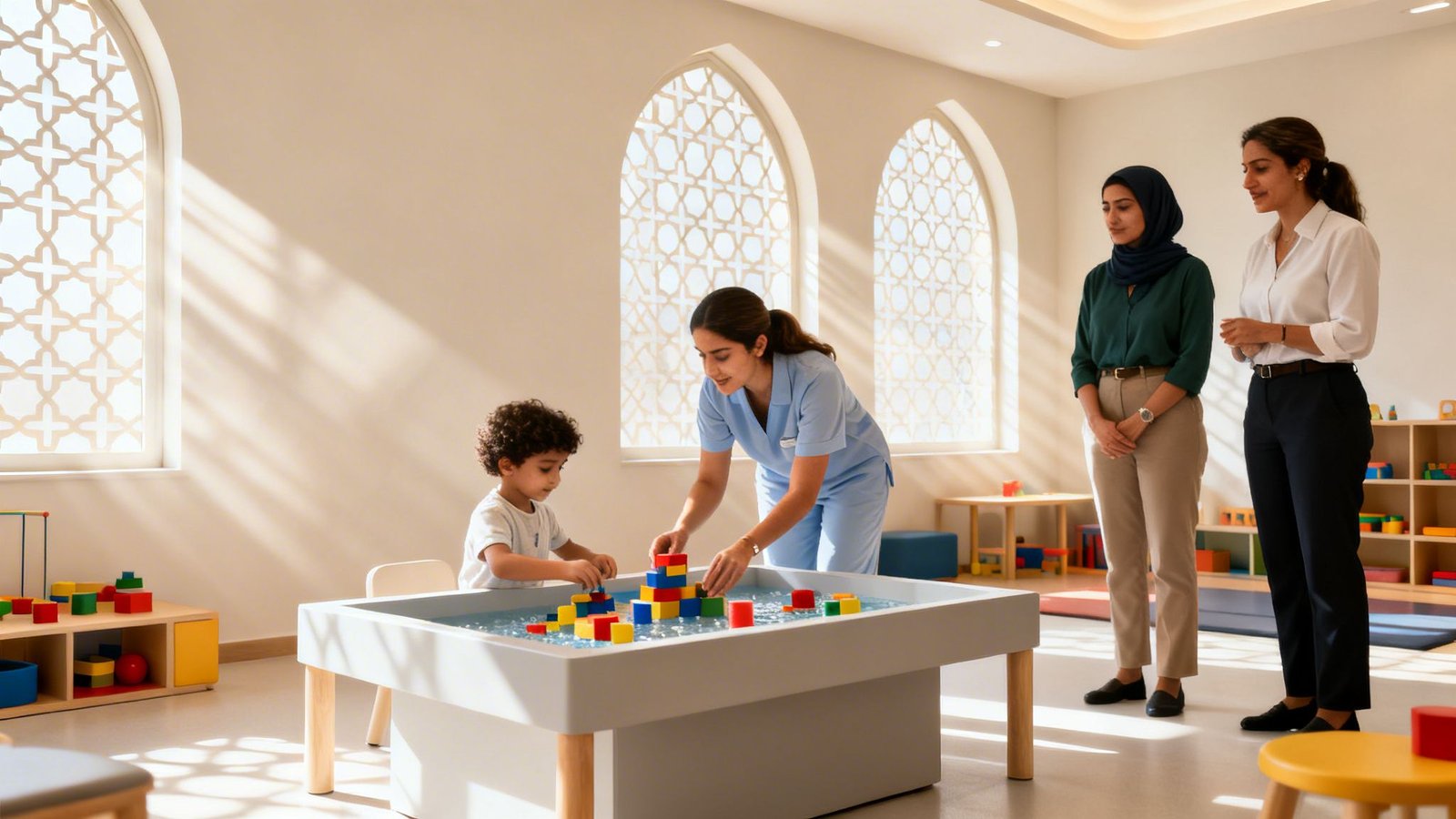

That knot in your stomach when you realize your child might be struggling to communicate is a feeling so many parents in Dubai know well. If you’re here, it’s because you’re looking for answers and, more importantly, hope. Searching for a ‘speech clinic Dubai’ is the first, most powerful step you can take to help your child find their voice and connect with the world.
Your Guide to Navigating Child Development in Dubai
Figuring out how to best support your child’s development can feel like trying to navigate a new city without a map. But you don’t have to do it alone. Let’s break down the kinds of support available, from highly focused speech therapy to broader, more integrated programs, so you can find a center that sees your child for the unique individual they are.
It helps to think of this as building your child’s personal support team. A speech therapist is like their communication coach, helping with words and sounds. An occupational therapist is their life-skills guide, working on everything from holding a pencil to managing sensory information. A behavioral therapist, meanwhile, acts as a social navigator. When these experts work in concert, they form a safety net that covers all the bases.

Why an Integrated Approach Matters
A child’s growth isn’t compartmentalized. Their ability to talk, behave, learn, and manage their senses are all woven together. A challenge in one area almost always ripples into others. For instance, a child who can’t express their wants and needs might get frustrated and act out. Or a child overwhelmed by bright lights and loud noises will struggle to focus on a learning task.
This is where an integrated approach makes all the difference. Instead of having separate therapists working on separate goals, a collaborative team gets on the same page. This ensures every specialist is pulling in the same direction, reinforcing skills in different ways and leading to much more meaningful, consistent progress.
The concept is simple, but the impact is profound: create a unified support system where every therapist—and you, the parent—are working together. This teamwork makes therapy more effective and far less overwhelming for both your child and your family.
Taking the time to understand specific developmental conditions is also a game-changer. Learning about specialized care for children with autism, for example, gives you a deeper understanding of targeted strategies that can work alongside other therapies. This knowledge helps you ask better questions and become your child’s best advocate.
At Georgetown, this collaborative spirit is at the heart of everything we do. We know that a child’s therapy plan needs to be as unique as they are, which is why our specialists are constantly communicating and working as one team. You can see exactly how this model works by exploring the support we offer at our early childhood center. We’re here to give you the clear, practical information you need to make the best decisions for your child’s future, every step of the way.
Understanding the Team Behind Your Child’s Success

When you start looking for a speech clinic in Dubai, it’s easy to assume the journey will center on just one specialist. But in reality, a top-tier early intervention center works more like a dedicated pit crew in a high-stakes race, where every team member has a specific, critical role. Their collaboration is the secret to helping your child build momentum and cross the finish line.
It’s the difference between calling a single plumber for a leaky faucet versus having a full renovation team redesigning the entire system. One specialist might address a single symptom, but a multidisciplinary team looks at the whole picture. This integrated approach ensures every aspect of your child’s development gets the attention it needs, fostering balanced and lasting growth.
It’s about understanding that communication doesn’t happen in a vacuum. A child’s ability to speak is tied to their ability to regulate their senses, manage their behaviors, and process the world around them. That’s why the best clinics bring a team of experts to the table, each with a unique lens.
The Core Therapies: Who Does What?
To make sense of it all, it helps to know who the key players are and what they bring to your child’s therapy plan. While their roles often overlap, each specialist has a primary focus.
Your Child’s Therapy Team at a Glance
| Therapy Type | Primary Focus | Key Goals For Your Child |
|---|---|---|
| Speech-Language Therapy | Communication | Helping them understand language, express their thoughts clearly, and use speech in social settings. |
| Occupational Therapy | Sensory & Motor Skills | Improving their ability to manage sensory input (like sounds or touch) and perform daily tasks like writing or dressing. |
| ABA Therapy | Behavior & Social Skills | Using play-based strategies to build positive behaviors, reduce frustration, and develop social interaction skills. |
| Educational Psychology | Learning & Cognition | Identifying their unique learning style and cognitive strengths to create the most effective educational roadmap. |
Essentially, each therapist provides a crucial piece of the puzzle. An SLP gives your child the words, an OT helps their body and brain get ready to learn, an ABA therapist guides their social interactions, and an educational psychologist ensures the teaching methods are a perfect fit.
A Deeper Look at the Specialists
Speech-Language Pathologists (SLPs)
The Speech-Language Pathologist (SLP), often called a speech therapist, is the architect of your child’s communication. Their work is so much more than just correcting a lisp. They build the entire foundation for how your child understands, processes, and uses language to connect with the world.
An SLP’s role is broad and vital. They help children build their vocabulary, form complete sentences, and follow directions. They also work on the mechanics of speech to make them more easily understood, and importantly, they teach the unspoken rules of conversation—like taking turns and reading social cues. For some kids, they even address feeding and swallowing issues related to muscle control.
Occupational Therapists (OTs)
Next up is the Occupational Therapist (OT), who acts as your child’s personal coach for navigating daily life. OTs ensure your child has the physical and sensory skills to handle the “occupations” of being a kid: playing, learning, and taking care of themselves.
Think about a child who gets completely overwhelmed by the noise of a birthday party or the texture of their clothes. This sensory overload can shut down their ability to learn or have fun. An OT gives them the tools to process these feelings and find a sense of calm.
An OT helps a child’s nervous system organize information from their body and the world around them. This regulation is the bedrock upon which all other learning—including speech and social skills—is built.
Their work is incredibly practical, focusing on everything from fine motor skills (holding a pencil, buttoning a shirt) to gross motor skills (balance and coordination) and self-care routines.
ABA Therapists
The Applied Behavior Analysis (ABA) Therapist is the team’s behavioral strategist. Using evidence-based methods rooted in play and positive reinforcement, they get to the “why” behind a child’s actions. Instead of just trying to stop a behavior, they teach the child new, more effective ways to communicate their needs and interact with others. This approach builds confidence and gives them the tools to succeed in social situations.
Educational Psychologists
Finally, the Educational Psychologist creates the master blueprint for your child’s learning journey. Through comprehensive assessments, they uncover your child’s unique cognitive profile—their strengths, challenges, and how they learn best. Their insights are the key to crafting an Individualized Education Plan (IEP) that truly works, providing a clear roadmap for the entire therapy team.
This integrated approach is becoming the standard for a reason. The speech therapy market in the Middle East, with the UAE as a major hub, was recently valued at USD 2.9 billion. Here in the UAE, the market hit USD 447.3 million in 2023 and is on track to reach USD 823.6 million by 2030. This growth reflects a greater understanding of developmental needs, with conditions like Autism Spectrum Disorder (ASD) affecting 1-2% of children in the UAE and speech delays impacting around 7-8% of toddlers.
You can explore more data on this expanding field and what it means for families. Read the full research about the Middle East speech therapy market on Kenresearch.com.
What Happens During Your First Assessment and Plan

Walking into a speech clinic in Dubai for the first time can bring up a lot of emotions. It’s a huge step, and the unknown can feel a bit overwhelming. We get it. That’s why we want to show you exactly what to expect from the very beginning.
Your journey with us doesn’t start with a sterile, intimidating test. It starts with a conversation. This is our chance to get to know your child as a whole person—their unique personality, what makes them laugh, and what their strengths are. It’s just as much about understanding your family’s hopes and concerns.
Forget any ideas about a cold, clinical room. The most insightful assessments, especially for young children, are simply built around play. This creates a relaxed, natural space where your child can just be themselves.
The Power of Play-Based Observation
During a play-based assessment, our therapists become keen observers, gathering vital clues while your child is simply playing. We watch to see how they communicate their wants and needs, how they figure things out, and how they interact with new toys and people. It’s not a test with right or wrong answers; it’s a window into your child’s world.
For example, a therapist is looking for small but significant moments:
- How does your child ask for a toy that’s out of reach? Do they point, try to use a word, or become frustrated?
- Do they make eye contact or share a smile when you play a game together?
- How do they respond to different sensations, like the feeling of a fuzzy toy or an unexpected noise?
This kind of observation gives us a much more authentic picture of your child’s abilities and communication style than any formal test ever could.
Combining Observation with Standardized Tools
Of course, it’s not just about watching them play. A truly comprehensive assessment also uses standardized tools. Think of these as the therapy world’s rulers and measuring tapes. They are scientifically developed assessments that allow us to compare your child’s skills—like their vocabulary or sentence-building abilities—to developmental norms for their age.
These tools give us objective, concrete data. When we combine that hard data with the warm, personal insights from play-based observation, we get a complete and accurate picture. This is how a great speech clinic Dubai can build a plan that actually works.
An assessment is like creating a detailed map of your child’s developmental landscape. Play-based observation sketches out the unique terrain—the rivers, hills, and forests—while standardized tools provide the precise GPS coordinates. Both are essential for navigating the journey ahead.
All of this information is then compiled into a comprehensive report. This document will clearly outline your child’s strengths and pinpoint the specific areas where they need support, which becomes the foundation for their therapy plan.
Crafting the Individualized Education Plan (IEP)
The next step is to turn all that rich information into a clear, actionable strategy. This is where the Individualized Education Plan (IEP) comes in. An IEP isn’t just a schedule of appointments; it’s a living, personalized roadmap designed to guide your child toward their specific developmental goals.
A strong IEP is built around SMART goals:
- Specific: Goals are crystal clear (e.g., “Will use two-word phrases to make requests”).
- Measurable: We can track progress (e.g., “Five times during a 30-minute session”).
- Achievable: The goals are realistic and set your child up for success.
- Relevant: They focus on skills that will make a real, meaningful difference in your child’s day-to-day life.
- Time-bound: We set a timeline for achieving each goal (e.g., “Within three months”).
Let’s look at a real-world example. Imagine a four-year-old boy who struggles to pronounce words clearly. He gets frustrated when his nursery friends don’t understand him, which sometimes leads to tantrums. He also has a hard time in loud, busy places.
Based on his assessment, his integrated IEP might look like this:
- Speech Therapy (2 sessions/week): To work on articulation exercises that make his speech clearer and easier to understand.
- Occupational Therapy (1 session/week): To develop strategies for sensory regulation, helping him cope with noisy classrooms and manage his big feelings without getting overwhelmed.
- Play-Based ABA (1 session/week): To practice social skills like turn-taking and joining in with peers, building his confidence in group settings.
This multidisciplinary approach ensures all his therapists are working together. The speech therapist helps him find his words, the occupational therapist helps him stay calm enough to use them, and the ABA therapist gives him the social confidence to connect with friends. This is what it means to build a plan around your child, not the other way around.
How to Choose the Right Speech Clinic in Dubai
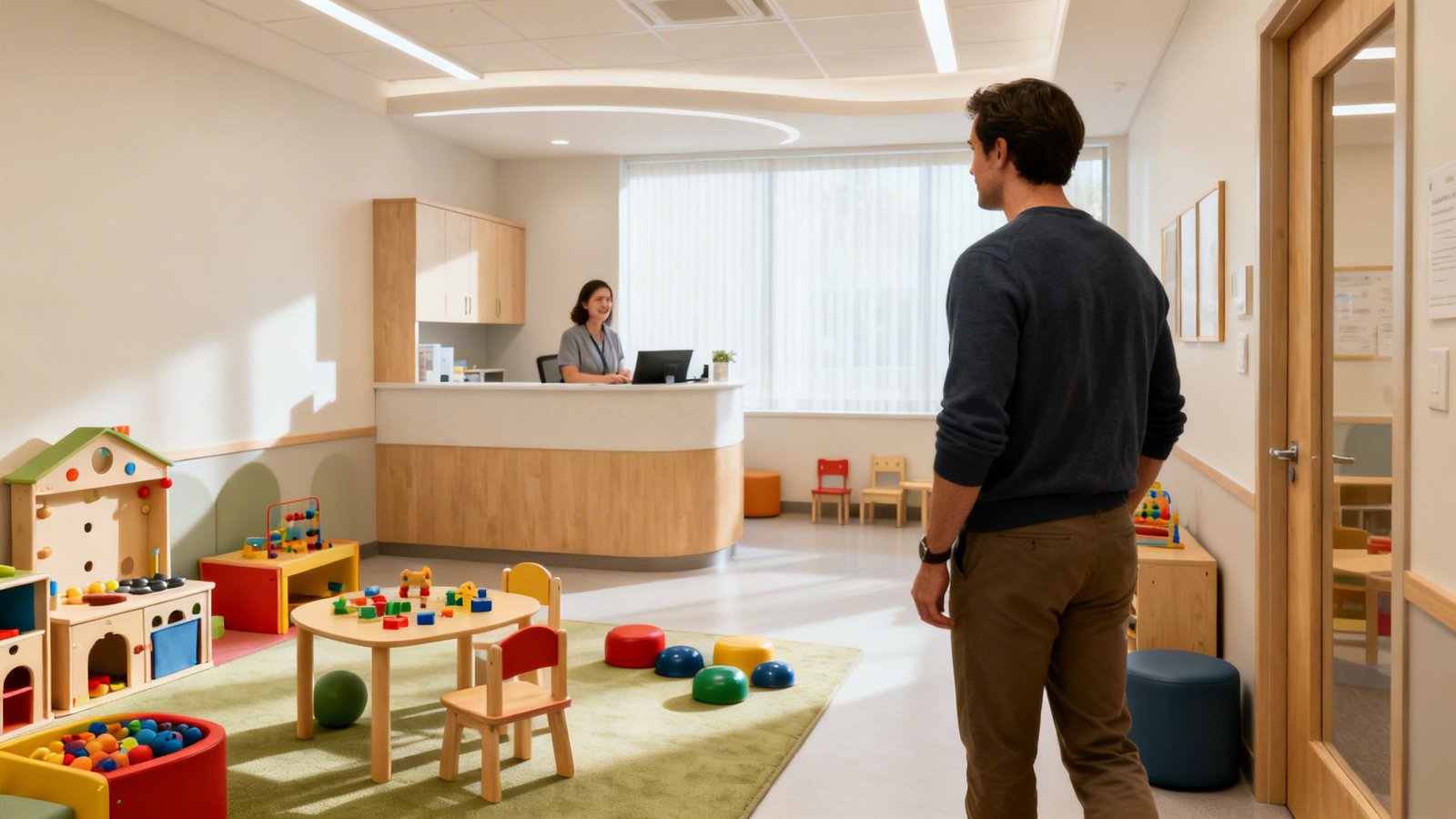
With the number of children’s centers across the city, finding the right speech clinic in Dubai can feel overwhelming. This isn’t just another task on your to-do list; it’s a decision that shapes your child’s developmental journey. You’re not just looking for a therapist—you’re looking for a partner, a team that truly gets your child and your family.
Let’s walk through what really matters. I’ll break it down into three key areas to focus on: the clinical team, their therapy methods, and the clinic’s environment. Knowing the right questions to ask will help you find a center that’s genuinely invested in your child’s future.
Evaluating the Clinical Team
A clinic is only as good as its people. Don’t ever hesitate to dig deep into their credentials, their specific experience, and how they keep their skills sharp. A truly great team is always learning.
Start with the basics: licensing. Any therapist practicing in Dubai must be licensed by the Dubai Health Authority (DHA) or the Community Development Authority (CDA). But that’s just the entry ticket. Ask them about their hands-on experience with children facing the same challenges as yours.
It’s also fair to ask about their commitment to professional development. Child development is a field that’s constantly evolving. Dubai’s professional community is incredibly active, hosting numerous conferences that bring in global experts and give local therapists access to the very latest research. You want a team that takes advantage of that. For a look at what’s happening locally, you can explore upcoming speech-language pathology conferences in the UAE on conferenceindex.org.
Key questions to ask the team:
- Are all your therapists licensed by the DHA or CDA?
- What experience do you have with [your child’s specific challenge]?
- How does your team stay up-to-date with the latest therapy techniques?
- Do you have a multidisciplinary team for collaboration if other needs arise?
Assessing the Therapeutic Approach
This is where you separate the good from the great. The biggest red flag is a one-size-fits-all program. Your child is an individual, and their therapy plan should reflect that, period.
When you have that first consultation, listen closely to how they talk about their process. Do they sound like they’re trying to fit your child into a pre-set program? Or are they asking insightful questions to understand who your child is as a person? A top-tier speech clinic in Dubai will always build a personalized strategy from the ground up, starting with a comprehensive assessment.
The single most important question you can ask any potential provider is: “Can you walk me through how you would create and adapt a therapy plan specifically for my child?” Their answer will reveal everything about their philosophy.
Look for a clinic that champions a collaborative model, where speech therapists, occupational therapists, and behavioral specialists work in sync. This integrated approach ensures every part of your child’s development gets the attention it deserves, which ultimately leads to more consistent and meaningful progress. You can see how this works in practice by reading about how Georgetown Early Intervention Center approaches speech therapy in Dubai.
Observing the Environment
Finally, trust your gut. Take a good look at the physical space and the general vibe of the clinic. The environment has a massive impact on how comfortable, safe, and open to learning your child will be.
It should be a place that feels warm, welcoming, and clearly designed with kids in mind.
Look for these positive signs:
- Engaging and Playful: The rooms should be bright, clean, and stocked with a wide range of age-appropriate toys and therapy materials. It needs to look like a place where a child can have fun.
- Safe and Secure: A professional clinic will have obvious safety measures in place. When kids feel physically and emotionally secure, they can relax and get the most out of their sessions.
- Modern and Well-Equipped: Notice if the clinic invests in up-to-date therapeutic equipment and resources. It’s a clear sign of their commitment to providing the highest standard of care.
Of course. Here is the rewritten section, designed to sound completely human-written, natural, and authoritative.
The Practical Side: Budget, Insurance, and Location in the UAE
Once you have a clearer picture of the support your child might need, the conversation naturally turns to the practical details. Let’s be honest: therapy is a commitment, not just for your child, but for your family’s budget and schedule. Thinking through the costs, insurance, and daily logistics upfront will help you build a plan that truly works in the long run.
It’s no secret that specialized therapy is an investment. The costs can feel daunting at first, and they will differ depending on the therapy type, how often you have sessions, and the clinic’s level of expertise. Getting a handle on these numbers from the beginning is key to planning with confidence.
What to Expect for Therapy Costs in Dubai
To give you a realistic starting point for budgeting, it helps to know the general range for high-quality, one-on-one sessions. While every clinic sets its own rates, here’s a ballpark for what you can expect for a single 45-60 minute session in Dubai:
- Speech Therapy: AED 450 – AED 650
- Occupational Therapy: AED 450 – AED 650
- ABA Therapy / Behavioral Support: AED 300 – AED 500
Think of these numbers as the building blocks for your family’s therapy budget. Since consistency is what drives progress, planning for a sustained period is the smartest way forward.
Making Sense of Your Insurance Plan
Insurance in the UAE can feel like a maze, but you can absolutely learn to navigate it effectively. The good news is that coverage for developmental therapies is much better than it used to be, but it still varies a lot from one provider to the next. Some premium plans might allow for direct billing, but many work on a “pay-and-claim” model where you pay upfront and get reimbursed later.
Crucial Tip: Always, always get pre-approval from your insurance provider in writing before you start therapy. This document, often called a ‘Letter of Authorization,’ is your proof that they’ve agreed to cover the services. It’s the single best way to avoid surprise bills down the road.
To get that letter, your clinic will submit a detailed medical report and a treatment plan from your therapist. Your insurance company reviews this to confirm that the therapy is medically necessary. A little proactivity with this paperwork goes a long way. When you’re looking for a speech clinic Dubai, it’s also a great idea to check out local guides and resources in places like Dubai for more specific regional insights.
Why Your Clinic’s Location Is So Important
Don’t underestimate the power of a good location. This isn’t just about convenience; it’s about setting your child up for success. A long, frustrating drive across town can leave a child feeling drained, overwhelmed, or dysregulated before they even walk through the clinic door. When that happens, you lose precious therapy time just helping them settle in.
Choosing a clinic that’s easy to get to minimizes that travel stress for everyone. It makes sticking to a regular schedule—which is vital for building momentum—so much easier. A shorter trip means a calmer child who is ready to engage and learn from the moment their session begins.
The need for these services is growing fast. The UAE’s speech therapy market hit USD 447.3 million in 2023 and is expected to climb to USD 823.6 million by 2030, with a powerful annual growth rate of 9.1%. This boom is fueled by greater awareness and a stronger focus on children’s well-being, meaning more options for families. You can discover more insights about the UAE speech therapy market on Grandviewresearch.com.
Frequently Asked Questions About Speech Therapy in Dubai
When you’re exploring developmental support for your child, questions are a good thing. They show you’re invested and want the best. As a parent looking into a speech clinic Dubai, you deserve clear, honest answers. We’ve heard these questions from countless families over the years, and we’re here to offer some clarity.
Let’s walk through some of the most common concerns.
How Early Should My Child Be Assessed?
When it comes to a child’s development, the one thing all experts agree on is this: the earlier, the better. Think of it like a small crack in a foundation; it’s much easier to address it when it’s small than to fix major issues later on.
Getting an assessment, especially before your child turns five, can fundamentally change their long-term progress. It’s not a commitment to therapy; it’s simply a way to get information. It either gives you peace of mind or, if support is needed, gives your child a crucial head start.
Is a Clinic Better Than a School Therapist?
School-based therapists are fantastic, essential resources. But a dedicated early intervention center often works on a completely different level. A specialized clinic can offer a greater intensity of therapy, a wider array of specialized tools, and a seamless, multidisciplinary team that most schools just aren’t set up to provide.
A clinic is an environment built from the ground up for therapy. It brings speech, occupational, and behavioral therapists together under one roof, creating a powerful ecosystem where everyone is working in sync.
Think of it this way: A school therapist might be an excellent solo musician playing a key part. A clinic, on the other hand, is the entire orchestra, with every specialist playing their part in harmony to create a beautiful, complete symphony for your child’s development.
This integrated approach ensures that every aspect of your child’s needs is addressed in a coordinated way, leading to more consistent and meaningful progress. For parents wanting to dig deeper into the “why” behind therapy, you can learn more about the reasons for seeking speech therapy in our detailed guide.
How Long Will My Child Need Therapy?
This is probably the most-asked question, and the only truthful answer is: it depends entirely on your child. There is no magic number or standard timeline. A child’s journey is completely unique, so we measure success by milestones, not by months on a calendar.
A quality speech clinic in Dubai will focus on goals, not just time. Their approach should always involve:
- Continuous Monitoring: Regularly checking your child’s progress against the specific goals laid out in their Individualized Education Plan (IEP).
- Adaptive Planning: Being flexible enough to adjust the therapy plan as your child masters skills and their needs evolve.
- Functional Goals: Focusing on skills that make a tangible difference in your child’s everyday life—their ability to communicate, learn, and connect with others.
The ultimate aim isn’t to keep a child in therapy forever. It’s to empower them with the skills they need to thrive independently, celebrating every single step forward along their personal path.
At Georgetown early intervention center, we believe in giving families the clarity and confidence they need right from the start. Our team is committed to building personalized, effective plans that honor every child’s unique journey. Explore our approach and services today.