
If you’ve heard the term SLP speech language therapy but aren’t quite sure what it means, you’re in the right place. Think of a Speech-Language Pathologist (SLP) as a personal coach for your child’s communication skills. They’re highly trained experts dedicated to helping children build the confidence and abilities needed to express their thoughts and understand the world.
Understanding the World of SLP Speech Language Therapy
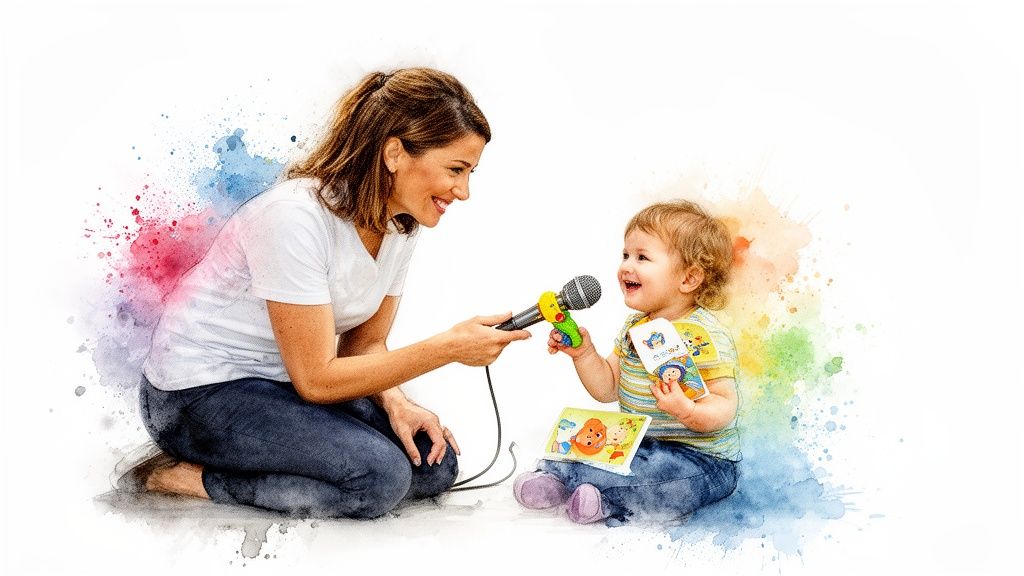
Navigating your child’s development can be a journey full of questions. Getting a handle on what SLPs do is a fantastic first step. At its core, communication involves two key parts: speech and language. An SLP is an expert in helping your child master both.
Speech is the physical side of talking. It’s all about how we move our lips, tongue, and vocal cords to make sounds. When speech is clear, others can understand the words we’re saying.
Language is the mental part. It’s the entire system of understanding what words mean, knowing how to string them together to make a sentence, and using them to share ideas, ask for things, or just have a chat.
Distinguishing Between Speech and Language
It’s easy to mix these two up, but they are quite different. Let’s use a simple analogy: think of language as all the words (the vocabulary) you know, and speech as how clearly you can say those words out loud. A child might have a huge vocabulary but struggle to physically form the sounds, making their words hard to understand. That’s a speech issue.
On the other hand, a child might be able to make sounds perfectly clearly but have trouble finding the right words or putting them in the correct order to make a sentence. That’s a language issue.
An SLP’s job is to figure out where the breakdown is happening and create a plan to build skills in that specific area. For a closer look, you might be interested in our guide on child speech therapy.
A Speech-Language Pathologist (SLP) is a communication expert who helps children connect their thoughts to their voice, turning ideas into clear, confident expression.
To quickly see the difference, this simple table breaks down what speech and language challenges might look like.
Speech vs Language At a Glance
| Area of Concern | What It Looks Like (Examples) | Related to SLP Focus |
|---|---|---|
| Speech | – Saying “wabbit” instead of “rabbit” – Stuttering on words – Having a very quiet or hoarse voice | Articulation, Fluency, Voice |
| Language | – Using only one or two words at a time – Trouble following directions – Difficulty answering questions | Vocabulary, Grammar, Social Communication |
Seeing these laid out can often help parents pinpoint what they’re observing at home.
Why Early Support Is So Important
Jumping on communication challenges early on is one of the best things you can do for your child. It builds a solid foundation for their future learning, friendships, and overall confidence.
These concerns are more common than you might think. About 40 million Americans have some kind of communication disorder. When we look at young children, around 8-9% experience speech sound disorders, and by the time they reach first grade, 5% have noticeable speech challenges. You can find more details in these speech therapy statistics and findings.
An SLP doesn’t just work with your child; they partner with your whole family, providing strategies that turn everyday moments into opportunities for growth. It’s a journey that can feel incredibly empowering.
Recognizing Early Signs of a Communication Delay
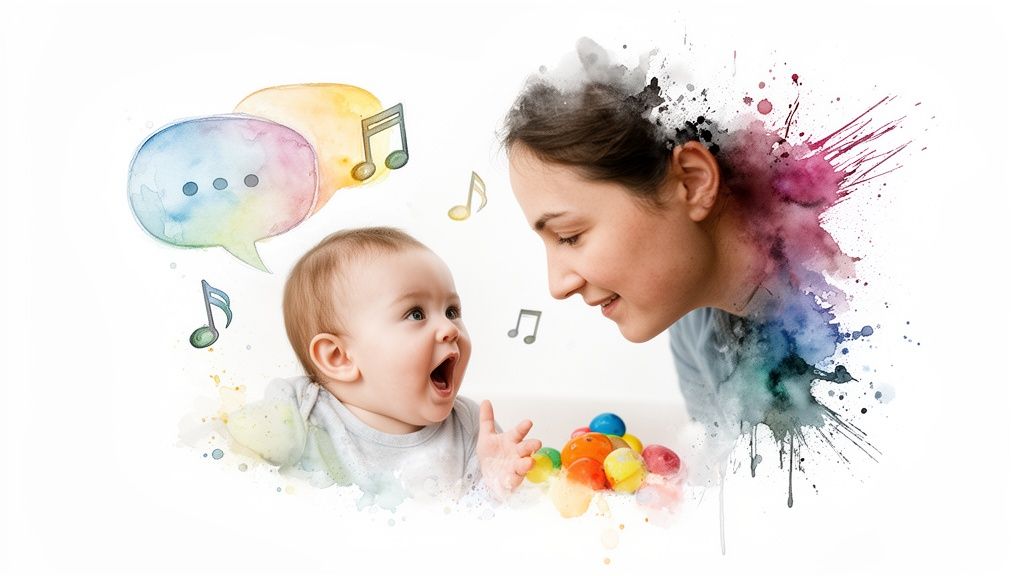
As a parent, you have a powerful tool that no one else does: your intuition. You know your child better than anyone, and that quiet feeling that something might be “off” with their communication is always worth listening to. Spotting the early signs of a speech or language delay isn’t about ticking boxes on a checklist; it’s about observing the beautiful, gradual way your child learns to connect with the world.
Every child hits their milestones on a unique timeline, but there are general patterns we expect to see. This guide is here to walk you through what communication looks like from the earliest days to the preschool years, so you can feel confident in knowing when a little extra support might be needed.
From First Coos to First Words
The journey of slp speech language development starts long before a baby says “mama” or “dada.” In that first year, communication is a rich tapestry of sounds, gestures, and expressions. A baby’s coos, squeals, and babbles are the essential building blocks for everything that comes next.
By around 6 months, most infants are babbling with repeated sounds like “bababa.” This isn’t just cute—it’s a critical workout for the muscles they’ll need for talking. As they get closer to their first birthday, these babbles start to sound more conversational, with different tones and rhythms.
Around the one-year mark, those first real words often start to emerge. If your baby is mostly quiet and isn’t babbling with a variety of sounds yet, it’s a good time to pay closer attention. A lack of pointing or using other gestures to show you what they want can also be an early sign.
Toddler Talk Milestones and What to Watch For
The toddler years are a language explosion! This is when you’ll see your child’s vocabulary leap from just a handful of words to simple sentences. It’s a truly fascinating time.
While every child is different, here are some general milestones that can act as helpful guideposts:
By 18 Months: Many toddlers are using at least 10-20 words, including names and simple verbs. They can also follow simple directions like “Get your shoes” and can point to a few body parts when you ask.
By 2 Years: A two-year-old’s word bank often grows to 50 words or more. This is also when they start putting two words together into little phrases like “more milk” or “my ball”—a huge step forward.
By 3 Years: At this age, many children are using three-word sentences and asking “what” and “where” questions. People who know them well can typically understand them about 75% of the time.
If you’re noticing your child isn’t hitting these milestones over a few months, it might be a signal to look into it. For instance, if your two-year-old isn’t combining words or gets frustrated when trying to communicate, a professional can offer some clarity.
Your observations as a parent are invaluable. Noticing that your child consistently struggles to be understood or has a very limited vocabulary for their age are valid reasons to seek guidance.
Trusting Your Instincts and Taking Action
It’s so important to remember that missing one milestone is rarely a cause for alarm. Development isn’t a straight line; it has spurts and pauses. What a speech-language pathologist looks for is a consistent pattern of delay over time.
If your gut is telling you that your child is struggling more than their friends, trust that feeling. Reaching out early doesn’t mean you’re overreacting—it means you’re giving your child the best possible head start on building strong communication skills. Being proactive is always the right move.
You can also weave fun, simple language development activities for toddlers into your daily routine. Playful interactions at home can make a huge difference in a child’s progress and confidence. The goal is to create a warm, supportive environment where communication can truly blossom.
What to Expect During a Speech and Language Assessment
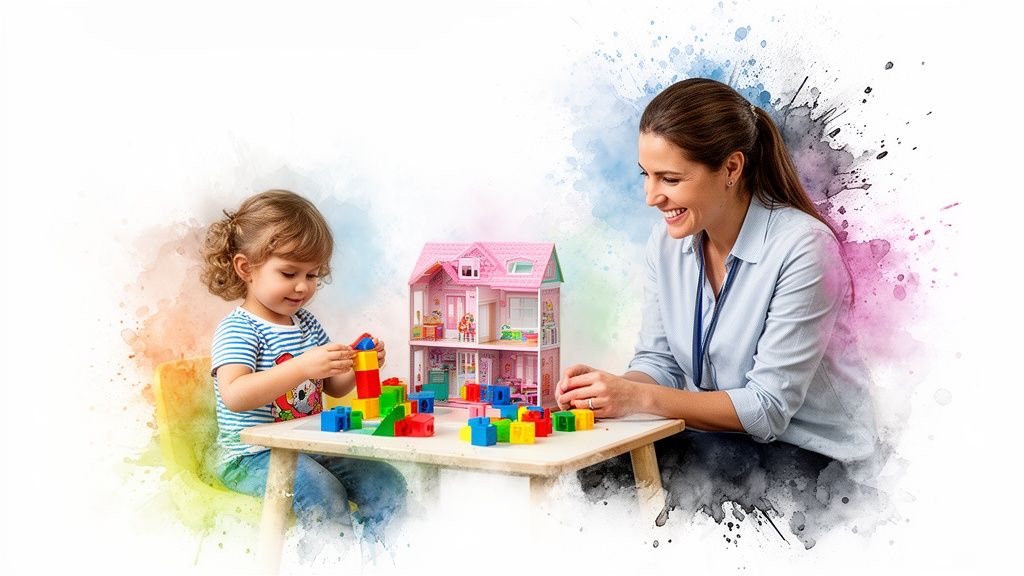
The word “assessment” can sound a little scary, especially when it involves your child. But a speech and language evaluation isn’t like a test at all. It’s much more like a carefully guided playdate.
A Speech-Language Pathologist (SLP) is trained to get to know your child’s unique communication style in a warm, natural, and low-pressure environment. The goal isn’t to find faults; it’s to discover their strengths and figure out where a little extra support might help. The whole process is designed to feel like fun, not work, so your child feels comfortable enough to show their true abilities.
The Power of Play-Based Observation
A great SLP is, at their core, an expert observer. They use toys, games, and fun activities to see how your child communicates in a setting that feels real and engaging. This play-based approach gives them far more insight than just asking a child to perform a list of tasks.
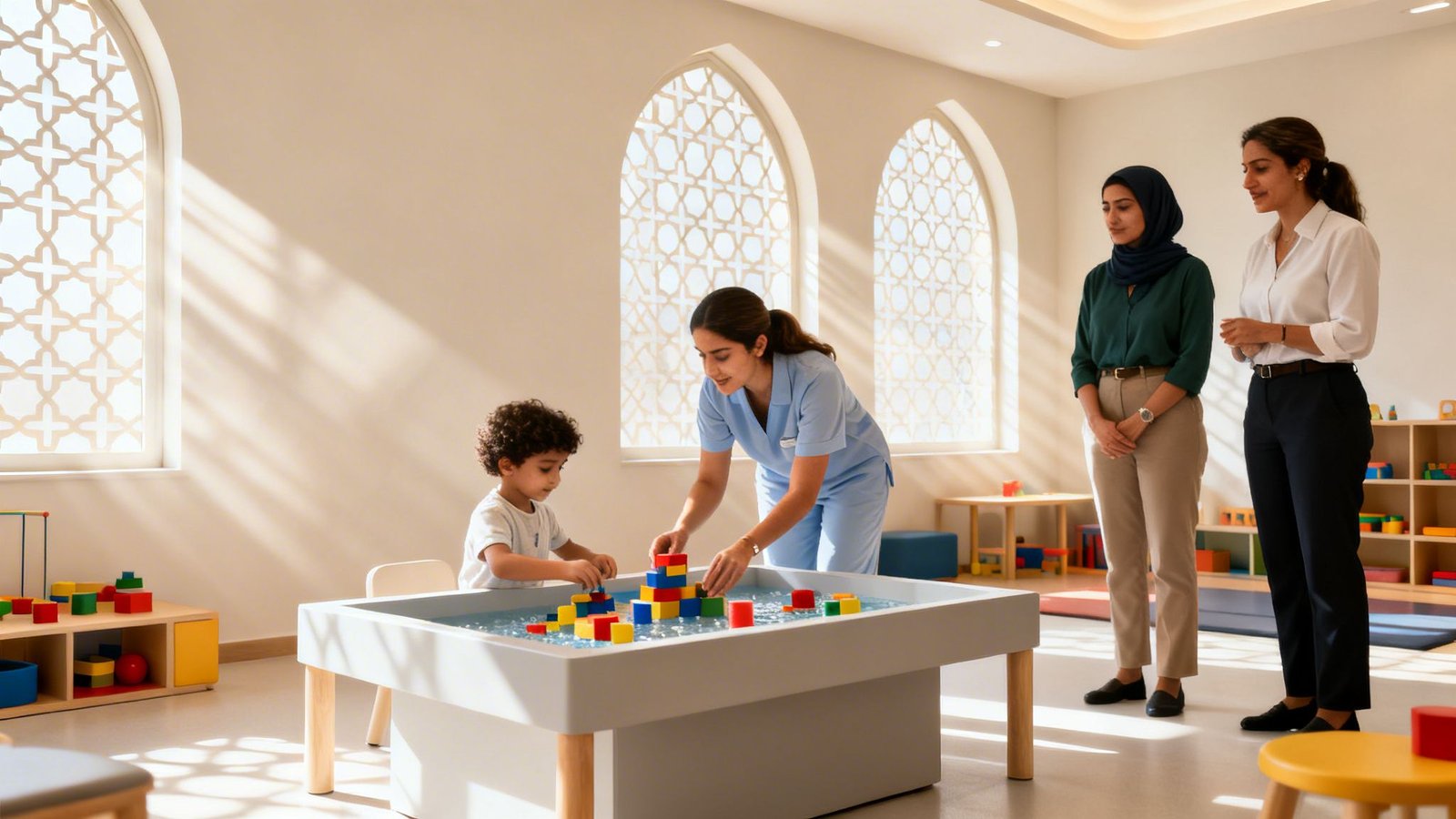
Think about it this way: while building with blocks, the therapist isn’t just watching them stack. They’re observing things like:
- Vocabulary: Does your child use words like “up,” “more,” or “big”?
- Sentence Structure: Are they starting to put words together, like “block fall down”?
- Following Directions: Can they follow a simple instruction, such as “Can you give me the blue block?”
- Social Interaction: How do they use eye contact, gestures, and turn-taking while you play together?
This method lets the SLP gather tons of information without your child ever feeling like they’re being tested. The focus is always on connection and understanding.
What the SLP is Looking For
During the assessment, the slp speech language professional is piecing together a complete picture of your child’s communication skills. They’re looking at both what your child can do and what they find tricky.
Key areas of focus usually include:
- Receptive Language: How well your child understands what’s said to them. This is often checked through simple requests and questions during an activity.
- Expressive Language: How your child uses words, gestures, and sounds to express their own wants and needs.
- Articulation: The clarity of their speech. The SLP listens for specific sound patterns, like saying “wabbit” instead of “rabbit.”
- Play Skills: How your child engages with toys and other people, since play is a powerful window into their cognitive and social development.
The demand for these skills is growing. The speech-language pathology industry is expanding to meet this need, with revenue expected to hit $6.9 billion in 2025. This growth is largely driven by a greater awareness of common challenges like speech sound disorders, which make up over 60% of cases and can impact a child’s daily interactions. You can find more details about the growth of the speech pathology field on IBISWorld.
The assessment isn’t just about identifying challenges; it’s about discovering how your child learns best. This information is the foundation for creating a therapy plan that is effective, motivating, and tailored specifically to them.
Your Role as a Parent Partner
Your insights are one of the most vital parts of the entire assessment. You are the true expert on your child. The SLP will want to hear all about their developmental history, daily routines, and what you’ve been seeing at home.
This collaborative conversation ensures the therapist gets a full view of your child’s skills across different situations. After observing your child and talking with you, the SLP will share what they found, explaining everything in clear, easy-to-understand terms. This is the first step in building a powerful partnership to support your child’s communication journey. To learn more about this partnership, check out the role of a speech therapy pathologist in our detailed guide.
Exploring Different Speech Therapy Approaches
Once we have a clear picture of a child’s unique communication profile, the real work—and fun—begins. It’s time to craft a therapy plan that feels less like a lesson and more like play. Modern slp speech language therapy isn’t about running through a generic, one-size-fits-all program. It’s a highly creative and dynamic process where a therapist carefully selects the right tools and strategies to fit a child’s specific needs, personality, and the way they learn best.
The whole idea is to build an environment where communication can just naturally blossom. This means we’ve moved far away from rigid drills. Instead, we embrace methods that are genuinely engaging, motivating, and meaningful for the child. Our goal is always to build skills they can actually use in the real world—at the playground, at the dinner table, with their friends—not just inside the four walls of a therapy room.
The Power of Play-Based Therapy
For young kids, there’s no more powerful learning tool than play. Play-based therapy taps into this by weaving communication goals right into fun, interactive activities. A dollhouse, for example, is so much more than a toy. It becomes a stage for practicing sentences (“The baby is sleeping”), following directions (“Put the doll on the chair”), and learning the back-and-forth rhythm of a conversation.
This child-led approach is fantastic because it allows the therapist to follow the child’s lead, keeping them completely absorbed and invested in what they’re doing. The SLP then skillfully guides the play to create natural opportunities for targeting specific goals, which makes the learning feel almost effortless.
Here’s what a session might actually look like:
- Building with Blocks: A therapist might model words like “up,” “more,” and “fall down,” encouraging the child to use them to ask for more blocks or narrate the action.
- Playing with a Toy Farm: This is a perfect setup for practicing animal sounds (articulation), naming animals (vocabulary), and answering simple “who” and “what” questions.
- Having a Tea Party: A simple pretend tea party is a goldmine for targeting social skills, like asking politely (“May I have a cookie, please?”) and keeping a conversation going.
Structured Approaches and Positive Reinforcement
While play is king, some children also thrive when more structured techniques are mixed in. These methods are designed to build skills in a systematic way, using clear steps and plenty of positive reinforcement. And no, this doesn’t mean sitting at a desk with flashcards. It’s all about creating fun, predictable routines that set the child up for success.
For instance, a therapist might use a picture-based system to help a child build a sentence. They could provide visual cues for “I want” followed by choices of desired items. When the child points to the pictures to form “I want juice,” they are immediately rewarded with the juice. This powerfully reinforces the connection between their communication attempt and getting what they want.
A core principle in modern therapy is that every single interaction is a chance to learn. By making activities successful and rewarding, an SLP builds a child’s confidence, which in turn motivates them to try new and more complex communication skills.
This positive feedback loop is absolutely essential for making progress. Great speech therapy often incorporates techniques designed to improve memory retention, making sure the new skills stick around and become a natural part of a child’s daily life.
Setting Concrete and Achievable Goals
An effective therapy plan is always built on a foundation of clear, concrete, and achievable goals. An SLP is an expert at translating a broad aim like “improving communication” into small, measurable steps that are perfectly matched to the child’s current abilities.
This is a highly collaborative process. We work closely with the family to make sure the goals we set are actually meaningful and useful for everyday life. Vague objectives get thrown out and replaced with specific, functional targets.
Here’s a look at how we transform those goals:
| Vague Goal | Concrete, Measurable Goal |
|---|---|
| “Will improve vocabulary” | “Will name 20 common objects when shown pictures” |
| “Will use more sentences” | “Will use two-word phrases (e.g., ‘more milk’) to make requests” |
| “Will speak more clearly” | “Will correctly produce the /k/ sound at the beginning of words” |
By breaking the journey down into these manageable steps, both the child and their family can see and celebrate progress along the way. This builds incredible momentum and keeps everyone motivated, turning those small victories into lasting communication success.
How Professionals Collaborate for Your Child

Effective therapy isn't a solo act. It’s much more like a well-coordinated team sport, with your child—and your family—as the star players. Each specialist brings a unique expertise to the field, and when they all work together, the impact is powerful.
Your Speech-Language Pathologist (SLP) is a crucial part of this team, but they rarely work in isolation. This integrated approach ensures we’re looking at the whole child, not just one piece of their development. We’re all aiming for the same goal: helping your child thrive.
Building a Synergistic Support Team
The real magic happens when professionals communicate and align their strategies. This synergy creates a consistent, supportive environment where the skills a child learns in one session get reinforced and built upon in another. This collaborative model is a cornerstone of comprehensive slp speech language services.
Here’s what that teamwork can look like:
SLP and Occupational Therapist (OT): An OT works on fine motor skills, sensory processing, and the practical skills of daily life. If a child has trouble with the motor control needed to make sounds, the OT and SLP can team up on activities that strengthen the oral muscles used for both eating and speaking.
SLP and Behavior Therapist: A behavior therapist, often trained in Applied Behavior Analysis (ABA), can help a child build the focus and engagement needed to get the most out of every session. They might design a strategy to improve joint attention, which makes it much easier for the SLP to hit those communication targets during play.
SLP and Educational Psychologist: An educational psychologist provides incredible insight into a child’s unique learning profile. Their assessments help the entire team understand the cognitive roots of a child’s challenges, making sure every therapy approach is tailored to how that specific child learns best.
A child’s support system is often made up of several key players. This table breaks down how these different specialists work together to create a unified plan.
Your Child's Collaborative Care Team
| Specialist | Primary Focus Area | How They Collaborate with the SLP |
|---|---|---|
| Occupational Therapist (OT) | Fine motor skills, sensory integration, and self-regulation. | Co-treating to improve oral motor skills for clear speech and feeding, or using sensory strategies to help a child stay calm and focused during therapy. |
| Behavior Therapist (ABA) | Increasing positive behaviors and improving social skills. | Creating reinforcement systems that motivate a child to participate in speech activities and helping to generalize language skills to different environments. |
| Educational Psychologist | Assessing cognitive abilities and learning styles. | Providing a comprehensive learning profile that helps the SLP tailor communication strategies to the child’s specific cognitive strengths and weaknesses. |
This teamwork ensures that every aspect of your child’s development is supported in a connected, holistic way.
You Are the Most Important Member of the Team
While professionals bring their training and experience, nobody knows your child better than you do. You are the MVP of this support team. Your day-to-day observations and insights provide the real-world context that makes therapy click.
The progress a child makes is significantly amplified when therapy goals are woven into the fabric of everyday life. Your role in reinforcing these skills at home is not just helpful—it is essential.
A huge part of our job is to empower you to be an active partner. We’ll give you simple, practical tips for turning daily routines into fun learning moments. Dinner time can become a chance to practice new vocabulary by naming foods. Story time is a perfect opportunity to ask “what” and “why” questions.
By integrating these small practices, you become a powerful force for change, helping your child build skills and confidence long after the therapy session is over.
Finding the Right SLP Speech Language Services
Deciding to seek support for your child’s speech and language is a huge step, and it’s a powerful one. Many parents ask, “Is it too early to get help?” The answer is almost always no. In fact, early intervention is the single most effective way to build a strong foundation for communication, learning, and making friends down the road.
Always trust your gut. If you have that nagging feeling that something isn’t quite right with your child’s communication, reaching out to a professional can bring you either peace of mind or a clear plan of action. The goal is to get your child the right support at the right time, and that journey starts with a qualified Speech-Language Pathologist (SLP).
How to Begin Your Search
Finding the right professional doesn’t have to be a stressful process. A great first stop is often your child’s pediatrician, as they can provide trusted referrals. You can also get recommendations from your local school district or search online for certified SLPs in your area.
Once you have a list, it’s time to start making calls. Think of this first conversation as a simple fact-finding mission to see if the therapist and their approach feel like a good fit for your family. A little prep work can make this feel much less intimidating.
Preparing for the First Call
When you connect with a potential therapist, it helps to have a few notes ready. This gives the SLP a quick, clear snapshot of your concerns and helps them advise you on what comes next.
Here’s a quick checklist of what to have handy:
- Your main concerns: Be ready to explain what you’ve noticed. For example, “My two-year-old isn’t putting words together,” or “We find it really hard to understand what our child is trying to say.”
- A few specific examples: Try to recall one or two recent moments that highlight your concerns.
- Key developmental milestones: Jot down when your child started babbling, crawling, or walking.
Trusting your parental intuition is key. You are the expert on your child, and your observations are the most valuable starting point in the entire process of seeking slp speech language support.
It’s also a great idea to have your own questions ready. This is a two-way street, and you need to feel confident and informed. You might ask about their experience with children your child’s age, what a first evaluation entails, or their general therapy philosophy. Finding the best speech therapist in Dubai or wherever you are located is all about finding a person whose expertise and style match your family’s needs. By taking these organized steps, you can confidently find the right support to help your child thrive.
Frequently Asked Questions About Speech Therapy
It’s completely normal to have a lot of questions when you first start exploring speech therapy. Let’s walk through some of the most common ones we hear from parents, so you can feel clear and confident about the journey ahead.
How Long Will My Child Need Speech Therapy?
This is probably the number one question parents ask, and the honest answer is: it truly depends on your child.
Some kids just need a little boost for a few months to master a tricky sound or catch up on a specific skill. Others, particularly those with more complex communication needs, might benefit from ongoing support for a year or more. The length of therapy is shaped by their unique challenges, the frequency of sessions, and, just as importantly, how much you can practice new skills together at home.
Your SLP will constantly be checking in on your child’s progress and tweaking their goals. The aim is always to make sure the plan is working effectively and moving your child toward becoming a confident communicator.
What Is the Difference Between School-Based and Private SLP Services?
This is a great question, as the two types of services have different goals but can complement each other perfectly.
School-Based Therapy: This support is tied directly to your child’s education. The SLP’s focus is on helping them access the curriculum and succeed in the classroom—things like understanding the teacher’s directions, participating in group discussions, or articulating ideas clearly. It’s all about academic success.
Private Therapy: This approach often takes a broader view. The goals might include foundational skills for younger children, improving social communication with friends, or even addressing challenges with feeding and swallowing. Sessions are typically one-on-one and can be tailored to be more intensive.
It’s not an either-or situation. Many families find that using both creates a fantastic, wrap-around support system for their child.
How Can I Support My Child’s Progress at Home?
Your role is absolutely crucial—you’re their most important teacher! While your SLP will give you specific activities to work on, the real magic happens when you weave language practice into your everyday life.
Simple things make a huge difference. Try narrating your day as you go about your routines, from making a snack to getting ready for bed. This immerses them in language. Reading together daily is another powerhouse tool; ask them to point to pictures and tell you what’s happening in the story.
Play is a child’s work—it’s how they learn best. Imaginative games, singing songs, and even simple turn-taking board games are amazing, low-pressure ways to build communication skills.
Above all, be patient and positive. Really listen when they try to communicate, and praise their effort, not just whether they get it “right.” That encouragement gives them the confidence they need to keep trying, which is how they’ll truly grow.
At Georgetown early intervention center, we know that a one-size-fits-all approach just doesn’t work. Our team of educational psychologists, occupational therapists, and speech and behavior therapists works together to design a plan that is as unique as your child. We focus on building the skills they need for school and for life. Learn more about our play-based, integrated therapy by visiting us at https://www.georgetownuae.com.