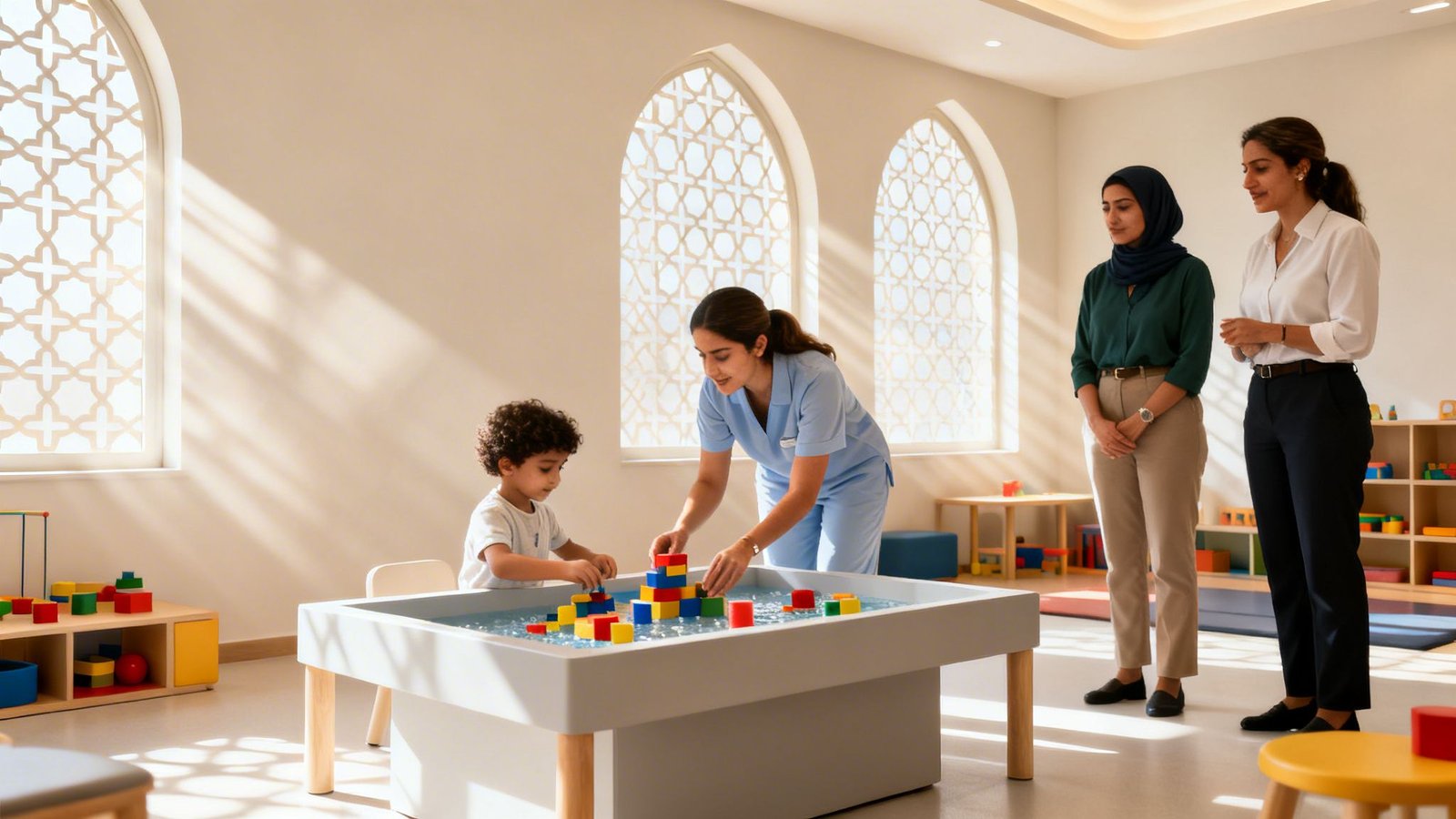

Imagine having a personal coach for your child, someone whose entire focus is helping them master the everyday activities of being a kid—playing, learning, and making friends. That’s really what occupational therapy for children UAE is all about. It’s a dedicated service focused on building the practical life skills your child needs to feel independent and successful.
Unlocking Your Child’s Potential Through Play
When most people hear “occupational therapy,” they think of adults getting back to work after an injury. For a child, though, their most important “occupation” is simply to play, learn, and grow. Occupational therapy (OT) is a health profession that gives children the support they need to participate fully in all the little moments that make up childhood.
It’s like building a bridge. An OT helps a child get from a place of frustration or difficulty to a place of confidence, giving them the right tools and strategies to navigate their world more easily. This kind of support is becoming more and more crucial here in the UAE, where early intervention is rightly gaining significant attention.

What Does an Occupational Therapist Do?
An occupational therapist always looks at the whole child. It’s not just about one specific problem; it’s about understanding their physical, cognitive, sensory, and motor skills to see where they might need a bit of a boost. The goal is never to change a child’s personality, but to empower them to thrive just as they are.
Let’s take handwriting, a common challenge. An OT won’t just drill a child on holding a pencil. Instead, they’ll dig deeper and might work on things like:
- Fine Motor Skills: Strengthening the tiny hand muscles needed for a good pencil grip through fun games like using tweezers or playing with clay.
- Visual-Motor Integration: Improving how the eyes and hands work together as a team, maybe by tracing mazes or catching a ball.
- Sensory Processing: Figuring out if the child is sensitive to the feel of the paper or the sound of the pencil, and finding ways to make it more comfortable.
Therapy often looks and feels just like playing, and understanding the importance of sensory play is a big part of why this approach works so well. When therapy is fun, children are naturally motivated to build new skills. You can learn more about our philosophy and https://georgetownuae.com/services/occupational-therapy-in-dubai/ at Georgetown Early Intervention Centre.
The Growing Need for OT in the UAE
Here in the Emirates, the demand for skilled therapists has been climbing steadily. The formation of the Emirates Occupational Therapy Working Group (EOTWG) on 7 November 2024 was a major milestone for the profession. By March 2026, its membership had already doubled to 73 licensed occupational therapists—a 100% growth that clearly shows the urgent need for specialised paediatric services.
At its heart, paediatric occupational therapy is all about fostering independence. Whether it’s learning to tie shoelaces, focusing in the classroom, or feeling confident enough to join a game with friends, OT helps children master the ‘jobs’ of childhood. This builds a strong foundation for a happy and capable future.
Signs Your Child Might Benefit from Occupational Therapy
As a parent, you have a gut instinct. You know your child better than anyone, and sometimes you notice little things that make you wonder, “Is this just a phase, or is something else going on?” It can be tough to tell the difference between typical childhood quirks and signs that a little extra support could make a world of difference.
Figuring this out isn’t about looking for a label. It’s about empowering your child. An occupational therapist (OT) is trained to see the world through a child’s eyes, connecting the dots between their behaviors and the underlying skills they need for daily life. When we talk about occupational therapy for children in the UAE, we’re really talking about giving them the tools to play, learn, and grow with confidence.
These signs often show up in a few key areas of a child’s world.

Challenges with Developmental Milestones
Developmental milestones are the building blocks of childhood. While it’s true that every child hits them on their own timeline, a consistent pattern of delays can signal that they’re hitting a roadblock.
Think of it like learning to ride a bike. Some kids just need the training wheels on a bit longer, and that’s okay. An OT is the one who helps fit those training wheels perfectly, providing just the right amount of support for life skills. These delays might look like:
- Fine Motor Skills: Is your child frustrated trying to button their school uniform? Do they struggle to hold a crayon, use a fork, or stack small Lego bricks? These are all fine motor tasks.
- Gross Motor Skills: Maybe they seem a bit more clumsy than their friends, have trouble with balance, or find it hard to run, jump, and climb with coordination.
- Self-Care Routines: They might have ongoing difficulty with age-appropriate tasks like getting dressed, brushing their teeth, or mastering toilet training long after their peers have moved on.
An OT is an expert at breaking these big challenges into small, achievable wins. This turns moments of frustration into boosts of confidence.
Sensory Processing and Regulation Issues
Does a trip to a bustling Dubai mall send your child into a meltdown from the noise and lights? Or, on the flip side, do they seem to seek out intense physical input, crashing into furniture or not even flinching at a fall? This could point to challenges with sensory processing.
A child’s nervous system acts like a traffic controller for all the information coming in from their senses—sight, sound, touch, and movement. When that controller gets overwhelmed or isn’t working efficiently, you get sensory “traffic jams,” which often look like emotional or behavioral outbursts.
An OT helps kids become better sensory traffic controllers. They’ll figure out if a child is over-responsive (hypersensitive) or under-responsive (hyposensitive) to sensory input and create fun, play-based activities to help their nervous system find that “just right” level of calm and focus.
Common signs of sensory challenges include:
- Over-Reactions: Intense dislike of clothing tags, certain food textures, loud sounds, or bright lights.
- Under-Reactions: A constant need to be moving or fidgeting, a high tolerance for pain, or a habit of touching everything and everyone.
- Emotional Dysregulation: Frequent and intense tantrums that seem completely out of proportion to the situation, often sparked by sensory overload.
Difficulties with School Readiness and Social Skills
For many families, the structured environment of nursery or school is where these struggles become most obvious. The classroom demands a lot from a little one: sitting still, paying attention, following multi-step directions, and getting along with others.
If your child avoids group activities or has trouble making friends, it might not just be shyness. They could be having a hard time reading social cues, understanding personal space, or managing their impulses during play.
You or their teacher might notice your child could use OT support if they show:
- Poor Attention and Focus: An inability to sit for a short story or finish a simple puzzle without getting sidetracked.
- Social Interaction Difficulties: Trouble with sharing, taking turns, or joining in imaginative play with their classmates.
- Task Avoidance: A strong refusal to do things like coloring or writing, which might actually signal an underlying difficulty with motor skills or the ability to plan out the steps of the task.
By strengthening these foundational skills, occupational therapy for children in the UAE doesn’t just help them keep up in the classroom—it gives them the confidence they need to build friendships and thrive in their social world.
Your Child’s Occupational Therapy Journey
Hearing that your child might benefit from occupational therapy can bring up a lot of questions. It’s completely natural to wonder what the process actually looks like. Think of it less as a formal procedure and more as a partnership—one that starts with a simple conversation and builds towards celebrating your child’s incredible progress.
Let’s walk through what this journey typically looks like here in the UAE.

It all begins with an initial chat. You might have been referred by a doctor or a teacher, or maybe you’re just following your own intuition as a parent. This first meeting is a safe space for you to share what you’ve been seeing and what’s on your mind.
The Comprehensive Assessment
Next comes the assessment. The word “assessment” can sound a bit intimidating, but it’s really not a test with pass or fail grades. It’s a discovery process designed to get a full picture of your child’s world. Our occupational therapist uses a mix of standardised tools and, most importantly, fun, play-based activities to see your child’s unique strengths and where they might need a little extra support.
During this observation, the therapist is looking for clues about a few key areas:
- Motor Skills: How they hold a crayon, manipulate small toys, or keep their balance while playing.
- Sensory Processing: Their reaction to a noisy room, the feel of different textures, or the sensation of swinging.
- Visual Perception: How their brain makes sense of what their eyes see, like solving a simple puzzle.
- Executive Functioning: Crucial skills like planning a game, staying focused, and following a few steps in order.
This in-depth understanding is the foundation for creating a therapy plan that truly works. We’re focused on getting to the root of the challenges, not just addressing the symptoms.
An assessment is all about seeing the world through your child’s eyes. We look at what they can do just as much as what they find difficult. This complete picture allows us to build the most effective and compassionate plan for them.
This child-first approach is central to the UAE’s focus on early intervention. Emirates Health Services (EHS) has built a robust framework for paediatric care, where occupational therapy is a key service helping children thrive. Their model supports everything from early detection to mental health, ensuring children get the support they need to meet their developmental milestones.
Crafting a Personalised Plan and Therapy Sessions
After the assessment, the therapist sits down with you to create an individualised therapy plan together. This isn’t a generic document; it’s a roadmap with specific, measurable goals that matter to your child and your family. A goal could be something practical like “to be able to button a shirt independently” or sensory-focused, like “to participate in a family meal for 10 minutes without distress.”
So, what does a therapy session actually look like? Most of the time, it looks like play. But it’s play with a purpose.
If a child is working on fine motor skills, they might be stringing beads to make a necklace. If the goal is better sensory regulation, they might be joyfully bouncing on a trampoline or gently swinging in a therapy swing. Our therapists are experts at weaving skill-building into activities that are so engaging, your child just thinks they’re having fun.
The entire process is a team effort, and your role is vital. The table below breaks down the typical phases and how we work together.
Phases of the Occupational Therapy Process
This table shows the typical stages you and your child will move through on your OT journey.
| Phase | Key Activities | Parent's Role |
|---|---|---|
| Referral & Consultation | A warm conversation to discuss your concerns, share your child's history, and understand what to expect. | Sharing your honest observations and asking plenty of questions. You are the expert on your child! |
| Comprehensive Assessment | Using standardised tests, clinical observations, and fun, play-based evaluations to understand your child's profile. | Providing key insights into how your child behaves and interacts at home and in other familiar settings. |
| Goal Setting & Plan | Collaborating to create specific, measurable, and meaningful therapy goals. | Partnering with the therapist to decide which goals are most important for your child and family right now. |
| Ongoing Therapy Sessions | One-on-one sessions filled with guided play and targeted skill-building activities. | Practising recommended strategies and activities at home to help new skills stick. |
| Progress Review | Regularly checking in to measure progress against goals and making adjustments to the plan as needed. | Celebrating every victory, big or small, and giving feedback to the therapist on what’s working. |
We constantly track progress and share it with you, because celebrating those achievements is what fuels motivation for everyone. This powerful partnership between therapist, child, and family is what makes the occupational therapy journey so successful.
How to Choose the Right OT Provider in the UAE
Finding the right support for your child's development is one of the biggest decisions you'll make as a parent. With more options for occupational therapy for children in the UAE than ever before, it can feel overwhelming. But this isn't just about finding a clinic; it's about finding a partner who will truly champion your child's success.
It’s a lot like picking a coach for your child’s sports team. You’d want more than someone who just knows the rules. You’d look for a person who really connects with your child, sees their potential, and knows exactly how to motivate them. The right occupational therapist becomes a key player on your child’s team, and finding that perfect fit is everything.
Verifying Credentials and Qualifications
Your first step is a practical one: making sure the therapist and their centre are properly licensed in the UAE. This is non-negotiable and provides a crucial baseline of safety and quality.
- In Dubai: Therapists need a license from the Dubai Health Authority (DHA).
- In Abu Dhabi: They must be licensed by the Department of Health – Abu Dhabi (DOH).
- In Other Emirates: Licensing is managed by the Ministry of Health and Prevention (MOHAP).
Don't be shy about asking a centre to see their therapists' license numbers. A professional and transparent provider will have this information ready for you. This simple check gives you peace of mind that your child is working with a regulated professional who meets the UAE's high standards.
Think of a professional license as your first guarantee of quality. In the UAE, it proves the therapist has met strict educational and practical training requirements, ensuring your child is in safe, qualified hands.
Once you’ve confirmed the basics, dig a little deeper. Ask about specialised training. If your child is autistic or has significant sensory processing challenges, a therapist with advanced certifications can make a world of difference. Things like a Certified Autism Specialist (CAS) credential or advanced training in DIRFloortime show a therapist has gone the extra mile in their field.
Asking the Right Questions
With credentials confirmed, it's time to see if the therapist's approach is a good match for your family. Your first meeting or call should feel less like a sales pitch and more like a conversation. You're interviewing them, but they should also be asking thoughtful questions to understand your child.
Here are a few key questions to get the conversation started:
- Experience with Specific Needs: "Tell me about your experience working with children who have [your child’s specific challenge, e.g., sensory sensitivities, fine motor delays, autism]."
- Therapeutic Approach: "Could you describe your therapy style? Is it mostly play-based, more structured, or do you blend different methods?"
- Parent Involvement: "How do you work with parents? What can I expect in terms of strategies or activities to use at home?"
- Measuring Progress: "How will we know it's working? How do you measure progress, and how often will we sit down to review my child’s goals?"
The way they answer will tell you a lot about their philosophy. You’re looking for a collaborator—someone who listens, respects your insights as a parent, and is genuinely invested in your child's journey. Getting a feel for how a clinic operates is key, and you can get more information from a trusted occupational medical clinic.
The Power of a Multidisciplinary Team
A child's challenges are rarely isolated. A little one who struggles with handwriting might also have a speech delay or underlying sensory needs. That’s why centres with a multidisciplinary team—where occupational therapists work alongside speech therapists, psychologists, and ABA therapists—offer a tremendous advantage.
When specialists collaborate under one roof, the therapy becomes much more powerful. A fine motor goal from OT can be woven into a speech therapy game, while a behavioural therapist can help support both. This creates a unified approach that often helps children make faster, more consistent progress.
This understanding of holistic care is one reason the field of occupational therapy for children in the UAE is growing. As awareness of developmental needs increases, so does the demand for high-quality, integrated services. This growth also helps attract top talent to the region, with projections suggesting pediatric occupational therapists in the UAE could earn an average of AED 94,333 by 2026, building an even stronger pool of skilled professionals for families to choose from.
How We Create Individualized Therapy Plans
Every child has their own unique personality, strengths, and way of seeing the world. So, when it comes to therapy, a standard, off-the-shelf plan just won’t cut it. At Georgetown Early Intervention Centre, our entire approach is built on this understanding: therapy must be as individual as the child themselves. We're not here to offer a generic program; we're here to create a personalized roadmap that addresses your child’s specific needs and helps them thrive.
This isn’t something one person can do alone. It takes a dedicated team. Our educational psychologists, speech therapists, behavioral specialists, and experts in occupational therapy for children in the UAE all work in concert. We see the whole child, not just a collection of skills, ensuring every aspect of their therapy plan works together seamlessly.

A 360-Degree View of Your Child
Our process starts with getting to know your child on a deep level. Forget simple checklists. We spend time observing, playing, and interacting to see the world from their point of view. This comprehensive assessment gives us a full picture of their passions, their strengths, and the specific hurdles they’re facing.
This initial deep dive helps us move beyond what challenges a child has and uncover why. For instance, is a child struggling with handwriting because of weak hand muscles, a visual processing issue, or a sensory dislike of the pencil? Pinpointing the root cause is the key to creating a plan that brings about real, lasting progress.
A truly individualized plan is built on a foundation of deep understanding. We look beyond behaviors to see the underlying reasons, allowing us to support the child’s development from the ground up, rather than just managing surface-level symptoms.
During this collaborative assessment, each specialist brings their unique perspective. An occupational therapist might spot a sensory need during a play activity, while a speech therapist notices a subtle communication cue in the same moment. This creates a rich, multi-layered picture of your child that a single assessment could never provide.
Weaving Goals Together for Faster Progress
With a complete picture in hand, our team comes together to build a single, unified strategy. This is where our approach really shines. Instead of having separate, siloed goals from different therapists, we integrate them into every single session. It creates a smooth, consistent experience for your child and makes their learning much more powerful.
Here’s a practical example of what this looks like:
- Occupational Therapy Goal: Improve fine motor skills by using a pincer grasp to pick up small objects.
- ABA Therapy Integration: During a behavioral therapy session, the child earns tokens for positive behavior. To "spend" their tokens, they must pick up small game pieces (practicing their pincer grasp) to advance in a board game.
- Speech Therapy Integration: In a speech session, the therapist uses small, textured alphabet blocks. The child must pick up the correct letter block (pincer grasp again!) to spell a word or make a sound they are working on.
By weaving the OT goal into other activities, your child practices the skill without it feeling like a drill. It becomes a natural part of play, helping them master it faster and apply it more consistently in different situations. You can find more ideas for this at home by learning about integrating sensory play into daily activities in Dubai.
The Result: A Cohesive and Accelerated Journey
This multidisciplinary model means you won't experience the fragmented care that can happen when a child sees different specialists at different centers. With us, everyone is on the same team, working from the same plan, and in constant communication.
The benefits of this synergy are clear:
- Accelerated Progress: Skills are reinforced constantly across sessions, leading to faster mastery.
- Consistent Skill-Building: Your child learns to use their new abilities in different contexts, not just in one specific therapy room.
- Holistic Development: We simultaneously nurture the child’s physical, cognitive, social, and emotional growth.
Ultimately, our goal is to build a strong, confident foundation that prepares your child not just for their next therapy session, but for success in school, on the playground, and in all aspects of life.
Your Questions About Paediatric OT, Answered
When you're first exploring occupational therapy, it’s natural to have a lot of questions. For parents looking into occupational therapy for children in the UAE, getting clear, practical answers is the first step toward feeling confident. Let’s walk through some of the most common things parents ask.
What Is the Cost of Children's OT in the UAE and Is It Insured?
The cost for paediatric occupational therapy here in the UAE really varies. It depends on the centre, the therapist's level of experience, and how long each session is. Your best bet is always to call a few centres directly to get a feel for their specific fee structures.
When it comes to insurance, the good news is that many premium health plans in the UAE do cover occupational therapy. The key, however, is that every policy is different. It’s so important to look at your specific plan to understand the details—things like coverage limits, any co-payment you might have, and whether you need a doctor’s referral first.
We always suggest a simple two-step check before you begin. First, call your insurance provider and get a crystal-clear understanding of your benefits. Then, chat with the therapy centre's admin team—they deal with this every day and can often help guide you through the financial side of things.
How Long Will My Child Need Occupational Therapy?
This is probably the most common—and most understandable—question we hear from parents. The honest answer? It depends entirely on your child. There’s no standard timeline for therapy because every plan is built around a child’s specific goals, the challenges they’re facing, and how they progress.
For some children, OT is a short-term boost to master a particular skill, like getting the hang of handwriting or learning to use a knife and fork. For others, especially those with more complex conditions like autism, OT can be a longer-term partnership. It evolves with your child, providing support as they grow and encounter new situations.
A huge part of the process is regular progress reviews. These are meetings where you and the therapist celebrate your child’s wins, track their achievements, and adjust the plan as they gain new skills and confidence.
My Child's Teacher Recommended an OT Assessment. Why?
It’s incredibly common for a teacher or nursery staff member to be the first one to suggest an OT assessment. They spend hours a day with your child in a setting full of peers and structured tasks, giving them a unique viewpoint.
A teacher might pick up on subtle challenges that you may not see at home. Things like:
- Struggling with classroom basics, like using scissors or keeping a school bag organised.
- Having a tough time focusing during group story time or following a few instructions in a row.
- Finding social situations tricky, like joining a game on the playground or understanding personal space.
- Seeming overwhelmed by the noise or general busyness of the classroom environment.
Try to see this recommendation for what it is: a caring and proactive step from an educator who wants the best for your child. An OT assessment is just a way to gather more information. It can bring peace of mind by confirming everything is on track, or it can provide a path for early support, turning small hurdles into stepping stones for success.
How Can I Support My Child's OT Progress at Home?
Your involvement is the single most powerful ingredient in your child's success. Think of your therapist as your coach; they will give you simple, practical strategies you can weave into your everyday life. This teamwork is what makes new skills stick.
For instance, when supporting older children, a therapy plan might include learning to use effective visual cues for autistic teens to manage transitions, helping them navigate daily changes with more independence.
Your therapist might also send you home with:
- Fun, playful activities that build fine and gross motor skills without feeling like "work."
- A personalised "sensory diet" filled with activities to help your child feel calm and focused.
- New ways to approach daily routines, like getting dressed or mealtimes, to build independence.
This partnership between the therapy centre and your home is what empowers your child to take their new skills and use them confidently, wherever they are.
At Georgetown Early Intervention Centre, we know that a therapy plan must be as unique as the child it’s for. Our multidisciplinary team works together to build a single, cohesive strategy, helping your child build a strong foundation for success in school and in life. Find out how we can support your family’s journey by visiting us at https://www.georgetownuae.com.