
That moment you type “language therapist near me” into a search bar is a big one. It’s often the first step on a new path for your family, and while it might feel a little daunting, it’s also the moment you start taking action to get your child the right support.
Where to Start Your Search for a Local Language Therapist

Starting the search can feel like you’ve been handed a map with no compass. But the good news is that there are well-trodden paths to follow. That initial search query is the beginning of a real, actionable plan to find a professional who truly fits your child’s unique personality and needs.
You’re not alone in this search. The need for specialized speech and language services is growing fast. In fact, the global speech therapy market is expected to hit $9.08 billion by 2032. With communication disorders affecting about 8-9% of young children, finding accessible, high-quality care is more important than ever.
Getting to Know the Key Professionals
As you start looking, you’ll come across a few different professional titles. Knowing who does what is the key to building the right support team for your child from the very beginning.
This quick guide breaks down the specialists you’ll likely encounter.
Comparing Key Therapy Professionals
| Professional Role | Primary Focus Area | How They Help Your Child |
|---|---|---|
| Speech-Language Therapist (SLT) | Communication | This is your go-to expert for speech sounds, language understanding, expressing thoughts, and social communication. |
| Educational Psychologist | Learning & Development | They assess cognitive skills and learning challenges, creating strategies to help your child succeed in school. |
| Occupational Therapist (OT) | Daily Living Skills | An OT helps with the practical skills of everyday life, like fine motor control (writing), sensory processing, and self-regulation. |
It’s helpful to see how these roles work together to provide a complete circle of care for your child.
A common misconception is that these roles are interchangeable. In reality, they form a collaborative team. An SLT might work on forming words, while an OT helps with the motor control to write them, and an Educational Psychologist ensures the school environment supports this learning.
Finding a Therapist Near You
So, where do you actually look?
A great place to start is a comprehensive online therapist directory. These websites are fantastic because they often let you filter by location, specialty, and even insurance, which really helps narrow things down quickly.
Beyond online directories, here are a few other reliable avenues to explore:
- Your Doctor or Pediatrician: Your family doctor is a trusted source and can provide referrals to local specialists they know and work with.
- School Recommendations: Your child’s school or daycare may have a list of recommended therapists they’ve worked with in the past.
- Parent and Community Groups: Never underestimate the power of word-of-mouth. Local parent support groups are an incredible resource for honest recommendations and firsthand experiences with therapists in your area.
Vetting a Therapist: How to Check Credentials and Expertise
You’ve got your shortlist of local therapists. Great! Now, it’s time to dig a little deeper. Finding the right language therapist near me goes beyond just proximity; it’s about matching their specific skills to your child’s unique way of communicating. This is where you shift from searching to really evaluating.
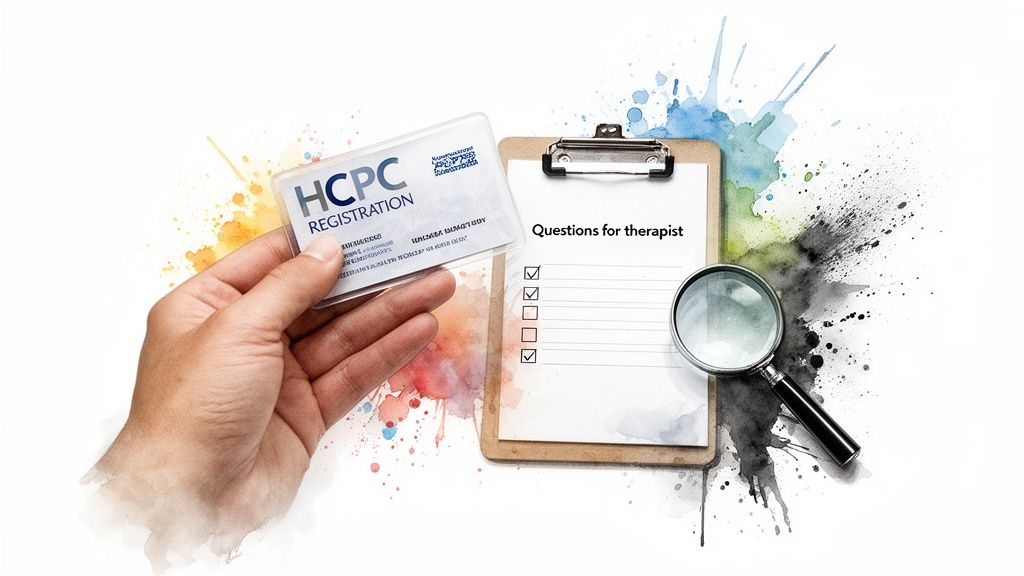
Your first checkpoint is simple: verify their credentials. Every qualified therapist will be registered with a professional governing body. This isn’t just a piece of paper—it’s your assurance that they’ve met strict educational standards, adhere to a code of ethics, and are committed to ongoing training. Don’t feel awkward asking about their registration; any true professional will be happy to provide this.
It’s a field in high demand. The U.S. currently has about 184,000 speech-language pathologists, and that number is expected to jump by 18% in the next decade. This growth reflects our growing awareness of communication disorders, which impact an estimated 40 million Americans.
Look for Specialized Experience, Not Just a General Title
A general qualification is the starting line, not the finish. Real progress happens when you find someone who has hands-on, proven experience with your child’s specific challenges. A therapist who is brilliant with stuttering might not be the best fit for a child with non-verbal autism, and that’s okay. Their skills are just different.
Think about what your child needs most and look for a therapist who specializes in that area.
- Speech Sound Issues: Do they have a track record with articulation (making sounds clearly) or phonological processes (sound patterns)?
- Language Delays: You’ll want someone with deep experience in helping kids build their vocabulary, string sentences together, and truly understand what’s being said to them.
- Social Communication: If making friends, reading body language, or a back-and-forth conversation is the main hurdle, look for a therapist who focuses on pragmatics.
- Autism Spectrum Disorder (ASD): Find a professional who genuinely understands neurodiversity and has specific training and experience in creating therapy that works for autistic children.
A key thing to remember: The “best” therapist isn’t necessarily the one with the longest list of degrees. It’s the one whose expertise directly matches what your child needs and whose approach feels right for your family.
Knowing What to Ask
That first phone call or consultation is your interview. Going in with a few specific questions will help you get a real feel for their style and whether they’ll be a good partner for you and your child.
Here are a few practical questions I always recommend parents ask:
- What’s your core philosophy on therapy? Are sessions mostly play-based, more structured, or a blend of the two?
- How do you keep parents in the loop? What kind of updates can I expect, and will you give me strategies to use at home?
- Could you describe your experience with children facing similar challenges to ours? Ask for general, anonymized examples of their work.
- How do you work with other professionals? This is vital if your child also has an occupational therapist, ABA therapist, or school support team.
The way they answer will tell you volumes. At Georgetown, we’re big believers in a true team approach. You can see it when you meet our multi-disciplinary team of specialists. Finding a professional who sees you as a crucial part of that team is the key to making real, lasting progress.
What to Expect from the Initial Assessment

That first appointment can feel like a huge, nerve-wracking step, but knowing what’s coming can make all the difference. Think of it less as a test and more as the beginning of a partnership. It’s a dedicated time for the therapist to get to know your child—not just their challenges, but their personality, their strengths, and what makes them light up.
The whole point is for the therapist to build a complete, 360-degree view of your child’s communication abilities. This isn’t about one single score or a scary diagnosis. It’s about gathering all the pieces of the puzzle to understand how your child navigates their world.
A Blend of Play and Purposeful Observation
For kids, especially the little ones, the best assessments feel just like playing. A great therapist is a master at using toys, games, and fun activities to see your child’s skills in action, when they’re most comfortable and natural.
They’re not just playing, though. They are skillfully observing crucial communication milestones, such as:
- Receptive Language: How well does your child follow directions? Can they point to the right picture in a book when asked, or follow a two-step command like, “Get your shoes and bring them to me”?
- Expressive Language: This is all about how your child gets their message across. Are they using single words, stringing sentences together, or relying more on gestures and sounds?
- Social Skills: The therapist will watch how your child interacts. Do they make eye contact, try to get your attention, or take turns during a game?
- Play Skills: You can learn so much from how a child plays. Is it imaginative? Repetitive? Do they engage with others? Play is a child’s work, and it’s a huge window into their development.
The most insightful moments often happen when a child is relaxed and engaged. A great assessment leverages play to create a comfortable environment where a child’s true communication abilities can shine through.
Adding in Standardized Tools
While play-based observation is key, the therapist will likely mix in some more formal, standardized tests. Don’t worry—these are designed to be kid-friendly.
These tools have been used with thousands of children, which allows the therapist to see how your child’s skills compare to others their age. It provides concrete data on things like vocabulary size or their understanding of grammar. Combining this objective data with the naturalistic observations gives a really powerful, well-rounded picture. It helps pinpoint not just the struggles, but also the hidden strengths.
And remember, this is a two-way street. While the therapist assesses your child, you should be assessing the therapist. Do they connect with your child? Do you feel like your concerns are being heard and respected? The search for the right language therapist near me ends when you find a professional who makes you feel like a valued teammate from the very first hello.
Understanding Your Child’s Individualised Therapy Plan
Once the initial assessment is complete, the therapist will sit down with you to go over a proposed therapy plan. Think of this document as your family’s roadmap—it’s what turns all those observations and test results into real, actionable steps for your child. A well-crafted plan is clear, collaborative, and gives everyone a shared destination.
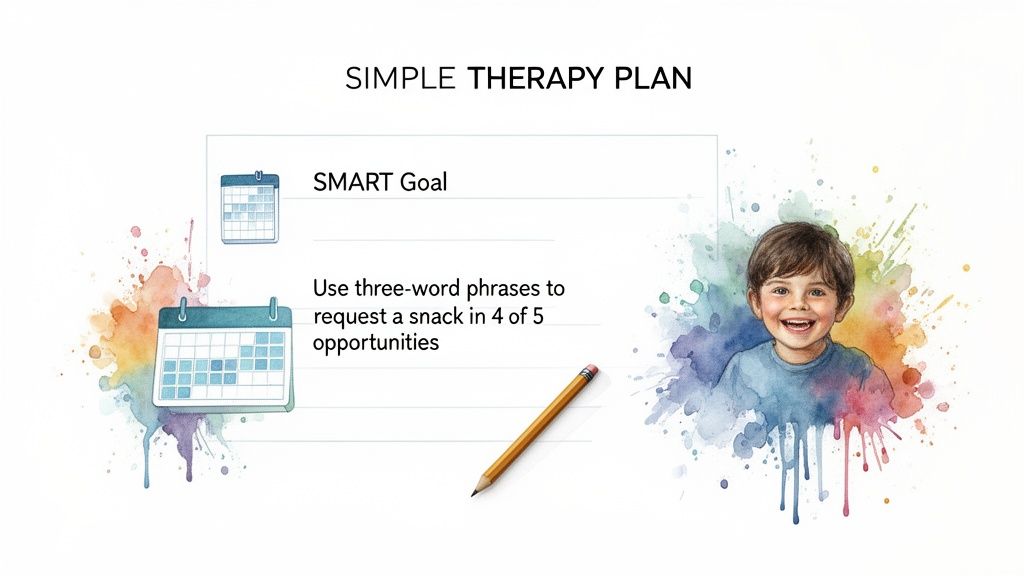
The best plans are built around what we call SMART goals. This framework is the gold standard because it prevents goals from being fuzzy or unattainable. It’s what separates a vague wish from a concrete target we can all work toward.
From Vague Ideas to SMART Goals
Let’s break down what this looks like in practice. It’s common for parents to say they want to “improve talking.” It’s a great starting point, but it’s not a goal we can actually measure.
Here’s how a therapist turns that idea into a SMART goal:
- Specific: The child will use three-word phrases to make requests (e.g., “I want juice,” “More play-doh, please”).
- Measurable: They will do this in 4 out of 5 opportunities during a structured activity, like snack time.
- Achievable: This is a good next step, since the child is already consistently using two-word phrases.
- Relevant: This goal focuses on functional communication—the ability to get needs and wants met—which is incredibly motivating for a child.
- Time-bound: We’ll track this and review progress in six weeks.
Having this level of detail is non-negotiable. It means you and your therapist are on the exact same page about what you’re working on and what success actually looks like.
At Georgetown Early Intervention Center, we believe every child is unique, and so their therapy plan must be too. A one-size-fits-all approach simply doesn’t honour the individual strengths and challenges each child brings. Our plans are built from the ground up for your child.
A Collaborative and Holistic Approach
A great therapy plan never exists in a silo. A child’s ability to communicate is tied to so many other things—their sensory needs, fine motor skills, and how they manage their emotions. That’s why a holistic, team-based approach makes such a profound difference.
The plan should reflect this. You might see strategies from an occupational therapist woven in to help with self-regulation during a challenging talking game, or input from a psychologist to ensure the goals support school readiness. This way, we’re not just treating a symptom; we’re supporting the whole child. To see how we put this into practice, you can learn more about our dedicated speech therapy services in Dubai.
This kind of detailed, customized planning is becoming more critical as awareness grows. With the speech-language pathology field expected to grow 19% by 2032, the demand for effective, personalized plans for conditions like autism and developmental delays has never been higher.
To keep the momentum going, your therapist will likely suggest simple but effective at-home language development activities for toddlers. This partnership between what happens in the clinic and what happens in your home is where the real magic happens and lasting skills are built.
Choosing a Partner in Your Child’s Progress
When you start searching for a “language therapist near me,” you’re looking for more than just a provider. You’re searching for a therapeutic home—a place where your child feels safe, understood, and truly seen. It’s about finding a genuine partner to walk alongside you on this journey, someone who will celebrate the small wins and help you navigate the challenges.
This partnership is all about collaboration. Any single therapist, no matter how brilliant, can only see one part of your child’s world. Real, lasting progress happens when specialists pool their knowledge, creating a support system that addresses your whole child.
An Integrated Team for a Unique Child
At Georgetown Early Intervention Centre, this collaborative spirit is at the heart of everything we do. We know a child’s communication skills are woven into their motor abilities, their emotional world, and how they learn. They don’t exist in a bubble.
That’s exactly why we built a multi-disciplinary team. Our specialists include:
- Educational Psychologists to understand how your child learns and to map out strategies for school.
- Occupational Therapists who work on the sensory and motor skills that are so vital for paying attention and taking part in activities.
- Speech and Language Therapists to focus on specific communication goals.
- Behaviour Therapists who use play-based ABA to help build positive social skills and behaviors.
This structure ensures your child’s therapy plan is never one-sided. The techniques from speech therapy are carried over into occupational therapy sessions, and the goals set by our educational psychologist are baked into every interaction.
A truly individualized plan comes from conversation and shared expertise. It’s the difference between a static list of goals and a living, breathing strategy that evolves right alongside your child.
More Than Therapy: A Partnership With Your Family
We believe parents are the true experts on their own children. No one knows them better than you do. Your insights are critical, and your involvement is the key to making progress stick. We see ourselves as partners for your entire family, not just your child. Our goal is to give you the tools and confidence to continue the work at home, turning daily routines into powerful learning moments.
Building that strong parent-therapist alliance is a core part of our mission. We offer dedicated support to help you feel empowered on this path. To learn more about how we work directly with families, take a look at our parent consultation services and see how we build this partnership right from the start.
Choosing a therapist is a big decision. By finding a center that champions teamwork and sees you as a vital collaborator, you’re giving your child a compassionate, comprehensive, and effective foundation for a future filled with confidence and success.
Common Questions Parents Ask When Looking for a Language Therapist
Taking that first step to find a “language therapist near me” can feel overwhelming. It’s natural to have a lot of questions running through your mind. We get it. Let’s walk through some of the most common concerns we hear from parents, giving you the clear, straightforward answers you need to move forward with confidence.
“How Do I Know if My Child Really Needs Therapy?”
This is probably the number one question parents ask. While every child hits milestones on their own timeline, there are some general guideposts to keep in mind. For example, if your little one isn’t using single words by 16-18 months or isn’t starting to string two words together by age 2, it’s a good idea to schedule an assessment.
Sometimes, the signs are more about behavior than specific milestones. You might see your child getting incredibly frustrated trying to get their point across, or maybe you’ve noticed that people outside your immediate family have a hard time understanding what they’re saying.
Trust your gut. Getting a professional opinion isn’t about labeling your child or finding something “wrong.” It’s about giving them the support they need to communicate confidently and prevent bigger challenges down the road. Early support truly makes all the difference.
“What’s the Difference Between Private Therapy and Public Services?”
This is a big one, and the answer often comes down to timing and flexibility. Publicly funded services, like those from the NHS in the UK, provide excellent, high-quality therapy at no direct cost. The main drawback is that demand is incredibly high, which can mean long waits—first for an assessment, and then again for therapy to actually begin.
Private therapy, which is what we do here at Georgetown, allows you to bypass the waitlists and get started right away. It also offers more flexibility with scheduling. Many families do both; they might start with private therapy to get the ball rolling while staying on a public waiting list, or use it to add extra support to what their child is already receiving. It’s a personal decision based on your family’s needs and how urgently you feel support is needed.
“How Involved Will I Be as a Parent?”
Your role is everything. A great therapist doesn’t just work with your child—they work with your whole family. You are the expert on your child, and your involvement is the key to making progress stick.
You should expect to be treated as a vital partner in this journey. That means getting regular, clear updates on how things are going, being invited to watch sessions, and, most importantly, being coached on simple, practical strategies you can use at home during everyday moments.
At Georgetown, we build our programs around this partnership. The skills learned in the therapy room are only as good as their ability to transfer to your home, the park, and the grocery store. We’re here to empower you with the tools to make that happen.
At Georgetown Early Intervention Center, we see parents as the most important members of our team. Our multi-disciplinary experts are here to build a plan that supports your entire family. Learn more about our collaborative approach and start your journey with us today.