
When the weather keeps everyone inside, it's easy to fall back on screens or default to the same old toys. But what if that time could be transformed into a powerful opportunity for growth? This guide moves beyond simple entertainment, offering a therapist-informed look at kids indoor activities designed to support crucial developmental milestones. We're not just listing ideas; we are providing a framework for intentional play.
This comprehensive roundup explores 10 engaging options, from classic construction blocks to imaginative role-playing scenarios. For each activity, we will break down exactly how it can be adapted to foster specific skills in key areas: speech and language, occupational therapy (OT), sensory processing, and social-behavioural development. The focus is on practical, actionable strategies that you can implement immediately.
Whether you are a parent seeking meaningful play ideas, a therapist looking for fresh inspiration, or an educator supporting a child with unique learning needs, you'll find concrete strategies here. We will detail the necessary materials, setup instructions, and safety considerations for each activity. Furthermore, we provide targeted adaptations for children on the autism spectrum or those with speech delays, ensuring inclusivity.
At centres like Georgetown Early Intervention, we believe every child is unique, and their play should be too. This list is your starting point for creating personalised, skill-building fun that turns any day indoors into a chance for significant developmental progress, right at home. You will learn how to structure activities within individualised learning plans and see how simple play can achieve profound results.
1. Building with LEGO and Construction Blocks
Construction play with interlocking bricks like LEGO or larger blocks is a classic for a reason. This powerful activity goes far beyond simple fun, serving as a foundational tool for developing spatial reasoning, fine motor precision, and creative problem-solving. Whether following instructions or building freely, children engage in a process of planning, executing, and adapting their designs, making it one of the most versatile kids indoor activities available.
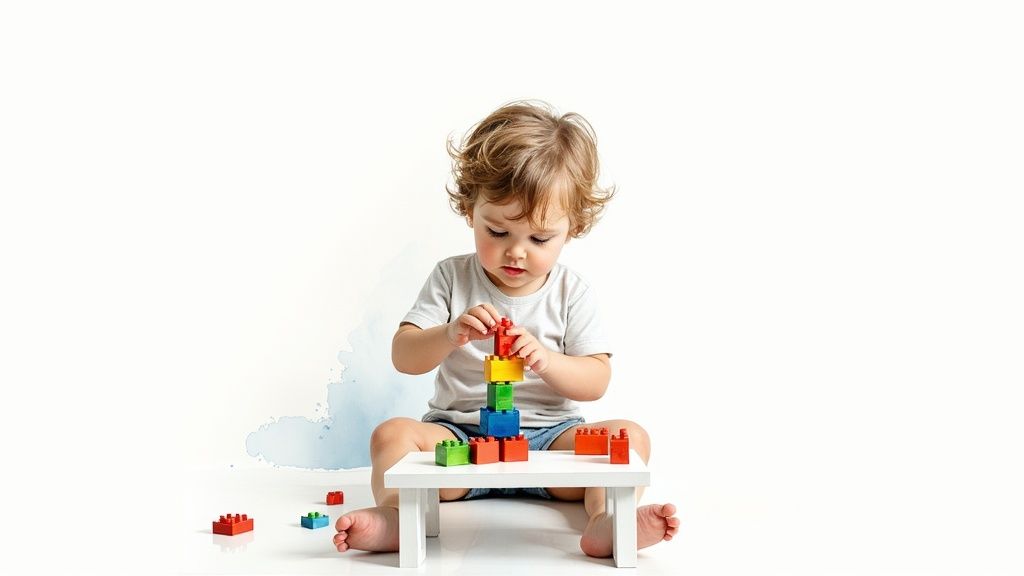
This activity is ideal for a wide range of developmental stages, from toddlers grasping chunky Mega Bloks to older children tackling complex architectural sets. The tactile nature of connecting and disconnecting pieces provides rich sensory feedback and strengthens hand muscles essential for handwriting.
Therapeutic Goals and Applications
- Occupational Therapy: Enhances fine motor skills, bilateral coordination (using two hands together), and pincer grasp. Following a model also improves visual-motor integration.
- Speech Therapy: Encourages the use of descriptive language (colours, shapes, sizes), prepositions ("put the red block on top of the blue one"), and sequencing words (first, next, last).
- Social/Behavioural: Collaborative building promotes turn-taking, sharing, negotiation ("Can I have the long blue piece?"), and joint attention as children work towards a common goal. It also teaches frustration tolerance when a structure collapses.
Adaptations for Diverse Needs
For children with autism or speech delays, adapt the activity to match their level. Start with simple, two-to-three-step instructions using a visual guide. You can use a "First-Then" board to structure the play: "First, we build a tower, then we can knock it down." For non-verbal children, use picture cards or model actions to request specific blocks, encouraging imitation. Organising blocks into separate, clearly labelled bins by colour or shape can also reduce sensory overload and make piece selection easier.
Therapist Tip: Use block play to teach cause and effect. Build a simple tower together and let the child knock it down. This demonstrates a clear action-reaction sequence while also providing a fun, motivating sensory crash.
2. Arts and Crafts Projects
Engaging in arts and crafts, from painting with watercolours to sculpting with clay, offers a powerful medium for self-expression and skill development. These activities provide a structured yet creative outlet, allowing children to manipulate materials, follow processes, and bring their imaginative ideas to life. This makes hands-on artistic creation one of the most enriching and adaptable kids indoor activities for a rainy day.

This category is incredibly broad, suiting any age or skill level. A toddler can enjoy finger painting, while an older child can create detailed friendship bracelets. The sensory experience of using different materials-the texture of collage paper, the coolness of clay, or the glide of paint-provides valuable input for a child’s developing brain.
Therapeutic Goals and Applications
- Occupational Therapy: Cutting with scissors, holding a paintbrush, and rolling clay are excellent fine motor skills activities. These tasks build hand strength, improve pincer grasp, and enhance hand-eye coordination.
- Speech Therapy: Crafts provide a natural context for language development. Children can request materials ("May I have the blue paint, please?"), describe their creations, and follow multi-step directions ("First, cut the paper, then glue it on").
- Social/Behavioural: Working on a craft project teaches planning, patience, and the ability to see a task through to completion. It also boosts self-esteem when children display their finished work, fostering a sense of accomplishment.
Adaptations for Diverse Needs
For children with autism or sensory processing challenges, choose materials carefully. Some may prefer the smooth feel of markers over the stickiness of glue. Provide a visual schedule with pictures for each step of a craft project to make the process predictable and less overwhelming. For children with speech delays, focus on functional communication by having them point to or name the supply they need next. A well-organised craft kit with clearly labelled containers can also help reduce visual clutter and support independent participation.
Therapist Tip: Use art to explore emotions. Ask a child to choose colours that represent how they feel today (e.g., yellow for happy, blue for sad). This provides a non-verbal way for them to express themselves and can be a gentle starting point for a conversation about their feelings.
3. Indoor Scavenger Hunts
An indoor scavenger hunt transforms the familiar environment of a home into a thrilling landscape of discovery. This activity involves children searching for specific items or solving clues to find a hidden treasure, making it one of the most adaptable and exciting kids indoor activities. By adjusting the complexity of the clues and the items being sought, you can create a dynamic experience that engages cognitive skills, encourages physical movement, and builds excitement.

The beauty of a scavenger hunt lies in its versatility. It can be a simple colour-finding game for a toddler ("Find something red!") or a complex series of riddles for older children leading to a prize. This flexibility allows it to be tailored to any theme, learning objective, or developmental level, providing a structured yet playful way to spend time indoors.
Therapeutic Goals and Applications
- Speech Therapy: Strengthens receptive language (understanding directions and concepts like prepositions), expressive language (describing found items), and vocabulary. Clues can target specific sounds or word categories.
- Occupational Therapy: Promotes visual scanning and discrimination as children search for objects. It also encourages motor planning to navigate the environment and problem-solving to decipher clues.
- Social/Behavioural: When done in a group, it teaches cooperation, turn-taking with clues, and joint problem-solving. It also enhances executive functions like working memory (remembering the list) and task initiation.
Adaptations for Diverse Needs
For children with autism or speech delays, simplify the hunt using pictures instead of words. A visual list of three to five familiar objects can be a great starting point. Use a "First-Then" board to clarify the sequence: "First, find the ball, then we get a sticker." For non-verbal children, they can point to the picture of the item they have found. Clearly defining the search area (e.g., "We are only looking in the living room") can also help prevent overwhelm and keep the activity focused and enjoyable.
Therapist Tip: Create a sensory scavenger hunt. Instead of looking for objects, have the child find things based on texture ("Find something soft"), sound ("Find something that crinkles"), or smell. This targets sensory processing and encourages descriptive language.
4. Movie and Popcorn Days
Organising an indoor movie day offers much more than simple entertainment. It creates a structured, low-demand environment that can be a powerful tool for relaxation, family bonding, and targeted skill-building. By transforming a passive screen time activity into a deliberate, shared experience, parents and therapists can create a comforting and engaging opportunity for learning, making it one of the most versatile kids indoor activities for a quiet afternoon.
This activity can be easily tailored to any age, from watching short animated series like Bluey to enjoying classic Disney films or even educational documentaries. The key is creating a cinema-like atmosphere with comfy blankets, pillows, and pre-planned snacks to signal that this is a special, designated activity.
Therapeutic Goals and Applications
- Speech Therapy: Encourages listening comprehension and narrative skills. Pause the film to ask "wh" questions ("What do you think will happen next?" or "Why is the character sad?"). This also helps with emotional literacy and perspective-taking.
- Social/Behavioural: Provides a structured opportunity to practise sitting for an extended period and managing excitement in a controlled setting. It's a great low-pressure social activity that promotes shared experience and joint attention without the need for complex interaction.
- Sensory/OT: A darkened room with a glowing screen can be calming for some children with sensory sensitivities. The routine of getting snacks and settling in provides predictability, while eating crunchy popcorn or chewy fruit snacks offers valuable oral-motor sensory input.
Adaptations for Diverse Needs
For children with autism or attention difficulties, keep the film choice short and predictable. Use a visual schedule or "First-Then" board to show the sequence: "First, we watch the movie, then we play a game." Offer sensory-friendly seating like a beanbag chair or weighted blanket. For non-verbal children, use picture cards representing different emotions so they can point to how a character is feeling during the movie, fostering emotional understanding without requiring verbal output. Pre-screening the content is crucial to avoid potentially overstimulating or frightening scenes.
Therapist Tip: Use movie time to practise sequencing and retelling. After watching a short film or a specific scene, ask the child to recount the events using three picture cards showing the beginning, middle, and end. This helps build narrative skills in a fun, visual way.
5. Interactive Board Games and Puzzles
Playing board games and completing puzzles are quintessential kids indoor activities that masterfully blend entertainment with crucial cognitive development. These structured play scenarios require children to understand rules, think strategically, and engage in turn-taking, making them powerful tools for building executive function skills. From simple matching games like Sequence for Kids to more complex family strategy games, the act of playing fosters patience, critical thinking, and social interaction.
Puzzles, whether a 30-piece floor puzzle or a complex jigsaw, offer a different but equally valuable challenge. They enhance visual-spatial reasoning, shape recognition, and persistence. The satisfaction a child feels upon placing the final piece provides a significant boost to their self-esteem and ability to see a task through to completion.
Therapeutic Goals and Applications
- Occupational Therapy: Manipulating small game pieces or puzzle parts strengthens pincer grasp and fine motor control. Scanning a puzzle or game board for a specific shape or colour improves visual scanning and discrimination skills.
- Speech Therapy: Games provide natural contexts for using specific vocabulary, asking questions ("Whose turn is it?"), making comments, and practicing social pragmatics. Puzzles encourage descriptive language related to colours, shapes, and object parts.
- Social/Behavioural: Board games are excellent for practicing turn-taking, managing frustration when losing, and celebrating gracefully when winning. To build teamwork, you can introduce fun cooperative board games where players work together towards a shared objective.
Adaptations for Diverse Needs
For children with autism or ADHD, choose games with clear, simple rules and a predictable turn structure, like Chutes and Ladders. Use a visual timer to help manage waiting for their turn. With puzzles, start with inset puzzles or those with a picture guide printed on the board. You can also reduce the number of pieces presented at one time by pre-sorting them and offering only a small selection, which minimises visual overwhelm and helps the child focus.
Therapist Tip: Modify game rules to meet your child's goals. If working on colour recognition, have the child name the colour of the space they land on in Candy Land. If the goal is social, require them to ask the next player, "Is it your turn?" This turns any game into a targeted therapeutic tool.
6. Reading and Storytelling Sessions
Dedicating time for reading and storytelling is more than just a quiet pastime; it's a powerful tool for cognitive and emotional development. This activity involves reading books aloud, engaging in silent reading, or creating interactive stories, all of which help children engage with narratives, expand their vocabulary, and develop imagination. It builds foundational literacy skills and fosters a lifelong love of learning, making it one of the most essential kids indoor activities.
From picture books like Where the Wild Things Are for toddlers to chapter books like the Percy Jackson series for older kids, there is a world of literature to explore. The key is creating a comfortable, engaging environment, like a cosy reading nook, and allowing children to choose books that capture their interest, whether it's a graphic novel or a non-fiction book about dinosaurs.
Therapeutic Goals and Applications
- Speech Therapy: Expands expressive and receptive vocabulary, improves sentence structure, and teaches narrative skills (character, setting, plot). Asking "wh" questions (who, what, where, when, why) during reading enhances comprehension.
- Occupational Therapy: Holding a book and turning pages improves fine motor control and bilateral coordination. For children learning to write, reading helps with letter recognition and understanding how print works.
- Social/Behavioural: Reading stories helps children understand different perspectives, emotions, and social situations in a safe context. It can be used to teach concepts like sharing, empathy, and problem-solving through character experiences.
Adaptations for Diverse Needs
For children with autism or speech delays, choose books with repetitive phrases, clear pictures, and a predictable structure. Sensory or "touch-and-feel" books provide tactile input that can enhance engagement. Use a visual schedule to signal reading time, making the transition easier. For non-verbal children, use picture-based systems like PECS to help them comment on the story or answer questions about what they see on the page.
Therapist Tip: Turn reading into an interactive game. Use a story sequence board with pictures representing the main events. After reading, have the child arrange the pictures in the correct order. This reinforces comprehension, memory, and the concept of sequencing.
7. DIY Science Experiments and STEM Projects
Hands-on science and STEM projects transform a kitchen table into a laboratory of discovery. These engaging activities, from classic baking soda volcanoes to building simple circuits, make abstract scientific concepts tangible and exciting. This process of inquiry, hypothesis, and observation is a powerful method for cultivating critical thinking, curiosity, and a foundational understanding of how the world works, making it one of the most enriching kids indoor activities for a rainy day.
These experiments are highly scalable, suitable for toddlers exploring cause-and-effect with magnets or older children designing and building a weight-bearing bridge from craft sticks. The structured, sequential nature of following an experimental procedure provides a fantastic framework for learning and skill development. For hands-on learning, you can even consider a simple biology experiment using these tips for starting seeds indoors, perfect for observing growth cycles.
Therapeutic Goals and Applications
- Occupational Therapy: Measuring ingredients, pouring liquids, and manipulating small items (like pipettes or tweezers) builds fine motor control and bilateral coordination.
- Speech Therapy: Experiments are rich with opportunities for sequencing language ("First, we add the vinegar, then we watch it fizz"). They also introduce new vocabulary related to science (e.g., "dissolve," "erupt," "reaction").
- Social/Behavioural: Working with a partner on an experiment encourages collaboration, communication, and patience while waiting for results. It also teaches problem-solving when an experiment doesn't go as planned, building resilience. These projects are a cornerstone of many therapeutic indoor activities for kids.
Adaptations for Diverse Needs
For children with autism or processing challenges, simplify experiments to focus on one or two clear steps. Use visual recipe cards with pictures for each step to reduce reliance on verbal instructions. Pre-measure ingredients into separate bowls to minimise mess and cognitive load. For non-verbal children, focus on cause-and-effect activities where their action creates a big, clear reaction, like dropping a tablet into water to make it fizz. This reinforces their sense of agency and makes learning motivating.
Therapist Tip: Frame "failed" experiments as new discoveries. If the slime is too sticky or the volcano doesn't erupt, ask questions like, "That's interesting! Why do you think that happened?" This reframes mistakes as valuable learning opportunities and promotes a flexible, scientific mindset.
8. Indoor Sports and Active Games
Bringing physical activity indoors transforms any space into a dynamic playground, crucial for releasing energy and regulating the nervous system. Indoor sports and active games are structured physical kids indoor activities that promote gross motor development, coordination, and cardiovascular health without needing a large outdoor area. From living room yoga sessions inspired by Cosmic Kids Yoga to energetic dance parties and DIY obstacle courses using cushions and furniture, these activities are vital for children who need to move their bodies to focus and learn.

This type of play is essential for sensory seekers who need proprioceptive (deep pressure) and vestibular (balance and movement) input. Activities like jumping, crashing into pillows, and navigating an obstacle course provide the intense sensory feedback their bodies crave, helping to improve body awareness and self-regulation.
Therapeutic Goals and Applications
- Occupational Therapy: Improves gross motor skills, motor planning (sequencing movements), balance, and bilateral coordination. Obstacle courses specifically target problem-solving and spatial awareness.
- Speech Therapy: Facilitates the learning of action words (jump, run, crawl), prepositions (under the table, over the pillow), and following multi-step directions ("First, do five jumping jacks, then crawl to the cushion").
- Social/Behavioural: Group games like relay races and dance-offs encourage turn-taking, sportsmanship, and following rules. These activities provide a structured outlet for excess energy, which can reduce disruptive behaviours and improve focus.
Adaptations for Diverse Needs
For children with autism or motor planning difficulties, simplify the activities and provide clear visual supports. Use picture cards or a visual schedule to outline the steps of an obstacle course. Break down complex movements, like a yoga pose, into smaller, manageable steps and offer physical guidance (hand-over-hand support). For children with sensory sensitivities, control the environment by using calming music instead of high-energy tunes and ensuring the play area is not visually overstimulating.
Therapist Tip: Create a "crash pad" with pillows, cushions, and blankets. This provides a safe, designated area for children to get the proprioceptive input they need from jumping and crashing. It's a highly effective self-regulation tool that satisfies sensory needs in a controlled way.
9. Imaginative Pretend Play and Role-Playing
Pretend play is the cornerstone of early childhood development, where children use their imagination to create and act out stories. This powerful activity allows them to process their understanding of the world, experiment with social roles, and develop complex language and emotional regulation skills. From playing "house" to running a pretend restaurant, these scenarios are foundational kids indoor activities for cognitive growth.
This type of play is highly adaptable and requires very few props; an empty box can become a spaceship and a blanket a superhero's cape. It’s through this symbolic thinking that children build crucial narrative skills, understanding concepts like sequence, characters, and problem-solving within a story.
Therapeutic Goals and Applications
- Speech Therapy: Expands vocabulary and sentence structure through character dialogue. It encourages the use of social scripts ("May I take your order?"), storytelling skills, and understanding different perspectives.
- Social/Behavioural: Role-playing provides a safe space to practise turn-taking, negotiation ("It's my turn to be the doctor!"), empathy, and conflict resolution. It helps children understand social rules and expectations.
- Occupational Therapy: Incorporates fine motor skills when manipulating props like doll clothes or toy food, and gross motor skills when acting out roles. It also supports executive functions like planning and organisation.
Adaptations for Diverse Needs
For children with autism or speech delays, start with familiar, concrete scenarios like a simple tea party. Use visual aids or picture cards to outline the steps of the play sequence (e.g., set the table, pour the tea, eat the cake). Model simple, repetitive scripts like "More tea, please" to encourage verbal participation. You can also join the play as a supportive character, gently guiding the interaction without taking over the narrative. For children who are non-verbal, focus on imitative actions and gestures.
Therapist Tip: Use role-playing to prepare for new or stressful events. If a child is anxious about a doctor's visit, act it out with a toy medical kit. This allows them to process the experience in a controlled, playful environment, reducing fear and building coping strategies.
10. Music and Instrument Playing
Engaging with music, whether through singing, playing simple percussion instruments, or learning a keyboard, is a profoundly enriching experience. This activity taps into auditory processing, rhythm, and emotional expression, making it a dynamic and joyful choice for kids indoor activities. It provides a powerful non-verbal outlet for creativity and communication, offering a unique way for children to connect with themselves and others.
This activity is highly scalable, suitable for toddlers exploring sound with maracas and xylophones, up to older children learning guitar chords or piano scales. The multisensory experience of creating sound, feeling vibrations, and following a beat supports cognitive and sensory development in a way few other activities can.
Therapeutic Goals and Applications
- Speech Therapy: Singing and vocal exercises can improve articulation, breath control, and prosody (the rhythm and intonation of speech). Learning song lyrics also enhances memory and vocabulary.
- Occupational Therapy: Playing instruments like drums or a keyboard strengthens bilateral coordination and hand-eye coordination. Pressing piano keys or strumming a ukulele develops fine motor strength and dexterity.
- Social/Behavioural: Group music activities, like a family karaoke session or a drum circle, encourage turn-taking, listening to others, and synchronising actions. It also provides a structured outlet for emotional expression and can boost self-confidence.
Adaptations for Diverse Needs
For children with sensory sensitivities, start with instruments that produce softer, more controlled sounds, like a small keyboard with adjustable volume or a rainstick. Use visual aids, such as colour-coded keys or simplified sheet music with shapes, to make learning more accessible. For a child with a speech delay, focus on simple call-and-response songs like "Old MacDonald," where they only need to produce animal sounds, which is a fun and low-pressure way to encourage vocalisation.
Therapist Tip: Use rhythm to regulate. Tapping a simple, steady beat on a drum can be incredibly calming for an overstimulated child. Match their energy initially (if they are agitated, start with a faster beat) and then gradually slow the tempo to help them co-regulate and find a calmer state. For more insight, you can explore the benefits of music therapy for children.
Top 10 Kids Indoor Activities Comparison
| Activity | 🔄 Implementation Complexity | ⚡ Resource Requirements | 📊 Expected Outcomes | Ideal Use Cases | ⭐ Key Advantages |
|---|---|---|---|---|---|
| Building with LEGO and Construction Blocks | Medium — skill progression from simple to complex | Moderate — initial set cost, storage space | Spatial reasoning, fine motor skills, problem-solving | Open-ended construction, collaborative builds, rainy-day projects | Modular, reusable, scalable learning tool |
| Arts and Crafts Projects | Low — simple setup to guided lessons | Low–Moderate — basic supplies (paper, paints, clay) | Creativity, fine motor control, self-expression | Short creative sessions, therapeutic activities, keepsakes | Flexible, low-barrier, produces tangible results |
| Indoor Scavenger Hunts | Medium — requires planning and clue design | Low — household items or small props | Observation, deductive reasoning, active engagement | Parties, classroom learning, energy-burning games | Highly adaptable, engaging, low-cost |
| Movie and Popcorn Days | Low — minimal preparation | Low–Moderate — streaming/subscription and snacks | Relaxation, family bonding, cultural exposure | Rest days, family time, reward-based activities | Very low effort, comforting, accessible |
| Interactive Board Games and Puzzles | Low–Medium — learn rules, moderate setup | Low–Moderate — purchase games, storage for pieces | Strategic thinking, social skills, patience | Family game nights, turn-taking practice, screen-free play | Reusable, educational, promotes social interaction |
| Reading and Storytelling Sessions | Low — minimal materials, some prep for selection | Low — books or digital library access | Literacy, vocabulary growth, imagination | Bedtime routine, quiet time, literacy development | Foundational for learning, low-cost, calming |
| DIY Science Experiments and STEM Projects | Medium–High — setup, instructions, safety oversight | Low–Moderate — household items or kits | Scientific thinking, curiosity, problem-solving | Hands-on learning, STEM exploration, classroom demos | Engaging, educational, shows cause-and-effect |
| Indoor Sports and Active Games | Medium — space preparation and supervision | Low — soft equipment or household items | Physical fitness, coordination, energy regulation | High-energy days, gross-motor development, group play | Promotes health, burns energy, adaptable intensity |
| Imaginative Pretend Play and Role-Playing | Low — unstructured or lightly guided | Low — simple props or costumes optional | Imagination, social-emotional skills, language | Free play sessions, social skill practice, emotional processing | Low-cost, highly flexible, fosters empathy |
| Music and Instrument Playing | Medium — skill development over time | Moderate–High — instruments, lessons, practice space | Auditory processing, memory, fine motor coordination | Regular practice, group music time, creative expression | Cognitive and emotional benefits, lifelong skill |
Creating an Individualised Play Plan for Your Unique Child
Throughout this guide, we have explored a diverse range of kids indoor activities, from the structured logic of LEGO building to the boundless creativity of imaginative pretend play. Each activity, whether it is a DIY science experiment or a simple storytelling session, offers a unique opportunity to connect with your child and support their development in a meaningful, targeted way. The true power of these ideas lies not in following them as rigid instructions, but in using them as a flexible blueprint for joyful, purposeful engagement.
The most impactful takeaway is that the "best" indoor activity is never a one-size-fits-all solution. It is the one that is thoughtfully adapted to your child's specific personality, interests, and developmental goals. By observing what captures their attention and understanding where they need gentle support, you can transform any of the activities we have discussed into a powerful therapeutic tool.
Key Insights for Tailoring Your Approach
To truly maximise the benefits of these indoor activities, consider these core principles as you move forward:
- Observation is Your Superpower: Before planning, take time to simply watch your child play. What do they gravitate towards? What frustrates them? These observations are crucial data points for creating an individualised play plan that feels both fun and productive for them.
- Focus on Connection, Not Perfection: The primary goal of any shared activity should be to strengthen your bond. Celebrate your child’s effort and enthusiasm, not just the final outcome of a craft project or the successful completion of a puzzle. This builds confidence and makes learning a positive experience.
- Integrate Therapy Goals Naturally: As highlighted in each activity description, therapeutic objectives can be seamlessly woven into play. A scavenger hunt can become a speech therapy exercise by focusing on prepositions ("look under the cushion"), while building with blocks can enhance fine motor skills and spatial awareness, key goals in occupational therapy.
- Embrace Flexibility and Adaptation: A child’s mood and energy levels can change quickly. Be prepared to pivot. If a planned board game feels too overwhelming, switch to a calming storytelling session. The ability to adapt is essential for maintaining a positive and engaging atmosphere.
Actionable Next Steps: Building Your Plan
Moving from inspiration to implementation is the most critical step. Here is a simple framework to help you create a personalised play strategy for your child, turning these ideas for kids indoor activities into a structured yet flexible routine.
- Identify Core Interests: List three to five things your child genuinely loves. This could be anything from dinosaurs and vehicles to music and painting. These interests will be the foundation of your activity choices.
- Define Two to Three Priority Goals: In collaboration with your child’s therapist or based on your own observations, pinpoint a few key developmental areas to focus on. Examples could include "improving turn-taking skills," "expanding expressive vocabulary," or "enhancing fine motor pincer grasp."
- Map Activities to Goals: Look back through the list of activities in this article. Match your child’s interests and your priority goals with specific activities. For instance, if the goal is turn-taking and the interest is vehicles, a board game with car-themed pieces is a perfect fit. If the goal is vocabulary and the interest is art, you can focus on naming colours and tools during a craft session.
- Create a Simple "Play Menu": Instead of a rigid schedule, create a visual menu of three to four pre-prepared activity options for the day or week. This gives your child a sense of choice and control, which can increase their engagement and cooperation.
By consciously curating your child’s play experiences, you are doing more than just keeping them busy on a rainy day. You are building a foundation of skills, confidence, and connection that will support them long after the game is over. Every block tower built and every story shared is a step forward on their unique developmental journey.
If you are looking for expert guidance in creating a comprehensive, individualised plan that turns everyday kids indoor activities into targeted therapeutic progress, our team is here to support you. At Georgetown early intervention center, we specialise in developing customised, play-based therapy programmes that honour each child's unique strengths and needs. Contact us today to learn how we can partner with your family to help your child thrive.
Related Posts