
You're probably doing this search with one tab open for maps, one for reviews, one for pricing, and one for a work calendar that isn't slowing down for your baby's needs. That's normal. Most parents looking up infant daycare near me aren't casually browsing. They're trying to make a high-stakes decision while tired, emotional, and short on time.
The problem is that most daycare advice is too shallow. It tells you to compare price, location, and hours. That's not enough for an infant. A baby doesn't just need supervision. Your baby needs stable adults, predictable routines, responsive care, and an environment that notices development early, especially if you already have questions about feeding, regulation, sensory differences, motor skills, or early communication.
Beginning the Search for Infant Care
A parent usually starts with urgency. Maternity or paternity leave is ending. Family help isn't reliable. Sleep is fractured. Every centre's website says “nurturing” and “safe,” and none of that tells you what the room feels like at 10:15 on a difficult morning.
That's why I'd shift the way you think about this search. You are not looking for a place that will “watch” your baby. You're looking for a partner in early development. That means basic safety has to be there, of course, but it also means asking whether the adults in that room can read infant cues, respond consistently, and notice when something in development may need closer attention.
If you're still organising the practical side of returning to work, this practical guide to baby gear preparation can help you sort the essentials you'll need for daily drop-offs without overpacking. And if you're still broadening your search beyond one postcode, reviewing options for early learning centres near you can help you think beyond the nearest listing and focus on fit.
Start with this mindset: proximity matters, but quality of care matters more. A shorter drive doesn't fix a poorly run infant room.
The parents who feel most confident in their final choice usually stop asking, “Is this convenient?” and start asking, “Will my baby be known here?” That single shift changes everything you notice.
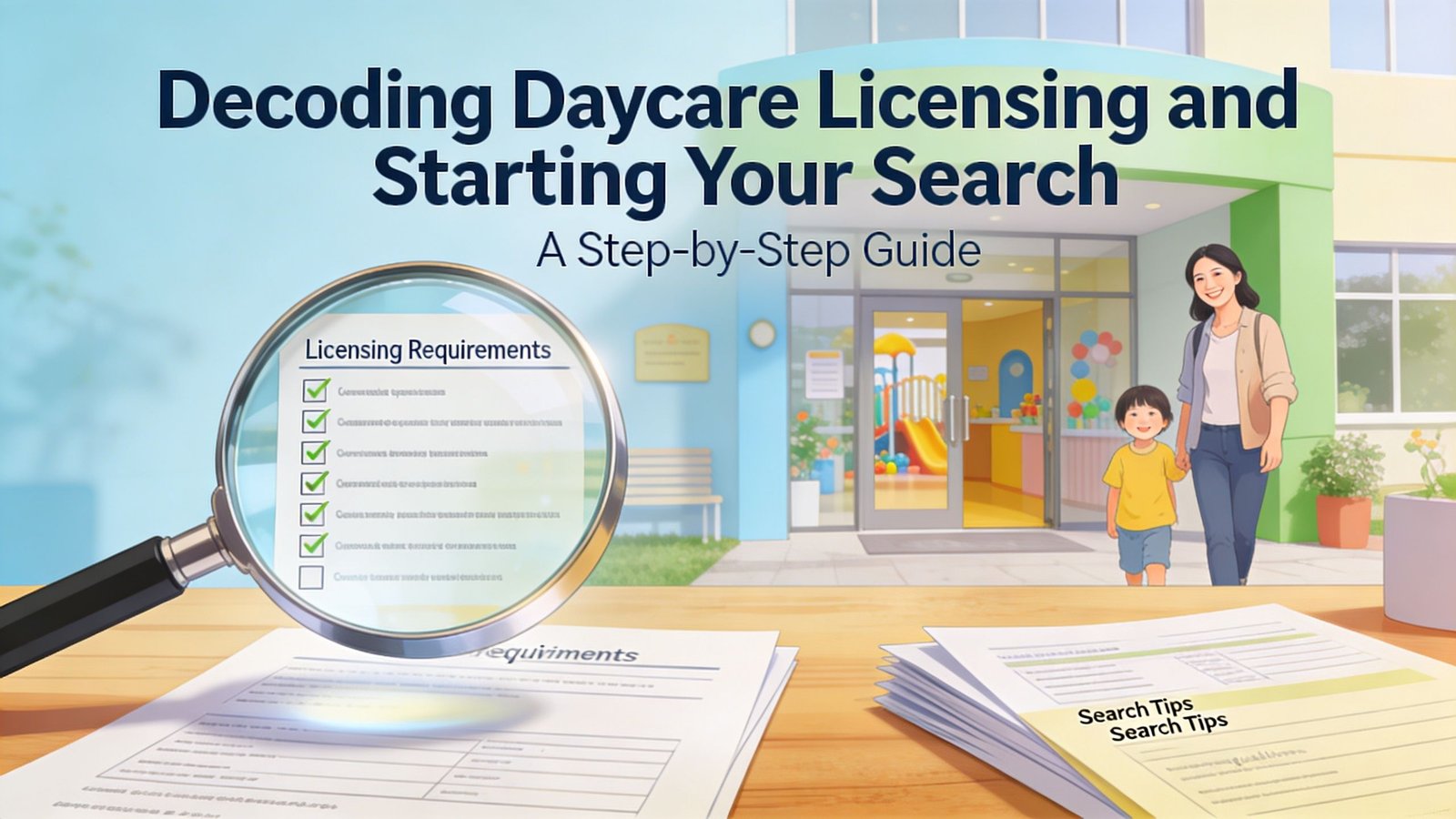
Decoding Daycare Licensing and Starting Your Search
Before you tour anything, filter aggressively. A polished website means very little. Licensing status, compliance history, and quality framework matter more.
Build a shortlist the smart way
Start with your state or local licensing database. For each provider, verify these first:
Active licence
If the licence isn't current, stop there.Type of setting
Centre-based care and home daycare can both work, but you need to know which model you're evaluating.Inspection history
Look for patterns, not just one isolated issue. Repeated concerns matter.Infant care authorisation
Some places serve young children broadly but aren't equally strong with infants.Basic operational fit
Hours, location, waiting list, and whether they can support your child's daily routine.
Once you've done that, narrow your list to three to five places worth a real conversation. That's enough to compare without overwhelming yourself.
Use ratings correctly
A practical way to screen providers is to evaluate licensing quality. In North Carolina, the quality rating system uses a 1-to-5 star scale, with higher ratings reflecting stronger standards in areas like program assessment and instructional quality, as described in North Carolina's 5-star preschool rating overview. That kind of framework is useful.
It is not enough on its own.
A star rating can help you sort options, but it won't tell you whether the infant room has stable staffing, whether babies see the same carers across the week, or what happens when someone calls in sick. Those details affect your child every single day.
Ratings are a first screen, not a final answer.
Ask every centre how they maintain consistency in the infant room. Ask how many children are in the room at one time, how they handle absences, and whether infants are shifted between carers. If the answers are vague, that's information.
What deserves extra weight
When you're comparing providers, prioritise these over marketing language:
- Staff consistency: Babies need familiar adults.
- Clear infant routines: Feeding, sleep, soothing, and transitions should sound organised.
- Responsive administration: If communication is chaotic before enrolment, it usually won't improve after.
- Transparency: Strong centres answer directly.
If you want a broader sense of what organised childcare can look like in a structured setting, it can help to compare with a day care centre model that clearly presents routines, age-group structure, and care expectations.
What to Look For During Your Daycare Tour
A tour tells you what the website never will. Don't just listen to the director. Watch the room.

What you should see
Start with the basics. Infants should be placed on their backs for sleep, in empty cribs, with no loose blankets or clutter. Entry and exit points should feel controlled. The room should look clean without smelling harshly of chemicals.
Then look at the setup itself. Is there space for floor play? Are bottles, nappies, and personal items organised? Does the room feel calm enough for babies to regulate, or is it noisy and overstimulating?
What you should hear
Listen to tone before words. Good infant carers sound warm, steady, and attentive. They talk to babies during care routines. They don't sound irritated, rushed, or detached.
You should also hear some predictability. Not silence, and not chaos. Normal infant rooms have crying, movement, and activity. What matters is whether adults respond promptly and calmly.
A well-run infant room doesn't have to be quiet. It has to feel regulated.
What you should feel
This part matters more than many parents realise. Walk in and notice your body. Do you feel tension, confusion, and hurry? Or do you feel that the adults know what they're doing?
That instinct isn't fluff. Your brain is processing staffing patterns, emotional tone, organisation, and safety cues quickly. Don't ignore it.
Watch caregiver behaviour, not just the environment
Focus on these moments:
- Floor-level interaction: Are adults down with the babies, not just standing over them?
- Responsive soothing: When a baby fusses, does someone respond in a way that looks familiar and confident?
- Face-to-face communication: Do carers make eye contact, narrate actions, and engage gently?
- Transitions: Nappy changes, feeding, and handoffs should look respectful, not mechanical.
Ask one cleanliness question with more depth
A spotless room can still have poor infection control practices. If you want a useful background read on why cleaning protocols matter in shared settings, this piece on Understanding Staphylococcus aureus in Schools is a good reminder that hygiene isn't about appearances alone. Ask what gets cleaned, how often, and how staff handle mouthed toys, feeding surfaces, and illness exposure.
A strong tour leaves you with specific observations, not just a pleasant impression. You should be able to say, “I saw carers soothe babies promptly,” or “I noticed too much turnover in and out of the room.” If you can't describe what made it feel good, be careful.
Key Questions to Ask Every Potential Daycare
Once you've seen the room, start interviewing. Don't apologise for asking direct questions. This is your infant.
The biggest mistake parents make here is staying too polite. They ask about hours and holidays, then go quiet on the questions that determine daily care quality. Ask the harder questions. The answers tell you whether the centre is organised, evasive, flexible, or rigid.
Ask about money with precision
General pricing can mislead you badly. In Coral Springs, Florida, Winnie lists 18 daycare providers with an average monthly price of $980 for full-time daycare on its Coral Springs daycare listings. But infant-specific care can be much higher. The verified local benchmark notes infant care estimates can start at over $2,700 per month, which is exactly why you should never accept a generic price sheet as your answer.
Ask for the exact tuition for your child's age, attendance schedule, and start date. Ask whether rates change as your infant moves into a different age band. Ask what's included and what triggers additional fees.
Practical rule: if a centre answers cost questions vaguely, expect other parts of the experience to be vague too.
Use questions to uncover how the place really works
These aren't box-ticking questions. They're pressure tests. A strong director or infant lead should answer clearly and without defensiveness.
| Category | Question to Ask |
|---|---|
| Staffing | How long have the current infant room staff been working here? |
| Staffing | Who covers the room when a regular caregiver is absent? |
| Continuity | Will my baby have the same primary carers most days? |
| Ratios and grouping | How many children are usually in the infant room at one time? |
| Daily care | How do you handle feeding schedules that differ from baby to baby? |
| Sleep | How do you follow safe sleep practices and document naps? |
| Communication | How will I receive updates during the day? |
| Health | What happens if my baby develops a fever or other symptoms while at daycare? |
| Settling in | How do you support new infants during the transition period? |
| Parent partnership | How do you handle concerns from parents about behaviour, feeding, or development? |
| Turnover | Have there been recent staffing changes in the infant room? |
| Costs | What is the exact tuition for my infant's age and schedule, and what is not included? |
Listen for substance, not polished phrasing
Good answers sound concrete. You'll hear specifics about who covers lunch breaks, how bottles are labelled, how naps are logged, and how carers communicate with parents.
Weak answers sound like this: “We're very nurturing.” “We treat everyone like family.” “It depends.” That language may be warm, but it's not operational.
One question most parents forget
Ask, “What does a difficult day in the infant room look like here, and how do you handle it?”
That question cuts through performance. It shows whether they can talk openly about crying, overtired babies, disrupted staffing, feeding refusal, and parent communication under pressure. You want realism, not perfection.
Evaluating Support for Your Infant's Development
Most infant daycare near me guides fail parents by treating development like an optional extra. It isn't. For infants, development is the whole story.

A good infant room doesn't just keep babies fed and clean. It supports regulation, movement, attention, communication, and early relationships. It notices when a baby seems unusually floppy, rigid, disconnected, overwhelmed by noise, not making expected eye contact, struggling to feed, or not using their body symmetrically. It doesn't diagnose. It notices, documents, and talks with parents early.
What developmental support actually looks like
You are looking for a centre that can answer questions like these without blinking:
- Milestone monitoring: How do you notice when an infant may need extra support?
- Parent communication: How do you bring up developmental concerns?
- Adaptation: How do you support babies with sensory differences, feeding challenges, or regulation difficulties?
- Collaboration: Will you work with outside specialists if a child receives speech therapy, occupational therapy, or behavioural support?
In Colorado, some childcare models explicitly integrate developmental screening and family support rather than treating childcare and early intervention as separate worlds. Ability Connection Colorado's Creative Options reports that 100% of enrolled children are screened for developmental and health concerns, and the programme includes speech therapists, occupational therapists, mental health specialists, and family coaches across five Aurora and Denver locations, as described on its education programmes page. That's a useful example because it shows what many parents actually need but rarely find in standard search results.
Why this matters if you already have concerns
If you're worried about speech, sensory processing, motor development, social engagement, or early signs associated with autism, don't wait for a centre to “see how it goes” for months without a plan. That usually means no one is actively monitoring anything.
Ask whether staff can describe how they individualise care. A serious answer includes routine adjustments, environmental supports, observation, and collaboration with the family. It does not stop at “every child develops differently.”
If your family needs a separate clinical partner alongside daycare, an early learning centre with access to professionals such as an educational psychologist, occupational therapist, speech therapist, or play-based behaviour therapist may be one practical option to explore. Georgetown early intervention center is one example of a service that builds individual plans around the child rather than assuming one model fits everyone.
The right question isn't “Do they offer enrichment?” It's “Will they notice my child, and will they know what to do next?”
Affordability should be judged by fit, not sticker shock alone
Some families assume that any more supportive setting will automatically be out of reach. That's not always how affordability works in real life. Beverly Research's 2026 Coral Springs childcare index gives the city a 68/100 score, ranks it 9th out of 250 U.S. cities and 2nd in Florida, and notes a median household income of $90,643. It also reports Broward County infant tuition at about $14,750 per year, equal to 16.3% of pre-tax household income, the lowest infant care burden among Florida cities in that index, according to Beverly's Coral Springs childcare affordability research.
That doesn't mean childcare feels cheap. It means families need to evaluate cost in context. If one setting offers stronger developmental support, better communication, and more consistency, it may be the better value for your family than a cheaper option that leaves you coordinating concerns alone.
Identifying Daycare Red Flags and Making Your Choice
Parents often override their own judgement when infant places are scarce. That's where bad decisions happen.
In Colorado, the pressure is real. The Colorado Coalition for the Homeless notes that Renaissance Children's Center prioritises Colorado Coalition families first and CCAP families second, and when space isn't available, children go on a waiting list, as explained on its childcare access page. That kind of shortage pushes families toward desperation.
Don't let urgency talk you into ignoring a bad fit.
Red flags that should stop you
Some concerns are manageable. These are not.
- Vague answers about staffing: If they can't clearly explain who cares for infants and who covers absences, that's a systems problem.
- A chaotic infant room: Babies need co-regulation, not constant sensory overload.
- Disengaged caregivers: If adults look detached, irritated, or purely task-focused, believe what you're seeing.
- Defensiveness when you ask questions: Good centres don't resent informed parents.
- Poor developmental awareness: If they dismiss concerns without examples or observations, move on.
- Inconsistent communication before enrolment: This usually gets worse once you're committed.
Make the decision with a simple filter
When you're down to your final options, ask yourself:
- Would I trust these people on my baby's hardest day?
- Do I believe my child will be known here as an individual?
- If a developmental concern appeared, would they notice and respond well?
If one of those answers is no, keep looking if you possibly can.
A full infant room is not proof of quality. Sometimes it only proves scarcity.
You are allowed to walk away from a centre that looks fine on paper but feels wrong in person. You are also allowed to choose the place that feels calmer, kinder, and more developmentally aware even if the lobby is less impressive.
Your Final Checklist for Choosing an Infant Daycare
Use this before you say yes.
- Licence checked: You verified active licensing and reviewed inspection history.
- Infant room observed: You watched real caregiver behaviour, not just listened to a tour script.
- Safety confirmed: Sleep setup, entry security, cleanliness, and supervision looked solid.
- Staffing clarified: You know who cares for your baby, how consistency is maintained, and what happens when staff are absent.
- Communication defined: You know how updates, concerns, and daily reports are handled.
- Tuition made specific: You received an exact quote for your infant's age and schedule.
- Development discussed: The centre could explain how it notices concerns and supports different developmental needs.
- Red flags faced: You didn't excuse evasiveness, chaos, or poor engagement because you felt rushed.
- Gut check completed: You can picture your baby there and feel more settled, not less.
There's no perfect daycare. There is a right-enough place that is safe, responsive, organised, and capable of seeing your child clearly. That's the standard to hold.
If you want help beyond basic childcare selection, especially when you're concerned about speech delay, sensory needs, motor development, school readiness, or autism-related support, Georgetown early intervention center offers services through an educational psychologist, occupational therapist, speech therapist, and play-based behaviour therapist, with individual plans built around each child's needs.