
Rainy days and quiet afternoons no longer need to be a challenge. For parents and caregivers of children with unique developmental paths, finding engaging indoor childrens activities that are both fun and therapeutic can feel overwhelming. The key isn’t just to keep them busy, but to provide structured, meaningful play that supports critical milestones in speech, motor control, and social interaction. This guide, informed by the expertise of occupational therapists, speech pathologists, and behaviour analysts, moves beyond generic ideas. We’ll explore ten powerful, evidence-based activities, detailing not just the ‘what’ and ‘how,’ but the crucial ‘why’ behind each one.
This collection is organised to help you target specific developmental goals, from fine motor precision and sensory integration to school-readiness skills and social communication. Each activity includes practical setup instructions, materials lists, and tips for adapting the difficulty to meet your child’s individual needs. You will learn how to transform simple household items and structured play into powerful tools that reinforce therapeutic objectives in a natural, low-pressure setting. For more ideas on engaging indoor play that specifically aims to spark scientific and technological interest, explore these rainy day activities for kids that spark STEM curiosity.
Our focus here is on purposeful play that feels like pure fun. Discover how to create a supportive at-home environment that complements an individualised therapy plan, just like the tailored programmes we design at Georgetown Early Intervention Centre, where we believe every child’s journey is unique and deserves a plan to match. Let’s delve into these activities and unlock new opportunities for growth and connection right in your living room.
1. Sensory Play Stations
Sensory play stations are structured indoor environments featuring multiple, distinct areas designed to engage a child’s senses. Rather than a single activity, this approach involves creating a circuit of sensory-rich experiences that a child can explore, stimulating touch, sight, sound, proprioception (body awareness), and the vestibular system (balance). This method is one of the most effective indoor childrens activities for promoting sensory integration and emotional regulation.
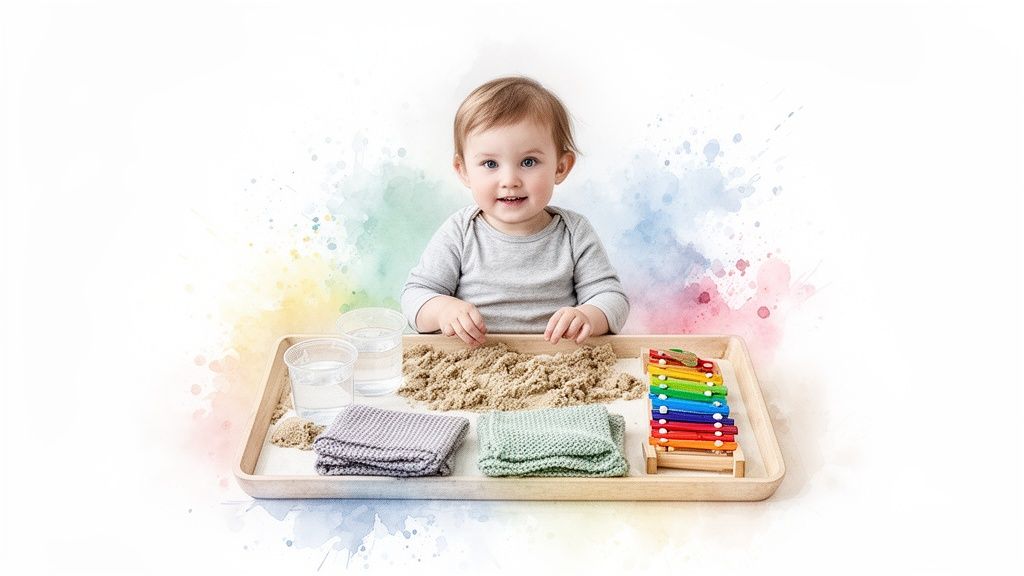
Popularised by therapeutic models like the DIR/Floortime approach and widely recommended by occupational therapists, this concept is highly adaptable for home use. The core idea is to provide controlled, predictable sensory input, which is particularly beneficial for children with autism spectrum disorder or sensory processing challenges.
How to Implement Sensory Stations
Setting up a sensory station circuit is straightforward. The goal is to offer variety and choice, allowing the child to move between different types of sensory input based on their needs.
- Design Your Stations: Start with 2-3 distinct stations. A simple setup could include a “messy” tactile station (kinetic sand, water beads), a “heavy work” station (pushing a weighted box, playing with therapy putty), and a “calming” station (a quiet corner with soft blankets and a sound machine).
- Use Visual Schedules: Help children understand the flow of the activity. A simple picture-based schedule can show them which stations are available and help them transition smoothly, reducing anxiety.
- Balance Energy Levels: Purposefully include both alerting and calming stations. This empowers children to self-regulate by choosing an activity that matches their internal state, whether they need to burn off energy or find a moment of peace.
Therapist Insight: “The power of sensory stations lies in their predictability and customisation. By rotating materials and aligning activities with specific therapy goals, parents can create a powerful tool for skill development that feels just like play.”
This approach can be tailored precisely to a child’s individual needs. For a child who seeks tactile input, you might include stations with different textures like fabrics, brushes, and finger paints. For a child who needs proprioceptive feedback, a mini-trampoline or a pile of cushions to crash into can be a designated station. Collaborating with a professional can help refine these choices; you can discover more about personalised strategies through occupational therapy in Dubai.
2. Structured Play-Based ABA Therapy Sessions
Structured play-based ABA sessions integrate the principles of Applied Behaviour Analysis (ABA) directly into engaging, child-led activities. Instead of traditional drills, therapists use techniques like incidental teaching and natural environment training within play to teach new skills. This approach transforms therapy into a motivating and dynamic experience, making it one of the most effective indoor childrens activities for children with autism to learn communication, social, and behavioural skills in a natural context.
Popularised by models like the Early Start Denver Model (ESDM), which merges ABA with developmental and relationship-based approaches, this method is highly child-centric. The core idea is to use a child’s natural interests and motivations as the foundation for learning, which significantly increases engagement and the generalisation of skills to everyday situations. This is particularly beneficial for making therapy feel less clinical and more like structured, purposeful play.
How to Implement Play-Based ABA
Setting up a play-based ABA session at home involves creating an environment where learning opportunities are embedded within activities the child already enjoys. The focus is on capturing and contriving teachable moments.
- Conduct Preference Assessments: Before starting, identify what truly motivates your child. Offer a choice of toys or activities (e.g., building blocks, a toy train set, bubbles) and observe which ones they engage with the most. These become your most powerful reinforcers and the foundation for your sessions.
- Use Visual Supports: Integrate visual schedules or social stories into the play. For example, a picture sequence can show the steps for building a tower together (“my turn,” “your turn”), helping to teach turn-taking and reducing frustration.
- Embed Learning Targets: Choose a specific goal and incorporate it into the play. If the target is labelling colours, you can do this while building with colourful blocks (“Pass me the blue block, please”). The request is natural and directly related to the fun activity.
Therapist Insight: “The beauty of play-based ABA is its flexibility. We are building critical skills in the child’s world, on their terms. This fosters a positive association with learning and empowers parents to become their child’s best teacher in everyday moments.”
This approach can be adapted for any skill level. For early learners, it might focus on establishing joint attention by rolling a ball back and forth. For more advanced learners, it could involve complex pretend play scenarios to teach problem-solving and social negotiation. Understanding how to apply these techniques is key, and you can explore more about professional guidance for ABA therapy in Dubai UAE.
3. Speech-Language Development Games and Activities
Speech-language development games are structured, interactive play sessions designed to target specific communication milestones. Far from being simple conversations, these activities use evidence-based strategies to build vocabulary, improve articulation, develop narrative skills, and enhance phonological awareness. These targeted indoor childrens activities are essential for promoting school readiness, especially for children with speech delays or language disorders.

Popularised by programmes like Hanen’s It Takes Two to Talk and methodologies recommended by the American Speech-Language-Hearing Association (ASHA), this approach integrates therapeutic goals into engaging play. The core principle is to create communication opportunities within a child’s natural environment, making learning feel motivated and meaningful rather than like a clinical drill.
How to Implement Speech-Language Activities
Setting up effective speech-language games involves embedding specific targets into activities the child already enjoys. The aim is to create a communication-rich environment that encourages spontaneous language use.
- Embed Targets into Play: Identify a few core vocabulary words or a target sound. If working on the /b/ sound, play with a ball, blow bubbles, or build with blocks. Narrate your actions and model the target sound clearly and repeatedly.
- Use Visual Supports: Tools like Boardmaker pictures or a Picture Exchange Communication System (PECS) can help children who are non-verbal or have limited expressive language. Use these to make requests, comment on activities, and build sentences.
- Focus on Turn-Taking: Structure games to have clear, predictable turns. Simple board games, rolling a ball back and forth, or even taking turns adding a block to a tower teaches the foundational rhythm of conversation.
Therapist Insight: “The most successful language intervention happens when a child doesn’t even realise they’re ‘working’. By embedding speech targets into highly motivating play, we create countless opportunities for repetition and reinforcement, which is key to motor planning for speech and vocabulary acquisition.”
This approach is highly adaptable. For a younger child, the focus might be on imitating sounds and gestures during a game of peek-a-boo. For an older child preparing for school, you might create story cards to practice narrative sequencing (“First, the boy got on the bus. Next…”). Understanding how to apply these strategies is crucial, and parents can explore professional guidance through speech therapy in Dubai.
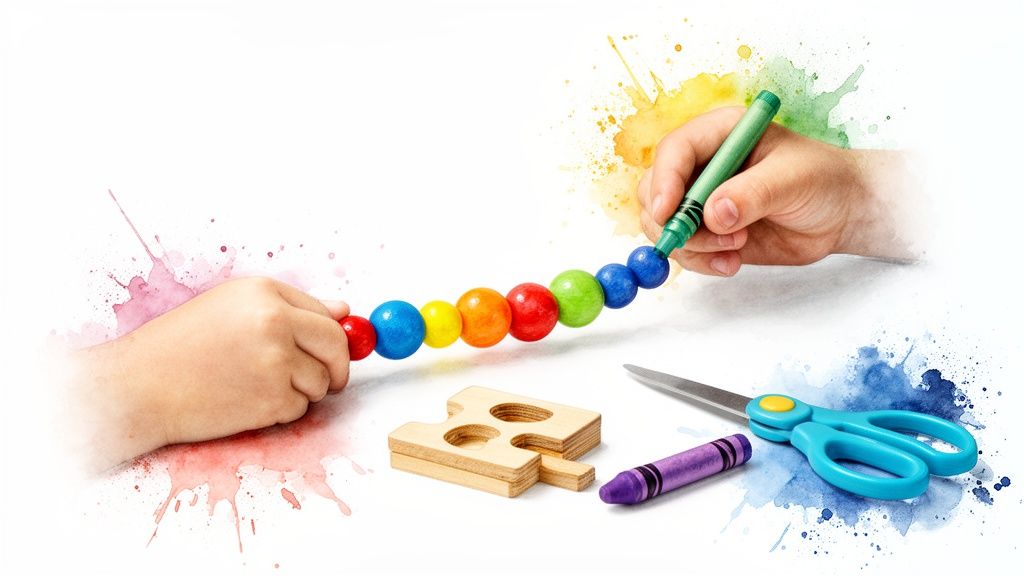
4. Fine Motor Skill Stations and Manipulative Activities
Fine motor skill stations are designated indoor areas organised around activities that build hand strength, dexterity, and precise muscle control. This approach uses manipulative play, which involves engaging with objects using the hands and fingers, to develop foundational skills necessary for tasks like writing, buttoning, and using utensils. These targeted indoor childrens activities are crucial for building pre-handwriting skills and overall school readiness.

Popularised by methodologies like Montessori education and strongly endorsed by the American Occupational Therapy Association (AOTA), this concept breaks down complex motor skills into manageable, playful steps. The core idea is to provide purposeful activities that feel like fun, making it an effective strategy for children who need support with motor planning and coordination.
How to Implement Fine Motor Stations
Setting up a fine motor station involves creating an inviting space with accessible materials that encourage exploration and practice. The goal is to isolate specific skills in an engaging way.
- Design Your Stations: Begin with a few distinct activities. A well-rounded setup might include a threading station (large beads on a shoelace), a building station (interlocking blocks), and a creative station (using tweezers to place pompoms onto a glue-based design).
- Rotate Activities: Keep the stations fresh and engaging by rotating materials weekly. This prevents boredom and introduces new challenges, encouraging children to generalise their skills across different objects and tasks.
- Start Big, Go Small: Follow a developmental progression by starting with larger manipulatives (like stacking rings) and gradually introducing smaller, more complex items (like LEGOs or lacing cards). This builds confidence and prevents frustration.
Therapist Insight: “Fine motor development is a prerequisite for academic success. Purposeful play with manipulatives strengthens the small muscles in the hands and improves hand-eye coordination, laying the essential groundwork for handwriting and self-care skills.”
This approach can be adapted to any child’s ability level. For a child just beginning, focus on whole-hand grasping activities like squeezing play-doh. As they progress, introduce activities that require a pincer grasp, such as picking up small objects with tongs. Providing hand-over-hand guidance initially and then fading support allows the child to build independence and mastery at their own pace.
5. Social Stories and Visual Supports for Social Skills Development
Social stories and visual supports are powerful tools designed to teach social rules, expectations, and appropriate behaviours in a structured, narrative format. These customised stories and visual aids break down complex social situations into simple, understandable steps, helping children with social communication challenges navigate their world with more confidence. This approach is one of the most effective indoor childrens activities for building social competence and reducing anxiety.
Popularised by Carol Gray’s Social Stories™ method and integral to structured teaching approaches like TEACCH, this technique provides clarity and predictability. By presenting social information visually, it helps children process concepts that may be too abstract when explained verbally, making it a cornerstone for supporting individuals on the autism spectrum.
How to Implement Social Stories and Visual Supports
Creating and using these tools at home can significantly enhance a child’s understanding of social interactions. The key is to make them personal, simple, and consistent.
- Create Your Story: Write a short story from the child’s perspective using “I” statements. For example, “When I want to play with a friend, I can ask, ‘Can I play too?'” Use simple language and include photos or drawings of the child to make it relatable.
- Integrate Visual Schedules: Use visual aids like Picture Communication Symbols (PCS) to create daily schedules or step-by-step guides for routines. This helps children anticipate what is coming next, which can reduce transition-related stress.
- Practise with Role-Play: After reading a social story, immediately engage in a short role-playing activity to practise the skill. This bridges the gap between understanding the concept and applying it in real life.
Therapist Insight: “Social stories are like a personalised script for the social world. They work best when they are positive, patient, and reviewed just before the child encounters the situation, giving them a clear and reassuring mental roadmap.”
This method is highly adaptable to a child’s evolving needs. As they master a skill, stories can be updated or faded out. For more in-depth guidance on tailoring these tools, you can explore various strategies for supporting children with learning differences that align with therapeutic play and skill development.
6. Gross Motor Movement and Body Awareness Activities
Gross motor movement and body awareness activities are large-scale physical challenges that build coordination, balance, and motor planning skills. Rather than focusing on fine-motor precision, these activities engage the entire body, from navigating an obstacle course to jumping and climbing. This approach is fundamental for developing a child’s sense of proprioception (knowing where their body is in space) and is a cornerstone of effective indoor childrens activities for physical and sensory development.
Championed by the American Occupational Therapy Association and physical therapy professionals, these activities are essential for sensorimotor development. They provide crucial physical outlets and heavy work that helps children regulate their energy levels, making it particularly beneficial for those who need to move to focus and learn.
How to Implement Gross Motor Activities
Creating a safe and engaging gross motor circuit at home is an excellent way to burn off energy constructively. The key is to design activities that challenge a child’s balance, strength, and coordination in a playful manner.
- Build an Obstacle Course: Use pillows, cushions, tunnels, and furniture to create a path. Incorporate different movements like crawling under a table, balancing on a line of tape on the floor, and jumping into a pile of soft blankets.
- Incorporate Music and Rhythm: Turn on some music and start a dance party. Play games like “freeze dance” or “animal walks” (e.g., bear crawls, frog jumps) to make movement more structured and fun. Rhythm helps with motor timing and sequencing.
- Focus on Safety First: Ensure the area is clear of sharp corners or hard objects. Use mats or soft rugs for cushioning, especially for activities that involve jumping or potential tumbles. Always supervise children closely during these activities.
Therapist Insight: “Gross motor activities are not just about physical strength; they are about building the brain. When a child plans and executes a movement like climbing over a cushion, they are strengthening neural pathways essential for learning, attention, and self-regulation.”
This approach can be easily adapted to a child’s skill level. For a child who is hesitant, start with simple actions like rolling a ball back and forth. For a child seeking more input, create more complex challenges like carrying a weighted ball through the obstacle course. These activities provide a powerful way to meet a child’s sensory needs while building foundational motor skills.
7. Interactive Book and Story-Based Learning
Interactive book and story-based learning transforms reading from a passive activity into an engaging, narrative-rich experience. This approach uses books, props, and conversational questioning to build a child’s language, literacy, and social comprehension skills. Instead of simply reading a story, this method creates a dynamic dialogue, making it one of the most effective indoor childrens activities for preparing a child for academic and social success.
Popularised by early literacy experts and programmes like The Hanen Centre, this strategy is a cornerstone of speech therapy. It focuses on making connections between the words on the page and the child’s own experiences, fostering deeper understanding and encouraging communication. This technique is highly beneficial for children with speech delays or those working on school-readiness goals.
How to Implement Interactive Reading
The key is to turn storytime into a shared adventure. The goal is to encourage participation and comprehension, not just to finish the book.
- Choose the Right Books: Select books with predictable patterns, rhymes, and engaging illustrations, like Bill Martin Jr.’s Brown Bear, Brown Bear, What Do You See?. Also consider creating personalised stories with photos of your child’s life to make the content highly relevant.
- Use Interactive Strategies: Don’t just read the text. Pause and ask “what do you think will happen next?” Point to pictures and label objects. Use different voices for characters to make the story come alive.
- Incorporate Props: Bring the story into the real world. If you’re reading about animals, have small animal figures available. This tactile element helps solidify vocabulary and concepts for children who benefit from multi-sensory learning.
Therapist Insight: “Repetition is a powerful tool in language development. Reading the same book multiple times isn’t boring for a child; it’s an opportunity for them to master new vocabulary, predict plot points, and build the confidence to participate in the storytelling.”
This method is entirely customisable. For a non-verbal child, you can pause and wait for them to point to a picture. For a child building sentences, you can model phrases like “I see the…” and encourage them to complete it. The focus is always on celebrating any attempt to communicate and making reading a joyful, connecting experience.
8. Structured Play Routines and Predictable Turn-Taking Games
Structured play routines are organised sequences of interaction that use predictable patterns, clear rules, and reciprocal turn-taking. Rather than free-form play, this approach involves engaging in games and songs with an established start, middle, and end, making it one of the most foundational indoor childrens activities for building social communication skills. It provides a safe and understandable framework for interaction.
Popularised by parent-coaching frameworks like The Hanen Centre’s programmes and the developmental approach of DIR/Floortime, this method helps children learn the fundamental rhythm of conversation and social engagement. The predictability reduces social anxiety and allows a child to focus on their part of the interaction, building confidence and a desire to communicate.
How to Implement Structured Play Routines
Setting up these routines is about creating consistency and clear expectations. The goal is to make the interaction feel safe and motivating, encouraging the child to participate and eventually initiate.
- Choose a Simple Game: Start with a game that has a clear, repetitive sequence. Traditional games like “Ring Around the Rosie,” “Peek-a-Boo,” or simple back-and-forth actions like rolling a ball are excellent starting points.
- Use Songs and Signals: Incorporate a specific song or phrase to signal the beginning and end of each turn or the game itself. This acts as an auditory cue, helping the child anticipate what comes next and understand the routine’s structure.
- Build in Pauses: After you take your turn, pause expectantly and look at the child. This non-verbal cue invites them to take their turn without pressure, giving them the processing time needed to respond. Celebrate any attempt they make to participate.
Therapist Insight: “Predictable routines are the building blocks of social communication. When a child knows what to expect, they feel secure enough to take social risks, like making eye contact, using a sound, or taking a turn. The magic is in the repetition.”
This approach is highly effective for children with autism or social communication challenges. By mastering a simple, predictable game, a child learns core skills like waiting, anticipating, and initiating. Once the initial routine is well-established, you can slowly introduce small variations to build flexibility, such as rolling the ball faster or hiding behind a different object for “Peek-a-Boo.”
9. Dramatic Play and Pretend Play Centres
Dramatic play centres are themed areas, such as a mock kitchen, doctor’s surgery, or grocery store, where children engage in imaginative role-playing using props. This activity is a cornerstone of early childhood development, directly supporting symbolic thinking, language acquisition, social skills, and executive functions like planning and problem-solving. These imaginative scenarios are excellent indoor childrens activities for fostering critical life skills in a natural, engaging way.
Popularised within occupational therapy clinics, Montessori classrooms, and quality early learning centres, pretend play is highly valuable for children developing social communication and symbolic thought. It provides a safe space to practise real-world interactions, understand different perspectives, and sequence complex actions, which is particularly beneficial for school readiness.
How to Implement Dramatic Play Centres
Creating a successful pretend play centre at home is about providing a structured yet flexible environment that invites imagination. The key is to start with familiar concepts and build from there.
- Choose a Familiar Theme: Begin with scenarios children understand, like a home corner, a café, or a grocery shop. Use realistic props that support the play script, such as empty food containers, toy cash registers, or old keyboards.
- Model and Fade Support: Initially, you may need to model play scenarios. For example, pretend to be a customer ordering food. As the child becomes more comfortable, gradually reduce your involvement and allow them to direct the play.
- Use Visual Aids: For children who benefit from structure, create simple visual guides showing a play sequence. A chart with pictures for “choose groceries,” “put in basket,” “go to checkout,” and “pay” can help guide their actions and build independence.
Therapist Insight: “Dramatic play is where language, social skills, and executive function converge. By creating these mini-worlds, we give children a laboratory to experiment with social roles, problem-solve in real-time, and attach meaning to their words and actions.”
The beauty of dramatic play is its adaptability. A simple cardboard box can become a car, a spaceship, or a boat. Rotate themes every few weeks to maintain novelty and introduce new vocabulary and social scripts. Observing a child’s play can also provide powerful insights into their understanding of the world and their developing skills, offering clear opportunities to extend their learning.
10. Visual Support Systems and Communication-Based Activities
Visual support systems are structured tools that use pictures, symbols, or written words to enhance communication and understanding. Rather than relying solely on spoken language, this approach provides a tangible, permanent visual cue that helps a child process information, express their needs, and navigate routines. These systems are powerful indoor childrens activities that transform passive listening into active engagement, building a crucial bridge for communication.
Popularised by systems like the Picture Exchange Communication System (PECS) developed by Dr. Andrew Bondy and the structured teaching methods of the TEACCH program, visual supports are a cornerstone of effective intervention for children with autism, speech delays, and processing challenges. They reduce anxiety by making expectations clear and empower children to communicate their wants and needs successfully.
How to Implement Visual Support Systems
Integrating visual supports into daily activities is a practical way to foster communication and independence. The key is to start simple and be consistent.
- Create Communication Boards: Design a board with core vocabulary relevant to a specific activity, like snack time or playing with blocks. Include pictures for “I want,” “more,” “all done,” and choices like “juice” or “crackers.”
- Use Visual Schedules: Help your child understand the sequence of events with a simple “First-Then” board (e.g., “First puzzle, then bubbles”). For longer routines, a picture schedule showing the steps of the day can minimise transition-related stress.
- Incorporate Visual Timers: A visual timer, which shows time elapsing, makes the abstract concept of time concrete. This is highly effective for managing transitions and helping a child understand how long an activity will last.
Therapist Insight: “Visual supports are not a crutch; they are a ramp. They provide the access a child needs to participate, understand, and communicate. The goal is always to build skills, and visuals are an evidence-based tool to make that happen.”
These systems can be tailored to any child’s level. Start by pairing every verbal request with its corresponding picture. For a child learning to make requests, you can use a PECS-style exchange where they physically hand you a picture of what they want. For more advanced learners, visual aids can support complex social stories or multi-step instructions for a craft. Consistency across all caregivers and environments is vital for success.
Comparison of 10 Indoor Childrens Activities
| Intervention | Implementation Complexity 🔄 | Resource & Space Requirements ⚡ | Expected Outcomes ⭐ | Ideal Use Cases 📊 | Key Advantages & Tips 💡 |
|---|---|---|---|---|---|
| Sensory Play Stations | High — multi-station setup, staff training, maintenance | High — dedicated space, varied materials, cleaning supplies | Strong for sensory integration, regulation, independence ⭐⭐⭐ | OT clinics, early intervention, children with sensory processing needs | Supports self-regulation; start with 2–3 stations; use visual schedules |
| Structured Play-Based ABA Therapy Sessions | High — requires certified ABA providers and data systems | Moderate–High — trained staff, structured materials, consistent sessions | Very high for measurable behavior and skill acquisition ⭐⭐⭐⭐ | Intensive ASD interventions, skill-building with data-driven goals | Evidence-based; run preference assessments; train caregivers |
| Speech-Language Development Games & Activities | Moderate — SLP planning, target selection | Low–Moderate — simple props, visual supports, minimal space | High for vocabulary, conversation, phonological skills ⭐⭐⭐ | Speech delays, preschool readiness, SLP sessions | Use core vocabulary; embed targets in preferred play; track progress |
| Fine Motor Skill Stations & Manipulatives | Moderate — activity progression and safety planning | Moderate — manipulatives, adaptive tools, supervision | High for dexterity, hand strength, pre-writing skills ⭐⭐⭐ | OT goals, school readiness, children needing fine motor support | Progress from large to small items; provide graded support; celebrate gains |
| Social Stories & Visual Supports | Low–Moderate — individualized story creation and updates | Low — printable visuals, photos, small props | High for reducing anxiety and teaching social scripts ⭐⭐⭐ | Transitions, new situations, social communication goals | Personalize with “I” statements; review before events; role-play afterward |
| Gross Motor Movement & Body Awareness | Moderate — circuit design, safety supervision | Moderate–High — open space, mats, equipment | High for coordination, regulation, motor planning ⭐⭐⭐ | OT motor development, energy regulation, group play | Ensure padding and supervision; use music; monitor fatigue |
| Interactive Book & Story-Based Learning | Low–Moderate — book selection and adaptation | Low — books, props, simple visuals | High for vocabulary, comprehension, literacy readiness ⭐⭐⭐ | Speech/language therapy, early literacy, parent coaching | Repeat books; use props; link to child interests and routines |
| Structured Play Routines & Turn-Taking Games | Low–Moderate — consistent routines and adult fidelity | Low — songs, small props, visual turn cues | High for turn-taking, joint attention, social rules ⭐⭐⭐ | Group settings, early social skills, AAC users | Use visual timers for turns; scaffold initiation; video-model parents |
| Dramatic Play & Pretend Play Centers | Moderate — themed setup, modeling, ongoing maintenance | Moderate — space, realistic props, rotation of materials | High for symbolic thinking, social language, executive skills ⭐⭐⭐ | Social communication goals, peer interaction, school readiness | Offer realistic props; model scenarios; rotate themes to sustain interest |
| Visual Support Systems & Communication Activities | Moderate — system design, consistency training | Moderate — printed symbols, boards, AAC devices/software | Very high for independence and communication access ⭐⭐⭐⭐ | Non-verbal children, speech delays, classroom supports | Start with core vocabulary; train all caregivers; pair visuals with speech |
Integrating Purposeful Play into Your Child’s Unique Journey
The journey of navigating indoor time with a child, especially one with unique developmental needs, can often feel like a puzzle. The ten therapist-informed strategies detailed in this article are designed to be the essential pieces of that puzzle. We’ve explored everything from creating rich Sensory Play Stations that regulate the nervous system to implementing Structured Play-Based ABA Therapy Sessions that build crucial skills in a naturalistic setting. Each activity serves as a powerful tool, not just a way to pass the time.
The core principle unifying all these approaches is the concept of purposeful play. This isn’t about transforming your home into a rigid therapy centre. Instead, it’s about understanding the developmental “why” behind each activity. When you set up a Fine Motor Skill Station, you’re not just keeping little hands busy; you’re building the foundational strength and coordination needed for writing, dressing, and self-care. When you engage in Interactive Book and Story-Based Learning, you’re simultaneously expanding vocabulary, improving comprehension, and strengthening the parent-child bond.
From Ideas to Impact: Your Actionable Next Steps
The true value of this guide lies in its application. Moving from reading to doing is the most critical step. Here’s a simple framework to help you start integrating these powerful indoor childrens activities into your daily life:
- Observe and Identify: Begin by observing your child. What are their current strengths? Where do they face the most significant challenges? Is it communication, sensory processing, or social interaction? Use your observations to select one or two activities from this list that directly address a primary goal.
- Start Small and Be Consistent: Avoid the temptation to implement everything at once. Choose one activity, such as introducing a simple Visual Support System for the morning routine or setting aside 15 minutes for a Gross Motor Movement break. Consistency over a few weeks will yield far greater results than an ambitious but unsustainable plan.
- Adapt and Personalise: Remember, these are templates, not prescriptions. Does your child love dinosaurs? Incorporate them into Dramatic Play or create social stories about them. Is your child motivated by music? Use songs to guide turn-taking games. Personalisation is what transforms a generic activity into a meaningful, motivating experience for your child.
The ultimate goal is to create an environment where learning and development are seamlessly woven into the fabric of everyday life. By thoughtfully selecting and adapting these indoor childrens activities, you shift the focus from “doing therapy” to simply playing, exploring, and connecting with your child in a way that nurtures their growth. This intentional approach empowers you to become your child’s most effective therapist, championing their progress one playful moment at a time. The cumulative effect of these small, consistent efforts is profound, building a robust foundation of skills that will support your child across all areas of their life, from the classroom to the playground.
Ready to create a truly comprehensive and individualised therapy plan that empowers your child to thrive? The team of educational psychologists and therapists at Georgetown early intervention center specialises in building integrated programmes that see the whole child, turning purposeful play into life-changing progress. Learn more about our collaborative approach and connect with our team today.