
You may be reading this after a nursery comment, a paediatric visit, or a quiet moment at home when you noticed your child seems to need more help than other children the same age. Maybe your child is bright and affectionate, but words are coming slowly. Maybe climbing, feeding, copying, or joining play still feels hard. That mix of love, worry, and uncertainty is familiar to many families.
When parents first hear the term global developmental delay, it can sound heavy. In practice, it’s a working description. It helps professionals organise what they’re seeing, identify which skills need support, and build a plan that fits your child rather than forcing your child into a generic programme.
A Parent’s First Question What If My Child Is Behind
A mother once described it this way. “I’m not looking for a label. I just want to understand why everything feels harder for my child.”
That’s usually where this journey begins. Not with a diagnosis. With a feeling.
The quiet signs parents notice first
It might start small.
Your child doesn’t seem interested in copying actions during songs. They struggle to sit still at circle time. They use fewer words than expected, or they understand more than they can express. Dressing, feeding, stacking blocks, following simple routines, or joining other children may all take more effort.
None of these signs means you’ve done anything wrong. And none of them automatically means something serious is happening. Children do develop at different speeds.
What matters is the pattern. If delays show up across several areas, it’s worth looking more closely.
Practical rule: Concern is enough reason to ask for help. You don’t need to wait until a problem feels “big enough.”
A term that helps, not a label to fear
Global developmental delay, often shortened to GDD, is a clinical term used for young children who are behind in more than one area of development. It isn’t a judgement about intelligence, personality, or future potential.
Think of it as a map marker. It tells the team, “This child needs a fuller look.” It also tells parents, “There’s a reason to be organised and proactive.”
For some families, the first step is learning what early support can look like in a structured setting. If you’re trying to picture that, this overview of an early learning centre in the UAE can help make the process feel more concrete.
Moving from fear to action
Parents often ask the same questions.
- Is my child just taking longer? Sometimes children do catch skills later. Sometimes they need support to do that.
- Should I wait a few months? If your concern keeps returning, it’s usually better to assess than to guess.
- What if the assessment confirms a delay? Then you have information. And information gives you options.
A useful shift happens when families stop asking, “What’s wrong?” and start asking, “What does my child need next?”
That question opens doors. It leads to screening, observation, therapy planning, school readiness work, and family strategies that can make daily life calmer and more successful.
Understanding Global Developmental Delay
The word global often worries parents. It sounds as if everything is affected. What it really means is simpler than that. It means professionals are seeing delays in two or more developmental domains, not just one.

Think of development like building a house
A child’s development is a bit like building a house.
One part is the structure. One part is movement through the space. One part is communication. One part is understanding how people work. One part is managing daily routines.
If the plumbing is delayed, that doesn’t mean the roof has failed. If the walls are up but the wiring isn’t finished, the house still needs coordinated work. Children are similar. Development happens in connected systems.
With global developmental delay, a child may need support in several of these “rooms” at once.
The main domains parents hear about
Here are the areas professionals usually assess.
Gross and fine motor skills
Gross motor means large body movements such as sitting, standing, walking, climbing, and balance. Fine motor means hand use, grasping, drawing, turning pages, and managing small objects.Speech and language
This includes understanding words, using words, gestures, sounds, and the back-and-forth rhythm of communication.Cognitive skills
These are early thinking skills such as attention, memory, problem-solving, play, and learning from experience.Social and emotional development
This area includes connection, imitation, shared attention, coping, and relationships. If you want a simple parent-friendly explanation of this area, this guide on what is social emotional development gives useful context.Activities of daily living
These are everyday functional skills such as feeding, dressing, toileting readiness, and following familiar routines.
What the diagnosis signifies
Global developmental delay affects 1 to 3% of children under five years old worldwide, and it’s defined by significant delays across two or more developmental domains. In up to 50% of documented cases, the exact cause remains unknown even after thorough evaluation, which is one reason personalised assessment matters so much (global developmental delay overview).
That last point matters. Parents often hope for one neat explanation. Sometimes doctors do find one. Sometimes they don’t.
A diagnosis of global developmental delay describes a child’s current developmental profile. It doesn’t write the child’s future.
Why one-size-fits-all support doesn’t work
Two children can both receive the same diagnosis and still look completely different.
One child may need most help with language and self-care. Another may be physically active but struggle with understanding instructions, flexible play, and social interaction. A third may have motor delays that affect how they explore and learn.
That’s why good support plans don’t begin with a fixed package. They begin with observation, assessment, family input, and practical goals.
Common Red Flags and Potential Causes
Parents don’t need to memorise milestone charts. They do need to notice patterns.
A red flag isn’t a diagnosis. It’s a sign that your child may benefit from a professional assessment.
Red flags across daily life
Sometimes concerns show up in movement.
A child may seem unusually floppy or unusually stiff. They may struggle to roll, sit, crawl, stand, or use both hands well during play. They may avoid climbing, have poor balance, or tire quickly during simple physical tasks.
Sometimes the concern is communication.
A child may use very few sounds, not point to ask for things, not respond consistently to language, or seem frustrated because they can’t get their message across. Parents often notice that “something isn’t connecting” even before they can describe it clearly.
Other signs appear in thinking and play.
- Attention difficulties can show up as drifting quickly from one activity to another
- Problem-solving concerns may look like not knowing what to do with familiar toys
- Imitation challenges often appear when a child doesn’t copy simple actions, gestures, or sounds
- Slow learning in routines can mean daily tasks need repeated teaching far longer than expected
Social and emotional signs matter too.
Some children don’t easily join shared play. Others struggle with turn-taking, eye contact, coping with change, or noticing what another person is doing. These signs can overlap with other developmental profiles, which is why proper assessment matters.
Daily living clues parents often miss
Families sometimes focus on talking or walking and overlook self-help skills.
These can be just as important.
- Feeding struggles such as difficulty with textures, chewing, or sitting for meals
- Dressing dependence that doesn’t improve as expected
- Limited play variety with repetitive or very simple use of toys
- Difficulty following routines like washing hands, tidying up, or moving between activities
When several of these concerns appear together, professionals start thinking more broadly about development across domains rather than an isolated delay.
If your child is behind in one skill, watch and monitor. If your child seems behind in several connected skills, ask for assessment.
Why delays happen
Parents often ask the hardest question first. “What caused this?”
Sometimes there’s a clear medical, genetic, neurological, or developmental explanation. Sometimes there isn’t. That uncertainty can be frustrating, but it’s common.
In the Arab world, risk factors linked to developmental disabilities include maternal factors such as antenatal and perinatal complications, followed by child-related factors like low birth weight and family-related factors including low socioeconomic status. Lower maternal education levels are also associated with higher rates, which is one reason family-centred support matters so much (Arab region developmental disability review).
Cause is not the same as blame
It helps to separate explanation from blame.
Parents did not cause a child’s delay because speech came late, screens were used at times, or a sibling developed differently. Life circumstances can affect access to support, but they don’t make a parent “the reason”.
Professionals usually look at a wider picture that may include:
- pregnancy and birth history
- early medical concerns
- hearing and vision
- family history
- feeding and sleep
- how the child plays, communicates, moves, and learns
Some children have one major contributing factor. Others have several smaller ones. And for many families, the most important question becomes less about “why did this happen?” and more about “what support will help now?”
Navigating the Assessment and Diagnosis Process
Assessment can sound intimidating. In reality, it’s often a series of careful conversations, observations, and structured activities.
The process usually starts with a parent saying, “I’m concerned.”
Who to speak to first
Your first conversation is often with your child’s paediatrician. Some families also start with a nursery teacher, health visitor, or therapist who has noticed developmental concerns.
From there, your child may be referred for broader developmental assessment. Depending on the child, that might involve a developmental specialist, psychologist, speech therapist, occupational therapist, or other clinicians.
The goal isn’t to rush to a label. It’s to understand how your child functions across settings.
What an assessment usually includes
A good developmental assessment looks beyond one skill.
Professionals may ask about pregnancy, birth, feeding, sleep, health history, behaviour, play, family concerns, and how your child manages at home or nursery. They’ll also watch how your child moves, communicates, solves problems, and responds to people and tasks.
Some children participate easily. Others need a slower pace, breaks, or play-based observation to show what they can do.
Assessment often includes:
- Parent interview to gather history and everyday concerns
- Structured observation during play, transitions, and interaction
- Developmental tools that compare current skills with expected age ranges
- Functional review of eating, dressing, sensory responses, and routines
- Team discussion so the picture is joined up, not fragmented
How GDD is different from other concerns
This is a common point of confusion.
A child with an isolated speech delay may struggle mainly with communication while motor, play, social learning, and self-help skills are developing more typically. A child with global developmental delay shows broader challenges across multiple areas.
Some children with GDD may also have autism, attention difficulties, sensory regulation challenges, or medical conditions. Others may not. That’s why professionals don’t stop after one observation.
Your Child’s Support Team Roles and Focus Areas
| Specialist | Primary Focus | Examples of Activities |
|---|---|---|
| Paediatrician or developmental doctor | Medical overview, referrals, ruling out related concerns | Medical history review, developmental screening, referral planning |
| Educational psychologist | Learning profile, attention, play, readiness, behaviour understanding | Play observation, problem-solving tasks, parent guidance, school readiness planning |
| Occupational therapist | Fine motor, sensory processing, self-care, participation | Hand skills work, dressing practice, sensory regulation activities, seating and routine support |
| Speech therapist | Communication, language understanding, expression, interaction | Sound and word building, play-based communication, comprehension tasks, parent coaching |
| Behaviour or play-based therapist | Learning through structured play, engagement, routines, adaptive behaviour | Turn-taking games, imitation, following instructions, tolerance for transitions |
If you’re preparing for this journey, it can help to review how an occupational medical clinic supports assessment and therapy planning for functional development.
What parents can do during assessment
You don’t need to “teach” your child to perform for the appointment.
Bring your observations instead.
- Write examples down so you don’t forget them under stress
- Notice what happens at home during meals, play, dressing, and outings
- Share videos if allowed when your child behaves differently in clinic than at home
- Ask what the team is seeing in plain language, not technical language only
Assessment works best when clinicians bring expertise and parents bring lived knowledge of the child.
Evidence-Based Early Intervention Strategies
Once families understand the developmental profile, the next question is practical. What helps?
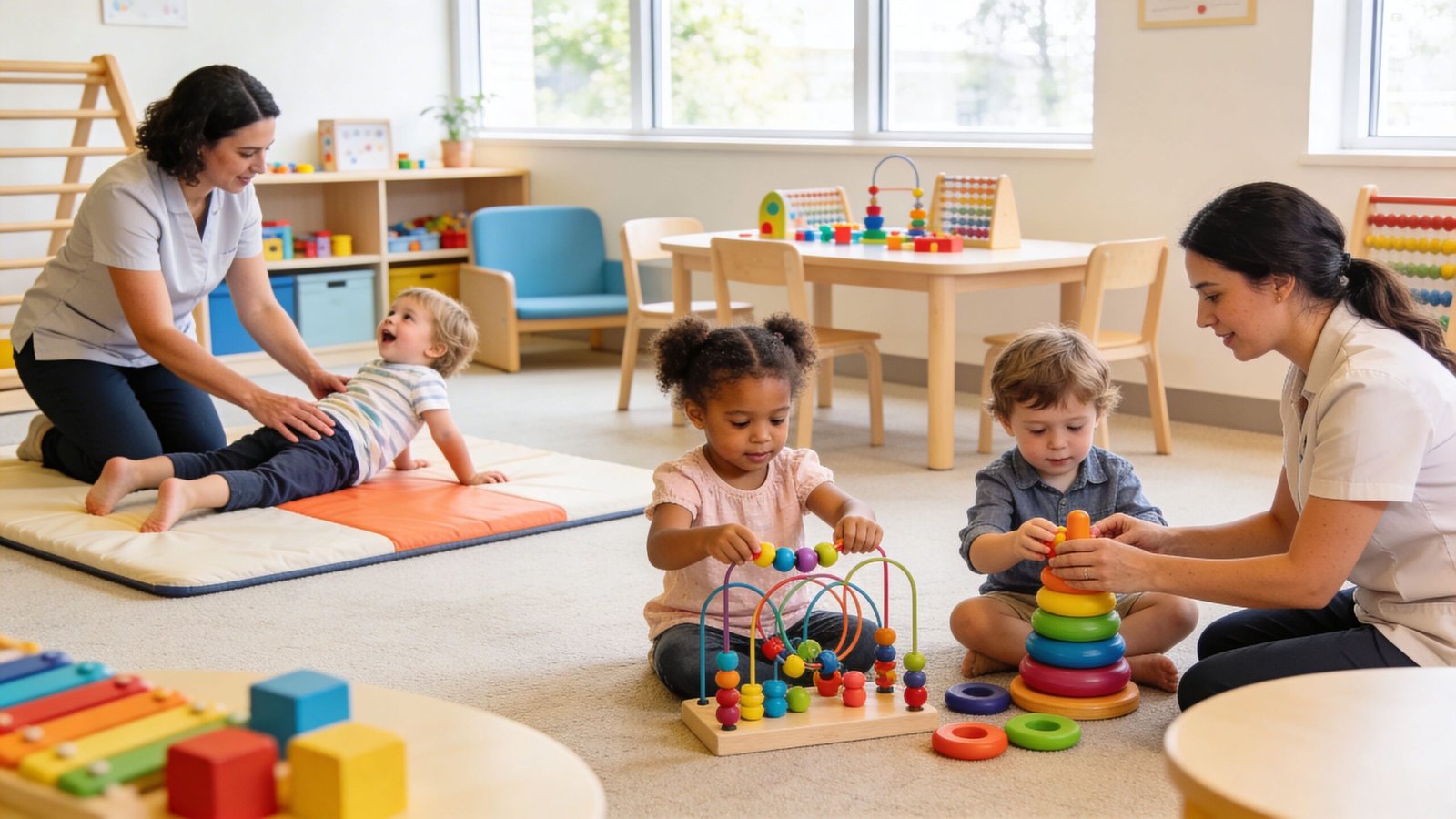
The short answer is this. Early intervention works best when it is timely, coordinated, and relevant to daily life.
Why timing and access matter
A 2025 review of interventions for GDD highlights the importance of service intensity and timing. It also notes that 95% of under-5s with developmental disabilities in LMICs face significant service barriers, which is why accessible, family-centred models that combine physical, occupational, speech, and psychological support are so important (2025 review of GDD interventions).
That doesn’t mean more hours always equals better care. It means the right support needs to happen early enough, often enough, and consistently enough to make practice meaningful.
Speech therapy in real life
Speech therapy isn’t just about saying words clearly.
For many children with global developmental delay, the first goals may be understanding language, making requests, using gestures, taking turns, copying sounds, or staying engaged in communication long enough to learn from it.
A therapist might use songs, bubbles, picture cards, pretend play, snack routines, or turn-taking games. To a child, it looks like play. Underneath, the therapist is building attention, comprehension, and communication.
Occupational therapy beyond hand skills
Parents sometimes think OT is just pencil grip or handwriting. For young children, it’s much broader.
Occupational therapy often supports:
- Body regulation so a child can sit, attend, and cope with sensory demands
- Fine motor development such as grasp, release, bilateral coordination, and tool use
- Self-care routines including feeding, dressing, and toilet readiness
- Participation in nursery tasks, transitions, and shared activities
If your child struggles to join daily routines, work with an child behavioral therapist or OT can be part of a coordinated support plan, depending on the main need.
Educational psychology and school readiness
Educational psychology helps answer questions families ask all the time.
Why does my child understand something one day and not the next? Why does group learning fall apart? How can we prepare for nursery or school?
This work often focuses on attention, play, cognitive readiness, emotional regulation, early learning style, and how to match expectations to the child’s current level. The aim is not just to teach isolated skills. It’s to help the child learn more effectively.
ABA and play-based behavioural support
Modern ABA-informed or play-based behavioural work is often most helpful when it’s practical, flexible, and child-focused.
That can include teaching:
- waiting briefly
- following simple instructions
- copying actions
- joining shared play
- tolerating change
- replacing challenging behaviour with functional communication
Some parents also want to understand how structured teaching materials are used in educational settings. Resources like the Autism Helper Curriculum can be useful for seeing how routines, visuals, and scaffolded tasks support learning.
Good intervention doesn’t force a child to perform. It builds skills in ways the child can understand, repeat, and use in everyday life.
Integration is the key
Therapies are most useful when they work together.
A child may need speech goals during OT because sensory regulation affects communication. They may need behavioural support during language tasks because engagement affects learning. They may need psychology input because school readiness depends on more than vocabulary.
An integrated service can help with this. Georgetown early intervention centre provides developmental assessments, speech therapy, occupational therapy, behavioural support, and family support for young children with developmental delays, which can make coordination easier when multiple domains are involved.
How Georgetown Creates Your Child’s Unique Plan
Parents often say the same thing after several disconnected appointments. “Everyone gave us useful advice, but no one joined it together.”
That gap matters. Children with global developmental delay don’t experience life in separate departments. Their movement, communication, attention, play, and daily routines all affect one another.

From intake to an individual plan
A joined-up model starts by asking what daily life looks like.
A child may come in because parents are worried about speech. During assessment, the team may also notice weak imitation, poor frustration tolerance, fine motor difficulty, and trouble following routines. If each therapist worked in isolation, the family would receive four separate lists.
A stronger process creates one coherent plan.
That often includes:
- shared goals across disciplines
- priorities chosen with the family
- therapy targets linked to home and nursery life
- regular review of what is and isn’t working
What collaboration looks like in practice
Consider a child who finds transitions hard, uses few words, and avoids table tasks.
The speech therapist may target requesting and understanding simple instructions. The occupational therapist may work on sensory regulation, posture, and hand use. The educational psychologist may look at attention, readiness, and the child’s learning profile. The behaviour therapist may shape engagement, flexibility, and participation in short play routines.
These aren’t separate tracks. They support one another.
A request like “help please” may reduce frustration. Better postural control may increase task tolerance. Clearer routines may improve attention. The child begins to experience success instead of repeated breakdowns.
Why this matters for families in the region
In many low- and middle-income countries, including some in the AE region, 43% of children under five are at risk of not reaching their developmental potential due to poverty and stunting. Global frameworks call for early intervention, but fragmented services often leave families without integrated support (early childhood development and LMIC context).
For parents, fragmentation feels exhausting. You repeat the same history, carry advice from one clinic to another, and try to make conflicting recommendations fit into ordinary life.
A family-centred plan reduces that burden.
The best therapy plan is one your child can follow, your family can understand, and the team can adapt over time.
How parents stay part of the process
Families aren’t spectators in this model.
Parents help define what matters most. That could be toilet readiness, safer feeding, communication during meltdowns, smoother nursery drop-off, or preparation for group learning.
Progress tracking then becomes meaningful because it’s tied to real function, not just test language. The key question is simple. Is daily life getting easier, more organised, and more connected for this child?
When the answer is yes, the plan is doing its job.
Your Family’s Next Steps Toward a Bright Future
If your child has global developmental delay, or you suspect they might, this isn’t the end of the story. It’s the point where the story becomes clearer.
Children grow with support. Families grow in confidence with guidance. And the right next step is usually much smaller and more manageable than worried parents expect.
A calm checklist for what to do next
Trust your observations
If your concern has stayed with you for weeks or months, write it down. Patterns matter more than one isolated off day.Book a paediatric review
Ask directly for developmental screening or referral if your child seems behind in more than one area.Gather everyday examples
Note what happens during meals, play, dressing, sleep, transitions, and social situations. Concrete examples help clinicians more than general statements.Ask for a multidisciplinary view
If communication, motor skills, learning, and behaviour all seem involved, a broader assessment is usually more helpful than addressing one area alone.Start support early
You don’t need to wait for every answer before beginning practical intervention.Stay involved in the plan
Ask what you can do at home, what the current priorities are, and how progress will be reviewed.
What to hold on to
Try to keep two ideas together.
First, global developmental delay is a real developmental profile that deserves proper assessment and support. Second, it does not define all of who your child is.
Your child is still the same child. Curious in some moments. Frustrated in others. Learning all the time. Therapy doesn’t replace childhood. It supports it.
The path forward is usually not one dramatic breakthrough. It’s a series of small gains that begin to add up. Better attention. Easier transitions. More communication. More participation. More confidence for your child, and more clarity for you.
If you’d like professional guidance, Georgetown early intervention center offers developmental assessment and coordinated support through educational psychology, occupational therapy, speech therapy, and play-based behavioural therapy, with individual planning shaped around each child’s needs and family goals.