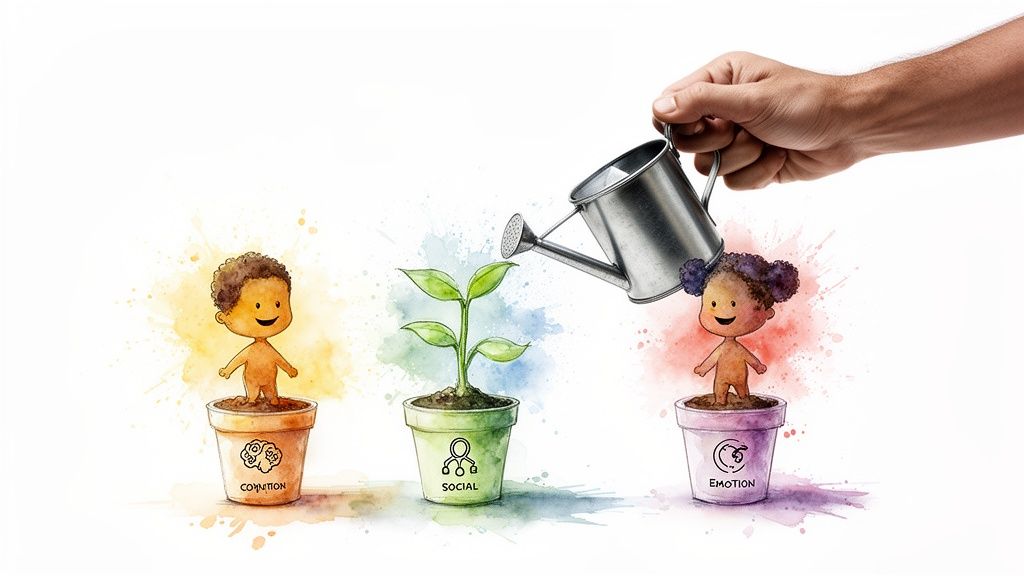
Think of an expert gardener tending to a patch of unique seedlings. Each one gets exactly what it needs to grow strong and vibrant. That’s the heart of a modern early learning centre Dubai. It’s not just a nursery or a daycare; it’s a launchpad for your child’s entire future, especially when they need a bit of specialised support to truly blossom.
Beyond Playtime: What Really Happens at an Early Learning Centre
It’s easy to see these centres as a more structured version of daycare—a place for kids to socialise and play. While that’s part of the picture, a top-tier centre in a bustling city like Dubai offers so much more, particularly for children who might be facing developmental hurdles.
Forget the idea of a traditional classroom. It’s better to think of it as a personalised development hub. During these critical early years, a child’s brain is like a sponge, rapidly forming new connections. A specialised early learning centre in Dubai is built to channel that incredible growth in a structured, supportive, and evidence-based way.
The True Mission of a Specialised Centre
The main goal isn’t simply about teaching ABCs and 123s. It’s about building the bedrock skills a child needs to succeed in every area of life. This mission is grounded in a few core beliefs:
- No Two Children Are Alike: Every child follows their own unique developmental timeline. A one-size-fits-all approach just doesn’t work.
- Developing the Whole Child: The focus is on everything—from cognitive skills and emotional control to social interaction, communication, and motor skills.
- Experts at the Helm: A team of specialists, including speech therapists, occupational therapists, and educational psychologists, work together to create a seamless support system for each child.
- You’re Part of the Team: The centre works hand-in-hand with parents. This ensures that the strategies used at the centre are reinforced at home, creating a powerful, consistent environment for your child.
This comprehensive method is particularly vital in Dubai’s diverse, multicultural setting. We’re not just getting children ready for their first day of school; we’re preparing them for a world where communication, resilience, and emotional intelligence are the keys to success.
At its core, a specialised early learning centre is a safe, nurturing environment where a child’s unique potential is understood and actively cultivated. It’s about giving them the right tools at the right time to build a solid foundation for a lifetime of learning and happiness.
This guide is here to help you understand your options, see the immense value of early intervention, and choose the right partner for your child’s journey with confidence. We’ll dive into how centres like Georgetown nurture each child’s individual path, providing an expert-led environment for growth from day one.
Why Early Intervention Is So Important
Think about a young sapling in your garden. If you notice a branch is starting to grow a bit crooked, you can gently guide it with a small stake. In no time, it corrects its course and grows straight and strong. But what if you wait until that sapling becomes a full-grown tree? Trying to fix that same branch then becomes a massive, if not impossible, undertaking. A child’s brain in the early years is a lot like that young tree—incredibly adaptable and ready to be guided.

This incredible period of flexibility in a child’s brain is called neuroplasticity. It’s the brain’s built-in ability to rewire itself by creating new connections between its cells. Early intervention taps directly into this critical window, providing focused support when the brain is at its most receptive.
For any parent who has noticed their child might be developing differently—perhaps in their speech, social interactions, or behaviour—this is a powerful message of hope. Acting early isn’t just about managing a current challenge; it’s about proactively laying the groundwork for a more successful and confident future.
Building Stronger Foundations for Life
When a child with a speech delay or early signs of autism gets specialised support, the therapies do more than just teach a new skill. They actively help forge new, more effective pathways in the brain. We’re learning more and more about this from fields like epigenetics and environmental influences on child development, which highlight just how vital these early, positive experiences are.
Starting this journey sooner rather than later has benefits that ripple throughout a child’s life.
- Improved Long-Term Outcomes: Children who receive support early on often need less intensive help as they get older.
- Enhanced School Readiness: It builds the core skills for communication, socialising, and managing emotions—all essential for thriving in a classroom.
- Increased Confidence and Self-Esteem: There’s nothing like the confidence boost a child gets from mastering a new skill or successfully navigating a playdate.
- Reduced Family Stress: Having a clear plan, a professional team, and seeing your child make progress can bring an enormous sense of relief and optimism to the whole family.
This proactive mindset is clearly catching on. In Dubai, enrolments at private early childhood centres jumped by an impressive 16% in the 2023-24 academic year. That brings the total to 274 centres supporting over 27,000 children, including more than 1,240 children of determination—those with unique needs who benefit from specialised care.
The Cost of Waiting Versus the Power of Acting
When support is delayed, a small developmental gap can easily widen. A child struggling to communicate might become frustrated, and that frustration can bubble up as challenging behaviour. Early intervention is all about getting ahead of this domino effect.
Seeking support from a specialised early learning centre in Dubai is one of the most powerful decisions a parent can make. It transforms worry into action and sets your child on a path to reach their true potential.
Ultimately, the goal isn’t to “fix” a child. It’s about understanding their unique way of seeing the world and giving them the right tools to thrive in it. It’s about building bridges for communication, fostering friendships, and unlocking their incredible capacity to learn and grow. Choosing to partner with an expert team is a huge step toward that brighter future.
Understanding the Core Therapies for Your Child
When you first step into the world of early intervention, it can feel like you’re learning a whole new language. You’ll hear acronyms like OT and ABA, and terms like Educational Psychology, but what do they actually mean for your child? At a specialised early learning centre in Dubai, these aren’t just clinical terms; they are the fundamental tools we use to help your child build real-world skills and blossom with confidence.
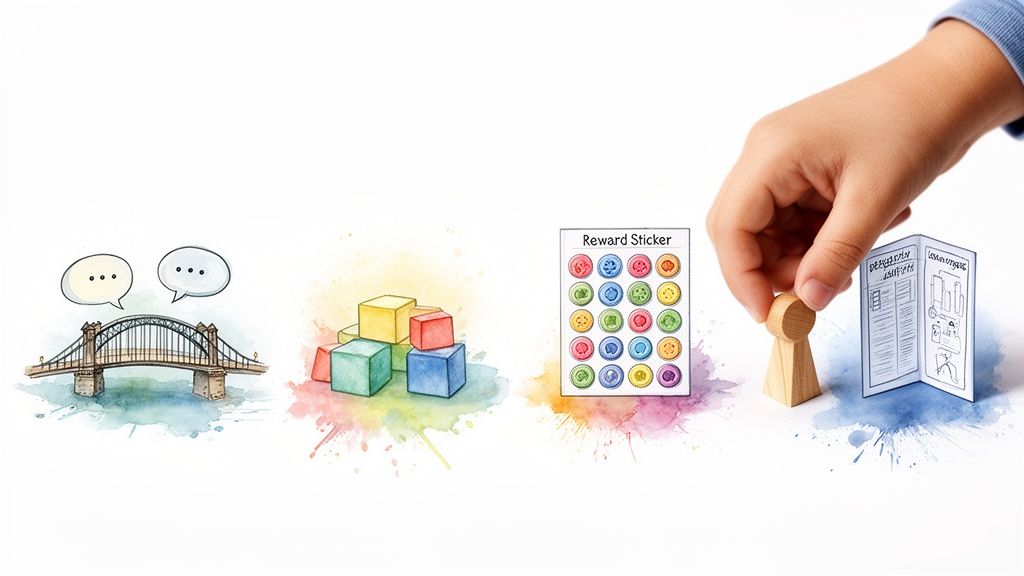
Think of it like putting together a team of master craftspeople to build a strong, beautiful home. Each therapist is a specialist with a unique set of skills, and they all work together to make sure every part of your child’s developmental foundation is solid. Let’s break down these core therapies so you can feel more comfortable and empowered in conversations about your child’s journey.
To give you a quick snapshot, here’s how these therapies fit together at Georgetown Early Intervention Centre.
Overview of Therapies at Georgetown Early Intervention Centre
| Therapy Type | Primary Focus | Who It Helps | Example Activity |
|---|---|---|---|
| Speech Therapy | Communication & Language | Children with speech delays, language disorders, or social communication challenges. | Using a fun, picture-based game to encourage a child to form a 2-3 word sentence to ask for a toy. |
| Occupational Therapy (OT) | Daily Living & Sensory Skills | Children who need support with fine motor skills, sensory processing, or self-care tasks. | Playing with therapeutic putty or threading beads to build hand strength needed for writing and buttoning. |
| ABA Therapy | Behaviour & Skill Acquisition | Children, especially those on the autism spectrum, who benefit from structured, positive reinforcement to learn new skills. | Breaking down the steps of hand-washing into a simple, visual chart and offering praise at each successful step. |
| Educational Psychology | Learning & Cognitive Assessment | Children who need a deeper understanding of their unique learning style, strengths, and challenges. | Conducting play-based assessments to identify how a child processes information and problem-solves best. |
Each of these specialties plays a crucial role, and they often overlap to provide a truly holistic support system for your child.
Speech Therapy: Building Bridges for Communication
Speech therapy is so much more than just correcting a lisp. Imagine your child’s thoughts and feelings are on one side of a river, and the world is on the other. A speech therapist is the engineer who expertly designs and builds the communication bridge to connect them.
This work covers a huge amount of ground:
- Expressive Language: This is all about helping children find their voice—using words, signs, and gestures to share what they need, think, and feel.
- Receptive Language: This is the other side of the coin. It’s about helping them understand what others are saying, follow directions, and make sense of the language around them.
- Articulation and Fluency: This is the more mechanical part, focusing on producing sounds clearly and speaking smoothly.
A session might look like a fun board game where a child has to name an object to take their turn, cleverly building their vocabulary without them even realising it’s “work.” For parents looking for deeper insights, resources on culturally sensitive speech delay therapy can offer valuable perspectives. Ultimately, the goal is to make communication feel rewarding and joyful, not like a test.
Occupational Therapy: Mastering the “Jobs” of Childhood
What exactly is a child’s “occupation”? It’s playing, making friends, learning at school, and managing everyday tasks like getting dressed or using a fork. Occupational Therapy (OT) helps children master these fundamental jobs of childhood so they can participate in their world fully and with independence.
An occupational therapist is a bit like a creative problem-solver. They look at any challenge a child is facing and come up with fun, engaging ways to build the skills needed to overcome it. If a child finds handwriting frustrating, an OT might start with activities like playing with clay or scooping sand to strengthen their hand muscles first.
Occupational Therapy helps a child build the physical, cognitive, and sensory skills needed to thrive in their environment. It’s about turning “I can’t” into “I can” through playful, purposeful activities.
The scope of OT is incredibly broad. A therapist might set up an obstacle course to improve a child’s balance and coordination or create a “sensory diet” to help a child who gets overwhelmed by loud noises or certain textures. You can learn more about how occupational therapy in Dubai provides this kind of practical, hands-on support to build foundational life skills.
ABA Therapy: A Positive Approach to Learning
Applied Behaviour Analysis (ABA) is one of the most effective, evidence-based approaches for supporting children, especially those on the autism spectrum. If you have any outdated ideas of rigid drills, it’s time to set them aside. Modern ABA is positive, child-led, and centered around play.
Think of an ABA therapist as a skill detective. They carefully observe a child to figure out the “why” behind a certain behaviour. Then, they use positive reinforcement—like a high-five, a sticker, or a minute with a favourite toy—to encourage positive skills and behaviours. It’s a gentle, systematic way to teach everything from social skills, like taking turns, to crucial life skills, like washing hands.
The magic of ABA is that it breaks down big, complex skills into small, achievable steps. This ensures the child feels successful along the way, which is a massive confidence booster. For instance, if the goal is to encourage interaction, a session might simply involve a therapist and child rolling a ball back and forth, gently guiding the child on how to ask for their turn.
Educational Psychology: Creating the Learning Blueprint
Finally, think of the Educational Psychologist as the architect of your child’s entire learning plan. They don’t just look at what a child is learning; they dig deep to understand how that child learns best.
Through comprehensive, often play-based assessments, they create a detailed blueprint of your child’s unique cognitive profile. This map highlights their natural strengths, their specific challenges, and their preferred learning style. This blueprint is absolutely invaluable. It gives the entire team—the speech therapist, the OT, and the ABA therapist—the precise information they need to tailor every single activity to your child. This is what makes an intervention plan truly individualised and genuinely effective.
Crafting Your Child’s Personalised Development Plan
When it comes to a child’s development, especially when they have unique needs, a “one-size-fits-all” model just doesn’t cut it. Think of it like getting a custom suit made—it’s tailored to fit perfectly. That’s exactly what a specialised early learning centre in Dubai should do for your child’s learning journey. This plan isn’t a static piece of paper; it’s a living, breathing roadmap we create together.

The entire process kicks off not with therapy, but with genuine understanding. It’s a true partnership from day one, built on careful observation, thorough assessment, and honest, open communication. As a parent, you are the most vital member of this team—you bring insights into your child’s world that no one else can.
This commitment to individual care is at the heart of Dubai’s fantastic early childhood sector. Just last academic year, enrolment grew by 8%, with over 29,600 children attending 312 private centres. This isn’t just a number; it shows a real community-wide belief in how these formative years shape a person for life. It’s a philosophy we live and breathe through our multidisciplinary approach. You can read more about these trends and the importance of early years from the KHDA.
The Comprehensive Assessment Phase
Before we even think about setting goals, we need to get the full picture. This isn’t just one test. It’s a holistic look at your child from several professional angles. Imagine building a house—you’d bring in an architect, an engineer, and a surveyor to create a detailed blueprint before laying a single brick. That’s our approach.
Our team typically involves:
- An Educational Psychologist to figure out your child’s unique learning style, cognitive strengths, and where they might need a bit more help.
- A Speech and Language Therapist to assess everything from verbal communication to understanding non-verbal cues.
- An Occupational Therapist to look at motor skills, sensory processing, and the ability to manage daily “jobs” like playing or getting dressed.
- A Behaviour Therapist (ABA) to analyse how your child interacts with the world around them and how they learn new skills.
Each specialist uses a mix of formal assessments and, just as importantly, informal play-based observations. This gives us a clear, accurate, and compassionate understanding of your child, ensuring their plan is built on a rock-solid foundation.
An individualised plan is more than just a list of therapies; it’s a strategic roadmap that connects your child’s current abilities to their future potential, with clear, measurable milestones along the way.
Setting Meaningful and Achievable Goals
With the assessments complete, our team sits down with you to map out the Individualised Education Plan (IEP). This is where your voice is absolutely essential. We work together to set goals that are SMART: Specific, Measurable, Achievable, Relevant, and Time-bound.
So, instead of a vague goal like “improve communication,” a SMART goal would be something like: “Within three months, your child will use two-word phrases to ask for a favourite toy in 80% of chances during play therapy.” This kind of clarity makes it easy for everyone—therapists, teachers, and you—to see and celebrate progress. These goals can cover anything from improving their pincer grasp for writing to learning how to take turns with a friend.
If you’re looking for ways to support this at home, our guide on fun and effective fine motor skills activities is a great place to start.
A Living, Breathing Document
Most importantly, this plan isn’t carved in stone. It’s a living document that we review and tweak all the time. We meticulously track progress through data collection during sessions and share everything with you in regular meetings and reports. As your child masters new skills and their needs change, the plan changes right along with them. This ensures the support they get is always perfectly in sync with their journey.
What to Look For When Choosing the Right Centre
Finding the right early learning centre in Dubai for your child is a big decision, and it’s completely normal to feel the weight of that responsibility. But this process doesn’t have to be a stressful test. Think of it more as a series of conversations and observations—a journey to find a place that feels like a true partner for your family.
This guide is here to give you the confidence to ask the right questions and know what to look for. We’ve broken down the key areas to focus on so you can walk into every tour feeling prepared and empowered to make the best choice for your child.
The Team: Who Will Be Working With Your Child?
The heart of any great centre is its people. The qualifications, experience, and simple kindness of the staff will have the single biggest impact on your child’s happiness and progress. When you visit, pay close attention to the human element.
Start by asking directly about the team’s credentials. Are the therapists and educators fully licensed and certified? What specific, hands-on experience do they have with children who share your child’s needs, whether that’s autism, a speech delay, or other developmental challenges? A transparent, high-quality centre will be happy—and proud—to share this with you.
What you’re really looking for is that spark. Watch how the staff interacts with the children. Are they warm? Respectful? Genuinely engaged? That positive, nurturing atmosphere is something you can feel, and it’s absolutely essential.
Don’t forget the practical side of things. Ask about the child-to-staff ratio. You’ll want to know this for group settings and, just as importantly, for one-on-one therapy sessions. Lower ratios almost always mean more focused, personalized attention, which is critical for children needing that extra layer of support.
The Space: Environment and Facilities
The physical environment sets the stage for learning. A well-designed centre should feel safe, welcoming, and stimulating—but never overwhelming. As you walk through the facility, try to see it through your child’s eyes.
- Safety and Accessibility: First things first, is the space clean, secure, and well-maintained? Are their safety protocols clear and visible?
- Sensory-Friendly Design: Does the centre cater to different sensory needs? Look for things like quiet corners for when a child needs a break, thoughtful lighting, and tools that help with sensory regulation.
- Tools for Growth: Take a look at the toys, books, and learning materials. Are they age-appropriate, in good shape, and designed to actually encourage development and curiosity?
Dubai’s focus on high educational standards is clear. Private school enrolments recently surpassed 387,000, and with a growing emphasis on early years education, the quality of foundational learning is more important than ever for ensuring school readiness. This means parents have high expectations, and the best centres are ready to meet them.
The Plan: Licensing and Measuring Progress
In Dubai, official oversight provides a crucial layer of quality control for parents. One of the first questions you should ask is about licensing. Is the centre licensed by the Knowledge and Human Development Authority (KHDA)? You have every right to ask to see their latest inspection report, and you absolutely should. It provides an objective, third-party look at their standards and performance.
Just as important is understanding how they’ll track and share your child’s progress with you.
- How are individual goals set in the first place, and how are they measured?
- How often can you expect to receive formal progress reports?
- What does the schedule for parent-therapist meetings look like?
- How is the Individualised Education Plan (IEP) kept alive and updated?
A top-tier early learning centre in Dubai will have a clear, data-driven approach to monitoring development. More than that, they’ll make it a priority to keep you in the loop every step of the way. For instance, if communication is a key goal, it’s worth asking about their specific methods. You can learn more about professional speech therapy in Dubai to get a better sense of what effective techniques look like. Ultimately, you’re looking for a team that sees you as a vital part of your child’s journey.
When you’re visiting different centres, it can be tough to keep track of everything. This checklist is designed to help you compare your options and make a decision based on what truly matters for your child.
Checklist for Choosing the Right Early Intervention Centre
| Category | Key Questions to Ask | What to Look For (The Ideal Answer) |
|---|---|---|
| Staff & Expertise | What are the qualifications of your therapists? What is your staff-to-child ratio? Can I observe a session? | Licensed and certified professionals (BCBA, OT, SLP). Low ratios for personalized care. A confident “yes” to observing interactions. |
| Therapies Offered | What specific therapies do you offer (ABA, OT, Speech, etc.)? How are they integrated into the daily schedule? | A multidisciplinary team offering a range of evidence-based therapies under one roof. A clear, cohesive schedule. |
| Individualized Plans | How do you create an Individualized Education Plan (IEP)? How often is it reviewed and updated with parents? | A collaborative process involving parents from day one. Regular, scheduled reviews (e.g., quarterly) with clear goals and data. |
| Environment | Is the facility sensory-friendly? What safety measures are in place? Are learning materials engaging and appropriate? | Dedicated sensory rooms, quiet spaces, and secure access. A clean, organized, and stimulating environment. |
| Progress Tracking | How do you measure and report progress? What tools or methods do you use? | Data-driven approach with regular, easy-to-understand reports. A mix of formal assessments and informal observations. |
| Parent Involvement | How are parents included in the therapy process? Do you offer parent training or support groups? | An open-door policy. Regular communication (apps, emails, meetings) and resources to empower parents at home. |
| Licensing & Fees | Are you licensed by the KHDA? Can I see your latest report? What is the fee structure and what does it include? | Full KHDA licensing with a positive report. Transparent, all-inclusive pricing with no hidden costs. |
Using a structured checklist like this ensures you gather the same critical information from each centre, making your final decision clearer and much less stressful. You’re not just choosing a centre; you’re choosing a partner in your child’s development.
Your Next Steps on This Journey
It’s completely normal to feel a bit overwhelmed when you’re navigating the world of developmental support for your child. Just by reading this, you’ve already taken the most important step: deciding to learn more and seek help. You now have a clearer picture of how a specialized early learning centre in Dubai is so much more than just childcare; it’s a place for targeted, expert-led support that can make a profound difference.
The most important thing to remember is that early, personalized intervention is one of the greatest gifts you can give your child. It lays the groundwork for a more confident and capable future.
This path is all about hope and partnership, and you absolutely do not have to walk it alone. We know the mix of questions, worries, and hopes you’re feeling right now. Our entire purpose is to make what comes next feel clear, simple, and supportive.
Taking That First Step With Us
We’ve designed the process at Georgetown Early Intervention Center to be as straightforward and comfortable for your family as possible. It all starts with a simple conversation, not a formal assessment.
Book an Initial Consultation: The best way to begin is to schedule a complimentary, completely confidential chat with one of our specialists. This is your time to share what you’ve been noticing, ask all your questions, and just get a feel for our team and our approach. There’s absolutely no pressure.
What to Expect During Your Visit: When you come to see us, you’ll step into a warm, welcoming space built for children. We’ll sit down and talk about your child’s unique personality, their strengths, and the areas where they need a bit more help. We can then walk you through how our multidisciplinary team would work together to build a plan just for them.
We see parents as our most important partners. Your insights are invaluable, and that first meeting is all about starting to build a trusting relationship to help unlock your child’s incredible potential.
From that first conversation, we can figure out the best way forward together. This might mean a more detailed, play-based assessment with our team, but every step is taken at a pace that feels right for you and with your full involvement.
Exploring support for your child is a true act of love and strength. We invite you to take that brave first step with a team that genuinely cares.
Contact us today to schedule your consultation and let’s begin this hopeful journey together.
Your Questions, Answered
As a parent, you’re bound to have questions when exploring early intervention. It’s a new world for many families. Here are some honest, straightforward answers to the things we’re asked most often by parents looking into an early learning centre in Dubai.
How Do I Know If My Child Needs Early Intervention?
First and foremost, trust your gut. You know your child better than anyone. If you have a nagging feeling about their development—whether it’s their speech, how they interact, their motor skills, or certain behaviors—it’s always a good idea to chat with a professional.
Common signs can be things like not hitting developmental milestones on time, finding it hard to communicate what they want or need, or struggling to play with other kids. An initial chat with an expert can bring so much clarity. It’s not about labeling a “problem”; it’s about understanding your child’s unique strengths and challenges so we can give them the right support, right when they need it.
What’s the Difference Between a Nursery and an Early Intervention Centre?
This is a great question, and the difference is significant. Think of a mainstream nursery like a general group fitness class—it’s designed to benefit everyone in a broad sense. An early learning centre in Dubai, on the other hand, is like having a dedicated personal trainer who designs a specific program just for you.
- Nurseries are fantastic for general early education and socialization for neurotypical children.
- Early Intervention Centres offer targeted, highly specialized therapy, often one-on-one or in very small groups. These sessions are led by qualified professionals like speech or occupational therapists and are all guided by a detailed Individualized Education Plan (IEP).
How Long Will My Child Need to Be in the Program?
There’s no one-size-fits-all answer to this, because every child’s journey is unique. The length of time really depends on your child’s individual goals, how they progress, and what our team of therapists recommends.
Some children might join us for a few months to focus on a very specific skill, like articulation. Others might benefit from a longer period of support to build a really solid foundation before they transition into a mainstream school.
The ultimate aim isn’t to keep a child in therapy indefinitely. It’s to give them the tools, skills, and confidence they need to truly thrive in a regular school setting and in life. We’re constantly checking in on progress and adjusting their plan as they master skills and hit new milestones.
Will My Child Still Get to Play and Just Be a Kid?
Yes, a hundred times yes! Play is the language of childhood, and it’s the cornerstone of everything we do. Modern, effective therapy, especially approaches like ABA, is built around play.
Honestly, our therapy sessions often just look like really fun, structured playtime. We use games, toys, songs, and activities your child already loves to teach new skills. This makes learning motivating and exciting, not a chore. They’ll be growing, learning, and building skills all while having a great time—and that’s when the real magic happens.
At Georgetown Early Intervention Center, we’re here to walk alongside you, answer every question, and make this process feel less overwhelming. We see parents as our most important partners in helping every child shine.
Ready to learn more? Schedule a free, confidential consultation with our team.