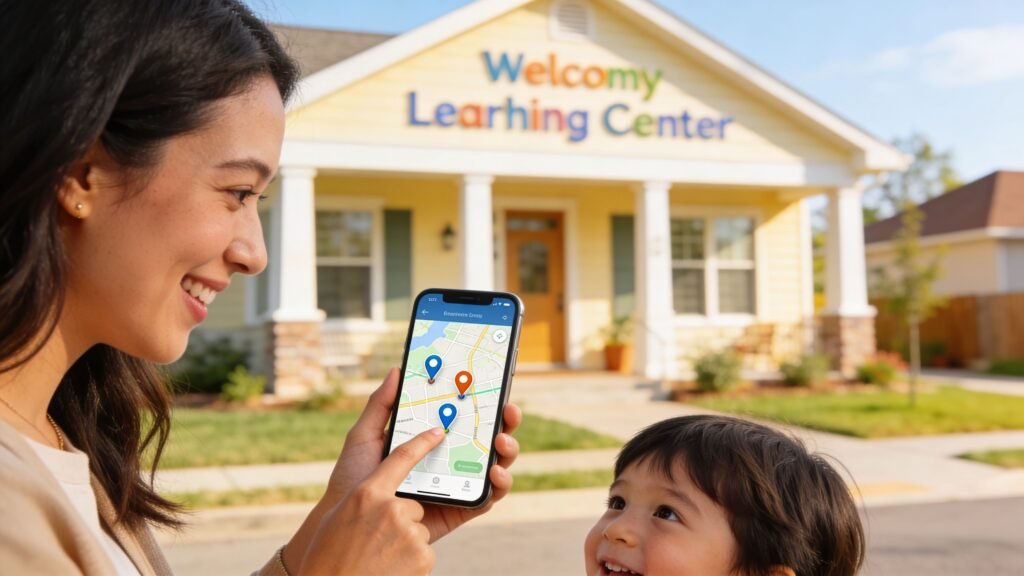
You have probably done the late-night search.
You typed early learning center near me, then changed it to “speech therapy for toddlers”, then “autism preschool near me”, then “is my child behind?”. You watched your child line toys up, avoid eye contact, struggle to say words, melt down during transitions, or fall behind peers in ways you cannot ignore anymore.
That feeling matters.
You are not just looking for childcare. You are looking for a place that can understand your child, support development properly, and give you honest answers. Generic preschool advice is not enough when autism, speech delay, sensory needs, or school readiness are part of the picture.
Your Journey to Finding the Right Support
A lot of parents arrive here carrying the same private worry. Their child is bright, funny, affectionate, and completely themselves. But something feels different. Maybe language is not coming easily. Maybe play looks repetitive. Maybe group settings end in tears. Maybe nursery staff have said, gently, that your child “might need a bit more support”.
That is usually the moment the search changes.
Instead of looking for convenience, you start looking for fit. You stop asking, “Who has a place available?” and start asking, “Who can help my child grow?”

What most parents discover too late
Many centres sound supportive online. Far fewer clearly explain how they handle a child who needs educational psychology, occupational therapy, speech therapy, and ABA working together. In the Atlanta East region, parents often ask for exactly that kind of individualised support, yet many centres do not explicitly advertise multidisciplinary intervention, according to GEEARS.
That gap matters. If a centre cannot explain how specialists work together, it often means they do not.
What a better search looks like
You need a centre that can answer questions such as:
- How do you assess communication delays
- Who writes the child’s goals
- How do OT, speech, and behaviour support connect
- What happens when my child is overwhelmed
- How do you prepare children for classroom expectations without forcing them into a rigid mould
The right centre does not dismiss your concerns or tell you to “wait and see” without a plan. It gives you a process.
If you are still deciding whether to act now or give it more time, review these benefits of early intervention. It is a useful reminder that early support is not about labelling a child. It is about reducing frustration, building skills, and making everyday life easier for both child and family.
You do not need to find a perfect centre. You need to find one that is organised, honest, skilled, and responsive to your child’s needs.
How to Begin Your Search for Local Centers
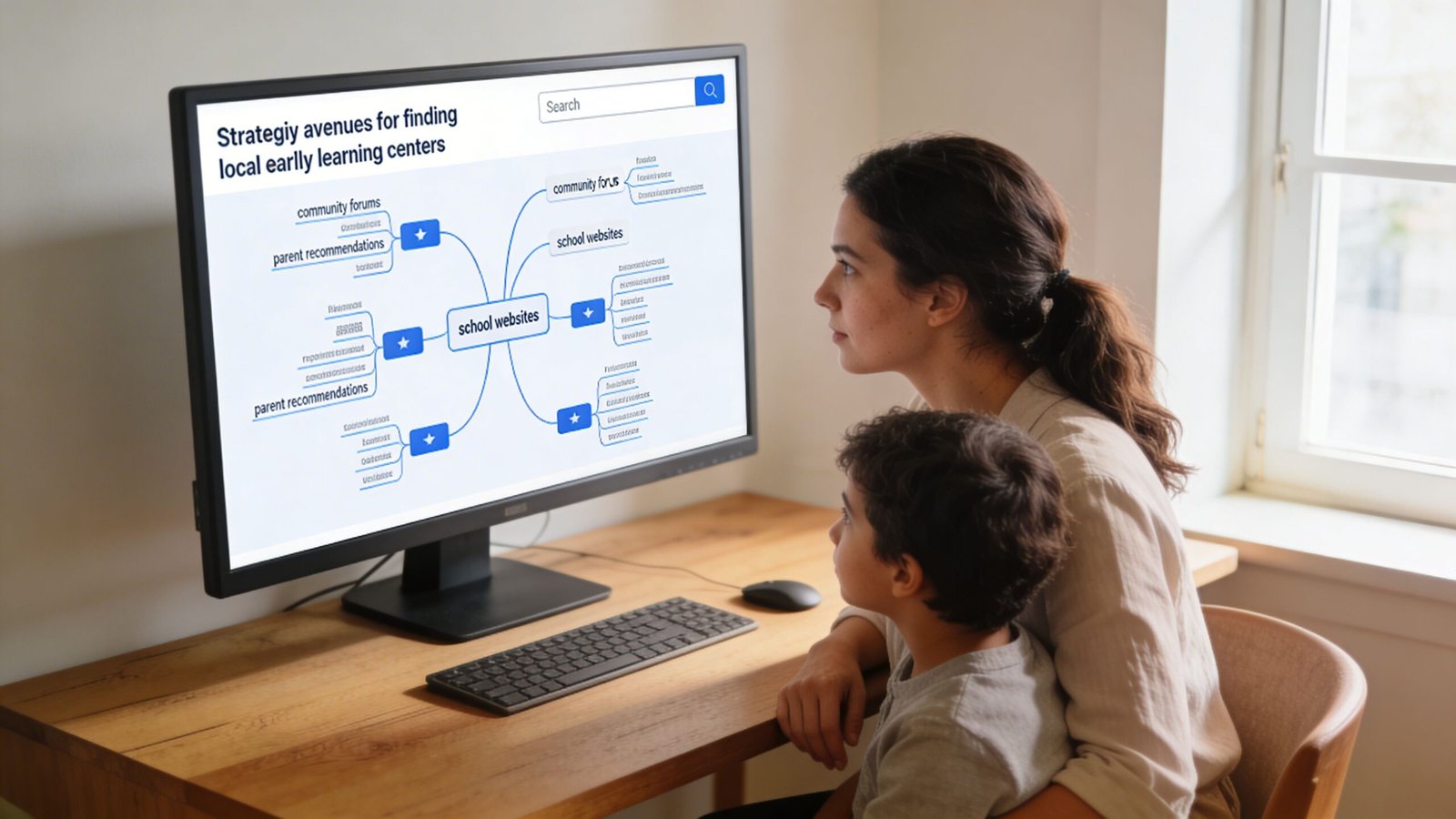
Start wide, then narrow fast. Parents often do the opposite. They click the first few results, skim glossy websites, and get stuck comparing marketing language. That wastes time.
In places with many options, a loose search creates noise. In Kansas City, for example, there can be over 129 licensed preschools and early learning centres, which is exactly why parents need a structured method instead of random browsing, as noted by Care.com’s Kansas City preschool listings.
Use search terms that force specificity
Do not just search early learning center near me and hope the right place appears.
Use combinations like:
- play-based ABA near me
- speech therapy for toddlers preschool
- occupational therapy sensory preschool
- school readiness programme for speech delay
- educational psychologist early childhood centre
- autism early intervention centre near me
These terms push therapy-based centres higher and generic nursery pages lower.
Build a short list from four places
Ask your paediatrician for names
Not broad recommendations. Names.
Ask, “Which local centres do you trust for children with speech delay, autism traits, sensory regulation issues, or school readiness concerns?” Doctors often know who communicates well and who sends useful progress updates.
Use parent groups carefully
Local parent groups can help, especially when you ask narrow questions. Ask which centres handle transitions well, communicate clearly, or support children who need OT or speech during the week.
Ignore comments that only mention friendly staff or pretty classrooms. Those things are nice. They are not enough.
Check licensing and public records
A centre can feel warm and still be poorly run. Licensing is your baseline filter, not your final decision-maker.
Map options before calling
Use a location overview such as https://georgetownuae.com/locations.kml to organise your search by area, drive time, and convenience. This matters more than parents admit. A centre may be excellent, but if the daily journey is unrealistic, attendance becomes inconsistent.
Make your first calls count
Keep the first call short and direct. Ask these three questions:
- Do you support children with speech delay, autism, or sensory needs?
- Do you have in-house specialists or outside referrals only?
- How do you create individual plans for children who need extra support?
If the answer is vague, cross them off.
A strong centre can describe its process in plain language. If staff dodge basic questions, the problems usually get worse once your child starts.
Your goal at this stage is not to choose. It is to eliminate weak options quickly.
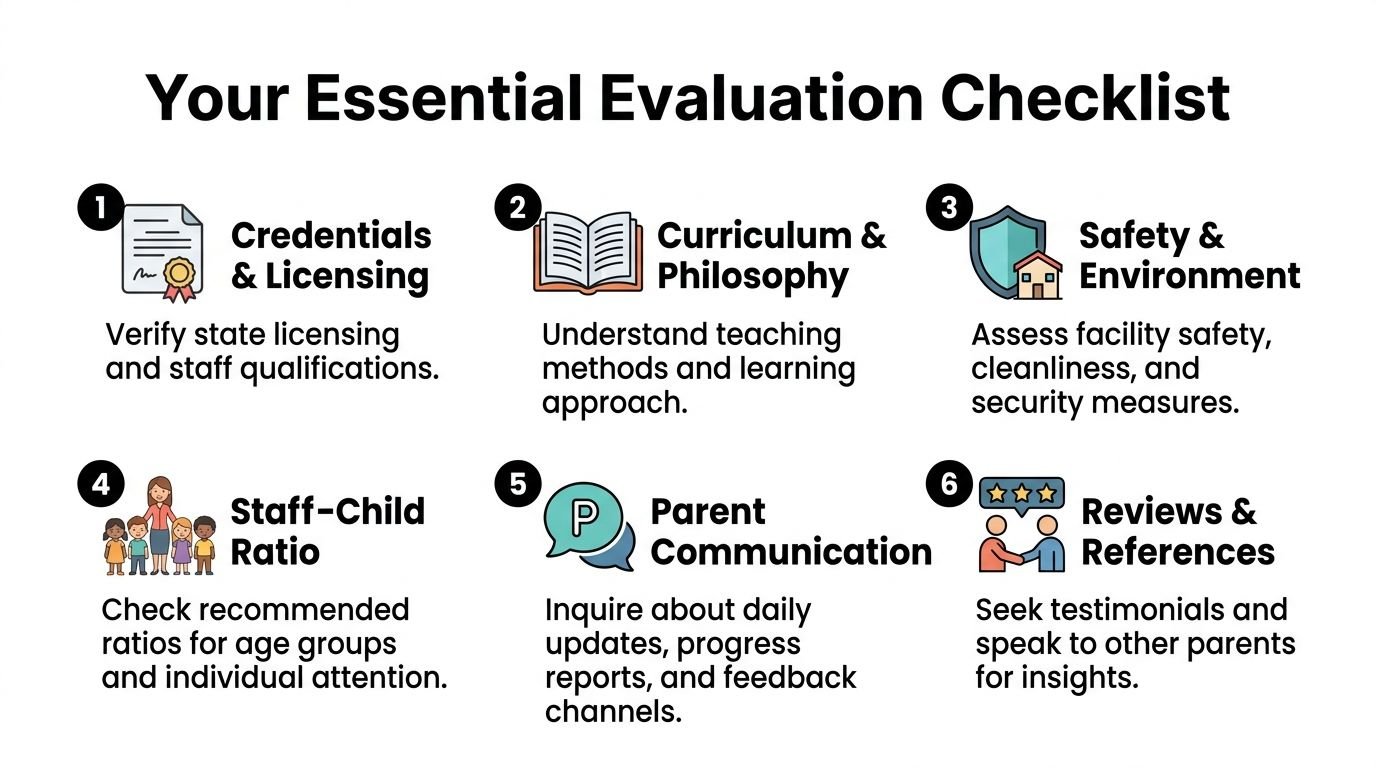
Your Essential Evaluation Checklist
Once you have a shortlist, stop being a polite browser. Start acting like an evaluator.
Most parents compare centres by atmosphere alone. That is a mistake. Warmth matters, but children with autism, speech delay, motor planning difficulties, or regulation challenges need more than a cheerful room and kind staff.
Check licensing first, then look underneath it
Licensing does not prove excellence, but lack of it is a major warning sign.
In Missouri, for example, state rules cap group sizes for registered home providers at 6 children to protect quality and individual attention, according to the Missouri child care search and licensing information. That should shape how you think about ratios everywhere else. Small numbers support observation, regulation, communication, and real teaching.
Ask the centre:
- What is your current staff-to-child ratio in my child’s age group
- How many children are in the room at one time
- Who steps in when a child needs one-to-one support
- How do you support children during toileting, mealtimes, and transitions
If your child is working on independence skills, this is also a good time to review a practical potty training readiness checklist, because toileting readiness and centre support often affect placement success more than parents expect.
Look for a real multidisciplinary team
A centre that says “we can accommodate” is not the same as a centre that can intervene well.
You want evidence that professionals know their roles and coordinate them. The strongest benchmark is a team that includes specialists such as an educational psychologist, speech-language pathologist, occupational therapist, and ABA therapist, all contributing to an individualised plan. That kind of IEP-driven collaboration is a meaningful standard for parents to ask about, based on the multidisciplinary model described by Child Achievement Center.
Ask for specifics, not slogans.
Good answers sound like this
- The speech therapist assesses communication and gives weekly targets.
- The OT addresses sensory regulation, fine motor skills, and participation.
- The behaviour therapist works on learning readiness, flexibility, and functional communication.
- The educational psychologist helps interpret learning profile, attention, and classroom access.
Weak answers sound like this
- “We personalise things for every child.”
- “All our staff are experienced.”
- “We take a thorough approach.”
Those are marketing phrases, not operational answers.
If a centre cannot tell you who assesses what, who writes goals, and how progress is reviewed, then the programme is not individualised in any meaningful way.
Reject one-size-fits-all programming
This is the checkpoint most parents miss.
Some centres place every child into the same routine, same circle time expectations, same sensory activities, and same behaviour system. That may work for typically developing children in a general preschool setting. It often fails neurodiverse children.
A proper plan should be built around your child’s profile. Ask:
- What assessments do you use at intake
- How do you set baseline goals
- How often do you review progress
- Do parents get written updates
- How do goals change when a child is not progressing
You can also compare what a centre says against its main early childhood offering, such as https://georgetownuae.com/early-childhood-centre/, to see whether its day-to-day model appears organised, developmentally appropriate, and built for young children rather than just supervised.
Use this scorecard during comparisons
| Area | What to look for | What to avoid |
|---|---|---|
| Licensing | Current, clear, easy to verify | Evasive answers |
| Ratios | Low enough for individual attention | Overcrowded rooms |
| Specialists | Named professionals with defined roles | “Consultants” with no visibility |
| Planning | Individual goals and regular review | Same programme for every child |
| Communication | Structured updates and parent involvement | Only verbal end-of-day comments |
| Environment | Calm, organised, adaptable | Chaotic or overly rigid |
A centre does not need to be fancy. It needs to be competent.
Making the Most of Your Center Tour
A website tells you what a centre wants you to believe. A tour shows you how the place functions.
Do not spend the visit admiring wall displays and tiny furniture. Watch adults. Adults tell you everything.

What to ask when you walk in
High-quality centres often rely on a multidisciplinary team, where educational psychologists, SLPs, OTs, and ABA therapists collaborate around an IEP-style plan. That is a strong benchmark for your questions, based on the model described by Child Achievement Center earlier in this guide.
Use that benchmark during the tour.
Ask the director or lead staff:
- Who completed the last child assessment for communication or sensory needs?
- How do therapists and classroom staff share information?
- What happens when a child cannot join group activities?
- How do you support transitions between activities?
- How do you handle sensory overload, avoidance, or distress?
- Can you show me how progress is documented?
- How often do parents meet with staff to review goals?
If they speak clearly and give examples, that is a good sign.
If they answer with broad philosophy only, keep your guard up.
What to observe without asking
During the tour, look for moments when things are not perfectly smooth. That is where quality shows.
Watch transitions
A strong centre prepares children before changes happen. Staff use visual cues, routines, prompts, and calm support. A weak centre relies on repeated verbal commands and then blames the child for struggling.
Watch how adults respond to frustration
Do staff crouch down, reduce language, and help the child regulate? Or do they talk over the child, rush them, or remove them without explanation?
Watch the room setup
Children with speech delay, autism, or sensory differences often do better in spaces that are structured but not harsh. You want defined activity areas, accessible materials, and enough visual order that the room makes sense.
The best room is not the loudest, brightest, or most decorated. It is the one where children can participate without becoming overwhelmed.
Bring a simple note sheet
Parents forget details after two or three tours. Use a quick note format on your phone or in a notebook.
Record:
- First impression
- How staff greeted your child
- How clearly they explained support
- Whether the environment felt calm or chaotic
- Whether you saw genuine engagement
- Any answer that felt vague
Pay attention to your child, not just the presentation
Some children move into a centre easily. Others freeze, cling, hide, or become dysregulated. Neither reaction gives the whole answer, but it gives useful information.
If staff notice your child’s signals and adjust naturally, that matters. If they push for compliance immediately, that matters too.
A good tour should leave you feeling informed. It should not leave you confused, pressured, or guilty for asking direct questions.
Recognizing Red Flags and Trusting Your Instinct
Parents often assume that if a centre is popular, full, or beautifully branded, it must be good. That assumption fails a lot of families.
Demand for play-based ABA and OT services has risen, and that can push newer or overstretched centres to expand before their systems are ready, as noted in the early learning trends described by United Way of Greater Atlanta Learning Spaces. When demand climbs, weak centres hide behind buzzwords.
Red flags that matter
Some warning signs are obvious. Others are subtle.
Watch for these:
- Vague language such as “we meet every child where they are” with no explanation of how.
- No clear specialist access even though the website heavily mentions support needs.
- Defensiveness when you ask about credentials, supervision, or progress tracking.
- One behaviour approach for every child, regardless of language level or sensory profile.
- Poor parent communication, especially if updates are casual and inconsistent.
- An environment that feels either chaotic or strangely rigid.
The most dangerous phrase
“We’ve seen it all.”
Experienced staff do not talk like that. Skilled professionals stay curious. They assess, adapt, and ask follow-up questions. Overconfidence usually covers weak observation.
If a centre minimises your concerns in the first conversation, expect more of the same after enrolment.
Trust the feeling you cannot quite explain
Sometimes a place checks boxes on paper and still feels wrong. Staff seem rushed. Children look managed rather than supported. Questions get answered, but not well. You leave with tension in your chest.
Pay attention to that.
Parental instinct is not irrational. It often picks up inconsistency before your brain can organise it into words. You do not need courtroom evidence to walk away from a centre that feels off.
How Georgetown Delivers on Every Checkpoint
Georgetown is built around the standards that matter most to families looking for more than a generic preschool placement.
The team includes an educational psychologist, occupational therapist, speech therapist, and behaviour play-based therapist (ABA). That matters because children do better when adults work together instead of treating communication, behaviour, sensory processing, and learning as separate problems.
The centre also rejects the standardised model that frustrates so many parents. Each learner receives an individual plan because each child presents differently. A child with autism and strong visual learning needs a different approach from a child with speech delay and motor planning difficulty. A centre should respond to that difference, not flatten it.
What this means for parents
You are not left guessing who is responsible for what.
You are not asked to settle for “he’ll grow out of it” or “let’s wait and see”.
You can expect a structured process, collaborative support, and a programme shaped around development rather than convenience. Families also looking ahead to classroom transition can review Georgetown’s https://georgetownuae.com/services/school-readiness-program-in-dubai/ to see how school readiness support fits into the wider intervention picture.
If you have read this far, you already know the standard to hold. Georgetown was designed to meet it.
Frequently Asked Questions
How do I know whether my child needs an early learning centre or a therapy clinic
It depends on what your child needs most during the day.
If the main challenge is participation in group routines, communication in natural settings, sensory regulation, play, or school readiness, an early learning environment with therapeutic support often makes more sense than isolated appointments alone. If your child needs highly specific clinical intervention only, a clinic may be part of the plan.
Many children need both.
What should I expect in the first few weeks
Expect adjustment. New adults, new sounds, new routines, and new demands can be hard, especially for children with autism, language delays, or sensory sensitivities.
A good centre prepares for this. Staff should talk with you about transition support, preferred toys, comfort items, snack routines, regulation strategies, and how to respond if your child becomes distressed.
How often should a centre communicate with parents
Frequently and clearly.
You should know what your child is working on, what is improving, where they are stuck, and how to support carryover at home. Casual comments at pick-up are not enough if your child has developmental goals.
Look for a centre that gives structured updates and invites real discussion.
What if my child is not toilet trained yet
That should not automatically rule out a placement, especially when developmental delays are part of the picture.
Ask how staff handle toileting routines, accidents, sensory discomfort, and transitions to the bathroom. The answer will tell you a lot about whether the centre is practical and supportive.
Should I worry if my child does not “perform” during the tour
No.
Some children shut down in new settings. Others become hyperactive or clingy. Skilled staff know how to read that without judging. Your child does not need to impress anyone on the visit. The centre needs to show that it can understand and respond appropriately.
How quickly should I decide
Do not drag it out once you find a strong fit.
Good centres fill places quickly. If a centre answers clearly, welcomes your questions, explains individual planning well, and feels organised in person, move forward. If you are still trying to convince yourself after the tour, keep looking.
If you want a centre that takes autism, speech delay, occupational therapy, ABA, educational psychology, and school readiness seriously, contact Georgetown early intervention center. The team can help you understand your child’s needs, explain the next steps clearly, and build an individual plan that fits who your child is.