
Your child has had a difficult week at nursery. A teacher mentions speech concerns, you have noticed more meltdowns at home, and by 11 p.m. you are comparing clinics on your phone, trying to work out which one can help. Parents rarely need more options. They need a reliable way to judge them.
That is the purpose of this guide. It is written for families comparing support for autism, speech delay, behaviour, sensory regulation, school readiness, and related developmental needs. The goal is not to rank every clinic as if they offer the same service. The goal is to help you choose based on fit, team structure, and the quality of the assessment and treatment plan.
Dubai has no shortage of providers, and that can make the process harder, not easier. Licensing is one basic filter. If you are unsure about a clinician’s status, you can verify professional licensing directly through the DHA’s official Sheryan provider search. The more difficult question is whether a centre can translate credentials into useful care for your child. Some clinics are strong with early autism support. Others do better with speech and language, feeding, sensory processing, or school coordination.
A good decision usually comes from asking better questions early.
How to Choose the Right Provider
Use these criteria when you compare centres:
- Licensing and role clarity: Confirm who will see your child and what each clinician is licensed to do. A centre may market itself well but rely heavily on one discipline when your child needs a broader team.
- Assessment quality: Ask what happens before therapy starts. Strong providers gather developmental history, observe the child carefully, and explain the reasoning behind their recommendations instead of pushing a preset package.
- Team coordination: Children with communication, sensory, and behavioural needs often make better progress when speech therapy, OT, ABA, and psychology are aligned. That coordination should show up in shared goals, not just in the clinic brochure.
- Parent coaching: Therapy is rarely enough on its own. Parents need clear home strategies, realistic expectations, and honest feedback about what is and is not working.
- Progress tracking: Ask how goals are written, how often they are reviewed, and what the centre changes if progress stalls.
- Practical fit: Travel time, session frequency, therapist consistency, waiting lists, and school collaboration all affect outcomes. The best clinical plan can still fail if the schedule is unsustainable.
For younger children, a provider with a strong early-years environment can matter as much as the therapy menu. Families weighing that option can also review Georgetown’s early childhood center program. If you are comparing support for sensory, motor, and daily living skills, this guide to occupational therapy for children is a useful companion.
One practical rule helps parents avoid wasted time. If a centre cannot explain how it sets goals, measures progress, and changes course when a plan is not working, keep looking.
1. Georgetown early intervention center
A common parent scenario starts like this. A toddler is late to speak, preschool is raising concerns about attention or behaviour, and every professional seems to suggest something different. In that situation, a centre built for early intervention often makes more sense than a general clinic, because the central question is not who offers the longest service list. It is who can assess the child clearly, set priorities, and turn therapy into a plan a family can follow.
Georgetown early intervention center is one of the stronger options in Dubai for that kind of early-years decision. Its model appears focused on children who need support across more than one area, including autism, speech and language, sensory processing, behaviour, and school readiness. That focus matters. Young children rarely fit into one neat category, and parents usually need a provider that can connect developmental goals instead of treating each concern in isolation.
The centre brings together ABA, occupational therapy, speech therapy, and educational psychology. For families comparing providers, that mix is useful if the child’s difficulties overlap. A child with speech delay may also struggle with regulation, transitions, play skills, or classroom participation. In practice, progress is often better when those issues are addressed together rather than split across separate clinics.
Where Georgetown fits best
Georgetown is likely to suit families who want a child-focused setting rather than a broad medical environment. That can be a better fit for younger children who need therapy that connects directly to play, routines, and early learning. Parents should still ask how the team decides what comes first. The right provider does not only confirm a diagnosis and start booking sessions. It explains which skills are limiting the child most right now and why.
Its early-years orientation is a meaningful advantage. Families looking at school readiness, transitions, and behaviour in group settings can also review Georgetown’s existing early childhood centre offering, since that gives a clearer picture of how the centre links therapy goals to daily functioning. If behaviour is one of the main concerns, it also helps to see how the centre frames support from a child behavioral therapist rather than assuming every behaviour challenge needs the same approach.
Family involvement is another point in its favour. The centre describes its care as family-centred and neuro-affirming, which is a good sign if it shows up in practice through coaching, realistic goal setting, and respect for the child’s profile. Parents should listen for specifics during intake. Ask what the first goals will be, how home strategies are taught, and what the team will change if the initial plan is not producing enough progress.
Trade-offs parents should weigh
The main limitation is practical transparency. Pricing, insurance details, and session availability are not clearly laid out in the section most parents will want to review first, so families will need to ask direct questions before deciding. That is not unusual in Dubai, but it does make comparison harder, especially for parents trying to judge long-term affordability across multiple sessions each week.
The service model also appears geared mainly toward in-person support in Dubai. That works well for families who want a structured centre-based setting and regular face-to-face input. It may be less suitable for families outside the city, families who need teletherapy, or parents whose schedules make frequent travel difficult.
For the right family, Georgetown is a strong choice because it addresses a common early intervention problem. Parents are often not choosing between "good" and "bad" clinics. They are choosing between a centre that can integrate speech, regulation, behaviour, and learning needs early, and a provider that handles only one part of the picture.
Best for
- Autism and developmental support: Families who want ABA, OT, speech, and educational input coordinated in one setting.
- Younger children with overlapping needs: Children whose speech, sensory, behavioural, and school-readiness challenges affect each other.
- Parents comparing providers carefully: Families who want a centre that can translate assessment findings into an early intervention plan, not just a stack of separate referrals.
2. Camali Clinic
A parent often reaches Camali after a messy few months. A teacher has raised attention concerns, speech is behind, meltdowns are getting harder to manage, and nobody is sure whether the main issue is developmental, behavioural, emotional, or a mix of all three. Camali is one of the clinics families look at when they need several questions answered in one place.
Camali Clinic stands out for its range of services. Psychology, psychiatry, speech and language therapy, occupational therapy, and ABA sit under one roof. That setup suits children whose difficulties do not fit neatly into one category, especially when parents are trying to work out what should be assessed first and which therapy should carry the most weight.
That breadth is useful, but it should be judged carefully. A long service list is only helpful if the clinic can translate it into a clear plan for your child. Parents should ask who leads the case, how goals are coordinated across disciplines, and what happens if the assessment points away from the service you first came in for.
Where Camali fits best
Camali makes sense for families who want both therapy input and medical oversight available in the same clinic. This can be especially helpful when attention, anxiety, mood, sleep, behaviour, and development may be interacting with each other. In those cases, separating therapy from psychiatric or psychological review can slow decisions.
For autism-related concerns, speech delay, or behaviour that is affecting school participation, families should also look at whether the clinic explains its clinical reasoning well. Good multidisciplinary care is not just access to several professionals. It is a process for deciding what matters now, what can wait, and how progress will be measured. Parents comparing options may find this overview of autism support and identification in the UAE useful before intake appointments, because it gives better context for the questions a clinic should be able to answer clearly.
Real-world trade-offs
The main drawback is practical, not clinical. Camali does not make pricing simple to compare from the website alone, so families usually need to contact the clinic directly to understand assessment fees, therapy rates, and how costs change if more than one discipline is involved. Therapy costs in Dubai can vary widely, and that matters quickly when a child needs several sessions each week.
Availability also deserves direct questioning. Larger private clinics often have stronger name recognition, which can mean less flexibility for preferred therapists, after-school slots, or intensive schedules. If consistency matters for your child, ask whether the same clinician is likely to stay on the case and how cover is handled during leave or schedule changes.
I usually suggest that parents treat Camali less as a name on a top-10 list and more as a decision point. It is a better fit for families who want one clinic to assess several overlapping concerns and help prioritise next steps. It is less ideal for parents who already know the exact therapy they need and are looking for the most transparent, low-friction weekly setup.
Ask for the treatment path, not just the service menu. The right question is not whether a clinic offers OT, speech, ABA, and psychology. It is how they decide which one your child needs first, and how that decision will be reviewed.
Camali is strongest for families who want a structured private-clinic setting with broad child and adolescent expertise, and who are prepared to compare fit by asking detailed intake questions rather than relying on the website alone.
3. Dubai Autism Center
A parent finally gets clarity that their child meets criteria for autism, then faces the harder question. What kind of setting will suit this child now? For some families, a broad child clinic is enough. For others, an autism-specific centre gives better structure from day one.
Dubai Autism Center stands out because autism is not one service line among many. It is the centre’s core focus across assessment, intervention, education, and parent support. That changes the experience in practical ways. Intake conversations are usually framed around autistic development, communication, behaviour, learning, and family adaptation rather than around a generic therapy menu.
This matters most for parents who are not just choosing a provider, but choosing a model. An autism-focused centre can offer stronger day-to-day familiarity with sensory needs, regulation difficulties, social communication differences, and school-readiness questions. For families trying to understand the local support system, this guide to autism support and identification in the UAE gives useful context before you compare centres.
Best for families who want autism-specific structure
DAC is often a stronger fit when the main question is not whether a child needs support, but whether that support should sit inside an autism-led environment. Some children benefit from being seen by clinicians and educators who work with autistic profiles all day and have systems built around that reality.
That can help in several situations. A child may need coordinated work on communication, behaviour, routines, parent training, and classroom participation. A family may also want support that extends beyond weekly therapy sessions into education and practical guidance at home. In those cases, DAC’s specialist identity is part of the value, not just its reputation.
The trade-off is straightforward. Specialisation can mean less breadth outside the autism remit, and highly sought-after centres are not always the fastest option to access.
What to ask before you commit
Parents should ask detailed questions about timelines, placement options, and how the centre decides what a child starts with first. In an autism-specific setting, that decision matters. One child may need communication support urgently. Another may need regulation, parent coaching, or educational placement advice before adding multiple therapies.
Ask how progress is reviewed, how parents are coached between sessions, and what happens if your preferred schedule is full.
It is also sensible to ask what support is available while you wait, especially if intake or placement takes time. Good centres usually give families a useful next step, even if regular sessions cannot begin immediately.
DAC is a strong option for families who want autism-specific expertise and a centre that understands the educational and family side of autism, not only the therapy side. It is a less natural fit if your child’s needs are still diagnostically unclear or if you want one clinic to cover a wider mix of non-autism developmental concerns under the same roof.
4. Neuropedia Children’s Neuroscience Center

Neuropedia Children’s Neuroscience Center is a different kind of option. It isn’t primarily an early intervention centre in the usual speech-OT-ABA sense. It’s a specialist paediatric neuroscience clinic that combines paediatric neurology and neuropsychology with in-house speech and language therapy, occupational therapy, physiotherapy, and paediatric psychology.
That makes Neuropedia particularly relevant for children whose developmental needs sit alongside medical or neurological questions. If your child has seizures, complex motor findings, developmental regression, unusual neurological signs, or a combination of learning and medical concerns, this model can be more appropriate than a standard therapy centre.
Best for complex profiles
The value here is coordinated medical oversight. In some cases, parents don’t just need therapy. They need someone to help separate what is developmental, what may be neurological, and what requires further diagnostic work. Neuropedia’s integrated structure supports that kind of higher-complexity decision-making.
This can also help when therapy seems to plateau and the underlying reason is unclear. A child who struggles with regulation, attention, language, or motor planning may need a closer neurodevelopmental lens before the therapy plan can be sharpened.
The practical trade-offs
Medical-specialist environments tend to feel more clinical and often cost more than standard therapy providers. Parents should expect a premium model and should ask carefully about which services are essential at the start versus which can be phased in later. A strong medical centre is useful, but not every child needs a medical-heavy pathway.
Availability can also depend on the specific subspecialist involved. In specialist centres, one excellent neurologist or neuropsychologist may be the reason families choose the clinic, so schedules can be less flexible than at larger therapy-only providers.
A final point is fit. Some families need the diagnostic precision of a neuroscience centre. Others need a warmer, more play-based, routine-heavy early intervention environment where parent coaching and school readiness lead the work. Neuropedia is strongest when complexity is the main concern, not when you’re looking for a standard speech or OT provider.
For those children, though, this kind of integrated medical and therapeutic setup can be the right call.
5. Pulse Center
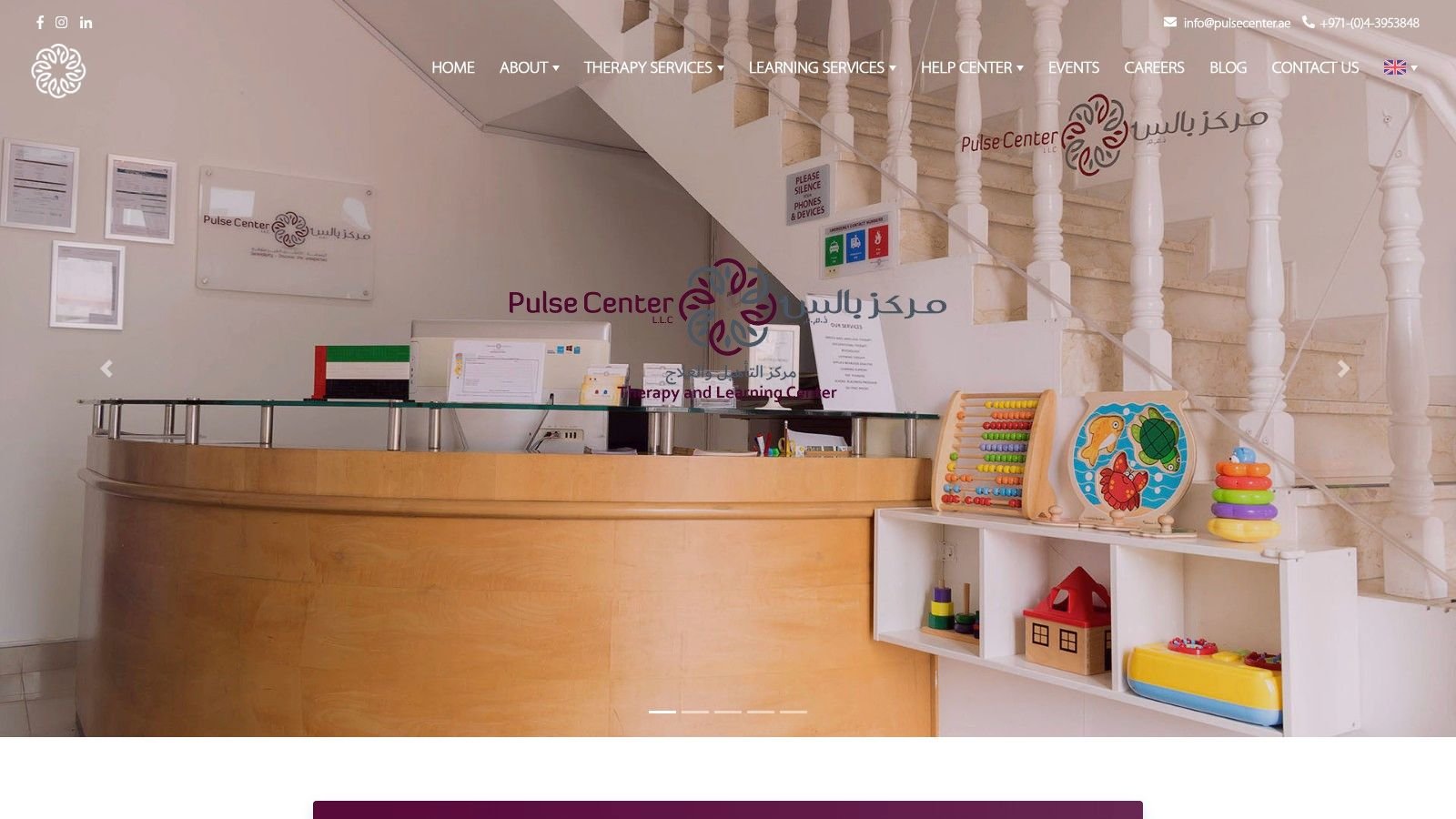
A common parent scenario goes like this. A child starts with speech therapy for delayed language, then sensory issues show up at nursery, then behaviour concerns start to affect daily routines. At that point, the key question is not only who offers therapy. It is who can organise the right mix of therapy around one child without turning the week into a patchwork of disconnected appointments.
Pulse Center tends to suit that kind of case. It offers ABA, speech and language therapy, occupational therapy, psychology, and inclusion support. That makes it relevant for families trying to address autism-related needs, ADHD, learning difficulties, speech delay, and school-readiness concerns under one roof.
Its value is in coordination. For parents using this guide as a decision-making framework, Pulse is worth shortlisting if the main priority is getting communication, behaviour, sensory needs, and school participation pulling in the same direction.
Where Pulse can work well
Pulse is often a sensible option when concerns overlap across home, clinic, and classroom. A child may need help with expressive language, transitions, emotional regulation, fine motor skills, and participation in group settings. In that situation, a multidisciplinary centre can save time and reduce mixed messages, but only if the team works from shared goals.
That is the key point to test at intake. Some centres offer several services but still function as separate silos. Ask who leads the treatment plan, how often goals are reviewed across disciplines, and whether parents receive one joined-up summary or several separate updates.
Inclusion support also matters here. Families choosing between Dubai centres should look beyond the service list and ask a practical question. Can this provider help a child function better in nursery or school, or does progress stay inside the therapy room?
Trade-offs to weigh before you commit
Pulse does not publish clear pricing online, so it is harder to compare costs in advance. That is not unusual in Dubai, but it does affect planning if a child may need speech, OT, and behavioural support in the same week. Insurance should be checked directly with the centre rather than assumed from the service list.
Intensity is another decision point. Some children do well with one focused service and strong home carryover. Others need a tighter weekly schedule with regular team coordination. Parents should ask how Pulse decides frequency, how progress is measured, and when a programme is scaled up or reduced.
A few questions will tell you a lot:
- How are shared goals set? Ask whether ABA, speech, OT, and psychology write one coordinated plan or run parallel plans.
- How is school communication handled? Inclusion support is more useful when the centre can give teachers clear strategies and feedback.
- What does parent coaching look like? Good carryover advice should fit meals, play, dressing, and other daily routines, not just clinic tasks.
Pulse is usually a better fit for families who want practical multidisciplinary support in a child-focused setting, especially when the decision is less about finding a single therapist and more about choosing a centre that can organise several moving parts well.
6. Family First Medical Center

Family First Medical Center tends to suit families looking for a balanced clinical and family-support model. It offers early-intervention assessments, speech and language therapy, occupational therapy, psychotherapy for children and adolescents, and parent guidance. That mix can be helpful when developmental concerns sit alongside stress, anxiety, family adjustment, or school-related emotional difficulties.
Not every child with a delay needs a highly specialised autism centre. Some children need steady, structured therapy plus thoughtful parent support. Family First appears well positioned for that middle ground.
Where this clinic shines
The clinic has an established presence in Dubai since 2012, which can reassure parents who prefer providers with a longer local footprint. It also appears to take school readiness and broader developmental concerns seriously rather than treating speech or OT as isolated add-ons.
This kind of clinic can work particularly well for milder-to-moderate presentations. If a child has speech delay, sensory challenges, emotional dysregulation, or developmental concerns that need support but not necessarily a full autism-only programme, a family-focused medical centre may feel more manageable and less overwhelming.
Sometimes the right clinic isn’t the most specialised one. It’s the one that gives your family enough structure, enough clarity, and enough consistency to keep going.
Where it may fall short
Family First doesn’t present itself as a large autism-specific provider, and that distinction matters. Children with more complex ASD profiles, intensive behavioural needs, or highly coordinated communication and sensory goals may need supplementary services or a more specialised multidisciplinary centre.
Fees also aren’t listed publicly, so intake calls need to cover cost, scheduling, and clinician match in detail. Parents should ask whether the recommended therapy plan is based on formal assessment findings or a more general consultation impression.
Another practical consideration is clinic scale. Some families prefer smaller or more family-oriented settings because they feel more personal. Others want the breadth and intensity that only a larger specialised centre can provide. Family First is likely to appeal most to parents who want a grounded, whole-family clinic experience with developmental and psychosocial support in the same place.
7. Austin Center for Rehabilitation
A parent finishes work, picks up one child from school, and still has to get another child to therapy across the city before dinner. In that situation, clinic access affects treatment just as much as clinician quality. Austin Center for Rehabilitation stands out here because it offers a wide therapy mix across multiple branches in Dubai and Sharjah, including ABA or behaviour therapy, speech and language therapy, occupational therapy, feeding and oral motor therapy, psychology, assessments, and listening or auditory verbal services.
For some families, that practical setup is the main reason to shortlist Austin.
A centre with several locations and a broad in-house service menu can reduce missed sessions, shorten travel time, and make it more realistic to keep therapy going for months rather than weeks. That matters for children who need support in more than one area at the same time, such as speech delay with feeding difficulty, or autism with sensory and communication goals. Parents often do better with a plan they can sustain.
Where Austin may fit well
Austin is a sensible option for families who want one provider that can cover several common developmental needs under the same organisational structure. That does not guarantee better therapy. It does make coordination easier if the team communicates well and the child benefits from overlapping input across speech, OT, behaviour, and psychology.
The centre also promotes consultations early in the process. That can be useful if parents are still comparing options and need to understand whether the clinic has the right therapist profile, schedule, and treatment approach for their child before committing to a full programme.
What parents should check carefully
A broad service list is helpful, but it should never be the deciding factor on its own. The better question is whether Austin can explain how your child’s goals will be assessed, who sets priorities, how progress is measured, and how often the plan is revised.
I would ask very direct intake questions here. Will the same therapist see my child each week? How much parent coaching is included? If my child needs both speech and behaviour support, how do those therapists coordinate goals? If feeding therapy is recommended, what training does the clinician have in that area?
Pricing is another point to clarify early. Austin does not publish standard session fees online, so parents should ask for the expected weekly cost, recommended frequency, cancellation rules, and whether home practice guidance is part of the package or billed separately.
Austin is worth considering for families who need convenience, branch choice, and access to several therapy types in one place. The right fit depends on something narrower and more important: whether the team can show a clear plan for your child, deliver it consistently, and adjust it based on real progress rather than general reassurance.
Top 7 Therapy Providers in Dubai, Comparison
| Provider | 🔄 Implementation complexity | Resource requirements | ⭐📊 Expected outcomes / impact | ⚡ Speed / efficiency | 💡 Ideal use cases / key advantages |
|---|---|---|---|---|---|
| Georgetown Early Intervention Center | High, individualized multidisciplinary 1:1 plans | High, licensed ABA, OT, SLP, educational psychology; in‑person centre | Strong skill acquisition and behaviour reduction with measurable tracking ⭐📊 | Fast response (24h), flexible half/full‑day scheduling ⚡ | Early autism & school‑readiness; family‑centred, neuro‑affirming approach and strong social proof 💡 |
| Camali Clinic (Dubai Healthcare City) | Medium–High, integrated mental health + ABA pathways | High, psychiatry/psychology, SLP, OT; clinic and school delivery options | Comprehensive clinical outcomes for behaviour and language with clinical oversight ⭐📊 | Moderate, private‑therapy scheduling; possible waitlists ⚡ | ASD with comorbid mental‑health needs and school collaboration; experienced multidisciplinary team 💡 |
| Dubai Autism Center (DAC) | Medium, structured centre‑based programmes and community training | Large, purpose‑built autism facilities, diagnostic teams, nonprofit resources | Broad access to diagnostics, structured interventions and community education ⭐📊 | Slower at times, high demand can create waiting lists ⚡ | Families seeking autism‑specific nonprofit services, community training and improved accessibility 💡 |
| Neuropedia Children’s Neuroscience Center | High, medical specialist model with integrated therapies | Very high, paediatric neurology, neurodiagnostics, neuropsychology, allied therapies | Best outcomes for medically complex neurodevelopmental cases; coordinated medical‑therapy impact ⭐📊 | Variable, specialist availability can slow scheduling ⚡ | Complex neurological/developmental presentations needing diagnostics and specialist oversight 💡 |
| Pulse Center (Umm Suqeim 1) | Medium, coordinated multidisciplinary therapy plans | Moderate–High, ABA, SLP, OT, psychology in a neighbourhood clinic | Practical gains across behaviour, communication and motor skills; school‑readiness focus ⭐📊 | Moderate, typical private‑market scheduling; confirm availability ⚡ | Families wanting coordinated ABA+SLP+OT locally for school readiness and inclusion support 💡 |
| Family First Medical Center | Low–Medium, clinic‑based developmental and psychosocial services | Moderate, SLP, OT, psychotherapy; established clinic presence | Balanced developmental and psychosocial support for mild–moderate cases ⭐📊 | Moderate, established clinic workflows; fees not public ⚡ | Milder developmental concerns, counseling and parent guidance; long‑standing family focus 💡 |
| Austin Center for Rehabilitation (Dubai & Sharjah) | Medium, broad therapy menu with parent/home programme emphasis | High, comprehensive services (ABA, SLP, OT, feeding, AVT, psychology); multiple branches and extended hours | Wide functional improvements with emphasis on home carryover and practical goals ⭐📊 | High accessibility, extended/7‑day hours and multiple locations improve access ⚡ | Working families needing flexible scheduling, multi‑site access and parent‑involvement programmes 💡 |
Making the Right Choice for Your Family's Future
It is 6:30 pm, your child is tired, and you are choosing between two centres that both sounded promising on the phone. Parents often reach this point after reading reviews and comparing service lists. The shortlist is useful, but the decision usually comes down to fit, clinical judgment, and whether the plan will work in real family life.
That is the purpose of this guide. It is not only a list of well-known names in Dubai. It is a framework parents can use to judge which provider is right for a child with autism, speech delay, sensory needs, behavioural concerns, or a mixed developmental profile.
The strongest provider is not always the one with the biggest name or the longest service menu. A better choice is a team that can explain what they see, set goals that matter at home and in school, and offer appointments your family can sustain. In practice, consistency often matters as much as reputation.
What good therapy should look like early on
The first stage should reduce confusion.
A careful therapist builds rapport, observes closely, asks specific questions about daily routines, and explains what is affecting function right now. Parents should leave the early sessions knowing what the team is targeting, why those targets matter, and how progress will be reviewed.
Look for these signs:
- Assessment shows strengths as well as difficulties: A useful evaluation explains what your child can do now, where things break down, and in which settings the problem shows up.
- Goals are functional and specific: “Improve communication” is too broad. “Use words, signs, or AAC to ask for help during meals and play” gives everyone something clear to work on.
- Updates are concrete: You should hear what changed, what is still hard, and what to practise between sessions.
- The plan can be adjusted: If progress stalls, the clinician should reconsider the goal, method, pacing, or frequency.
Good therapy gives parents clarity and direction.
Understanding pricing, access, and real-world trade-offs in Dubai
Clinical quality matters. Practical access matters too.
Fees vary by discipline, therapist seniority, session length, assessment needs, and whether your child needs one service or a coordinated plan across speech, occupational therapy, psychology, or ABA. Many centres do not publish full prices, so ask directly about assessment charges, session rates, package terms, report fees, cancellation policies, and insurance paperwork before agreeing to a block of therapy.
Scheduling can change the best-looking option into the wrong one. A centre may assess well and communicate clearly, yet still be a poor fit if after-school appointments are scarce, school observations take weeks to arrange, or the commute makes regular attendance unrealistic. I often advise parents to weigh access realistically. A good plan you can attend consistently usually outperforms an excellent plan that falls apart after the first month.
Specialisation also comes with trade-offs. A highly focused autism provider may offer stronger diagnostic depth or more structured behavioural support. A smaller neighbourhood clinic may offer easier booking, faster starts, and better family follow-through. Neither is automatically better. The right answer depends on your child’s profile and your family’s capacity.
Questions that help you choose well
Contact two or three suitable providers at the same time. Their answers will tell you a great deal before the first session.
Ask:
- Who will assess my child? Ask whether the first evaluation is done by one clinician or coordinated across disciplines.
- How are goals joined up across services? If your child needs speech, OT, and behaviour support, someone should own the full plan.
- What parent coaching is included? Ask what guidance you will receive between sessions, not just whether parents are “involved.”
- How is progress measured? Look for examples, data points from sessions, and regular review points.
- What do you do if the plan is not working? Good teams can explain how they revise targets and methods.
Some families want help judging whether a provider’s recommendations are clear enough to use at home. This guide to understand effective treatment plans can help you assess whether a proposed plan is specific, realistic, and functional.
One final check is simple. Pay attention to how the team responds when you describe your child. Strong clinicians ask focused follow-up questions, listen for context, and avoid forcing every family into the same package.
Choose the provider that gives you a clear plan, realistic access, and thoughtful clinical reasoning. If Georgetown early intervention center seems like the right fit for your child’s needs, you can review their services and contact details at Georgetown UAE.