
When you first realise your child might need extra support, it can feel like you're standing at the base of a huge, confusing mountain. But here in the UAE, you’re not alone. A strong and caring network is ready to help you climb.
When we talk about family support services in the UAE, we’re not just talking about one single thing. It’s a whole ecosystem of support designed to help children and their parents, from specialised clinical therapies and school-readiness programmes to essential government and community aid. This guide is here to be your compass, helping you turn that feeling of uncertainty into a confident plan for your child’s future.
Navigating Your Family's Support Journey in the UAE

Taking that first step to find the right support for your child is a big one. Here, "family support" is more than just a phrase; it's a blend of clinical, educational, and community resources all working together to help your child thrive.
The best way to think about it is like building a dedicated team for your child, with you, the parent, as the team captain. Each professional on this team plays a unique but connected role. For instance, an educational psychologist might act as a "learning detective," uncovering how your child learns best. An occupational therapist becomes a "life-skills coach," while a speech therapist helps build crucial bridges for communication.
So, what does this support actually look like on the ground? Let’s break down the main categories of services available across the Emirates.
Quick Guide to Support Services in the UAE
This table provides a snapshot of the primary support categories you'll encounter.
| Service Category | Primary Focus | Common Examples |
|---|---|---|
| Clinical Therapies | Addressing specific developmental, behavioural, or communication goals with evidence-based methods. | Applied Behaviour Analysis (ABA), Speech and Language Therapy, Occupational Therapy, Physiotherapy, Psychology. |
| Educational Programmes | Preparing children for academic and social success in a school environment. | School-Readiness Programmes, Social Skills Groups, Early Intervention Classes, Learning Support Assistants (LSAs). |
| Government & Community Aid | Providing a foundational safety net through public resources, financial aid, and community initiatives. | Ministry of Community Development services, support from non-profit organisations, parent support groups, counselling. |
Each of these pillars is crucial, but they are most powerful when they work in harmony.
The Power of an Integrated Approach
Juggling appointments and updates from multiple providers can be challenging. This is where understanding the importance of good care coordination in healthcare becomes a game-changer for families. The goal isn’t to have a collection of separate services, but a single, seamless strategy.
An integrated approach ensures that support isn't delivered in isolation. Instead, therapists, educators, and family members all collaborate, creating a unified plan that reinforces skills across every part of a child's life—at the centre, at home, and eventually, at school.
Ultimately, finding the right family support services in the UAE is about creating a pathway that fits your child's unique needs and your family's circumstances. Whether your child requires intensive early intervention or just a bit of targeted help with a specific challenge, the resources are here. This guide will serve as your roadmap, giving you clear, practical steps to build a strong foundation for your child’s happiness and success.
Understanding the Core Types of Child Support

When you first start looking into support for your child, the sheer number of specialised services can feel overwhelming. It’s easy to get lost in clinical terms, but at their heart, each one offers targeted help that can make a genuine difference in your child’s day-to-day life.
Think of these supports not as disconnected treatments, but as a team of specialists all working together for your child. To make sense of it all, let's look at the main types of support you'll find: clinical therapies, educational programmes, and community resources. Seeing how they fit together is the first step to building a strong plan for your family.
Key Clinical Therapies Explained
Clinical therapies are where the specialised, one-on-one work happens. These are evidence-based approaches designed to help your child meet specific developmental goals. Imagine them as different experts on your child's personal team, each bringing a unique skill to help them build confidence and master new abilities.
Educational Psychology: Think of an educational psychologist as a "learning detective." Their main job is to figure out how your child learns and processes the world around them. Through careful assessments, they identify specific learning strengths and challenges, creating a clear map that guides everyone else on the therapy team.
Occupational Therapy (OT): An occupational therapist is like a practical life-skills coach. OT helps children master the everyday tasks—or "occupations"—of childhood. This might mean developing the fine motor skills needed to hold a pencil or button a shirt, or it could focus on improving sensory processing to help them cope with a noisy classroom or a busy playground.
Speech and Language Therapy (SLT): A speech therapist is a communication expert. They work on everything from the clear articulation of sounds to understanding the nuances of a conversation. For a child struggling with a speech delay, an SLT can unlock their ability to express needs and feelings, which dramatically reduces frustration and helps them build friendships.
Applied Behaviour Analysis (ABA) Therapy: Far from the rigid methods of the past, modern ABA therapy is a positive, play-based approach for teaching new skills and managing challenging behaviours. The therapist acts as a skills architect, breaking down big goals (like waiting for a turn or sharing a toy) into small, manageable steps and using positive reinforcement to celebrate every bit of progress. It is recognised as one of the most effective family support services in the UAE for children with autism.
These therapies are at their most powerful when the professionals communicate, sharing insights to create a truly unified strategy for your child.
Building a Bridge to the Classroom
While clinical therapies focus on specific skills, educational programmes are all about getting your child ready for the social and academic demands of school. These services are the essential bridge between intensive one-on-one therapy and a typical classroom.
School-readiness programmes are a fantastic example. These are small, specialised classes that mimic a school day but in a much more supportive and structured environment.
In these programmes, children learn how to follow group instructions, sit for circle time, switch between activities without getting overwhelmed, and interact positively with their classmates. It’s all about building the foundational skills and confidence they need to thrive in a larger school setting.
This kind of transitional support is a critical piece of the puzzle. It ensures the skills learned in therapy can actually be used in the real world of school.
Government and Community Support
Finally, it's crucial to know about the wider network of family support services UAE families can tap into. Government initiatives and community organisations offer a vital safety net, providing resources, guidance, and—just as importantly—a sense of community.
This can be anything from public awareness campaigns that help reduce stigma to parent support groups where you can connect with other families who truly understand what you're going through. While clinical services provide direct support for your child, these community programmes offer the structural support that holds everything else together. They’re a powerful reminder that you are not on this journey alone.
How Government and Community Programs Can Help
When you’re navigating your child's developmental journey, it's easy to feel isolated. But here in the UAE, you’re never truly on your own. The government and a host of community organisations have worked hard to build a real, caring support system for families. This isn't just about policies on paper; it's about tangible help you can access right now.
Think of this network as a crucial safety net. It works hand-in-hand with clinical therapies by providing stability, guidance, and a much-needed sense of community. From financial aid and legal advice to counselling and parent groups, these programmes give families the foundation they need to focus on what matters most—their child's wellbeing.
The Role of Government Authorities
The UAE government has a deep and genuine commitment to keeping families strong and children protected. This is put into action through dedicated authorities that act as a central point of contact, making sure support is organised and easy to find.
A powerful example is the Family Care Authority (FCA). This organisation is a testament to the UAE’s proactive approach to family wellness. Its entire purpose is to offer integrated services that empower families to work through social, psychological, and even legal challenges.
The impact is huge. In 2023 alone, the Family Care Authority in Abu Dhabi handled 7,854 cases, directly helping 17,634 people between January and November. This included providing emergency social support to 238 people in crisis and offering advanced social, psychological, and legal counselling to another 1,666 individuals who needed expert guidance. You can learn more about these powerful support statistics and what they mean for families across the Emirates.
Key Government and Community Support Services
The help available goes far beyond just one authority. It’s a wide-ranging system with different kinds of assistance designed for specific family needs. Just knowing what's out there is the first step.
Here are some of the main forms of support you can find:
- Social and Psychological Counselling: Confidential sessions with trained professionals help parents and children manage the stress, anxiety, and complex emotions that often come with the territory.
- Legal Guidance: For families dealing with legal issues around custody, care, or individual rights, these services provide essential advice and bring much-needed clarity.
- Emergency Support: In a crisis, rapid-response services are there to ensure the immediate safety and stability of your family.
- Parent Support Groups: These community-led groups are invaluable. They connect you with other parents who get it, creating a space for encouragement, practical advice, and real understanding.
These programmes are designed to be a lifeline, reinforcing the idea that seeking help is a sign of strength. They provide the scaffolding that allows families to build resilience and navigate challenges with greater confidence.
Connecting with the Right Resources
Knowing these services exist is one thing; actually connecting with them is another. The good news is that the system is designed to be approachable. It often starts with a simple call or visit to a local authority or community centre.
Many programmes, particularly those for specific conditions, can be found through your therapy centre or healthcare provider. Our guide on a parent's journey with autism in the UAE offers more insight into how these community supports fit together with clinical care.
The UAE's investment in these initiatives highlights a core belief: strong families are the foundation of a healthy society. By providing this extensive network of family support services UAE authorities ensure every family has the tools to build a hopeful, resilient future.
Finding the Right Support Center for Your Child
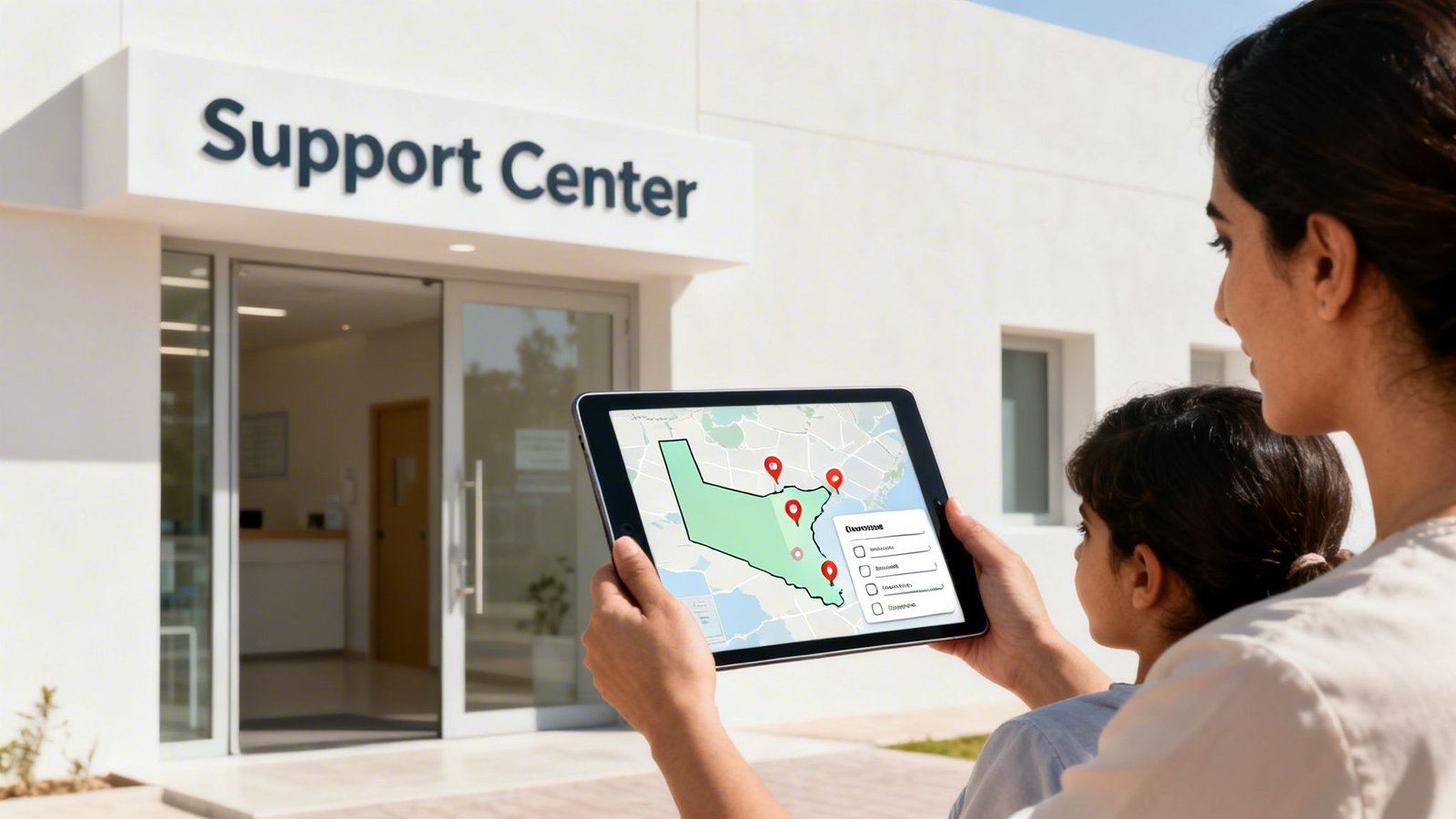
Choosing a support center is one of the biggest decisions you'll make for your child. This isn't just about finding a convenient location; it's about finding a true partner you can trust with your child’s development and your family's well-being. It can feel like an overwhelming task, but if you go in with a plan, you can confidently find the perfect fit.
The path to finding support often starts with a referral. If you have concerns, your first stop is usually your child's pediatrician. They can guide you to a developmental pediatrician or an educational psychologist—specialists trained to identify developmental delays and learning challenges. A formal diagnosis from them isn't just a label; think of it as a key that unlocks access to specialized family support services in the UAE.
Thanks to the UAE government's strong commitment to Children of Determination, a robust support network is readily available. A wide array of government and private centers are scattered across the emirates, helping families with everything from autism to speech delays. With 684 child and family service locations in Dubai and 449 in Abu Dhabi alone, help is never far away.
Your Checklist for Choosing a Center
Once you have a shortlist of potential centers, it's time to dig deeper. This is your opportunity to look past the glossy brochures and get a real feel for their philosophy. Treat it like an interview—because you are, in fact, hiring a team to champion your child's progress.
Here are some non-negotiable questions to ask every provider:
- Therapist Qualifications: What are the credentials and specific experience of your therapists? Are they certified in certain approaches, like ABA, and do they get regular, ongoing training?
- Therapy Models: What is your core therapeutic philosophy? Is it a rigid, one-size-fits-all model, or do you blend different methods and incorporate play-based learning?
- Parent Involvement: How are parents woven into the therapy process? Do you offer parent training, frequent progress meetings, or chances to observe sessions?
- Progress Tracking: How do you actually measure and report on my child's progress? Can I see a sample of how goals are set, tracked, and updated?
The answers to these questions will give you a clear window into how a center truly operates. A high-quality provider will not only welcome your questions but will also give you transparent, honest answers.
The Value of a Multidisciplinary Team
One of the greatest advantages a support center can offer is a multidisciplinary team all under one roof. This means specialists like educational psychologists, occupational therapists, speech therapists, and behavior therapists work in concert.
A multidisciplinary approach ensures that everyone on your child's team is aligned. Instead of you having to coordinate between different providers, the team collaborates directly, creating a unified plan that addresses your child's needs from every angle.
This collaborative setup saves you an enormous amount of time and stress. More importantly, it creates a much more consistent and effective therapy experience for your child. For example, insights from a speech therapist can directly inform the strategies a behavior therapist uses, making sure skills are reinforced across every single session. If you're exploring your options, you can learn more about how our early childhood center organizes these teams to build truly individualized plans.
The Power of an Individualised Therapy Plan

When your child starts a support programme, the single most powerful tool they’ll have is a plan built just for them. Think of it like a custom-tailored suit versus one bought off the rack—the fit makes all the difference. A one-size-fits-all approach simply falls short in developmental support because every child’s brain is wired differently.
An individualised plan goes far beyond generic goals. It creates a specific, detailed roadmap based on your child's unique personality, their strengths, and the challenges they face. This is the blueprint that guides every single therapy session, making sure each activity is purposefully designed to help them make real, meaningful progress.
This kind of personalised approach is at the very heart of effective family support services in the UAE. It shifts therapy from just a series of exercises into a journey of targeted growth.
Crafting the Individualised Plan
Putting this plan together is a team effort, led by specialists who each bring a crucial perspective to the table. And it’s not a static document; it’s a living, breathing guide that changes and adapts as your child masters new skills and grows.
Here’s a look at who is typically involved and the role they play in building this roadmap.
- Educational Psychologist: The process often kicks off here. This professional is like the architect, running comprehensive assessments to map out your child's cognitive profile, learning style, and specific areas of need.
- Occupational Therapist (OT): The OT’s focus is on practical, real-world skills. They’ll contribute goals for fine motor abilities (like holding a pencil), sensory processing, and daily activities (like getting dressed).
- Speech and Language Pathologist (SLP): The SLP zeroes in on all things communication. They set goals for everything from articulating sounds and building vocabulary to understanding social cues and expressing complex thoughts.
- ABA Therapist: Using the principles of Applied Behaviour Analysis, this therapist designs strategies to teach new behaviours and skills in a structured and positive way. Their strength is breaking down big goals into small, achievable steps.
The real power of an Individualised Education Plan (IEP) or therapy plan comes from this multidisciplinary input. It ensures the plan is holistic, addressing every facet of your child’s development in a coordinated fashion, rather than in isolated silos.
A Dynamic Roadmap to Success
A great plan is never set in stone. It’s a dynamic tool that gets reviewed and updated all the time, based on consistent data collection and observation. Therapists track progress against every single goal, which allows them to see what’s working and, just as importantly, where they need to make adjustments.
This data-driven mindset is also reflected in the UAE's wider strategies for child wellbeing. For instance, Abu Dhabi's 2023 launch of the Thriving Child Index was designed to pull together data from health, education, and social services. The goal is to flag issues early on to enable life-changing support. You can read more about how these initiatives support child well-being in the emirate. This focus on data is just as critical at the national level as it is for your own child's plan.
Ultimately, once you understand how an individualised plan is built around your child’s specific needs, you can see how this tailored support delivers true progress. It’s the difference between just "doing therapy" and embarking on a strategic, personalised journey toward your child's success. Finding a provider who excels at this is key; learn more about how a child behavioral therapist can build this custom support.
Costs, Insurance, and Financial Support Explained
Let's talk about the elephant in the room: the cost. For many parents, the financial side of accessing support services is the biggest source of stress. It’s completely understandable. But with a bit of know-how, you can map out a financial plan that works for your family without the constant anxiety.
We'll walk through the typical expenses you can expect, how to get the most out of your insurance, and where else you might find financial help in the UAE.
Understanding the Typical Costs of Therapy
Therapy costs in the UAE aren't one-size-fits-all. They can swing quite a bit depending on the service, how experienced the therapist is, and how intensive the programme needs to be. To give you a realistic picture, here are some ballpark figures you might encounter:
- Applied Behaviour Analysis (ABA): As one of the more intensive therapies, ABA often ranges from AED 250 to AED 450 per hour.
- Speech or Occupational Therapy: You can generally expect to see session rates between AED 300 and AED 600 per hour. This often depends on the clinic's reputation and the therapist's specific qualifications.
- Educational Psychology Assessment: A full psycho-educational assessment is a significant, one-time evaluation. These detailed reports can cost anywhere from AED 5,000 to AED 10,000, and sometimes more.
Think of these numbers as a starting point. They give you a baseline so you can begin planning your budget as you look for the right provider.
Navigating Your Health Insurance
For most families, health insurance is what makes ongoing therapy truly manageable. But policies can be notoriously tricky to decipher. Getting a handle on the financial side is especially important for expats, and resources covering the average cost for health insurance for families can offer a wider perspective.
The first step is to become an expert on your own policy. Pull out the documents (or log in to the portal) and look for specific terms like "behavioural therapy," "speech therapy," "occupational therapy," or "developmental support."
Coverage varies across the Emirates. In Abu Dhabi, the Thiqa plan for UAE Nationals and some higher-tier Daman plans for residents are known for having solid coverage. In Dubai, it’s a bit more of a mixed bag, with coverage differing greatly between insurance companies and the level of your plan.
One piece of advice I give every parent: Before you start any therapy, always get a pre-authorisation from your insurance company. This is your golden ticket—a formal confirmation that they will cover the services. If you skip this step, you could get stuck paying for everything out of pocket.
To help you speak the same language as your insurance provider, it’s useful to understand a few key terms. The table below breaks down the most common ones you'll encounter.
Key Questions for Your Insurance Provider
Before committing to a therapy plan, call your insurance provider and have a list of questions ready. This simple step can save you from major financial surprises down the road.
| Question Category | Specific Question to Ask | Why It’s Important |
|---|---|---|
| Coverage Basics | “Are speech therapy, occupational therapy, and ABA therapy covered under my plan for developmental delays?” | You need to confirm that the specific service your child needs is an included benefit, not an exclusion. |
| Financial Limits | “What is my annual limit or session limit for these therapies?” | Many plans cap the amount they will pay per year. Knowing this limit helps you budget for any costs once you’ve reached it. |
| Out-of-Pocket Costs | “What is my deductible, co-payment, or co-insurance for these services?” | This tells you exactly how much you will have to pay for each session (e.g., a 20% co-insurance or a fixed AED 100 co-pay). |
| Provider Network | “Is [Therapy Centre Name] in my network? What are my out-of-network benefits?” | Staying in-network is almost always cheaper. If your preferred centre is out-of-network, you need to know what percentage of the cost you’ll be responsible for. |
| Authorisation | “What documents do I need to submit for pre-authorisation?” | The provider usually handles this, but knowing the requirements (like a doctor’s referral or a diagnostic report) helps speed up the process. |
Having clear, written answers to these questions will empower you to make informed decisions and confidently manage the financial aspect of your child's care.
Exploring Additional Financial Support
Insurance isn't the only path to making therapy affordable. It’s always worth looking into other avenues of support.
Some non-profit organisations and community groups in the UAE occasionally offer grants or subsidised services to families who qualify. When you speak with a potential therapy centre, don't hesitate to ask if they know of any such programmes. Many centres also offer flexible payment plans to help spread the cost over time, making it much more manageable for your monthly budget.
Your Questions About Family Support, Answered
Stepping into the world of family support can feel overwhelming, and it’s natural to have a lot of questions. We’ve been there. Here, we’ve put together answers to some of the most common concerns we hear from parents, hopefully offering some clarity and reassurance.
How Do I Know If My Child Needs Early Intervention?
The simple answer is to trust your gut. You know your child better than anyone. If you have a nagging feeling that something isn’t quite right—maybe they’re missing developmental milestones, struggling to connect with other kids, or have certain repetitive behaviours—it’s always worth looking into.
Your first port of call should be your paediatrician or a trusted educational psychologist. Think of an early assessment not as a scary test, but as a positive, proactive step. It's about getting a clearer picture so you can provide the right support at the right time, which can make all the difference.
What Is the Difference Between ABA Therapy and Play Therapy?
This is a great question, as both often use play but have very different goals. Understanding this distinction is vital when looking at family support services in the UAE.
ABA Therapy: Applied Behaviour Analysis is a highly structured approach focused on teaching specific skills. It works by breaking down big goals—like communicating needs or learning daily routines—into small, achievable steps and uses positive reinforcement to build success. Modern ABA is often done through play to keep children engaged and motivated.
Play Therapy: This approach is much less structured. It’s about creating a safe space for a child to use play to express their feelings, process difficult emotions, and work through social or emotional challenges with a therapist's guidance.
The best centres today often blend these two methods, creating a support plan that’s both effective and genuinely fun for the child.
How Long Will My Child Need Therapy?
There’s really no magic number here. The length of time a child spends in therapy is completely tied to their individual needs, the goals you set together, and their own unique pace of progress.
Some children might just need a short-term boost to get over a specific hurdle. Others benefit from longer-term support to build a solid foundation of life skills. Any quality centre will meet with you regularly to review progress, celebrate wins, and adjust the plan as your child grows and masters new abilities.
The goal is always empowerment, not dependence. Therapy is about giving your child the tools they need to thrive on their own, long after their sessions have ended.
At Georgetown, we know that every child is unique, and their support plan should be too. Our multidisciplinary team partners with you to build individualised early intervention plans that create meaningful, lasting change. Find out more about how we do things at https://www.georgetownuae.com.