When the weather keeps everyone inside, finding engaging indoor activities for kindergarteners can feel like a significant challenge. For parents, therapists, and educators supporting children with unique developmental paths, such as autism, speech delays, or sensory and motor needs, the objective extends beyond simply passing the time. The real goal is to create meaningful, targeted play experiences that build critical skills, foster genuine connection, and celebrate each child’s individual strengths.
Traditional lists of crafts and games often fall short, presenting generic ideas without the necessary structure, adaptability, or therapeutic insight. This guide offers a different approach. We will explore ten therapeutic-grade activities, each meticulously designed with clear developmental objectives in mind. Our focus is not just on what to do, but on understanding why each activity works and, most importantly, how to tailor it to specific learning goals.
This resource transforms unavoidable indoor time into a powerful opportunity for growth and discovery. You will find actionable strategies for adapting each activity to support communication, fine and gross motor skills, social interaction, and sensory regulation. Each suggestion is rooted in the belief that play should be purposeful and individualised. We will provide practical steps for setting up, implementing, and modifying activities to ensure they are both enjoyable and effective, helping you create a supportive environment where every child can thrive.
1. Sensory Play Stations
Sensory play stations are dedicated areas designed to engage a child’s senses through hands-on exploration. These carefully organised spaces feature a variety of materials-such as kinetic sand, water tables, or bins filled with textured objects-that allow children to touch, see, and even smell different elements in a controlled environment. This approach is fundamental for developing sensory integration, the process by which the brain organises and interprets sensory information.
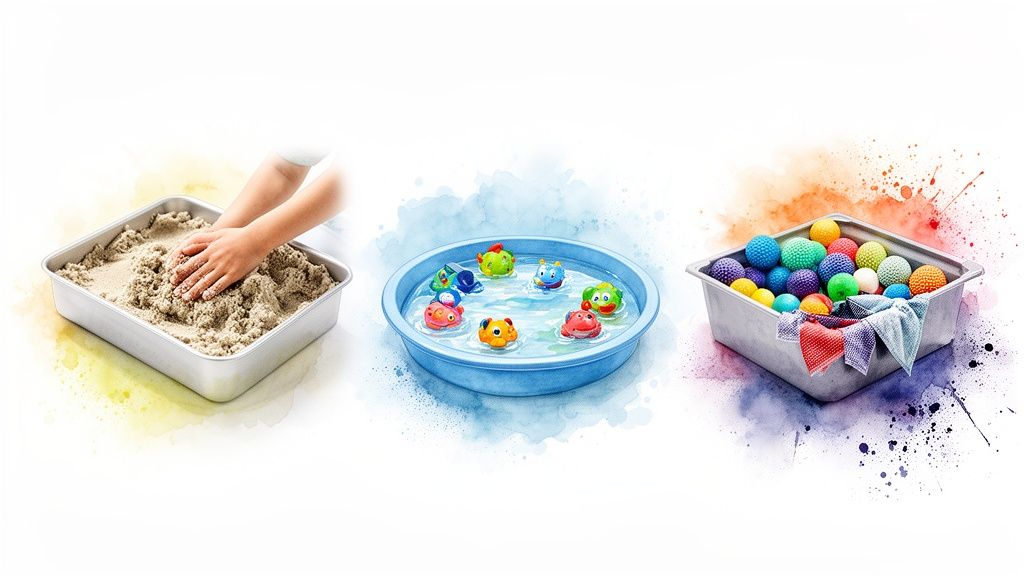
This type of play is one of the most effective indoor activities for kindergarteners, particularly for those with autism or sensory processing challenges. It provides a safe outlet for sensory seeking or avoiding behaviours, helping children learn to self-regulate their responses to stimuli. By customising stations to a child’s specific needs, we can create therapeutic and calming experiences that build crucial developmental skills.
Why It’s a Top Choice
Sensory play directly supports cognitive growth by strengthening neural pathways in the brain. It also enhances fine motor skills when children manipulate small objects, promotes language development as they describe their experiences, and encourages problem-solving. These stations are particularly beneficial for children in pre-school or kindergarten who are preparing for more structured academic settings. The hands-on nature of this activity makes learning feel like play, boosting engagement and retention.
Practical Tips for Implementation
- Observe and Customise: Begin by observing a child’s sensory preferences. Do they gravitate towards wet or dry textures? Do they enjoy scooping and pouring? Use these observations to tailor each station.
- Rotate Materials: Keep the stations engaging by rotating materials weekly. Swap out dry pasta for coloured rice, or introduce scented playdough to add a new olfactory dimension.
- Set Clear Expectations: Use a visual schedule to show which stations are available and for how long. This structure is especially helpful for children with autism, providing predictability and reducing anxiety.
- Integrate Therapy Goals: A child working on fine motor control can use tongs to pick up pom-poms from a bin of beans. This transforms a simple sensory activity into a targeted therapeutic exercise. For professional guidance on integrating these activities, you can learn more about how specialists approach occupational therapy in Dubai.
- Provide Behavioural Support: For children who may become overstimulated, introduce calming strategies and designated quiet corners nearby. Always supervise play to guide and redirect as needed.
2. Interactive Story Narration and Picture Books
Interactive story narration transforms reading from a passive activity into a dynamic, guided experience. This approach uses colourful, engaging picture books as a platform for therapists and parents to employ targeted speech and language strategies. Stories are carefully chosen to align with a child’s individual goals, whether it involves vocabulary expansion, practicing specific sounds, or developing social communication skills. This evidence-based method effectively merges narrative therapy with proven speech-language pathology principles.
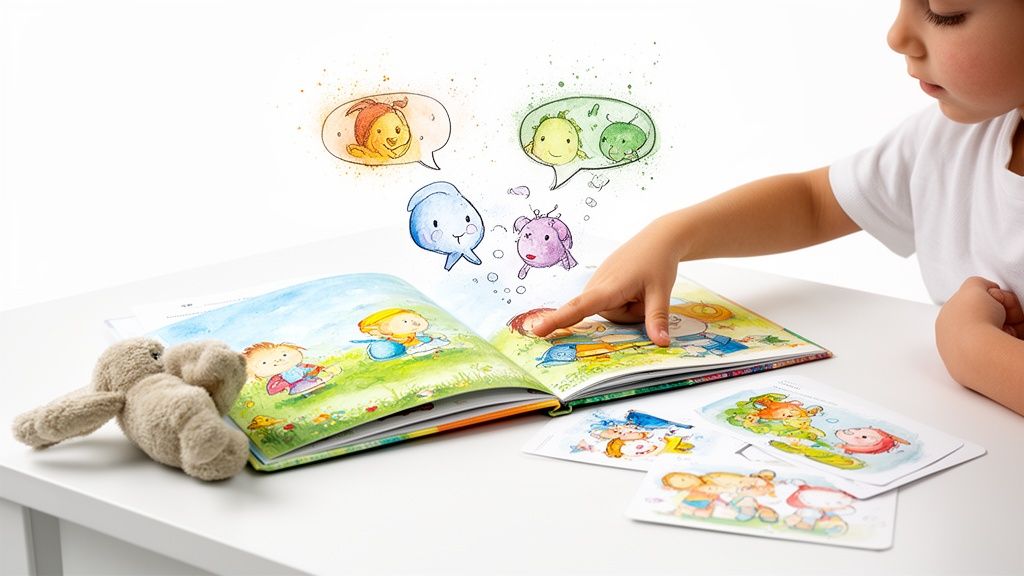
This technique is one of the most powerful indoor activities for kindergarteners, particularly for those with speech delays or social communication challenges. For instance, a book like The Very Hungry Caterpillar can be used to target /k/ sounds and colour vocabulary. Similarly, repetitive books such as Brown Bear, Brown Bear, What Do You See? are excellent for building language patterns and encouraging participation from a hesitant child.
Why It’s a Top Choice
Interactive reading directly fosters language comprehension, expressive vocabulary, and narrative skills, which are foundational for academic success. It helps children understand story structure, make predictions, and connect events to their own experiences. This method also supports joint attention, a critical skill for children with autism, as the book provides a shared focus. The engaging nature of storytelling makes therapy feel enjoyable, boosting a child’s motivation to communicate and learn.
Practical Tips for Implementation
- Pre-select Target Words: Before a reading session, identify key vocabulary or words with target sounds. You can place small sticky notes on the pages as a reminder to emphasise them.
- Use the ‘Pause and Wait’ Technique: After reading a sentence or asking a question, pause expectantly. This gives the child time to process and formulate a response without pressure.
- Create Communication Aids: Develop a simple communication board with pictures of key characters and objects from the story. This allows non-verbal or minimally verbal children to participate actively.
- Choose Relatable Themes: Select books with themes that resonate with the child’s life, such as starting school or making friends. To foster a love for literacy and engagement, exploring a guide to children’s picture books for joyful reading can provide valuable insights.
- Document Language Samples: Keep a brief record of the child’s utterances during reading. This data is invaluable for tracking progress in speech and language development over time.
3. Fine Motor Skill Development Activities
Fine motor skill activities are structured tasks designed to strengthen the small muscles in the hands, fingers, and wrists. These activities focus on developing hand-eye coordination, dexterity, and bilateral coordination through engaging actions like threading, stacking, lacing, and manipulating small objects. This targeted practice is crucial for building the foundational skills needed for academic tasks such as writing, cutting with scissors, and buttoning a coat.

This type of focused play is one of the most beneficial indoor activities for kindergarteners, especially for children working on occupational therapy goals related to school readiness. By strengthening these essential muscles, children gain the independence and confidence required for daily self-care and classroom activities. These tasks can be easily adapted to a child’s ability level, making them a versatile tool for therapists and parents alike.
Why It’s a Top Choice
Developing fine motor skills directly impacts a child’s ability to succeed in a school environment. Activities like lacing cards or using pegboards enhance concentration and problem-solving abilities. They also improve dexterity, which is a direct precursor to legible handwriting. For children with motor delays or dyspraxia, these activities provide repetitive, structured practice that helps create and strengthen crucial neural pathways for motor planning and execution.
Practical Tips for Implementation
- Grade the Activity: Start with larger objects, like big beads for threading or chunky puzzles, and gradually introduce smaller, more complex items as the child’s skills improve.
- Use Hand-Over-Hand Guidance: Initially, provide physical support to guide the child’s movements. As they gain confidence and control, gradually reduce your assistance to foster independence.
- Ensure Proper Ergonomics: Provide a comfortable chair and a table at the correct height to support good posture and allow the child’s arms and hands to move freely.
- Incorporate Preferred Themes: Increase motivation by using materials that feature the child’s favourite characters, animals, or vehicles. A dinosaur-themed lacing card is often more engaging than a plain one.
- Generalise the Skill: For a deeper understanding of how to apply these concepts across different contexts, you can find a variety of fine motor skills activities that can be integrated into daily routines.
- Celebrate Progress: Acknowledge and praise small achievements, such as successfully threading one bead or placing a puzzle piece correctly. Positive reinforcement is key to building self-esteem and encouraging persistence.
4. Social Skills Games and Role-Playing Activities
Social skills games and role-playing activities are structured, playful scenarios designed to teach and practise crucial social interactions. These activities use games and dramatic play to model concepts like turn-taking, sharing, emotional recognition, and problem-solving. By creating a controlled and supportive environment, children can learn and rehearse social behaviours without the pressures of real-world situations, making this a foundational approach for social-emotional learning.
This method is one of the most vital indoor activities for kindergarteners, especially for children with autism spectrum disorder or social communication challenges. It makes abstract social rules concrete and understandable. For instance, a pretend trip to the grocery store can explicitly teach skills like waiting in line, asking for help, and interacting with a cashier. These guided experiences build confidence and provide a script for future interactions.
Why It’s a Top Choice
Role-playing and social games directly address the building blocks of social competence. They help children develop perspective-taking (understanding another person’s thoughts and feelings), improve emotional regulation, and enhance expressive and receptive language skills. These activities explicitly teach the “unwritten” rules of social engagement, which many children find difficult to grasp intuitively. This direct instruction is essential for preparing them for the dynamic social environment of a school classroom.
Practical Tips for Implementation
- Use Visual Supports: Create and display simple, picture-based rules for games (e.g., “Wait for your turn,” “Use a kind voice”). Visual scripts for role-playing scenarios can guide a child through the expected steps.
- Start Small: Begin with one-on-one role-playing to build foundational skills and confidence before introducing a small group, which adds social complexity.
- Provide Immediate Feedback: Offer gentle, in-the-moment coaching. Use behaviour-specific praise like, “I love how you looked at your friend when you asked for the block,” to reinforce positive actions.
- Connect to Real Life: After a role-playing session, discuss how the skills can be used in real situations, such as at a birthday party or during playtime at school.
- Use Social Stories: Introduce a social scenario using a Social Story, developed by Carol Gray. Then, act out the story to help the child practise the appropriate response in a safe, repeatable manner.
5. Music and Rhythm-Based Activities
Music and rhythm-based activities use structured songs, sounds, and instruments to support a child’s development. This approach taps into the brain’s natural responsiveness to melody and beat, making it a powerful tool for building skills in language, motor coordination, and emotional regulation. By engaging children with familiar tunes and simple percussion instruments, these activities create a motivating and joyful learning environment.
This method is one of the most engaging indoor activities for kindergarteners, particularly for children with developmental delays or autism. The predictable patterns in music can be very comforting, while the act of singing or playing an instrument provides a non-verbal outlet for expression. These activities can be easily adapted to target specific goals, from motor planning in “If You’re Happy and You Know It” to smooth behavioural transitions between daily tasks.
Why It’s a Top Choice
Music naturally activates multiple areas of the brain simultaneously, strengthening connections related to auditory processing, memory, and motor control. For children with speech delays, the repetitive lyrics in songs can help with articulation and vocabulary acquisition. It also promotes social skills, as children learn to take turns, listen to others, and participate in a group activity. The inherent structure of music provides a sense of security, making it easier for children to learn and self-regulate.
Practical Tips for Implementation
- Select Simple Songs: Choose songs with clear, repetitive lyrics and a strong rhythm. Action songs that link words with movements are excellent for building motor planning skills.
- Use Visual Supports: Create picture cards that correspond to song lyrics or actions. This helps children with language processing difficulties understand and participate more fully.
- Incorporate Pauses: When singing, pause strategically before a key word or phrase to encourage the child to vocalise and fill in the blank. This is a great technique for promoting speech.
- Match Instruments to Abilities: Offer a variety of simple instruments like maracas, rhythm sticks, or drums. Ensure the instrument’s complexity matches the child’s fine motor skills to avoid frustration. For those looking to introduce their kindergarteners to more structured musical engagement, comprehensive music lessons for kids can be an excellent option.
- Establish Musical Routines: Use a specific song to signal transitions, such as a “clean-up song” or a “goodbye song.” This consistency helps children anticipate what’s next, reducing anxiety and improving cooperation.
6. Gross Motor and Movement Activities
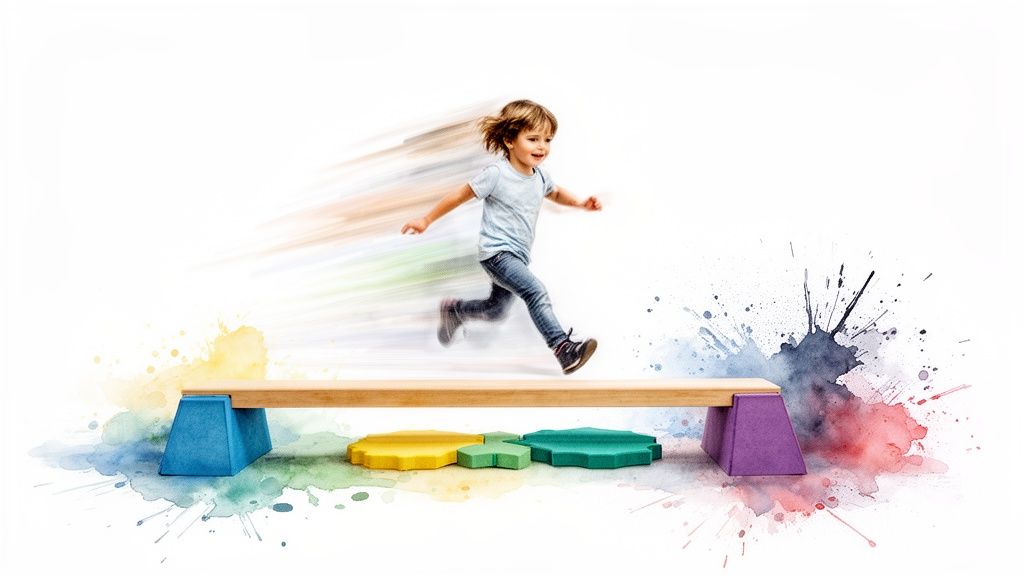
Gross motor activities involve structured indoor movements that use large muscle groups to build strength, balance, and coordination. These activities range from simple obstacle courses to coordinated games, all designed to enhance a child’s body awareness, motor planning, and overall physical confidence. For many children, especially those needing significant sensory input, these movements are essential for self-regulation and focus.
These planned movements are highly effective indoor activities for kindergarteners because they provide a productive outlet for physical energy that might otherwise lead to disruptive behaviour. Activities like animal walks, yoga poses, or navigating a line of pillows on the floor help improve bilateral coordination-the ability to use both sides of the body together. This foundation is crucial for later academic skills like writing and cutting.
Why It’s a Top Choice
Gross motor development is directly linked to a child’s ability to sit still, pay attention, and participate in classroom activities. Engaging in planned physical play strengthens core muscles, which supports good posture and endurance during seated tasks. It also improves motor planning, the brain’s ability to conceive, plan, and carry out an unfamiliar action. For children with motor delays or sensory processing disorders, these activities are a fun, non-threatening way to build essential skills and regulate their nervous systems.
Practical Tips for Implementation
- Create a Simple Obstacle Course: Use household items like pillows for stepping stones, a blanket over two chairs for a tunnel, and painter’s tape on the floor for a balance beam.
- Use Visual Demonstrations: Model the movements yourself or use pictures to show the child what to do. This is particularly helpful for children with autism or motor planning challenges.
- Break Down Complex Actions: If an activity like jumping with two feet is difficult, break it down. Start with bending knees, then practice a small hop before progressing to a full jump.
- Integrate Movement into Routines: Use short movement breaks, like doing ten “frog jumps,” between quiet activities to help maintain focus and provide necessary sensory input.
- Ensure a Safe Environment: Always clear the space of hard objects and use soft mats or cushions for activities that involve jumping or potential falls. Supervise closely to prevent injury.
7. Communication and Language Games (AAC-Friendly)
Communication and language games are interactive activities designed to foster speech and language development in a playful, motivating setting. These games are intentionally structured to target specific skills, such as vocabulary building, sentence formation, and conversational turn-taking. By incorporating supports for Augmentative and Alternative Communication (AAC) systems, these activities ensure that all children, including non-verbal or minimally verbal communicators, can actively participate and express themselves.
This approach transforms structured learning into a fun, shared experience, making it one of the most effective indoor activities for kindergarteners who have speech delays or complex communication needs. Games like ‘Go Fish’ with picture cards or barrier games that require precise verbal descriptions create natural opportunities for language use. The focus is on making communication rewarding and successful, reducing frustration and building confidence in young learners.
Why It’s a Top Choice
These games directly target the foundational components of language: vocabulary, syntax (grammar), and pragmatics (social use of language). They provide a low-pressure environment for children to practise new words and sentence structures. For AAC users, these activities offer repeated opportunities to navigate their devices to communicate wants, needs, and ideas, improving both their linguistic and motor planning skills. This playful practice is crucial for generalising communication skills to everyday situations.
Practical Tips for Implementation
- Adapt Classic Games: Modify familiar games like Bingo or Memory using a child’s target vocabulary or core words from their AAC device.
- Embed Communication Goals: Choose a few target words or phrases to focus on during the game. For example, in a building block game, model and encourage phrases like “I want blue” or “put on top”.
- Use Visual Supports: Create simple, visual rule cards for the game to minimise verbal instructions and help children understand expectations.
- Allow Processing Time: Give children, especially AAC users, ample time to formulate their thoughts and locate the words they want to use without rushing them.
- Model Language Extensively: Use the ‘speak and do’ technique by narrating your own actions and thoughts during the game, providing a rich language model. For targeted support, a professional can offer guidance on integrating these games effectively; you can explore the benefits of child speech therapy for more specialised strategies.
- Monitor and Record: Casually note the language used during play to track progress over time. This can be as simple as jotting down new words or sentence structures the child attempts.
8. Art and Creative Expression Activities
Art and creative expression activities encompass a broad range of open-ended and structured tasks, including painting, drawing, collage making, and sculpting with clay. These activities are designed to foster a child’s imagination while simultaneously building crucial developmental skills. By providing materials like finger paints, modelling clay, or assorted collage textures, we create a rich environment for sensory exploration and emotional expression. This hands-on approach allows children to translate abstract thoughts and feelings into tangible creations.
This form of engagement is one of the most versatile indoor activities for kindergarteners, as it can be easily adapted to support various therapeutic goals. For a child working on self-regulation, the process of methodically stamping patterns or kneading playdough can be incredibly calming. For another, discussing their artwork provides a natural opportunity to practise language skills, making art a powerful tool in a holistic developmental plan.
Why It’s a Top Choice
Creative expression directly supports fine motor development through actions like gripping a paintbrush, cutting with scissors, or tearing paper for a collage. It also enhances cognitive abilities such as planning, problem-solving, and symbolic thinking. These activities offer a non-verbal outlet for children to communicate complex emotions, which is particularly beneficial for those with speech delays or who find verbal communication challenging. The focus on process over product builds self-esteem and encourages a healthy approach to learning and experimentation.
Practical Tips for Implementation
- Provide a Structured Workspace: Define a clear area for art with all materials easily accessible. This helps manage mess and provides the child with a sense of predictability and control.
- Offer Choice within Structure: Limit overwhelming options by offering a simple choice, such as, “Would you like to use the red paint or the blue paint?” This empowers the child while keeping the activity focused.
- Use Adaptive Tools: For children with fine motor challenges, provide adaptive grips for pencils and brushes or larger tools like chunky crayons and thick-handled stamps to make participation easier and more enjoyable.
- Focus on Effort, Not the End Product: Frame artwork positively by praising the effort and process. Use encouraging phrases like, “I can see you worked very hard on choosing those colours,” to build confidence.
- Integrate Language Goals: Use the activity to expand vocabulary. Discuss the colours, shapes, and textures (“This paper feels rough”), and ask open-ended questions about their creation (“Tell me about what you have made”).
9. Structured Play and Pretend Play Scenarios
Structured play scenarios are guided dramatic play activities that use themed environments to scaffold social interaction, language use, and problem-solving skills. Unlike free play, these activities have clear objectives and a defined sequence, making them highly effective for building specific competencies. Environments like a pretend kitchen, doctor’s office, or grocery store become interactive learning labs where children practise real-world skills in a safe, predictable setting.
This method transforms imaginative play into a goal-oriented exercise, ideal for children with autism or speech delays who may find unstructured social situations challenging. By providing clear roles, scripts, and visual aids, therapists or parents can guide interactions, model appropriate behaviours, and embed therapeutic goals seamlessly into the play. This makes it one of the most versatile indoor activities for kindergarteners, blending fun with functional skill development.
Why It’s a Top Choice
Structured pretend play is a powerful tool for developing social-emotional and communication skills. It allows children to rehearse social routines, understand different perspectives, and practise conversational turn-taking. Scenarios like a doctor’s visit can also help reduce anxiety about real-life situations by building familiarity. The narrative-based format enhances vocabulary, sequencing abilities, and abstract thinking, laying a strong foundation for both academic and social success.
Practical Tips for Implementation
- Start with Familiar Themes: Begin with high-interest scenarios the child knows, like a grocery store or a pet shop, to maximise engagement before introducing new concepts.
- Use Visual Schedules: Create a simple, picture-based schedule that outlines the steps of the play scenario (e.g., 1. Get basket, 2. Pick food, 3. Go to checkout, 4. Pay). This adds predictability and reduces overwhelm.
- Model and Scaffold: Act out roles and model the target language and actions. For instance, in a restaurant scene, model how to order by saying, “I would like the pizza, please.”
- Embed Target Vocabulary: Intentionally place and label items related to your goals. In a pretend kitchen, label the “mixer,” “spatula,” and “bowl” to reinforce vocabulary during a cooking sequence.
- Use Narrative to Guide: Narrate the play to build comprehension and guide the child’s actions. For example, “Oh no, the teddy bear is sick! We need to take him to the doctor. What should we do first?”
10. Technology-Assisted Learning Activities
Technology-assisted learning involves using carefully selected digital tools, educational apps, and interactive programmes to support skill development in young children. These resources are designed to provide engaging, individualised, and often self-paced learning experiences that can supplement traditional therapy and educational methods. For kindergarteners, this means transforming a tablet or computer into a powerful tool for practising speech sounds, developing language, or refining motor control.
When managed correctly, these digital tools become excellent indoor activities for kindergarteners, especially for targeting specific therapy goals. Apps like Articulation Station can provide repetitive, game-like practice for sound production, while Augmentative and Alternative Communication (AAC) apps give non-speaking children a voice. The key is to use technology as a focused intervention tool rather than passive entertainment, ensuring it supports and enhances learning objectives.
Why It’s a Top Choice
Well-designed educational technology offers immediate, motivating feedback that can significantly boost a child’s engagement and confidence. Many high-quality apps feature adaptive learning, where the difficulty adjusts based on the child’s performance, ensuring they are always appropriately challenged. For therapists and parents, these tools often provide valuable data-tracking features, making it easier to monitor progress and identify areas needing more support. This makes technology a highly efficient and targeted method for skill reinforcement.
Practical Tips for Implementation
- Select Purpose-Driven Apps: Choose apps with clear, evidence-based goals that align with the child’s specific needs. Examples include Endless Alphabet for language development or apps that use a stylus for fine motor practice.
- Limit and Supervise Screen Time: Use technology in short, structured sessions (e.g., 15-20 minutes). Always supervise to guide the child, reinforce learning, and ensure they are using the app as intended.
- Use as a Supplement, Not a Replacement: Digital tools should complement, not replace, hands-on activities and direct interaction with therapists or caregivers. It is one of many tools in the developmental toolkit.
- Monitor Progress and Generalisation: Regularly review the data within the app and, more importantly, observe whether the skills learned on-screen are transferring to real-world situations.
- Provide Parent Guidance: Equip parents with a list of recommended apps and clear instructions on how to use them effectively at home to support therapy goals consistently.
10-Point Comparison: Indoor Activities for Kindergarteners
| Intervention | Implementation Complexity (🔄) | Resource Requirements (⚡) | Expected Outcomes (📊 / ⭐) | Ideal Use Cases (💡) | Key Advantages (⭐) |
|---|---|---|---|---|---|
| Sensory Play Stations | Medium 🔄🔄 — setup & supervision | Moderate ⚡⚡ — materials, space, staff | Improves regulation & motor planning 📊 — ⭐⭐⭐ | Children with sensory profiles, OT goals 💡 | Supports integration, adaptable, fosters independent play ⭐ |
| Interactive Story Narration & Picture Books | Low–Medium 🔄🔄 — prep & facilitation | Low ⚡⚡⚡ — books, minimal props | Increases vocabulary, joint attention 📊 — ⭐⭐⭐⭐ | Speech/language targets, literacy, parent coaching 💡 | Direct language targeting, scalable, motivating ⭐ |
| Fine Motor Skill Development Activities | Medium 🔄🔄 — grading & progression | Low–Moderate ⚡⚡⚡ — manipulatives, OT guidance | Improves dexterity & writing readiness 📊 — ⭐⭐⭐⭐ | OT, school readiness, pencil/utensil skills 💡 | Measurable progress, transferable daily-living skills ⭐ |
| Social Skills Games & Role-Playing | High 🔄🔄🔄 — scripting & coaching | Moderate ⚡⚡ — props, trained facilitator | Enhances social communication & regulation 📊 — ⭐⭐⭐⭐ | ASD pragmatic deficits, small groups, ABA goals 💡 | Generalizable social practice, repeatable, data-friendly ⭐ |
| Music & Rhythm-Based Activities | Low–Medium 🔄🔄 — song selection & pacing | Low–Moderate ⚡⚡⚡ — simple instruments, space | Boosts speech prosody, motor planning, regulation 📊 — ⭐⭐⭐ | Engagement-driven language/motor goals, transitions 💡 | Highly motivating, multi-sensory, supports emotion regulation ⭐ |
| Gross Motor & Movement Activities | Medium 🔄🔄 — safety & progression | High ⚡ — space, equipment, supervision | Improves strength, coordination, sensory regulation 📊 — ⭐⭐⭐ | Energy regulation, motor planning, OT goals 💡 | Strong proprioceptive input, high engagement, builds confidence ⭐ |
| Communication & Language Games (AAC-Friendly) | Medium 🔄🔄 — adaptation for AAC | Moderate ⚡⚡ — AAC tools, visuals, facilitator | Functional communication gains & AAC use 📊 — ⭐⭐⭐⭐ | AAC users, pragmatic language, measurable speech targets 💡 | Integrates AAC in natural contexts, game-based data collection ⭐ |
| Art & Creative Expression Activities | Low–Medium 🔄🔄 — structure vs open-ended | Moderate ⚡⚡ — materials, cleanup | Supports fine motor skills, expression, regulation 📊 — ⭐⭐⭐ | Emotional regulation, low-demand engagement, fine motor practice 💡 | Low-pressure, expressive, documents progress visually ⭐ |
| Structured Play & Pretend Play Scenarios | High 🔄🔄🔄 — themed setup & scaffolding | Moderate–High ⚡⚡ — props, space, facilitation | Builds social language, problem-solving, generalization 📊 — ⭐⭐⭐⭐ | Role rehearsal, functional social routines, transition prep 💡 | Multifaceted targets, naturalistic practice, flexible goals ⭐ |
| Technology-Assisted Learning Activities | Medium 🔄🔄 — app selection & monitoring | High ⚡ — devices, licenses, maintenance | Individualized practice & automated data; variable generalization 📊 — ⭐⭐⭐ | Telehealth, independent practice, data-driven intervention 💡 | Adaptive content, progress tracking, remote access ⭐ |
From Activities to Achievements: Creating an Individualised Plan
Throughout this guide, we have explored a diverse collection of engaging and purposeful indoor activities for kindergarteners. We have moved beyond simple entertainment, delving into sensory play stations that calm and regulate, interactive storytelling that builds language, and fine motor challenges that prepare small hands for writing. From structured social games to the free-flowing joy of music and art, each activity presented is a powerful tool designed to foster critical developmental skills.
The true value, however, lies not in the activities themselves, but in their thoughtful application. A random selection of games, while fun, may not yield the specific, targeted progress your child needs. The most impactful approach involves transforming this curated list into a dynamic, individualised plan that aligns precisely with your child’s unique developmental profile, strengths, and areas requiring support.
Weaving Activities into a Cohesive Strategy
An effective plan is more than just a schedule; it is a holistic strategy. It requires observing how a child engages with a gross motor activity and noticing if they also need support with sequencing or following multi-step directions. It means recognising that a child who struggles with expressive language might flourish when given a chance to communicate through a technology-assisted learning game or a creative art project.
The key is to see the connections between different developmental domains. For instance:
- Connecting Fine Motor and Communication: Can a fine motor activity like threading beads be paired with a language goal, such as naming colours or counting each bead aloud?
- Integrating Sensory and Social Skills: During a sensory bin activity, can you introduce a simple role-playing scenario to encourage turn-taking or sharing with a peer?
- Combining Gross Motor and Structured Play: Can a gross motor obstacle course be transformed into a pretend play adventure, like navigating a jungle or training to be a superhero, to boost imagination and executive functioning?
By viewing these indoor activities for kindergarteners as interconnected building blocks, you create a richer, more integrated learning environment where skills generalise across different contexts.
The Power of Observation and Adaptation
The journey from a list of activities to tangible achievements is paved with careful observation and consistent adaptation. An activity that works wonders one week might need modification the next. This is where tracking progress becomes indispensable.
Key Takeaway: Documenting small wins is crucial. Note not only if a child completed a task, but how they did it. Did they show less frustration? Did they maintain focus for longer? Did they initiate a step independently for the first time? These observations are the data that informs your next steps.
This process of observation, documentation, and adaptation ensures that the plan evolves with your child. It prevents stagnation and guarantees that every play session remains both challenging and achievable, fostering a sense of competence and encouraging a love for learning. Mastering this approach transforms playtime from a simple pastime into a powerful engine for growth, building the foundational skills necessary for school readiness and lifelong success. Ultimately, the goal is to create a supportive framework where every indoor moment becomes an opportunity for discovery, connection, and meaningful development.
This collection of indoor activities for kindergarteners provides a starting point, but creating a truly effective, individualised therapy plan requires specialist expertise. At Georgetown early intervention center, our multidisciplinary team collaborates to design and implement targeted strategies that turn play into progress. If you are ready to develop a comprehensive plan that unlocks your child’s full potential, contact our experts at Georgetown early intervention center to learn more.