A Speech-Language Pathologist, or SLP speech therapist, is much more than a speech teacher. Think of them as a personal coach for communication. These are highly trained experts who get to the root of speech, language, and social communication challenges, then build a customized roadmap to help your child connect and express themselves with confidence.
So, What Does an SLP Actually Do?
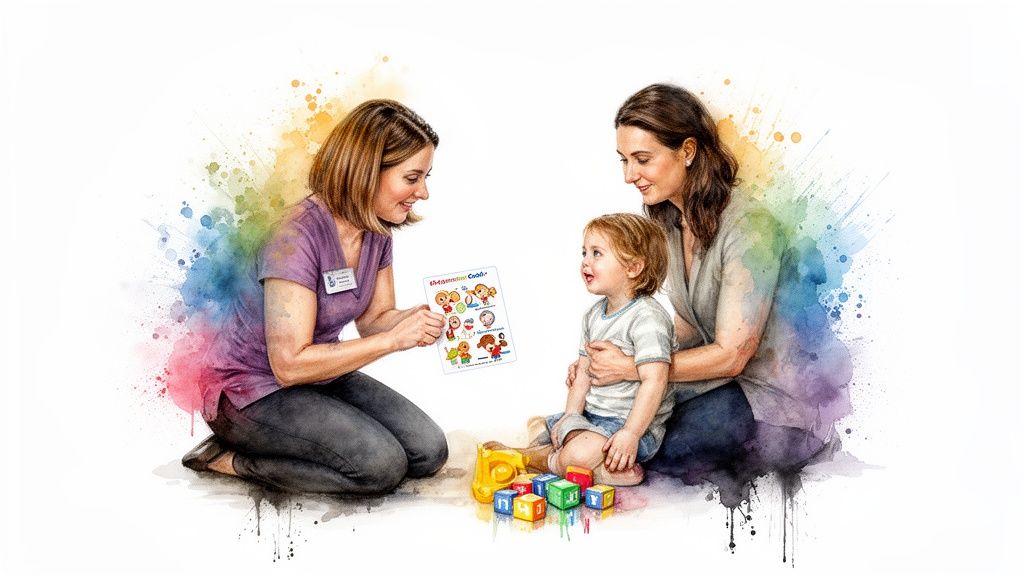
It’s a common misconception that SLPs only work on lisps or stutters. In reality, they are communication architects. They help build the foundational skills a child needs for every part of life, from making their first friend to raising their hand in the classroom.
At Georgetown Early Intervention Center, we often use the ‘communication coach’ analogy. Like a great sports coach, our SLPs first identify a child’s unique strengths and pinpoint the exact areas that need a bit more practice. From there, they design a custom playbook for success, ensuring every child gets the specific support they need to truly shine.
Core Areas of Support
An SLP’s work is incredibly detailed, touching on all the interconnected parts of communication. They create targeted, often play-based activities that help children master the building blocks of language and social connection.
Here are a few key areas an SLP focuses on:
- Articulation and Phonology: This is all about the physical act of making sounds. An SLP works with a child to correctly form sounds and put them together into clear words, helping turn “wabbit” into “rabbit.”
- Expressive Language: This is how we put our thoughts into words. Support here helps children expand their vocabulary, build grammatically correct sentences, and eventually tell their own stories.
- Receptive Language: This is the other side of the coin—understanding what others are saying. Our SLPs work on crucial skills like following multi-step directions (“Get your shoes and then grab your backpack”) and understanding questions.
- Social Communication (Pragmatics): You can think of this as the art of conversation. It includes learning how to take turns, read body language, and stay on topic with a friend.
A Speech-Language Pathologist does more than correct speech; they build bridges of understanding between a child and the world around them. They are essential members of a multidisciplinary team, ensuring every strategy supports the child’s overall development.
A Critical Role in Early Intervention
The need for skilled and compassionate SLPs is undeniable. For example, in the state of Texas alone, data from the Bureau of Labor Statistics showed that 1,175 SLPs were employed in 2023, making it one of the top states in the US for this profession.
This number highlights the massive demand for specialized support, especially for children with autism, speech delays, or those who need a boost to get ready for school.
You can explore our unique approach to speech therapy in Dubai to see how we create these bespoke plans. Our SLPs craft strategies from the ground up, ensuring every child can progress at their own pace and build the communication skills essential for a bright future.
Signs Your Child May Benefit from a Speech Therapist
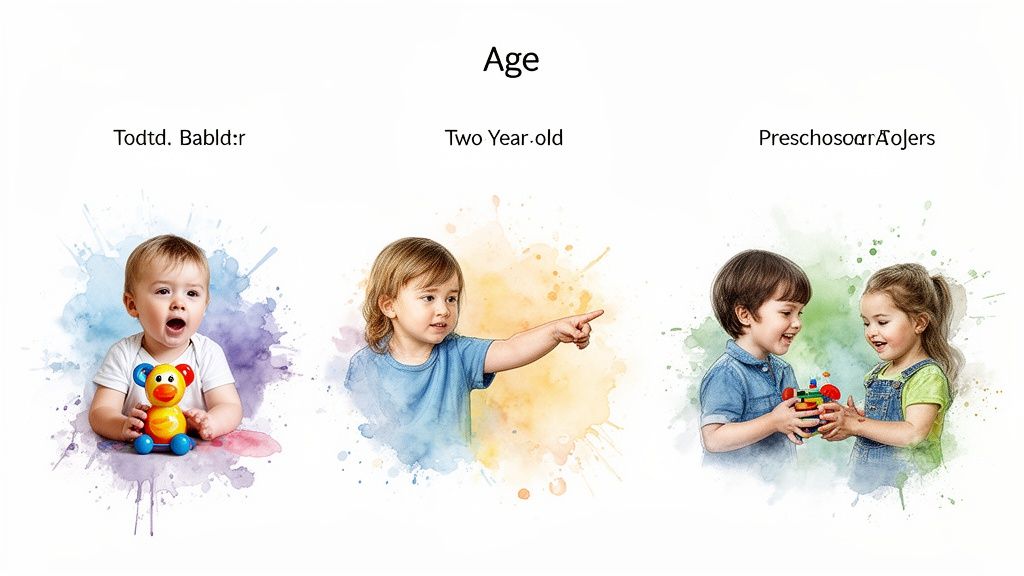
You know your child better than anyone. You see the little things—the way their concentration flickers when they’re figuring out a new toy, or how their eyes light up at the sound of your voice. So, it’s completely natural to wonder if their communication skills are developing as they should.
Think of this guide as a friendly chat, not a clinical checklist. We’ll walk through some common signs that might suggest your child could use a little extra support, from their first babbles to their preschool chatter. These are just gentle guideposts.
Noticing a few of these signs doesn’t automatically point to a problem. It simply means that starting a conversation with a professional, like an SLP speech therapist, could offer you clarity, strategies, and most importantly, peace of mind.
Early Toddlerhood Clues
Long before they say “mama” or “dada,” your baby is a busy communicator. Those gurgles, coos, gestures, and gazes are the very foundation of language. Sometimes, the earliest signs that a child might need support show up here.
By 12-15 months, for instance, most babies are masterful gesturers. They point to the snack they want, wave hello and goodbye, and reach for you when they want to be picked up. Their babbling also starts to sound more like a conversation, with a rich variety of sounds instead of just one or two repeated noises.
A few things to watch for at this age:
- Limited Vocalizations: Is your baby mostly quiet? Are they making a wide range of cooing and babbling sounds?
- Lack of Gestures: Are they using gestures like pointing or waving to get their message across?
- Poor Eye Contact: Do they have trouble looking at you when you interact with them?
Getting a handle on typical developmental timelines can be really helpful. For a deeper dive, understanding major baby milestones is a great resource.
Developmental Communication Milestones A Quick Guide for Parents
Every child’s journey is unique, but it can be helpful to have a general roadmap of what to expect and when. This table breaks down key communication milestones by age, offering a clear snapshot of typical development. It’s designed to empower you, not to create worry.
| Age Group | What to Look and Listen For | When to Consider an Evaluation |
|---|---|---|
| By 12 Months | – Babbles with different sounds (“bababa,” “mamama”) – Responds to their name – Waves “bye-bye” and points | – Not babbling or using gestures |
| By 18 Months | – Says several single words (e.g., “cup,” “dog”) – Follows simple one-step commands (“Give me the ball”) | – Has a vocabulary of fewer than 6-10 words |
| By 24 Months | – Puts 2 words together (“more juice,” “my car”) – Points to pictures in a book when named – Speech is 50% understandable to strangers | – Not yet combining words into simple phrases |
| By 36 Months | – Uses 3-4 word sentences – Asks “Why?” questions – Speech is 75% understandable to strangers | – Speech is very difficult for family to understand |
Remember, this is just a guide. If you have any concerns at all, no matter how small they seem, it’s always best to trust your instincts and seek a professional opinion.
Signs in Two and Three Year Olds
This is when language skills often explode, and any differences in development can become more noticeable. You might find yourself wondering about how your child pronounces certain words, the size of their vocabulary, or their ability to follow simple instructions.
A common area of concern is articulation—the clarity of their speech. It’s completely normal for a two-year-old to say “wabbit” for “rabbit.” But if their speech is so unclear that even you have a hard time understanding them, it might be worth looking into.
Their vocabulary should also be growing by leaps and bounds. While there’s a wide range of “normal,” a child who is using very few words could benefit from a boost. An experienced SLP speech therapist can help build that all-important word bank.
Early intervention isn’t about applying a label. It’s about giving your child the right tools to communicate confidently and effectively. Spotting a potential delay is the first step toward unlocking their full potential.
Preschool and School Readiness Indicators
As kids gear up for school, communication gets a lot more complex. It’s not just about naming things anymore; it’s about using language to learn, negotiate with friends on the playground, and build relationships.
At this stage, you might see challenges in following classroom routines or answering a teacher’s questions. For example, a child might struggle with a two-step direction like, “Put your drawing in the cubby and then wash your hands.”
Social communication is another huge piece of the puzzle. Does your child have a hard time starting a game with other kids, taking turns in a conversation, or reading a friend’s facial expressions? These are the skills that help them make friends and feel successful at school, and they are exactly what an SLP speech therapist is trained to support.
Your First Steps in the SLP Assessment Process

Stepping into the world of speech therapy for the first time can feel a little overwhelming. The word “assessment” might conjure images of formal tests and quiet rooms, but that’s not how we see it at Georgetown Early Intervention Center.
Think of it less as a test and more as a collaborative discovery mission. Our goal is to see the whole child—their personality, their strengths, and the specific areas where we can offer support. We’ve designed the initial evaluation to be a warm, welcoming, and even fun experience, creating a space where your child’s true abilities can shine.
Right from the start, this process is a partnership between you and your SLP speech therapist. After all, you’re the expert on your child, and your insights are the key to building a complete picture.
The Parent Interview: A Collaborative Start
The journey always begins with a conversation. We start with a detailed parent interview because your perspective is the most valuable piece of the puzzle. This isn’t about filling out forms; it’s a dedicated time for you to share your story, observations, and concerns in a supportive environment.
We’ll chat about your child’s developmental history, from their first babbles to their current vocabulary. We want to hear what a typical day looks like for your family and where your child communicates most comfortably. This dialogue helps us understand your goals and sets the stage for everything that follows.
Play-Based Observation: Uncovering Abilities Naturally
After we talk, the focus shifts to your child. Our therapists create a comfortable, play-filled setting with engaging toys and activities. This is more than just fun and games—it’s a strategic way for us to see your child’s communication skills in a natural, low-pressure context.
An SLP can learn an incredible amount just by watching a child play. They look for key communication behaviors, such as:
- How your child asks for a toy (using words, gestures, or sounds).
- Whether they engage in back-and-forth interactions with the therapist.
- The kinds of sounds and words they use spontaneously.
- How they understand and respond to simple directions during play.
The goal of an assessment isn’t just to find what’s missing. It’s about creating a holistic profile of your child’s communication skills—celebrating their strengths while identifying areas for growth. This balanced view is the bedrock of a truly personalized therapy plan.
Using Standardized Tools: Benchmarking Skills
Along with watching your child play, your SLP speech therapist will likely use some standardized assessment tools. These are carefully designed evaluations that allow us to compare your child’s skills to those of other children their age. This gives us objective data to help pinpoint specific areas of need.
These tools provide a clear benchmark for skills like vocabulary size, sentence structure, and sound production. When we combine this formal data with our informal observations, we get a comprehensive and accurate understanding of your child’s abilities.
This data-driven approach is essential. In Georgetown, Texas, access to certified SLPs is vital. The 2024 ASHA Workforce Data reports that 78.5% of school-based SLPs noted unfilled positions nationally in 2023. With 7.2% of U.S. children having a communication disorder, the need for precise support is clear. Our thorough assessments ensure your child gets the right help, right from the start. You can explore the national SLP workforce data to understand its local impact.
The information we gather from all these pieces—your interview, our observations, and formal testing—comes together to build a complete profile. This profile becomes the foundation for a targeted, effective, and individualized therapy plan. You can learn more about our multidisciplinary team of experts who collaborate on this important process.
Building Your Child’s Individualized Therapy Plan
Once the assessment is complete, all that valuable information doesn’t just get filed away. It becomes the blueprint for your child’s progress. Here at Georgetown Early Intervention Centre, this is where we roll up our sleeves and put our philosophy into action, turning clinical data and our observations into a dynamic, personalized therapy plan that’s as unique as your child.
This plan isn’t a static checklist of goals. Think of it as a living document, a roadmap that grows and adapts as your child does. It charts a clear course toward confident communication by setting goals that actually mean something in your family’s day-to-day life.
Translating Clinical Goals into Real-World Wins
An SLP speech therapist might identify a clinical target like “improving phonological awareness.” While that’s a critical skill for learning to read, the term itself doesn’t mean much when you’re snuggled up for a bedtime story. Our job is to bridge that gap, translating the technical goal into something tangible for you and your child.
So, instead of focusing on jargon, we reframe the objective. “Improving phonological awareness” becomes “helping your child hear the different sounds in their name so they can get ready for school.” It’s a small shift in language, but it’s powerful. It connects the therapy directly to a meaningful milestone, making the entire process more intuitive and motivating for everyone. To do this, an SLP will often build in fun activities based on proven strategies for teaching phonemic awareness that feel more like play than work.
Here are a couple more examples of how this looks in practice:
Clinical Goal: Increase mean length of utterance (MLU).
Family-Centred Goal: Help your child use three-word phrases to ask for their favorite snack.
Clinical Goal: Improve pragmatic turn-taking skills.
Family-Centred Goal: Teach your child how to play a simple board game with their sibling.
This approach ensures you’re always clear on the “why” behind every activity. We believe that when parents are empowered partners, progress happens faster. That’s why we offer dedicated guidance through our parent consultation services to help you feel confident every step of the way.
A Multidisciplinary Navigation Team
A child’s development is far too complex to be captured on a single map. That’s why our SLP speech therapists are part of a deeply integrated, multidisciplinary team. Picture us as an expert navigation crew for your child, where each specialist brings a vital and unique chart to the table.
Our team at Georgetown works in constant collaboration to support your child from every possible angle.
- Occupational Therapists (OTs) bring the “sensory map.” They help us understand how a child processes the world through their senses and how that impacts their ability to focus, regulate their body, and engage. An OT might suggest a specific type of seating or a calming pre-session activity to help a child arrive ready to communicate.
- Educational Psychologists provide the “learning map.” They offer incredible insight into a child’s cognitive profile, pinpointing strengths and challenges in areas like memory or attention that directly influence how they acquire language.
- ABA Therapists contribute the “behavioral map.” Using the principles of play-based Applied Behavior Analysis, they help reinforce positive communication attempts and create highly motivating opportunities for learning.
An individualized therapy plan is never created in a silo. It is the result of a collaborative fusion of expertise, where the SLP, OT, psychologist, and ABA therapist all work together to guide your child toward their destination.
This integrated model means communication goals aren’t just for speech sessions. The OT might be working on the fine motor skills needed to point to pictures in a storybook, while the ABA therapist reinforces asking for a toy using a new phrase. This ensures skills are practiced consistently across different settings, which we know is the fastest way for children to learn and generalize new abilities.
By layering these specialized “maps,” we create one comprehensive navigation plan for your child. Everyone on the team is working toward the same family-centered goals, providing a seamless and supportive experience that truly addresses the whole child. Your SLP speech therapist often acts as a central coordinator, making sure all the strategies align for the greatest possible impact.
A Look Inside a Play-Based Therapy Session

When you walk into a session at Georgetown Early Intervention Centre, you might be surprised. Forget quiet, clinical rooms—what you’ll see looks a lot more like a vibrant, purposeful playroom. Every game, every toy, and every silly moment is carefully chosen by an SLP speech therapist to help your child reach their communication goals.
The real magic here is that your child is learning and growing without even realizing it. They’re just having fun. This approach transforms hard work into joyful discovery, creating a positive and motivating space where new skills can naturally blossom.
Turning Play into Progress
Let’s take a closer look. Imagine a child and their therapist laughing as they blow bubbles. To the child, it’s a delightful game. But for the SLP, it’s a powerful articulation exercise in disguise.
- The Goal: To practice making the /p/ and /b/ sounds.
- The Activity: Blowing bubbles.
- How it Works: The therapist models the rounded lip shape needed for the word “bubbles,” encouraging the child to shout “pop!” or ask for a “big bubble!” This simple game strengthens oral muscles and teaches specific mouth movements for clearer speech, all through pure fun.
This seamless integration of goals into play is the heart of what we do. When a child is happy and engaged, they are far more receptive to learning and practicing new skills.
Building Language with Barnyard Friends
Next, picture the therapist and child on the floor with a toy barn and a few plastic animals. This isn’t just imaginative play; it’s a rich language-building activity designed to grow vocabulary and develop sentence structure.
The SLP might ask, “Which animal should go in the barn?” or playfully declare, “The cow is on the roof!” These little interactions are targeting several key areas at once:
- Vocabulary: Naming the animals (“cow,” “pig,” “sheep”).
- Sentence Structure: Forming simple sentences (“The pig is in the mud”).
- Prepositions: Understanding concepts like “in,” “on,” and “under.”
A play-based session is a carefully choreographed dance between the child’s interests and their therapy goals. The SLP acts as a guide, creating countless opportunities for communication within an activity the child already loves.
The Power of a Multidisciplinary Team
Our approach goes even deeper through collaboration. An Occupational Therapist (OT) on our team might suggest using weighted animals to provide sensory input, helping the child feel more grounded so they can better focus on the language task.
At the same time, we weave in principles from play-based ABA. When a child successfully says, “I want the horse,” the natural reward of getting the horse immediately reinforces that positive communication attempt. This integrated model ensures every moment of the session is maximized for learning.
Our ability to attract and retain top-tier professionals makes this collaborative success possible. In Texas, where our center is based, the Bureau of Labor Statistics reported 1,175 SLPs with a mean wage of $92,770 in 2023. This competitive environment allows us to build a team of highly skilled therapists. For families, that means access to experts who can craft these sophisticated, multidisciplinary plans. With 1 in 14 U.S. children facing a speech-language disorder, our holistic approach is more critical than ever. You can learn more about the professional landscape for SLPs in the region.
Empowering Parents as Partners
Your role as a parent is the most important piece of the puzzle. Progress doesn’t stop when the session ends. Your SLP speech therapist will actively involve you, showing you how to turn everyday routines into powerful learning opportunities.
You’ll leave each session with practical, easy-to-use strategies, not just a progress update. You might learn how to use bath time to practice new sounds or how to narrate your grocery store trip to build vocabulary. We equip you to become your child’s most effective communication coach, making you a true partner in their incredible journey.
Of course. Here is the rewritten section, designed to sound natural, human, and expert-written.
Your Top Questions About Speech Therapy Answered
Taking that first step into speech therapy brings up a lot of questions. It’s a new world for most families, so feeling a bit uncertain is completely normal. We find that the best way to move forward with confidence is to get clear, honest answers.
We’ve put together the most common questions our SLP speech therapist team at Georgetown Early Intervention Center hears from parents just like you. Our aim here is to give you practical, reassuring answers that speak to your real-world concerns—from how long therapy might take to how you can be the biggest champion for your child’s success.
How Long Will My Child Need Speech Therapy?
This is usually the first thing parents want to know, and the most honest answer is: it truly depends on your child. There’s no magic number or standard timeline because every child’s brain, personality, and communication hurdles are unique. The length of therapy really hinges on a few key things we look at together.
Things like the specific goals we’re working on, your child’s age, how quickly they pick up new skills, and how much practice happens between sessions all play a big part. Because of this, we steer clear of making one-size-fits-all predictions.
Instead, we map out a plan with clear, achievable goals that we review with you regularly.
Some kids might just need a short-term boost for a few months to nail a tricky sound. Others with more complex needs, like those connected to autism or a significant speech delay, will likely see the best results with consistent, longer-term support. Our focus is always on giving your child exactly what they need to blossom into a confident communicator—no more, no less. We promise to keep you in the loop about their progress every step of the way.
What Is My Role as a Parent in All of This?
Your role is everything—you are, and always will be, your child’s most important teacher! We don’t just see you as a parent bringing your child to an appointment; we see you as our most important partner. The real magic happens when the skills learned in therapy are woven into everyday life, and that’s where you shine.
An SLP speech therapist will often use part of your session to show you simple, fun activities you can do at home. That consistent practice is the secret sauce that helps a new skill stick for good.
You might get tips for moments like:
- Bath Time: Making “ssss” sounds like a snake or playing with foam letters.
- Mealtime: Chatting about what you’re eating—”crunchy carrots,” “sweet banana”—to build vocabulary.
- Story Time: Asking simple “who” or “what” questions to build understanding.
- Playtime: Modeling slightly longer sentences while you build with blocks or play with cars.
You are the expert on your child. Your insights into what makes them tick—their personality, their passions—are priceless. You’re not a bystander in this process; you’re a core member of the team, and your involvement makes a huge difference.
We always want you to ask questions, share what’s working (and what’s not!) at home, and celebrate every tiny win with us. When we combine our clinical expertise with your family expertise, we get the best possible results.
How Do We Know if Therapy Is Actually Working?
It’s so important for you to feel confident that your time, effort, and investment are paying off. At Georgetown, tracking progress isn’t an afterthought; it’s built right into our process to make sure we’re on the right track. We look at your child’s growth from a few different angles.
First, we use the specific, measurable goals in your child’s therapy plan as our guide. In every session, our therapists are quietly collecting data on how your child is doing with those targets. This gives us hard numbers on how they’re progressing.
Second, every so often we’ll do a reassessment. This might involve a mix of formal, standardized tests and informal, play-based observations to see how their overall communication skills are growing beyond just the weekly goals.
Finally, and maybe most importantly, we listen to you. Are you noticing more words at home? Is your child less frustrated when they try to tell you something? Are they joining in more with cousins or friends? That real-world progress is what it’s all about, and your observations tell us so much. We hold regular progress meetings to pull all this information together and decide on the next best steps.
How Is Speech Therapy Different for a Child with Autism?
This is a fantastic question. While the basic goals of communication are the same for all kids, our approach for children on the autism spectrum is much more specialized and collaborative. We know that for autistic children, communication challenges often go deeper than just sounds and words.
They can involve the social side of language (sometimes called pragmatics), like understanding body language, taking turns in a conversation, or getting the hang of figures of speech. Our SLP speech therapist team is deeply trained in these specific areas.
Here, our SLPs work hand-in-glove with our play-based ABA therapists. This means communication goals aren’t just for the therapy room; they’re woven into every single thing your child does with us during their day.
We lean on proven strategies that really connect with autistic learners, including:
- Visual Supports: Using picture schedules and choice boards helps make the day predictable and less stressful.
- Social Stories: We use simple, customized stories to help explain social situations and what to expect.
- Video Modeling: Watching short videos of a desired skill can be a powerful and low-pressure way to learn.
We always build therapy around your child’s unique interests, because that’s how we keep them motivated and engaged. This “all-hands-on-deck” approach provides the consistent, holistic support that helps autistic children find their voice and thrive.
At Georgetown early intervention center, we believe every child has a unique voice waiting to be heard. Our dedicated team of therapists is here to build a personalized plan that celebrates your child’s strengths and supports their journey toward confident communication. Learn more about our individualised approach and how we can partner with your family.