Child speech therapy is a specialized field dedicated to helping children build their communication skills from the ground up. It’s designed to address a whole range of challenges—from forming specific speech sounds and understanding language to improving voice quality and fluency. The ultimate goal is to empower a child to share their thoughts, feelings, and needs with confidence.
Your Guide to Child Speech Therapy
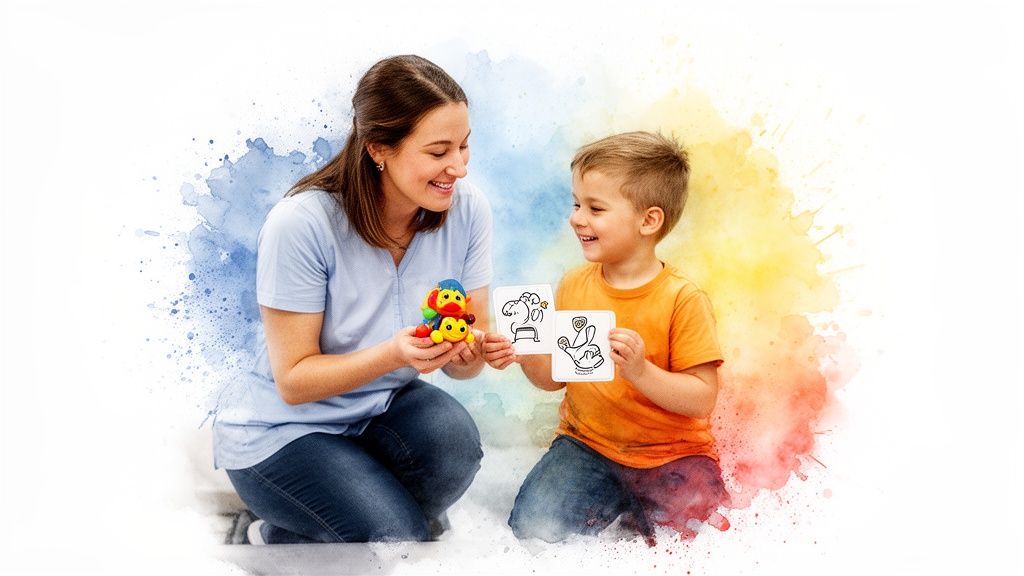
Dipping your toes into the world of child speech therapy for the first time can feel like a lot to take in, but at its core, it’s a simple, supportive process. The easiest way to think of a Speech-Language Pathologist (SLP) is as a personal coach for your child’s communication. Much like a sports coach uses fun drills and targeted exercises to build physical muscles, an SLP uses structured, play-based activities to strengthen communication abilities.
This whole process is meant to feel like guided fun, not sterile clinical work. At Georgetown Early Intervention Center, we know that children learn best when they’re happy, engaged, and motivated. That’s why our therapy sessions often just look like playtime—we use games, stories, and creative activities to build those crucial skills without the pressure.
Speech vs. Language: What’s the Difference?
It’s really helpful to understand the two main areas a therapist focuses on: speech and language. People often use these terms interchangeably, but they’re actually two very distinct parts of communication.
- Speech is the physical act of making sounds. It’s all about the precise coordination of the tongue, lips, and jaw to form words. A child with a speech challenge might have trouble pronouncing certain sounds, which can make their words hard for others to understand.
- Language is about making meaning—both understanding others and being understood. This covers vocabulary (knowing what words mean), putting sentences together to share ideas, and following directions. A child with a language challenge might have plenty of words but struggle to string them together into a coherent thought.
Knowing the difference helps us zero in on exactly where your child might need support. This clarity is the first step toward creating a plan that builds not just clearer talking, but more effective communication all around. For some children, these challenges are part of a broader developmental profile, and learning about helpful strategies for supporting children with autism can provide a more complete picture of integrated care.
Seeking support early is a proactive and powerful step. It equips your child with the foundational tools needed for building friendships, engaging in the classroom, and developing lifelong confidence.
The need for these specialized services is certainly growing. Here in the United Arab Emirates, demand for child speech therapy has shot up, with speech and language concerns now making up 30–40% of all developmental referrals. In fact, recent data shows that referrals for these delays in children under six have nearly doubled, highlighting just how much parents and doctors are recognizing the importance of early intervention. You can explore the full findings on the increasing need for early intervention services.
Recognizing Key Communication Milestones
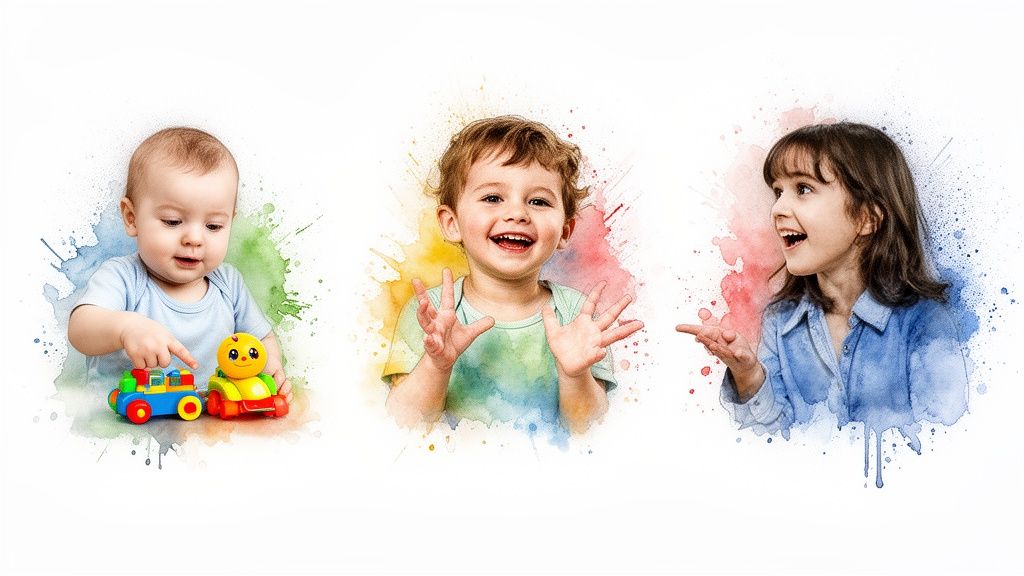
As a parent, you are the world’s leading expert on your child. You know their quirks, their rhythms, and their unique personality better than anyone. This makes you the perfect person to notice how their communication skills are unfolding day by day.
But let’s be honest, tracking these skills can be confusing. It’s far too easy to fall down a rabbit hole of clinical checklists that seem to cause more worry than clarity. Instead of getting bogged down in a rigid list, it’s much more helpful to think about communication in real-world moments. The goal isn’t to diagnose, but to observe with gentle curiosity and understand when it might be time for a professional chat.
Every child’s journey is different, and there’s a wide range of what’s considered “typical” development. A slight variation from a specific milestone is rarely a reason to panic. What really matters are the overall patterns of how their communication is growing over time.
The First Steps: From Babbling to Words
The journey into language starts long before the first clear word. In these early stages, what we’re really looking for are the foundational blocks of communication.
Around 12 months, you’ll likely hear intentional babbling—think strings of sounds like “mamama” or “bababa.” A baby at this age should also be responding to their name and simple requests like “come here,” often with the help of gestures. They might wave “bye-bye” or point to things they want, which shows they’re starting to understand that actions can communicate needs.
By 18 months, most toddlers have a vocabulary of around 10 to 20 words, even if they aren’t pronounced perfectly. What’s even more important is that they understand many more words than they can actually say. They should be able to point to familiar objects or parts of their body when you name them.
From Words to Simple Conversations
As your child moves into the toddler years, you’ll start to see an explosion in their language. This is when they begin putting words together to express more complex ideas.
At 2 years old, a child is typically using two-word phrases like “more juice” or “my ball.” A key question to ask yourself is, “Is my two-year-old using gestures more than words?” While gestures are still part of the picture, their spoken vocabulary should be growing, with at least 50 words being a common benchmark.
Fast forward to 3 years old, and their vocabulary often expands to several hundred words. They’ll start using three- to four-word sentences and asking simple “who,” “what,” and “where” questions. At this stage, they should be generally understood by familiar listeners, like parents and close relatives.
One of the most important things to remember in the UAE is our wonderfully multilingual environment. It is completely normal for a child learning two or more languages to mix them up or have slightly slower vocabulary growth in each individual language. This is not the same as a true language delay.
A child speech therapy expert can help you tell the difference between the natural process of acquiring multiple languages and an underlying communication challenge that needs support.
Growing Into a Confident Communicator
Between ages four and five, your child’s speech and language skills become much more refined. This is a crucial time as they get ready for the social and academic demands of school.
At 4 years old, children usually speak in longer, more complex sentences. They can tell simple stories, and their speech should be clear enough for strangers to understand most of what they’re saying. A helpful question to consider here is, “Do family or friends frequently struggle to understand what my four-year-old is saying?” If articulation issues are making them consistently difficult to understand, it may be worth exploring.
By 5 years old, a child can typically carry on a back-and-forth conversation, follow multi-step directions, and use correct grammar most of the time. They should be able to explain what happened during their day in a way that makes sense to others, setting the stage for strong literacy and social skills down the road.
Developmental Communication Milestones At a Glance
Every child develops at their own pace, but knowing the general timeline can help you spot potential areas where a little extra support might be needed. This table offers a quick reference for key speech and language milestones.
| Age Range | What to Listen For (Speech & Language Milestones) | When to Consider a Consultation |
|---|---|---|
| By 12 Months | • Using intentional babbles (“bababa”) • Responds to their name • Uses gestures like pointing or waving | If there’s very little babbling or no response to their name or simple sounds. |
| By 18 Months | • Has a vocabulary of at least 10-20 words • Can point to familiar objects when named • Follows simple one-step commands | If they haven’t said their first words or seem to rely only on gestures. |
| By 2 Years | • Uses two-word phrases (“want milk”) • Has a vocabulary of around 50 words • Speech is becoming clearer | If they are not yet combining words into simple phrases. |
| By 3 Years | • Uses 3-4 word sentences • Asks “who, what, where” questions • Can be understood by familiar adults | If their speech is very difficult for family to understand or sentences remain very short. |
| By 4 Years | • Tells simple stories • Speech is understood by most people • Follows 2-3 step instructions | If unfamiliar people consistently cannot understand them. |
| By 5 Years | • Carries on back-and-forth conversations • Uses grammatically complex sentences • Can explain past events clearly | If they struggle to tell a coherent story or have significant trouble with grammar. |
Remember, this chart is just a guide. If you notice your child is consistently missing these milestones or if your parental intuition tells you something is off, it never hurts to seek a professional opinion. Spotting patterns that deviate significantly from these general timelines is the first step in getting proactive support.
What to Expect During a Speech Evaluation
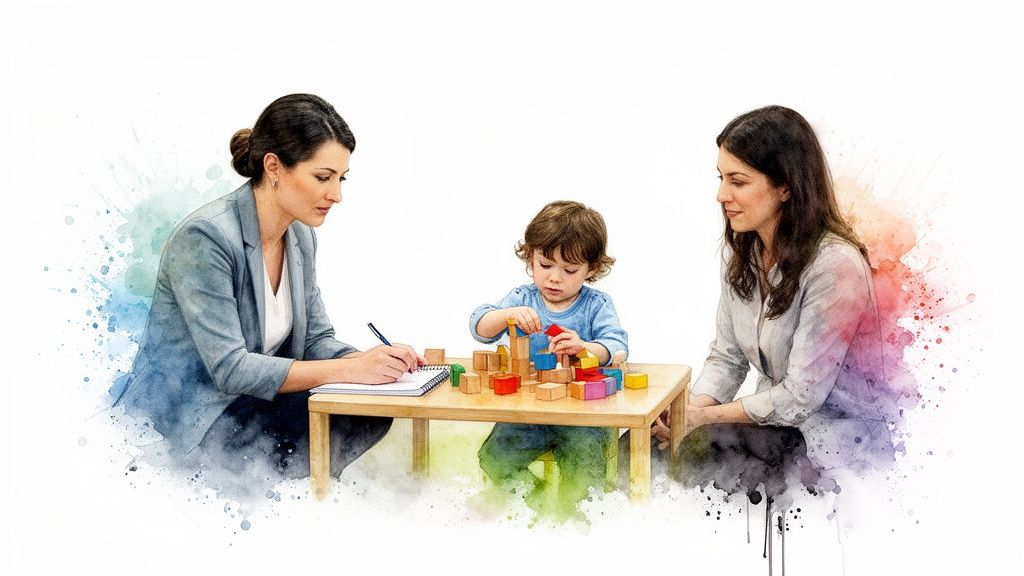
The word “evaluation” can sound a little intimidating, but it’s best to think of this first step as a collaborative discovery session, not a test. This is where we start piecing together the puzzle of your child’s unique communication style. Our main goal is to create a comfortable, stress-free experience for everyone so we can see an authentic picture of your child’s abilities.
This process is a true partnership right from the start. We don’t just observe your child from a distance; we listen carefully to you. Your insights, concerns, and stories provide the crucial context that no formal assessment could ever capture. In fact, this initial conversation is the foundation for everything that follows.
The Parent Conversation
The first part of any good evaluation is simply talking with you. You are the expert on your child, and your perspective is invaluable. We’ll sit down and discuss your child’s developmental history, what you’re seeing at home, and what you hope to achieve for their communication.
This is your time to share everything. What makes your child light up when they try to communicate? Where do they seem to get stuck or frustrated? No detail is too small, because these everyday observations help us understand the full picture.
Play-Based Observation and Interaction
A big part of the evaluation will look and feel just like playtime. That’s intentional. Children communicate most naturally when they’re comfortable, engaged, and having fun. Our speech-language pathologists are experts at creating an inviting environment where they can observe your child’s skills in a very natural way.
During this play-based interaction, the therapist is looking at several key areas:
- Expressive Language: How your child uses words, gestures, and sounds to share their wants and needs.
- Receptive Language: How well they understand what’s being said, follow directions, and respond to questions.
- Speech Production (Articulation): The clarity of their speech sounds and whether there are any noticeable patterns or errors.
- Social Communication: How they engage in back-and-forth interactions, use eye contact, and take turns in a “conversation,” even a non-verbal one.
This hands-on approach lets us see your child’s strengths and challenges in real-time, without the pressure of a formal test. It’s a gentle yet incredibly powerful way to gather information. The insights from these sessions are what allow our highly qualified team of therapists to build a plan that truly works.
An evaluation is not about finding what’s “wrong.” It’s about discovering your child’s unique communication style, identifying their strengths, and pinpointing the exact areas where targeted support will make the biggest difference.
Standardised Assessments and Language Samples
Along with our play-based observations, we often use standardised assessments. These are specific, evidence-based tools designed to see how your child’s skills compare to others in the same age group. This isn’t about getting a score or a label; it’s about using proven methods to identify specific areas that might need a little extra support.
We might also take a language sample. This just means we record your child as they chat and play. Later, we can analyze this sample to get a detailed look at their vocabulary, how they structure sentences, and their grammar.
This combination of structured and unstructured methods gives us a complete, well-rounded understanding. Ultimately, all this information—your insights, our observations, and the assessment results—comes together to form the roadmap for your child’s personalised therapy plan.
How We Design Your Child’s Therapy Plan
Once the initial evaluation is complete, we have a clear and detailed map of your child’s unique communication profile—both their strengths and the areas where they could use a little extra support. This map is the foundation for everything that comes next. Think of it like a custom blueprint for a house; it’s a carefully designed guide ensuring every single activity is purposeful and perfectly suited to your child.
Our approach is the exact opposite of a one-size-fits-all model. Every child is different, so every therapy plan has to be, too. We take all the rich information from the assessment and translate it into a dynamic, actionable strategy that will guide your child’s journey in their speech therapy services in Dubai.
This plan is also a shared document. We believe in total transparency, so you’ll always understand not just what we’re working on, but why it matters and how it all connects to your child’s bigger developmental picture.
Building Goals with the SMART Framework
To make our goals effective and easy to track, we use a trusted method called the SMART framework. This structure helps us turn broad ideas like “improving speech” into concrete, achievable steps that set your child up for one win after another.
Here’s what SMART goals look like in action:
- Specific: We get really precise about what we want to achieve. Instead of a vague goal like “better communication,” we’d set a target like, “The child will correctly produce the /s/ sound at the start of words.”
- Measurable: We define exactly how we’ll measure success. For example, “The child will achieve this in 8 out of 10 attempts during our structured games.”
- Achievable: The goal has to be realistic for your child right now. We aim for that sweet spot of a gentle challenge that builds skills without causing frustration.
- Relevant: Every single goal is tied directly to improving your child’s ability to communicate in their real world—at home, with friends, or at school.
- Time-bound: We set a clear timeframe for reaching the goal, like “within the next three months.” This helps us monitor progress and make smart adjustments to the plan along the way.
This framework transforms a therapy plan from a simple wishlist into a powerful roadmap. It gives our therapists clarity, empowers you as a parent to see tangible progress, and gives your child a series of successful steps to build their confidence.
A Collaborative and Multidisciplinary Approach
Communication skills don’t develop in a bubble. A child’s ability to speak clearly is often connected to their fine motor skills, their ability to focus, and even their emotional regulation. That’s why our therapy plans are almost always designed with a multidisciplinary lens, treating your child as a whole person, not just a set of symptoms.
At Georgetown, our experts work side-by-side to create a truly cohesive strategy. This collaboration ensures every aspect of your child’s development is supported in a coordinated way, leading to deeper, more lasting progress.
Here’s how that might look for a child struggling with articulation:
- A speech-language pathologist will work on the specific sounds and mouth movements.
- An occupational therapist might join in to help strengthen the fine motor control in the tongue and lips needed for clearer speech.
- An educational psychologist could provide strategies to boost attention and focus, making it easier for the child to absorb and learn during their sessions.
This integrated model means that a breakthrough in one area often sparks growth in another. By tackling interconnected challenges together, we create a strong support network that helps your child truly thrive. It’s how we ensure your child’s plan is robust, thoughtful, and built for success from every possible angle.
Once we have a clear, personalized roadmap for your child, it’s time for the fun part: bringing it to life. This is where we open up our “therapist’s toolbox,” which is packed with evidence-based, engaging methods designed to make therapy both effective and, most importantly, enjoyable. Every single activity, game, and story has a purpose, chosen specifically to help your child reach their communication goals in a way that keeps them motivated.
The guiding principle of modern speech therapy is that kids learn best through joyful, natural interactions. We’ve moved far beyond rigid drills. Instead, we create a world where building communication skills feels more like an exciting adventure, which keeps children invested and helps them build positive feelings around communication.
The Power of Play-Based Therapy
At the very heart of what we do is play-based therapy. It’s simple, really: play is a child’s natural language. It’s how they explore, make sense of their surroundings, and connect with others. By weaving therapy goals into activities your child already loves, we can help them develop new skills in the most organic way possible.
So, what does this actually look like in a session?
- Building with Blocks: As we build a tower, we’re not just stacking blocks. We’re working on turn-taking (“my turn,” “your turn”), understanding prepositions (“put the block on top“), and following multi-step directions (“first get the blue block, then the red one”).
- Playing with a Toy Farm: This everyday toy becomes a fantastic stage for practicing animal sounds to improve articulation, growing vocabulary (“barn,” “tractor,” “hay”), and forming simple sentences (“The cow eats grass”).
This approach makes sure therapy isn’t something that happens to a child. It’s an experience they get to lead and enjoy. We’re tapping into their natural curiosity, which is the most powerful engine for progress.
Targeting Specific Skills with Fun Activities
While play is our foundation, we also use more focused techniques for specific challenges. The trick is to disguise this direct practice as a game. This keeps your child engaged and sidesteps the pressure of a formal lesson, which can sometimes cause them to shut down.
Articulation Therapy
When a child struggles to make certain sounds, like /s/ or /r/, we turn articulation practice into a fun challenge instead of just repeating sounds over and over.
For instance, we might:
- Invent a “New Sound”: For a slushy-sounding /s/, we might call it the “flat tire” sound (t-t-t-sssss) and use pictures of a tire losing air as a visual cue. We then practice slotting this “new sound” into words, which helps bypass the child’s old, incorrect motor pattern.
- Go on a Sound Hunt: We’ll read books that are full of their target sound and turn it into a game to find all the words with that sound.
Every technique is chosen based on what clicks with your child. The aim is to build a new motor plan for speech sounds in a way that feels creative and low-pressure, making it much easier for the new habit to stick.
Language and Literacy Development
Growing a child’s understanding and use of language is all about stories, pictures, and lively conversation. We work on building their vocabulary, grammar, and storytelling skills through activities they find genuinely captivating.
This could look like:
- Interactive Storytelling: We might use puppets or props to act out a story, asking your child to guess what happens next, describe the characters, or retell the plot in their own words. This is a brilliant way to work on narrative skills and sentence structure.
- Picture Description Games: Using detailed picture scenes, we can play “I Spy” to work on vocabulary, descriptive words (adjectives), and putting together more complex sentences (“I see a big, red ball under the tree”).
By weaving these targeted exercises into playful moments, we help children build essential skills without it ever feeling like “work.” Each game and story is a stepping stone, carefully placed to guide them toward clearer, more confident communication, ensuring the speech therapy journey is a positive one.
Becoming a Partner in Your Child’s Progress

While the progress your child makes in therapy sessions is a huge step forward, the real magic happens in the small moments you share at home. Think of your speech therapist as their coach—they design the game plan and teach the core skills. You, as the parent, are the most valuable player who helps your child practice those skills all week long.
Your role is absolutely essential. You’re not expected to become a therapist overnight, but you are your child’s first and most important teacher. The small, consistent interactions you have every day can amplify their progress in ways you can’t even imagine. The best part? You don’t need to block out extra time or add more to your plate. The most powerful support is simply woven into the daily routines you already have.
Turning Daily Routines into Learning Opportunities
You can transform almost any everyday activity into a fantastic language-building experience. Because these moments feel so natural to your child, learning becomes effortless and fun.
- During Mealtimes: Chat about the food you’re eating. You can talk about its color, texture, and taste. For example, you might say, “This apple is so crunchy and red,” or ask simple questions like, “Do you want some more soft bread?”
- In the Car: A car ride is the perfect captive audience! Play a game of “I Spy” using descriptive words (“I spy something round and green“) or just talk about what you see out the window, narrating your journey as you go.
- At the Grocery Store: This is a goldmine for new words. Name the items you put in the cart, talk about their categories (“Okay, let’s find some fruit now”), and describe what you plan to do with them at home.
These simple strategies turn otherwise passive moments into active learning opportunities, reinforcing everything your child is working on in speech therapy.
The goal isn’t to drill or test your child. It’s about surrounding them with a rich, responsive language environment. Your consistent, gentle modeling is one of the most powerful tools you have.
Practical Tips for Everyday Conversations
Integrating language support at home is less about specific activities and more about your approach. A few key techniques can make a huge difference in how your child learns and uses language.
1. Narrate Your Actions
Simply talk about what you’re doing as you do it. While making breakfast, you could say, “I’m opening the fridge. Now I’m getting out the milk. I’ll pour the milk into your bowl.” This provides a steady stream of simple, grammatically correct sentences for your child to absorb.
2. Model Without Pressure
If your child makes a mistake, just gently model the correct way without making them repeat it. If they say, “Her run fast,” you can respond with a warm, positive tone, “Yes, she is running so fast!” This corrects the error naturally and avoids creating any anxiety around speaking.
3. Expand on Their Words
When your child says something, build on it. If they point to a car and say, “Car,” you can expand by replying, “Yes, it’s a big, blue car! That car is going fast.” This technique validates what they said and shows them how to build longer, more detailed sentences.
By becoming an active partner, you create a powerful bridge between therapy sessions and real life. For more personalized guidance on this journey, exploring our parent consultation services can give you the strategies to feel even more confident in your crucial role.
Common Questions About Child Speech Therapy
When you’re exploring speech therapy, it’s completely normal to have a lot of questions. As a parent, you want to understand what the journey looks like for your child. We hear these questions all the time, so we’ve put together some straightforward answers to give you the clarity and confidence you need.
How Long Will My Child Need Speech Therapy?
This is usually the very first question parents ask, and the most honest answer is: it truly depends on your child. There’s no one-size-fits-all timeline. The length of therapy is shaped by a few key things, like your child’s specific communication goals, how often we have sessions, and how much the strategies are practiced at home between visits.
For some kids with simpler articulation goals—like mastering a tricky “r” sound—it might only take a few months. For others with more complex language needs, they may benefit from longer-term support to build a really solid foundation. We’re constantly tracking progress and keeping the conversation going with you, making sure the plan is always working toward empowering your child with skills that last a lifetime.
Will My Child Just Grow Out of It?
It’s a tempting thought, isn’t it? While it’s true some very minor speech errors can clear up on their own, waiting is a real gamble with your child’s development. Early intervention is so important because strong communication skills are the bedrock for everything else—making friends, participating in the classroom, and building a healthy sense of self.
A professional evaluation takes the guesswork out of it. It helps us figure out if we’re looking at a typical developmental hiccup or a delay that needs targeted, evidence-based support to get your child on the right track.
What Is the Difference Between a Speech and Language Delay?
This is a great question, and it’s easy to get them mixed up. The simplest way to think about it is this:
Speech is all about the mechanics of talking—how the mouth, tongue, and lips physically produce sounds. A child with a speech delay might say “wun” instead of “run” or “tat” instead of “cat.” It’s about clarity.
Language, on the other hand, is the content and the rules. It’s about understanding what words mean and how to put them together to share ideas. A child with a language delay might have trouble following directions, asking questions, or stringing words together to make a full sentence.
Our comprehensive evaluation is designed to pinpoint exactly where the breakdown is happening—whether it’s in the mechanics, the content, or a little of both.
How Do We Get Started?
Taking that first step is much simpler than you might think. It all begins with an initial consultation where we just talk. We’ll listen to your concerns, walk you through our process, and make sure every single one of your questions is answered. We’re here to support your family on the path toward clear, confident communication.
Ready to help your child find their voice? The dedicated team at Georgetown Early Intervention Center is here to create a personalized plan that nurtures their unique potential. Contact us today to schedule your initial consultation.