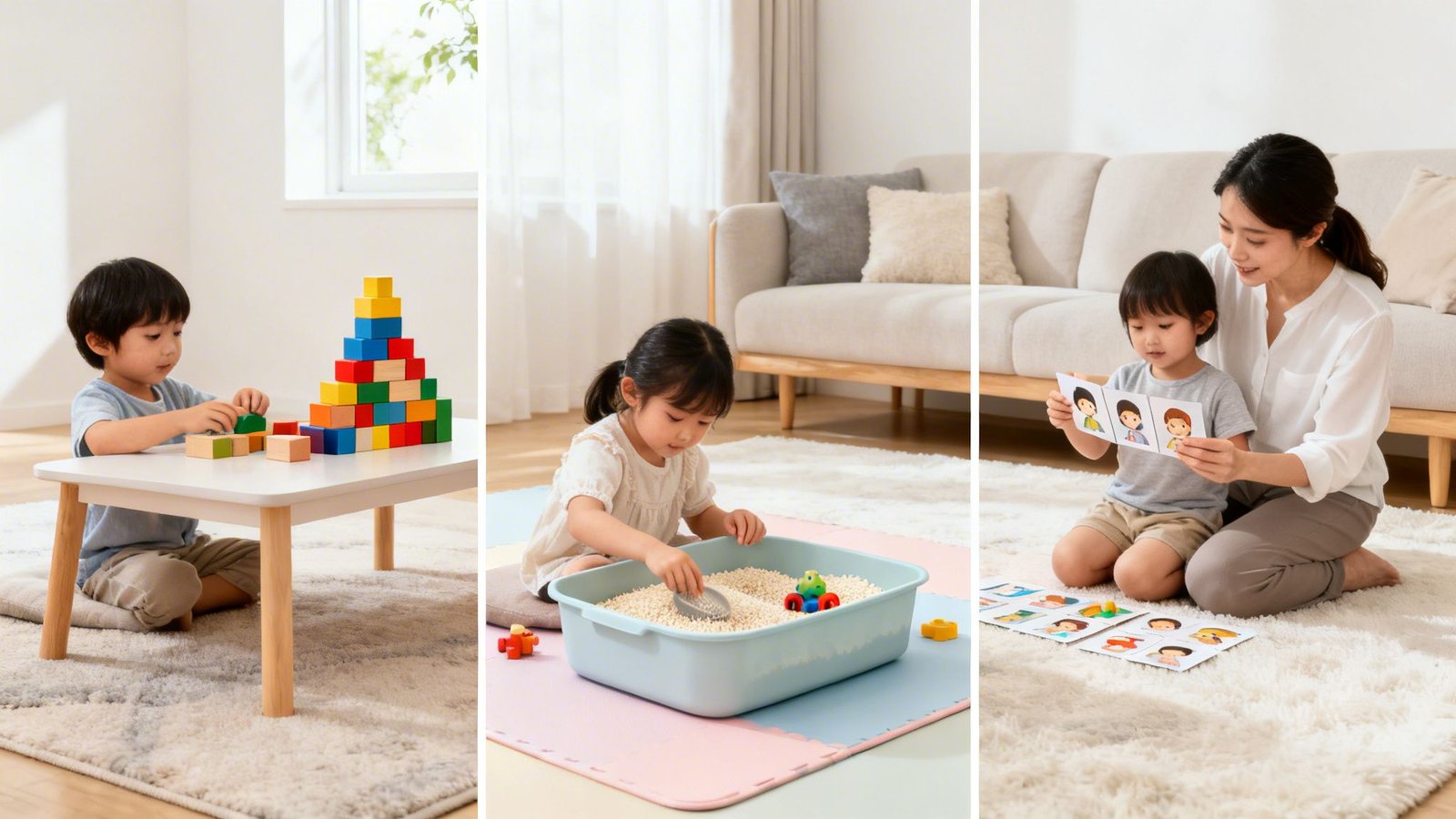

When the weather keeps everyone indoors, it's easy to fall back on the usual pastimes. But what if that time could be transformed into a powerful tool for your child's development? This guide reimagines classic indoor activities for kids through a therapeutic lens, offering a structured, goal-oriented approach to play that supports key developmental milestones. We move beyond generic suggestions to provide actionable strategies tailored for speech, sensory, social, and academic readiness.
This is not just another list of things to do. Instead, we present a comprehensive resource for parents and therapists seeking to integrate therapeutic goals into everyday fun. You will discover how to turn a simple board game into a lesson on turn-taking and social cues, or how a baking project can enhance fine motor skills and sequential processing. Each activity is broken down with clear, practical details:
- Materials Needed: Simple, accessible items you likely already have.
- Step-by-Step Prompts: Clear instructions to guide the activity.
- Measurable Objectives: How to track progress towards specific therapeutic goals.
- Adaptations: Modifications for different ages and ability levels.
At Georgetown Early Intervention Centre, we believe that every child's plan should be as unique as they are. This principle is woven into every suggestion, providing tips for individualisation. Our goal is to empower you to turn a simple rainy day into a meaningful, milestone-making opportunity, making progress feel less like work and more like play. This framework provides the structure needed to make playtime truly productive.
1. LEGO and Building Block Construction
Building with LEGOs and other construction blocks is a classic indoor activity for kids that masterfully blends play with skill development. It involves using interlocking plastic bricks or wooden blocks to create everything from simple towers to complex, imaginative structures. This hands-on process is foundational for developing spatial reasoning, problem-solving skills, and fine motor precision.
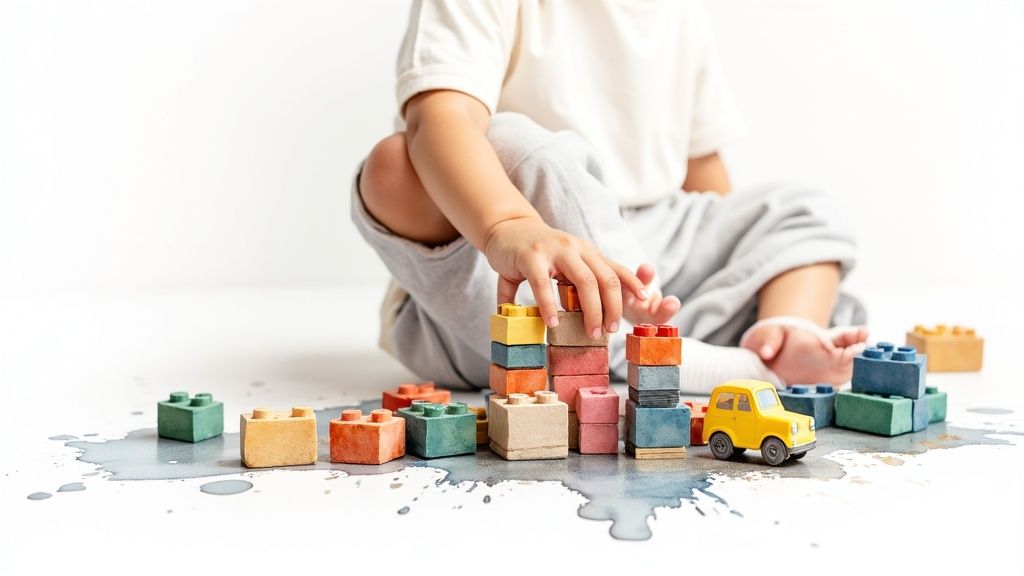
At Georgetown Early Intervention, we use block play to target a wide range of therapeutic goals. The tactile nature of connecting and stacking blocks provides rich sensory input, while the intricate movements required to fit pieces together enhance fine motor dexterity and hand-eye coordination.
Therapeutic Objectives and Implementation
- Speech and Language: Describe actions using verbs ("stack," "push," "build") and prepositions ("on top," "next to," "under"). Create a story about the structure being built, encouraging narrative skills.
- Sensory/Occupational Therapy: Improve pincer grasp and bilateral coordination by having the child hold a base with one hand and build with the other. The weight and texture of different blocks (e.g., wood vs. plastic) offer varied sensory experiences.
- Social/ABA Therapy: Practise turn-taking by adding one block at a time. Work on joint attention by following a shared building plan or diagram, requiring both participants to focus on the same task.
- School Readiness: Introduce concepts like colours, shapes, counting, and sorting. Following multi-step instructions from a LEGO manual builds sequencing skills and attention span, crucial for classroom learning.
Individualising the Activity
To adapt this activity, start with large, easy-to-handle blocks for younger children or those with significant motor challenges. For children needing a greater challenge, introduce complex sets like LEGO Technic or assign specific building prompts ("Build a bridge that can hold a toy car"). Create a "calm-down corner" with a bin of blocks for self-regulation, as the repetitive motion of building can be very soothing. This adaptability makes it a cornerstone of effective indoor activities for kids at all developmental stages.
2. Arts and Crafts Projects
Engaging in arts and crafts projects is a versatile and powerful indoor activity for kids, transforming simple materials like paint, paper, and clay into avenues for self-expression and skill-building. This creative process involves everything from finger painting to sculpting, allowing children to explore textures, colours, and forms. It is a fundamental way to foster creativity, sensory exploration, and fine motor control.

At Georgetown Early Intervention, our therapists use arts and crafts to make therapeutic goals both fun and functional. The hands-on nature of these activities provides crucial sensory feedback while developing the precise hand movements necessary for tasks like writing and self-care. It's a fantastic tool for encouraging focus and expressing emotions non-verbally.
Therapeutic Objectives and Implementation
- Speech and Language: Build vocabulary by naming colours, shapes, and art supplies ("paintbrush," "glue," "scissors"). Use sequencing language ("First, we draw the circle, then we colour it in") to describe the steps of a project and strengthen narrative skills.
- Sensory/Occupational Therapy: Activities like squishing clay or finger painting offer rich tactile input for sensory regulation. Using scissors, tearing paper for collages, and holding a paintbrush all work to refine pincer grasp, bilateral coordination, and hand strength. For more inspiration, explore these ideas for occupational therapy activities.
- Social/ABA Therapy: Promote sharing and turn-taking by having children use a shared set of art materials. Collaborative projects, such as creating a large mural, encourage teamwork, communication, and working towards a common goal.
- School Readiness: Following step-by-step craft instructions enhances listening skills, attention, and the ability to execute multi-step directions. Sorting beads by colour or cutting along a line directly prepares a child for classroom activities.
Individualising the Activity
Adapt craft projects to meet individual needs by using chunky crayons or large-handled paintbrushes for children developing their grasp. For those who need a greater challenge, introduce more complex tasks like origami or detailed watercolour painting. If a child is sensitive to messy textures, start with "clean" crafts like sticker art or drawing with coloured pencils. Creating a designated, organised craft station can also provide the structure and predictability that helps many children thrive in creative indoor activities for kids.
3. Board Games and Card Games
Board games and card games are structured, rule-based activities that offer a fantastic platform for social interaction and cognitive development. These indoor activities for kids involve everything from simple luck-based play like Chutes and Ladders to complex strategic thinking in games like Catan Junior. Playing games together teaches critical life skills, including following directions, turn-taking, and managing emotions tied to winning and losing.

At Georgetown Early Intervention, we use board games to create a fun, motivating environment where children can practise and generalise skills. The clear rules and predictable nature of a game provide a safe structure for children to navigate social complexities and executive functioning challenges.
Therapeutic Objectives and Implementation
- Speech and Language: Use games like Go Fish or Uno to practise asking questions ("Do you have a…?"), naming colours and numbers, and using social phrases like "Your turn" or "I win."
- Sensory/Occupational Therapy: Handling cards, moving game pieces, and rolling dice all refine pincer grasp, hand-eye coordination, and in-hand manipulation skills. Games requiring a gentle touch teach graded force.
- Social/ABA Therapy: Games are ideal for teaching turn-taking, waiting patiently, and good sportsmanship. We model appropriate responses to both winning ("Good game, everyone!") and losing ("That was fun, let's play again!").
- School Readiness: Following multi-step rules builds listening comprehension and working memory. Games involving counting spaces, matching colours, or making strategic choices directly support foundational academic skills like mathematics and problem-solving.
Individualising the Activity
To make this activity accessible, start with cooperative games where players work together towards a common goal, which can reduce the pressure of competition. For children who struggle with fine motor skills, choose games with large, chunky pieces. As skills develop, introduce games with more complex rules or strategic elements, like Ticket to Ride Junior. Watching a quick tutorial video together before playing a new game can also help clarify the rules and reduce frustration for everyone involved.
4. Reading and Storytelling
Reading and storytelling are cornerstone indoor activities for kids, fostering literacy, expanding vocabulary, and igniting the imagination. This involves engaging with narratives through various forms, from reading printed books and listening to audiobooks to creating and acting out original tales. The act of diving into a story is fundamental for cognitive development, emotional intelligence, and building a lifelong love of learning.

At Georgetown Early Intervention, we harness the power of stories to achieve critical therapeutic outcomes. Sharing a book or telling a story creates a shared experience that strengthens communication skills, enhances comprehension, and provides a safe space for children to explore complex emotions and social scenarios.
Therapeutic Objectives and Implementation
- Speech and Language: Build vocabulary by introducing new words and discussing their meanings in context. Improve narrative skills by asking "wh-" questions (who, what, where, when, why) about the plot and characters. Encourage retelling the story in their own words.
- Sensory/Occupational Therapy: Use textured "touch-and-feel" books for tactile sensory input. For children working on attention, audiobooks can help develop listening skills without the visual demand of tracking words on a page.
- Social/ABA Therapy: Practise perspective-taking by discussing characters' feelings and motivations. Use social stories to teach appropriate behaviours for specific situations. Reading together promotes joint attention and shared enjoyment.
- School Readiness: Develop pre-reading skills like letter recognition and phonological awareness. Following a story's sequence of events builds comprehension and sequencing abilities. For an immersive magical journey, exploring the correct reading order for the Harry Potter series provides a beloved storytelling experience.
Individualising the Activity
Adapt this activity by choosing books that align with a child's developmental level and interests. For non-verbal children, use picture books to point and identify objects. For older children, introduce chapter books or graphic novels to maintain engagement. Create a cozy "reading nook" with soft pillows and good lighting to make reading a special, calming routine. By tailoring the content and environment, reading becomes a versatile and powerful tool for growth.
5. Science Experiments and STEM Projects
Hands-on science and STEM (Science, Technology, Engineering, Mathematics) projects are powerful indoor activities for kids that transform abstract concepts into tangible, exciting experiences. From simple kitchen chemistry like a baking soda and vinegar volcano to building a simple circuit, these activities ignite curiosity and foster a foundational understanding of the world. The process of forming a hypothesis, conducting an experiment, and observing the outcome is central to developing critical thinking and analytical skills.
At Georgetown Early Intervention, we leverage STEM projects to make learning interactive and multisensory. The structured, step-by-step nature of an experiment provides a predictable framework that helps children with processing or attention challenges, while the often surprising results offer immense sensory feedback and motivation.
Therapeutic Objectives and Implementation
- Speech and Language: Build vocabulary with scientific terms ("dissolve," "erupt," "circuit"). Practise sequencing and narrative skills by having the child explain the steps of the experiment ("First, we add the vinegar. Then, we watch it bubble"). Encourage "why" and "what if" questions to promote higher-level reasoning.
- Sensory/Occupational Therapy: Activities like making slime or ooze provide rich tactile input. Carefully measuring ingredients and pouring liquids hones fine motor control and bilateral coordination. Following a set of instructions strengthens executive functioning skills like planning and organisation.
- Social/ABA Therapy: Collaborative projects like building a tower or launching a rocket require teamwork, communication, and negotiation. Children can practise taking on different roles, such as "materials manager" or "chief observer," fostering cooperation and joint attention.
- School Readiness: STEM activities directly support classroom learning by introducing concepts of cause-and-effect, measurement, and data collection. Documenting results in a journal with drawings or simple charts introduces early scientific documentation and improves attention to detail.
Individualising the Activity
To adapt these activities, begin with simple, high-impact experiments like colour-mixing with food dye in water for younger children. For older kids or those needing a greater challenge, introduce kits like Snap Circuits or LEGO Robotics that require more complex problem-solving and multi-step assembly. For a child who is easily overwhelmed, pre-measure all ingredients and lay them out in sequential order. This focus on individualisation makes STEM one of the most versatile and impactful indoor activities for kids across all learning profiles.
6. Indoor Scavenger Hunts and Treasure Hunts
Indoor scavenger and treasure hunts transform the home into a landscape of adventure, turning a simple search into an engaging quest. This activity involves hiding items or creating a series of clues that guide children through an indoor space to find a final prize. It's a fantastic way to combine physical movement with cognitive challenges, making it one of the most dynamic indoor activities for kids.
At Georgetown Early Intervention, we design scavenger hunts to embed therapeutic goals into a high-motivation, playful context. The excitement of the search encourages children to practise complex skills like following multi-step directions, problem-solving, and executive functioning without it feeling like work. The hunt's structure provides a clear beginning, middle, and end, which is often comforting for children who thrive on predictability.
Therapeutic Objectives and Implementation
- Speech and Language: Use clues with specific prepositions ("Look under the blue chair") or descriptive language ("Find something soft you sleep on"). Encourage the child to ask "wh-" questions (e.g., "Where is it?") and to describe the items they find.
- Sensory/Occupational Therapy: Create a sensory-based hunt where children must find items with different textures (smooth, rough, bumpy) or properties (squishy, hard). The physical act of searching, crawling, and reaching works on gross motor skills and spatial awareness.
- Social/ABA Therapy: Design hunts for pairs or small groups to promote turn-taking and collaboration. One child can read the clue while the other searches, requiring teamwork and joint attention to succeed in the task.
- School Readiness: Reinforce academic concepts with themed hunts. For example, a letter hunt ("Find something that starts with 'B'") or a colour hunt ("Find three green objects") builds foundational literacy and numeracy skills in a fun, active way.
Individualising the Activity
For non-readers or younger children, use picture clues instead of written ones. For older children or those needing a cognitive challenge, create riddle-based clues or puzzles that must be solved to reveal the next location. Adjust the physical demands by placing items at different heights to encourage stretching or crouching. A scavenger hunt’s difficulty can be easily scaled, making it a perfectly adaptable tool for targeting individual goals within a thrilling adventure.
7. Movie, Show, and Documentary Watching
Thoughtfully curated screen time can be a powerful and engaging indoor activity for kids, transforming passive viewing into an active learning experience. This involves selecting age-appropriate movies, TV shows, and documentaries that entertain while offering educational value. By structuring this time with purposeful content choices and follow-up discussions, media consumption becomes a springboard for therapeutic and academic growth.
At Georgetown Early Intervention, we guide families on how to use media as a tool for connection and skill-building. Watching a show like a BBC nature documentary or a Pixar film together provides a shared experience that can be used to model social cues, expand vocabulary, and explore complex emotions in a controlled, supportive environment.
Therapeutic Objectives and Implementation
- Speech and Language: Pause the show to ask "what," "where," and "why" questions about the plot. Encourage the child to predict what will happen next, building inferencing skills. After watching, have them retell the story in their own words to practise sequencing and narrative abilities.
- Sensory/Occupational Therapy: For children sensitive to auditory or visual stimuli, adjust the volume and brightness. Use programmes with a calm pace and clear visuals. Activities like eating themed snacks (e.g., "gummy fish" while watching a sea documentary) provide oral sensory input.
- Social/ABA Therapy: Use character interactions to discuss emotions, perspectives, and appropriate social responses. Pause during a scene and ask, "How is he feeling? How can you tell?" This helps children identify non-verbal cues like facial expressions and body language.
- School Readiness: Choose content that reinforces academic concepts like letters, numbers, colours, and problem-solving (e.g., educational YouTube channels). Documentaries about animals or history can spark curiosity and build background knowledge on topics they will encounter in school.
Individualising the Activity
Customise the experience by selecting media based on a child’s specific interests to maximise engagement. For non-verbal children, use picture cards or a communication device to help them answer questions about the show. For those who need more active involvement, plan a related craft or drawing session afterwards to reinforce the themes. Transforming a simple viewing into a structured "movie night" event with tickets and special snacks can make it a highly motivating and regulated part of your routine for indoor activities for kids.
8. Music, Singing, and Karaoke Activities
Engaging in music, singing, and karaoke is a vibrant indoor activity that powerfully combines entertainment with therapeutic development. This involves everything from singing along to favourite tunes and playing simple instruments to putting on a full karaoke show. These musical experiences are fantastic for building rhythm, auditory processing skills, emotional expression, and self-confidence in a joyful, low-pressure environment.
At Georgetown Early Intervention, we harness the power of music to unlock communication and regulate emotions. The predictable rhythm and melody of songs provide a structured and calming sensory experience, while the act of singing itself is a natural tool for exercising vocal cords and improving articulation. Learn more about the benefits of music therapy for children.
Therapeutic Objectives and Implementation
- Speech and Language: Karaoke is excellent for practising reading fluency and word recognition as children follow lyrics on a screen. Singing helps with articulation, pitch modulation, and breath control, all crucial components of clear speech.
- Sensory/Occupational Therapy: Playing instruments like drums or shakers provides strong proprioceptive and auditory input. Dancing to music improves gross motor skills, coordination, and body awareness, making it a comprehensive sensory activity.
- Social/ABA Therapy: Taking turns singing songs during karaoke fosters patience and social reciprocity. Performing a song for family members can be a major confidence booster, encouraging positive social interaction and applause-seeking behaviours.
- School Readiness: Following the rhythm and lyrics of a song enhances listening skills and auditory memory. Learning simple songs about numbers, letters, or daily routines (like a "clean up" song) helps reinforce foundational academic concepts in a memorable way.
Individualising the Activity
For children who are non-verbal or hesitant to sing, start with simple rhythm instruments like egg shakers or a small drum. Use picture cards to let them choose the next song. For more advanced children, challenge them to create their own lyrics to a familiar tune or learn a simple song on a ukulele. To make your singing sessions even more dynamic and interactive, consider exploring fun and engaging karaoke party games. This flexibility makes music one of the most versatile and effective indoor activities for kids.
9. Cooking and Baking Projects
Cooking and baking projects are engaging, multi-sensory indoor activities for kids that transform the kitchen into a hands-on learning environment. This activity involves following recipes to prepare meals, bake treats, or create simple snacks, combining practical life skills with therapeutic benefits. The process of measuring, mixing, and observing ingredients transform is a powerful tool for cognitive and physical development.
At Georgetown Early Intervention, we use cooking to integrate skills across multiple domains in a highly motivating context. The immediate, tangible, and often delicious reward of completing a recipe helps children stay engaged while working on complex goals like following multi-step directions and managing sensory input.
Therapeutic Objectives and Implementation
- Speech and Language: Build vocabulary around food (e.g., ingredients, textures) and actions ("mix," "pour," "spread"). Practise sequencing and narrative skills by asking the child to explain the steps of the recipe before, during, and after the activity.
- Sensory/Occupational Therapy: The kitchen offers rich sensory experiences: the smell of baking bread, the texture of sticky dough, and the temperature changes of ingredients. Actions like kneading dough, whisking, and spooning batter improve hand strength, bilateral coordination, and motor planning.
- Social/ABA Therapy: Working with a partner to create a dish provides natural opportunities for turn-taking ("Your turn to stir, my turn to pour") and collaboration. Sharing the final product with family members fosters a sense of pride and social connection.
- School Readiness: Following a recipe is a practical exercise in reading, comprehension, and sequencing. Measuring ingredients introduces foundational maths concepts like fractions, counting, and volume, preparing children for academic tasks.
Individualising the Activity
For younger children or those with fine motor difficulties, start with no-bake recipes like energy balls or fruit salads, focusing on simple actions like mashing or stirring. Older or more advanced children can be challenged with complex recipes that require precise measurements and multiple steps, such as baking a cake from scratch. Using visual recipe cards with pictures for each step can support children who struggle with verbal instructions, making these indoor activities for kids accessible and successful for everyone.
10. Interactive Gaming and Video Games
Interactive gaming and age-appropriate video games offer a modern, engaging avenue for indoor activities for kids, merging entertainment with significant developmental benefits. Far from being a passive activity, games like Minecraft or cooperative puzzle games require active problem-solving, strategic thinking, and quick decision-making. This digital play can be a powerful tool for cognitive and motor skill development when chosen carefully and used in moderation.
At Georgetown Early Intervention, we leverage video games as a highly motivating therapeutic medium. The structured rules and immediate feedback inherent in gaming can help children practise following directions, managing frustration, and celebrating small victories, all within a context they find exciting and relevant.
Therapeutic Objectives and Implementation
- Speech and Language: Use cooperative games like Mario Kart to practise directional words ("turn left," "go faster") and social communication ("My turn next," "Good race!"). Narrative games can prompt discussions about plot and character motivations.
- Sensory/Occupational Therapy: Gaming controllers require precise thumb and finger movements, enhancing fine motor control and bilateral coordination. Games that involve timing and rhythm can improve motor planning and reaction time.
- Social/ABA Therapy: Multiplayer games provide a structured environment to practise turn-taking, collaboration, and sportsmanship. Following shared goals in games like Animal Crossing encourages joint attention and shared enjoyment.
- School Readiness: Educational apps and puzzle games directly target academic skills like mathematics, reading, and logic. Games that require following sequences or managing in-game resources build executive functioning skills such as planning and organisation.
Individualising the Activity
Adapt the experience by choosing games that match the child's skill level and interests. For a child working on problem-solving, a puzzle game like Portal 2 on co-op mode is ideal. For those needing sensory regulation, the calm, creative world of Minecraft in "creative mode" can be soothing. It is crucial to set clear boundaries around screen time; for more guidance, you can explore our resources on parenting in the digital age. Using parental controls and playing alongside your child ensures the experience remains positive, safe, and therapeutically beneficial.
Quick Comparison of 10 Indoor Activities for Kids
| Activity | 🔄 Implementation Complexity | ⚡ Resource Requirements & Cost | 📊 Expected Outcomes | 💡 Ideal Use Cases | ⭐ Key Advantages |
|---|---|---|---|---|---|
| LEGO and Building Block Construction | Moderate → varies by set; can be simple or complex | Moderate–high upfront cost; reusable pieces; storage needed | Spatial reasoning, fine motor skills, creativity | Open-ended play, STEM intro, independent or shared projects | Durable, modular, long-term engagement |
| Arts and Crafts Projects | Low → simple setup; scales to complex mixed-media | Low cost; common supplies; can be messy | Fine motor development, self-expression, confidence | Creative expression, therapy, low-prep activities | Highly accessible, flexible, tangible keepsakes |
| Board Games and Card Games | Low–moderate → learn rules; social facilitation | Low–moderate cost per game; requires multiple players | Strategy, turn-taking, social skills | Family game nights, group learning, structured play | Encourages social interaction and rule-based thinking |
| Reading and Storytelling | Low → minimal prep; adaptable formats | Low cost (libraries/free digital); books/audiobooks | Vocabulary, literacy, imagination, focus | Quiet time, literacy routines, group read-alouds | High cognitive impact at low cost |
| Science Experiments and STEM Projects | Moderate–high → safety and prep often needed | Low–moderate per project; some kits or special materials | Critical thinking, scientific method, STEM confidence | Hands-on learning, classroom enrichment, maker sessions | Measurable learning outcomes; scalable difficulty |
| Indoor Scavenger Hunts and Treasure Hunts | Low–moderate → planning time for clues | Minimal cost; uses household items; flexible space | Observation, problem-solving, physical activity | Parties, quick active breaks, team-building | Customizable, active + cognitive engagement |
| Movie, Show, and Documentary Watching | Low → content selection and supervision | Low–moderate ongoing (streaming subscriptions) | Entertainment, thematic knowledge, discussion prompts | Rest days, thematic learning, family movie nights | Accessible, passive learning with discussion potential |
| Music, Singing, and Karaoke Activities | Low–moderate → practice improves skill level | Low cost options; instruments or apps may add expense | Rhythm, coordination, confidence, emotional expression | Group performances, music therapy, creative play | Engaging, mood-lifting, fosters confidence |
| Cooking and Baking Projects | Moderate → safety and adult supervision often required | Low–moderate per project; kitchen tools needed | Practical life skills, math, nutrition, sensory learning | Family bonding, practical lessons, cultural exploration | Tangible edible results and transferable skills |
| Interactive Gaming and Video Games | Low–high → depends on game/platform complexity | High initial hardware cost; variable game costs; online access | Problem-solving, hand-eye coordination, persistence | Educational games, cooperative multiplayer, scheduled play | Adaptive difficulty, high engagement and achievement systems |
Personalising Play for Your Unique Child
Throughout this guide, we have explored a diverse range of indoor activities for kids, from the structured logic of LEGO construction to the expressive freedom of arts and crafts. We have delved into the social dynamics of board games, the cognitive benefits of storytelling, and the sensory engagement of cooking projects. Each activity, whether it's a simple scavenger hunt or a complex science experiment, offers a unique opportunity for growth.
However, the most crucial takeaway is not the list of activities itself, but the underlying principle of personalisation. The true therapeutic value of play emerges when it is thoughtfully adapted to your child's individual profile. A standard board game, for instance, can be transformed into a powerful tool for social-emotional learning just by modifying the rules to encourage turn-taking and cooperative problem-solving. Similarly, a simple baking project can become a rich sensory experience or a practical lesson in following multi-step directions, depending on the specific goals you set.
From Activity to Achievement: The Power of Intentional Play
The core message is to shift your perspective from merely keeping your child occupied to creating moments of intentional, goal-oriented engagement. This does not mean every moment of play needs to be a structured lesson. Rather, it is about recognising the inherent potential within these activities and gently guiding them toward developmental milestones.
Here are the key principles to remember as you implement these ideas:
- Observe and Adapt: Pay close attention to your child's reactions. Are they engaged, frustrated, or bored? Use these observations to adjust the difficulty, provide more support, or change the activity entirely. Your child's engagement is your best guide.
- Focus on Process, Not Perfection: The goal of a craft project is not to create a masterpiece, but to practise fine motor skills, sequencing, and creative expression. The objective of a cooking activity is not a gourmet meal, but the development of life skills and sensory tolerance. Celebrate the effort and the small steps of progress along the way.
- Integrate Goals Naturally: The most effective learning happens when it feels like play. Instead of drilling flashcards, embed number and letter recognition into a treasure hunt. Practise speech sounds by creating a silly story together. This seamless integration makes learning enjoyable and far more effective.
Building a Foundation for Lifelong Success
Mastering this approach of personalised play is invaluable. It empowers you, as a parent or caregiver, to become an active and effective partner in your child's developmental journey. You learn to see the world through their eyes, understand their unique strengths and challenges, and create an environment that nurtures their growth in a supportive, positive way.
This ability to transform everyday indoor activities for kids into targeted therapeutic opportunities builds a powerful foundation for your child. It fosters not only specific skills in communication, motor coordination, and social interaction but also cultivates a love for learning, a sense of confidence, and the resilience to tackle new challenges. Every block tower built and every story read is a step toward greater independence and a brighter future. By embracing intentional, individualised play, you are not just passing the time on a rainy day; you are strategically building the skills your child needs to thrive.
If you're ready to create a more structured, goal-oriented play routine for your child, the multidisciplinary team at Georgetown early intervention center is here to help. Our specialists can help you design a personalised plan that transforms these indoor activities into powerful therapeutic tools, ensuring every moment of play is a meaningful step forward. Visit us at Georgetown early intervention center to learn more about our individualised programmes.