
When you hear the term early learning center, you might picture a typical daycare or preschool. But it's so much more than that. Think of it as a specialized environment meticulously designed to nurture a child's cognitive, social, and emotional growth through carefully structured, play-based learning. It’s about building a rock-solid foundation for a lifetime of learning during those crucial first few years.
Understanding the Role of an Early Learning Center

I like to think of an early learning center as a 'developmental greenhouse.' It's a space built with a purpose, where children from infancy through their preschool years are given the perfect conditions to thrive. While traditional childcare might focus more on supervision, these centers are staffed by educators and therapists who are experts in early childhood development.
The entire philosophy is built around intentional, play-based learning. This means every single activity—from building a block tower to circle time with a storybook—is intentionally designed to achieve a specific developmental goal. It’s a brilliant way to nurture essential skills that feels completely natural and fun for a young child.
More Than Just a Preschool
While there's certainly an overlap, an early learning center often provides a more comprehensive, and sometimes more specialized, range of services than a standard preschool. The goal isn't just about getting a child ready for school academically; it's about fostering their holistic development.
This integrated approach means we're focused on building a whole range of skills at once:
- Cognitive Skills: This is where they learn to solve problems, think critically, and get their first taste of numbers and patterns.
- Social and Emotional Growth: Kids learn how to share, work together, put their feelings into words, and form their first friendships.
- Language and Communication: We work on everything from expanding their vocabulary and following directions to helping them express their own thoughts clearly.
- Fine and Gross Motor Skills: Coordination is developed through all sorts of activities, like drawing and painting, or running and climbing in a safe space.
By weaving all of these elements together, we help children build not just knowledge, but also the confidence and social skills they need to truly flourish.
A Hub for Early Identification and Support
One of the most important roles a high-quality early learning center plays is in early identification. Our educators are trained to observe children closely and recognize potential developmental delays or challenges that might otherwise go unnoticed.
Catching these things early is absolutely critical. If a child is showing signs of a speech delay or seems to be struggling with social interactions, the center can step in with immediate, targeted support. By addressing these challenges in the formative years, we can make a massive positive impact on a child's long-term developmental path. To see how this specialized support works, you can explore our guide on what to expect from an early intervention center in Dubai.
An early learning center acts as a crucial partner for parents, providing not just education and care, but also expert guidance and a supportive community dedicated to helping each child unlock their full potential.
A big piece of the puzzle is introducing foundational literacy and cognitive skills using engaging materials. For instance, classic books are considered a cornerstone of early learning literature because their repetition and simple visuals are perfect for building vocabulary and memory in young minds.
This kind of supportive structure is clearly in high demand. The preschool market in the Middle East and Africa, which includes early learning centers, was valued at USD 26.4 billion in 2024 and is expected to hit USD 41.44 billion by 2033. This incredible growth shows just how much parents are prioritizing structured early childhood education.
At Georgetown, we don't just see ourselves as a facility. We are a dedicated partner in your child's developmental journey, every step of the way.
Why Early Intervention Is So Critical

A child's first five years are a time of explosive growth unlike any other. Their brain develops at an astonishing pace, forging more than one million new neural connections every single second. You can think of a young child’s brain like wet clay—it’s incredibly malleable, ready to be shaped by every experience, interaction, and environment it encounters.
This amazing adaptability is what scientists call neuroplasticity. It’s the brain's built-in ability to rewire itself by forming new pathways between its cells. For a young child, this means their brain is primed and ready to learn, creating a critical window of opportunity to build a solid foundation for life. This is exactly why early intervention can make such a profound and lasting difference.
Seizing the Critical Window for Development
During these formative years, a child's brain is at its most receptive. It’s a sponge for new skills, whether that's learning a language, picking up on social cues, or mastering motor coordination. When a developmental challenge appears—like a speech delay or trouble with social interactions—tackling it early leverages this natural plasticity. The brain can more easily forge new pathways to work around the hurdle.
If you wait, those challenges can become more ingrained and much harder to change later on. An early learning center creates the perfect setting to spot these issues and put supportive strategies in place right away.
By intervening early, we aren't just fixing a problem. We are proactively shaping a child's developmental trajectory, setting them on a path toward greater confidence and success.
This proactive approach helps stop small issues from snowballing into bigger obstacles, giving children the tools they need to flourish when they start school and for years to come.
Building Skills and Confidence for Life
Early intervention is about so much more than just targeting a specific developmental delay; it's about nurturing the whole child. By offering targeted support in a warm, play-based environment, an early learning center helps children build a huge range of essential life skills. The benefits ripple out far beyond the therapy room.
For instance, a child in speech therapy isn't just learning how to pronounce words. They're gaining the confidence to share their ideas, join in classroom conversations, and make new friends. In the same way, a child in occupational therapy who learns to hold a crayon isn't just improving motor skills—they're building the independence to feed themselves, get dressed, and dive into creative play.
This is why understanding the importance of early intervention in child development is so vital for parents. The skills a child gains create a positive feedback loop: as they become more capable, their confidence blossoms, which in turn encourages them to tackle new challenges and keep learning.
Bridging the Developmental Gap
Unfortunately, not every child has access to quality early childhood development services. This is a major issue in many parts of the world, including the Middle East and North Africa (MENA) region. A World Bank report revealed that coverage of primary health services for children aged 0–5 is below 70%, and access to early childhood development programs is very low.
This gap has serious ripple effects, with as many as 70% of 10-year-olds in the region struggling to master basic literacy and numeracy. These figures highlight an urgent need for robust early learning opportunities. You can find more details in the World Bank report on early childhood development in MENA.
An early learning center like Georgetown plays a crucial role in closing this gap by providing essential, individualized support. By focusing on the unique needs of every child, we help ensure that all children, no matter their starting point, have the chance to build the foundational skills for a bright and successful future.
Recognizing When Your Child Might Need Support
You know your child better than anyone on the planet. You’re their biggest cheerleader, the one who sees every little triumph and knows every quirky habit. That deep, intuitive understanding is your most powerful asset as a parent.
So, when that little voice in your head whispers that something might be off, it’s worth listening to. Every child hits their milestones on their own unique timeline, of course. Think of developmental charts as a friendly roadmap, not a rigid race schedule. A small detour here or there is perfectly normal, but if you start noticing a consistent pattern of missed signposts, it might just mean your child could use a little extra help navigating the path.
The best way to figure this out is to simply watch them play, learn, and grow in their everyday environment. How do they ask for a snack? How do they react when another child joins them in the sandpit? These ordinary moments are packed with clues.
Key Areas To Observe in Your Child
To make sense of your observations, it helps to break things down into a few key areas. Focusing on how your child communicates, interacts with others, and moves their body can give you a clearer picture without feeling like you're searching for problems. This is all about gentle awareness, not diagnosis.
Developmental Red Flags by Age: A Quick Guide
To help you put your observations into context, here’s a simple table outlining some common signs that might warrant a conversation with a professional. Please remember, this is not a diagnostic tool but simply a guide to help you frame what you're seeing.
| Age Group | Communication Signs | Social & Emotional Signs | Motor Skill Signs |
|---|---|---|---|
| 1-2 Years | Doesn't respond to their name by 12 months. | Avoids eye contact or doesn't share enjoyment (e.g., pointing). | Isn't walking by 18 months or walks only on toes. |
| Has a vocabulary of fewer than 50 words by age two. | Shows little interest in other children or playing simple games. | Struggles with a pincer grasp to pick up small items. | |
| 2-3 Years | Isn't using two-word phrases (e.g., "more juice"). | Has trouble with back-and-forth play, like rolling a ball. | Is noticeably clumsy; frequently trips or bumps into things. |
| Strangers have a very hard time understanding them. | Emotional responses are often extreme and difficult to soothe. | Has difficulty running, jumping, or climbing by age three. | |
| 3-4 Years | Struggles to follow simple, two-step directions. | Withdraws from social situations; prefers to play alone. | Can't hold a crayon with a proper grip. |
| Can't answer simple "who," "what," or "where" questions. | Has trouble separating from a parent or caregiver. | Struggles to stack more than a few blocks or use kid-safe scissors. |
Seeing one or two of these signs in isolation isn't usually a cause for panic. Development is a wonderfully complex process. However, if you notice a cluster of these signs or a consistent pattern across different areas, it’s a good signal to seek some expert guidance.
Motor Skills and Physical Coordination
It’s not just about words and feelings. The way a child physically engages with their environment is a huge part of the developmental puzzle. We look at both gross motor skills (the big stuff, like running and jumping) and fine motor skills (the delicate stuff, like holding a crayon). When a child struggles here, it can sometimes knock their confidence and make it harder for them to join in on fun, age-appropriate activities.
Parental instinct is often the most accurate early detection tool. If you have a persistent feeling that your child is struggling, seeking a professional opinion is a proactive and loving step.
For example, observing how a child masters a complex skill like using the toilet can be very telling. A great resource like a potty training readiness checklist helps parents interpret specific physical and cognitive cues, much like we do for broader developmental progress.
If any of this resonates with you, the next step is simple and pressure-free: just start a conversation. Talking with a developmental specialist or an educational psychologist at an early learning center can bring so much clarity and peace of mind. It’s a partnership where your deep knowledge of your child is just as valuable as the expert’s clinical training. This isn’t about finding labels; it’s about finding solutions and giving your child every tool they need to shine.
Key Therapies Offered in an Early Learning Center
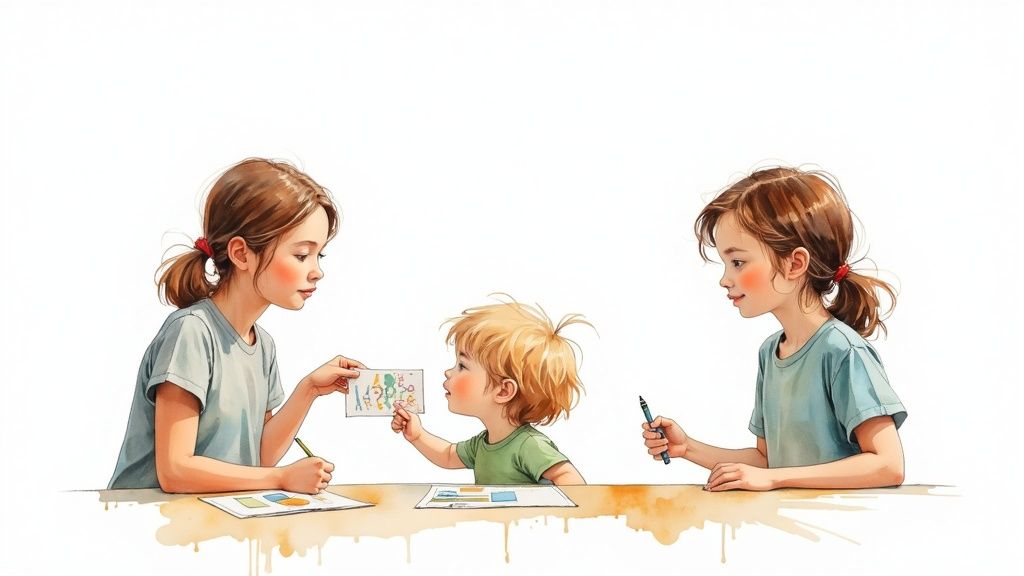
Once you recognize that your child might benefit from a little extra support, the natural next question is: what does that support actually look like? An early learning center isn't just a single type of classroom. It’s a hub of specialized expertise, offering a whole suite of therapies that are designed to work together.
Think of it as a coordinated team of specialists. Each expert has a unique role, but they're all focused on the same goal: helping your child thrive. These therapies aren't separate, siloed treatments. Instead, they're woven right into your child's daily activities, making learning feel natural, engaging, and genuinely fun.
At Georgetown, this integrated approach is at the heart of everything we do. Our specialists collaborate to support your child’s whole development. Let’s break down the core therapies you'll find and what they do in simple, practical terms.
Speech and Language Therapy
When most people hear "speech therapy," they immediately think of correcting a lisp or helping a child pronounce their 'r's. While that’s certainly part of it, the field is so much broader and more foundational. A speech-language pathologist (SLP) is really a communication coach for your child.
Their work focuses on two key areas:
- Expressive Language: This is all about how children express themselves. It starts with gestures and first words and builds all the way up to forming complex sentences and telling stories.
- Receptive Language: This side is all about understanding. Can your child follow directions? Do they grasp the meaning of questions and comprehend what others are saying?
An SLP uses play-based activities to build these skills. A session might look like playing with a toy kitchen to practice requesting items ("more apple, please") or reading a picture book together to work on answering "who" and "what" questions.
Occupational Therapy: The Life Skills Coach
Occupational Therapy (OT) is one of the most vital—and often misunderstood—services in an early learning center. Put simply, an occupational therapist helps children fully participate in the "occupations" of childhood: playing, learning, and growing. They’re essentially a life skills coach.
OTs help with a huge range of essential skills, including:
- Fine Motor Skills: Things like holding a crayon, using scissors, buttoning a coat, or stacking blocks.
- Gross Motor Skills: Improving balance and coordination for big movements like running, jumping, and climbing.
- Sensory Processing: Helping children who are over- or under-sensitive to certain sounds, textures, or movements to better manage their sensory world.
- Self-Care Routines: Building independence in daily tasks like eating with utensils and getting dressed.
A typical OT session could look like a fun obstacle course to build coordination or playing with therapeutic putty to strengthen the hand muscles needed for writing.
At its core, therapy in an early learning center is about empowerment. It gives children the specific tools and strategies they need to navigate their world with greater confidence and ease, turning challenges into opportunities for growth.
Applied Behavior Analysis: A Focus on Positive Actions
Applied Behavior Analysis (ABA) is a therapy built on the science of learning and behavior. The main goal is to help children increase helpful behaviors while decreasing those that might be harmful or get in the way of learning. It’s an evidence-based approach that uses positive reinforcement to teach new skills.
Imagine a gardener tending to a plant. They provide sunlight, water, and good soil to encourage strong, healthy growth. ABA works in a similar way, creating a positive environment where desired skills and behaviors are gently encouraged and rewarded.
This might involve breaking down a complex skill, like sharing a toy, into small, manageable steps. Each step a child successfully completes is met with praise or a small reward, which reinforces that positive action. You can learn more about how our different therapies work in concert by exploring our guide to pediatric therapy in Dubai.
This kind of structured, professional care is on the rise globally. In fact, the child care services market in the Middle East and Africa (MEA) region generated a total revenue of USD 37,962.4 million in 2024. It’s also telling that center-based early learning centers are the fastest-growing segment, which signals a clear trend toward professional environments for early childhood development. You can discover more insights about the MEA child care services market on Grand View Research.
Together, these therapies form a powerful, interconnected support system within an early learning center, ensuring every aspect of your child's development is nurtured.
Creating Your Child’s Individualized Plan

Every child is wired differently, with their own special mix of strengths, quirks, and challenges. So, it stands to reason that their support plan should be just as unique. A cookie-cutter program just won't cut it in child development, which is why a top-notch early learning center builds every child’s program from the ground up.
This isn't some mysterious, behind-the-scenes process. It's an open, collaborative journey that puts you and your child right at the heart of it all. At Georgetown, we know that you are the world's leading expert on your child. Our job is to bring our clinical expertise to the table and combine it with your deep understanding to map out a path for success.
This roadmap is often called an Individualized Education Plan (IEP) or a similar name. But it's far more than a document. It's a living guide that pinpoints your child's specific goals and lays out the exact strategies we'll use to help them get there.
The First Steps: Consultation and Assessment
It all starts with a conversation. In our first meeting, our main job is to listen—to hear about your child’s wins, your worries, and your dreams for their future. This isn't about us ticking boxes; it's about starting a partnership built on trust and a shared goal.
From there, our multidisciplinary team conducts a comprehensive assessment. This isn’t a single, high-pressure test. Instead, it’s a series of observations and thoughtful activities designed to give us a complete picture of your child. Each specialist views your child through a different, expert lens:
- An educational psychologist might explore cognitive skills and how your child learns best.
- A speech therapist will look at everything from understanding words to expressing thoughts.
- An occupational therapist observes fine motor skills, sensory responses, and practical daily tasks.
- A behavior therapist focuses on social skills and how your child navigates different environments.
This team approach is non-negotiable. It helps us see the whole child, not just isolated skills. By bringing their findings together, our experts can see the connections—like how a sensory challenge might be making it tough for a child to focus during a speech session.
Crafting the Plan Together
With the assessment complete, we all sit down together to build the plan. This is a true working session where we turn all those observations into clear, meaningful goals. We’re big believers in setting goals that are SMART: Specific, Measurable, Achievable, Relevant, and Time-bound.
A truly effective individualized plan is not written for a family, but with a family. It is a promise of partnership, a shared commitment to a child's growth, and a dynamic guide that evolves as they do.
So, instead of a fuzzy goal like "improve communication," an IEP goal gets right to the point: "By the end of the term, Adam will use two-word phrases to request toys in 80% of opportunities during playtime." That kind of clarity means everyone—therapists, teachers, and you—is pulling in the same direction.
The plan also details the specific therapies, how often they'll happen, and the exact techniques we'll use. It’s a transparent blueprint. We track progress carefully, with regular updates and review meetings to make sure the plan is working and to adjust it as your child grows and hits new milestones. Think of it as a living document, designed to celebrate every step of their unique journey.
What to Expect on Your Journey
Taking that first step into an early learning center is a huge moment for your family. It’s filled with hope, and it's the beginning of a partnership focused entirely on your child's future. It helps to go in with a clear picture of what the path ahead looks like. This is a journey of growth, and like any real growth, it has its own pace and rhythm.
The first few weeks are usually an adjustment period for everyone involved. Your child is navigating new faces, new routines, and a whole new environment. It’s completely normal for them to feel a mix of excitement and maybe a little uncertainty—and honestly, you might feel the same way. This initial phase is all about building trust and helping your child feel safe and like they belong.
Understanding the Ebb and Flow of Progress
It’s so important to remember that progress isn't a straight, upward line. A child's development often happens in bursts. You'll see periods of incredible leaps forward, but these can be followed by plateaus where things seem to level off for a bit. You might even see a small step back here and there. This is a completely natural part of the learning process.
Some days, you’ll be celebrating a massive breakthrough—maybe hearing a new word for the first time or seeing them share a toy without being prompted. Other days might feel tougher. The key is to look at the journey as a whole and trust that every single step, whether it feels like it's forward or sideways, is part of building a stronger foundation for the future.
Your role as a parent is irreplaceable. You are the constant in your child's life, and your partnership with the therapy team is the single most powerful factor in their success.
The Power of Partnership and Communication
The whole thing works best when there's open, honest communication between you and your child's team. You have insights into your child’s world at home that are absolute gold for their therapists—they're crucial pieces of the puzzle. At the same time, the team's professional observations can give you new perspectives and strategies to try at home.
Think of it as a true collaboration. You can take the progress made at the center and amplify it by weaving the new skills into your daily life. It’s simpler than it sounds.
- If your child is working on asking for things in speech therapy, you can turn snack time into a chance to practice.
- If they’re building fine motor skills in occupational therapy, doing a simple craft together over the weekend can make a huge difference.
Creating this kind of consistency between the center and home builds a seamless learning environment for your child, which really helps new skills stick. At Georgetown, we don't just work with your child; we partner with your whole family. Together, we can help unlock your child’s incredible potential and set them on a path toward a bright, confident future.
Frequently Asked Questions
When you're exploring support for your child's development, it’s natural to have a lot of questions. We get it. Here are some straightforward answers to the things parents often ask us.
How Is an Early Learning Center Different from a Regular Daycare?
It's a great question and one we hear all the time. Think of it this way: a traditional daycare focuses primarily on providing a safe and caring environment while you're away. An early learning center does that too, but its main purpose is to deliver specialized, goal-oriented support.
Everything we do is built around a curriculum designed by developmental experts. The activities, the structure, even the way we play, are all intentionally planned to help children build crucial cognitive, social, and motor skills. It’s a much more targeted, educational approach.
What Is the Ideal Age to Enroll My Child?
Honestly, there’s no magic number. Every child develops at their own pace, and their journey is completely unique. These centers typically help children from infancy right up to preschool age.
The real key is timing. The most crucial window for brain development happens between birth and five years old. So, if you have a feeling that your child could use some extra support, the best time to act is now. Trust your instincts.
It's less about hitting a specific birthday and more about recognizing when your child might benefit from specialized help. Acting on that feeling is the most powerful first step you can take.
Will My Child Just Be Playing All Day?
Yes, absolutely—and that’s by design! For young children, play isn't just fun; it's the most powerful way they learn about the world. It’s their work.
At a high-quality early learning center, that play is anything but random. Every activity, whether it's building with blocks, singing songs, or painting, is carefully chosen to target specific developmental milestones. We call it purposeful play, and it’s how we build the foundational skills your child will use for the rest of their life.
At Georgetown, we believe every child deserves a plan as unique as they are. Our team of specialists is ready to partner with you to create a supportive, effective path forward for your child. Explore our programs and see how we can help by visiting the Georgetown website.