
Why Spotting Early Red Flags Matters
Early detection of autism can transform a toddler’s developmental path. This roundup highlights the 8 most reliable signs of autism in toddlers, offering specific, actionable insights and real-world examples vetted by experts at Georgetown Early Intervention Center.
Detecting these signs before school age boosts the effectiveness of speech therapy, ABA, occupational therapy, and educational psychology support. By spotting joint attention gaps, language delays, or sensory sensitivities early, families can immediately access tailored interventions that improve long-term outcomes.
In this listicle, you’ll discover:
- Clear strategies for observing limited or absent joint attention through everyday play
- Step-by-step tips to track speech and language milestones
- Practical methods to identify repetitive behaviors and manage sensory responses
- Real scenarios showing atypical social interest and unusual play patterns
- Guidelines for supporting transitions, reducing distress around routine changes
These insights equip parents, therapists, and educators to recognize red flags promptly and take informed action. With concise examples, focused tips, and expert-backed advice, you’ll know exactly what to look for, and how to respond, when signs of autism in toddlers emerge. Let’s dive into the first early warning signal.
1. Limited or Absent Joint Attention
Joint attention is the shared focus between a child and another person on an object or event. It shapes early learning and social interaction by building communication foundations.

Toddlers typically follow a point or use pointing gestures themselves by 12 to 18 months. In toddlers with autism, this milestone may be significantly delayed or missing entirely, making it a key sign to watch for in early screening of signs of autism in toddlers.
How Joint Attention Develops
Between 9 and 12 months most toddlers start alternating gaze between people and objects. This pattern underpins social referencing and helps them learn language with caregivers.
Examples of Limited Attention
- Not turning to look when a parent points to a bird outside
- Failing to point at a toy to share excitement
- Avoiding back and forth eye contact during simple play
Why It Matters
Absence of joint attention is one of the earliest reliable indicators of autism risk. Early detection allows families and professionals to start targeted interventions sooner, improving long term communication outcomes.
Actionable Tips
- Observe point following during daily routines
- Differentiate pointing to request from pointing to share
- Note eye contact consistency with caregivers
- Log instances across settings and activities
- Use play based prompts to encourage shared focus
- Consult an early intervention specialist if patterns persist
This early warning sign deserves its place in our list because of its strong predictive value. Learn more about Limited or Absent Joint Attention on georgetownuae.com.
2. Delayed Speech and Language Development
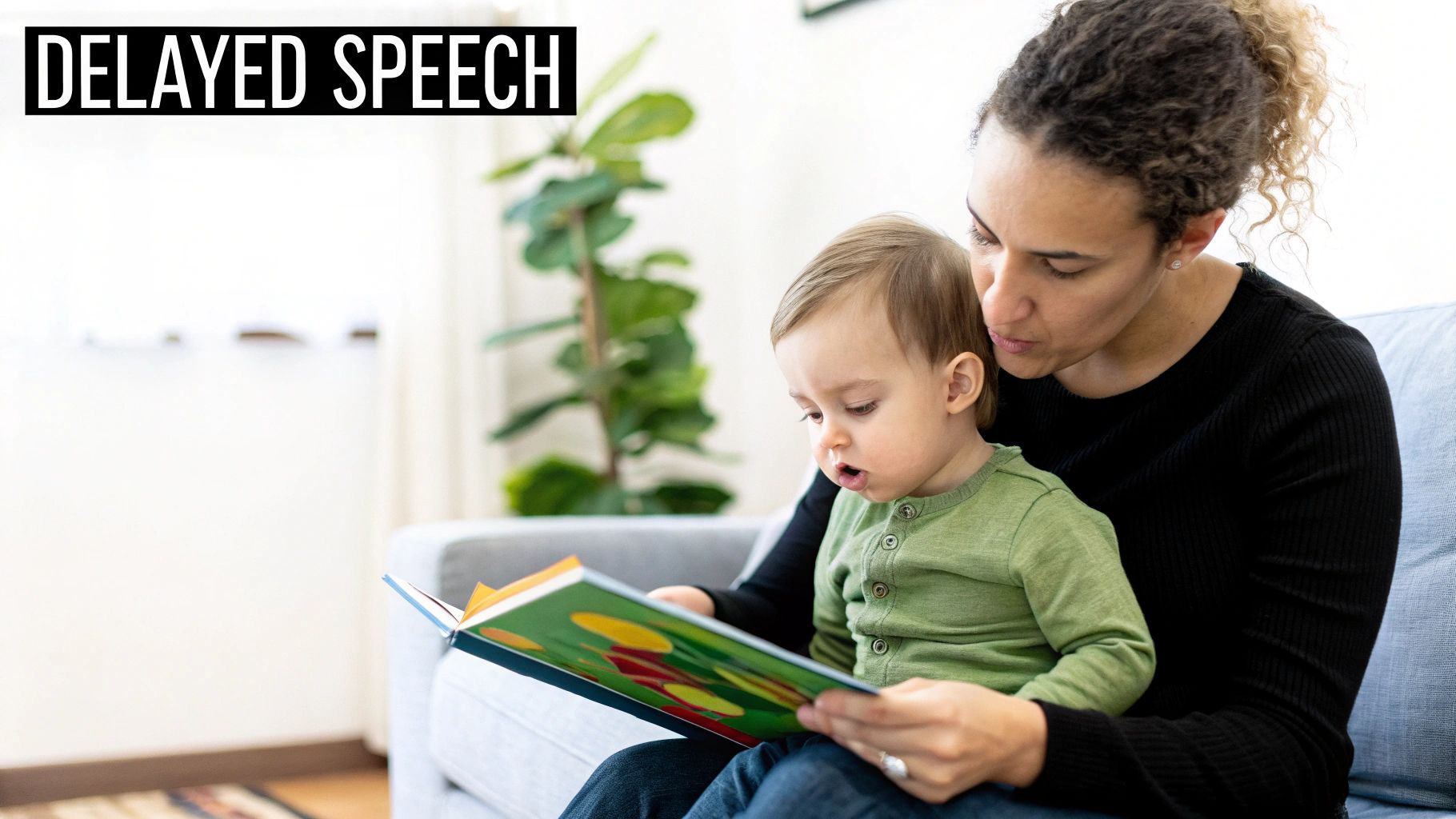
Speech and language delays are among the most commonly reported early signs of autism in toddlers. Many children with autism experience slowed development in babbling, understanding words, or combining sounds into meaningful speech. This delay often becomes apparent between 18 and 24 months when most toddlers rapidly expand their vocabulary.
How Speech and Language Normally Progresses
Between 6 and 12 months most infants begin babbling consonant-vowel combinations.
By 12 to 18 months toddlers typically speak 5 to 20 words and follow simple instructions.
Between 18 and 24 months vocabulary growth accelerates, with many children combining two-word phrases.
Examples of Delayed Speech
- An 18-month-old with fewer than five identifiable words
- A two-year-old who relies on pointing or vocal sounds to request toys
- A toddler echoing phrases or songs without apparent comprehension
- A child who understands far less than same-age peers
Why It Matters
Delayed speech is a key sign because language underpins social interaction and learning. Early identification of this delay allows families to access targeted interventions sooner, improving later communication and school readiness outcomes.
Actionable Tips
- Track vocabulary growth each month from 18 to 24 months
- Encourage meaningful communication during daily routines
- Use visual supports and gestures alongside spoken words
- Request an early speech-language evaluation if concerns persist
- Avoid excessive screen time that limits interaction
- Create simple back-and-forth games to prompt responses
This early warning sign deserves its place in our list given its prevalence and predictive value. Learn more about Delayed Speech and Language Development on georgetownuae.com.
3. Repetitive Behaviors and Interests (Stimming)
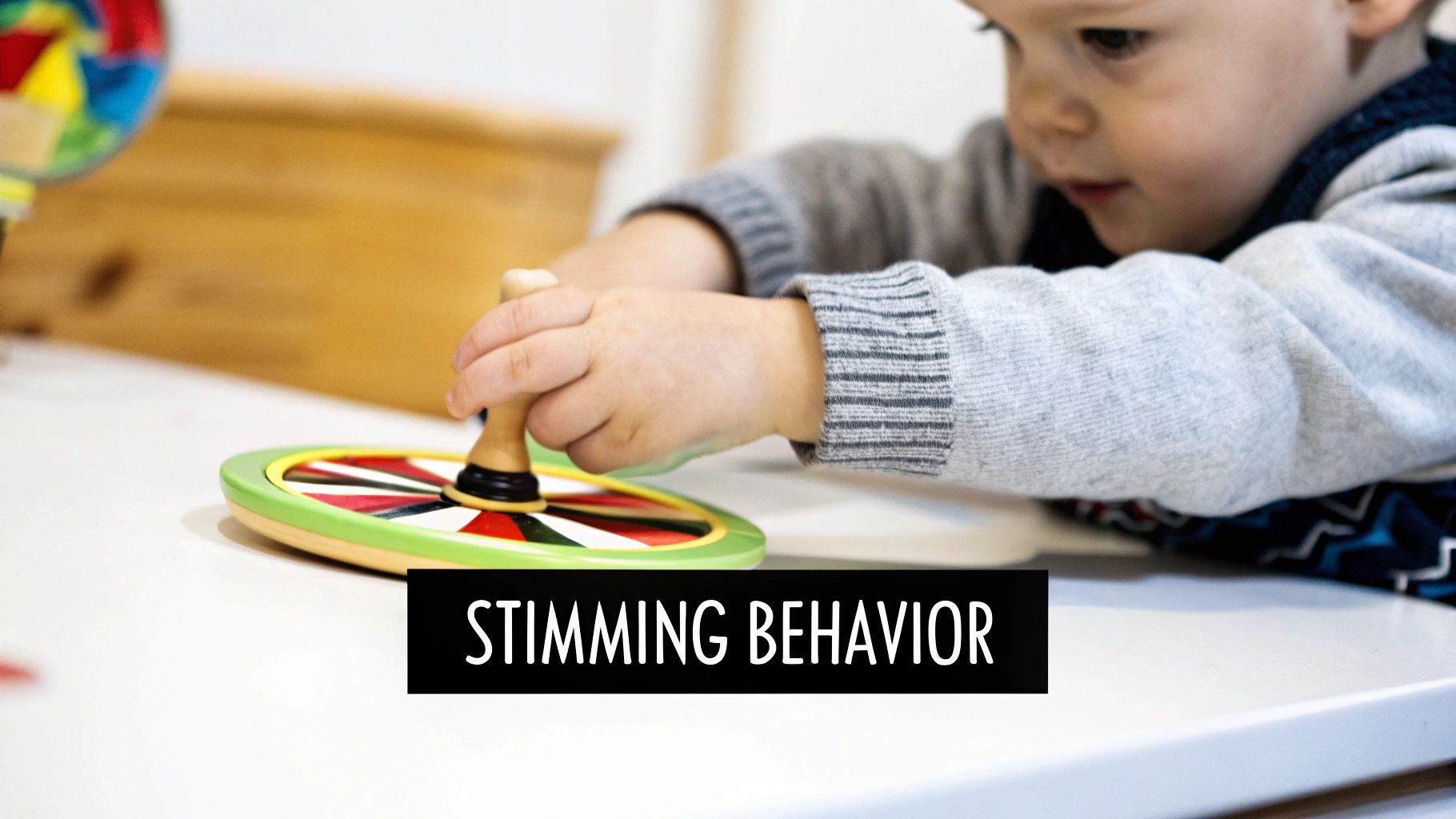
Repetitive behaviours, often called stimming (self-stimulatory behaviour), are highly characteristic of autism. These patterns may include flapping hands, spinning objects, lining up toys or focusing intensely on a part of a toy. While all toddlers show some repetitive play, children with autism repeat behaviours more intensely and for longer durations. In toddlers with autism, stimming serves a self-regulatory function rather than exploratory play.
How Repetitive Behaviors Develop
Stimming often appears between 12 and 24 months as a mechanism to process sensory input and manage strong emotions. Neurological differences in sensory processing can make these repetitive movements calming or emotionally soothing for a child with autism.
Examples of Stimming
- Rapid hand flapping when excited or distressed
- Lining up all toys in straight formations for extended periods
- Intense spinning or watching wheels rotate repeatedly
- Focusing exclusively on a toy’s wheels instead of playing with the whole toy
Why It Matters
Rigid stimming patterns can restrict a toddler’s opportunity for varied play and social interaction. Early recognition of these behaviours helps caregivers differentiate typical play from autism-related stimming. Understanding these patterns also guides targeted interventions that support communication and adaptive skills.
Actionable Tips
- Observe when and where stimming occurs to identify triggers
- Distinguish between curiosity-driven play and rigid stimming
- Offer alternative sensory tools like fidget toys or textured objects
- Teach replacement behaviours gradually, such as squeezing a stress ball
- Redirect to appropriate activities without punishment or shame
- Keep a daily log of stimming episodes to share with professionals
- Consult an occupational therapist for tailored strategies
This early warning sign deserves its place in our list because it highlights sensory and emotional regulation challenges unique to autism. Learn more about Repetitive Behaviors and Interests (Stimming) on georgetownuae.com.
4. Lack of Pretend Play and Imaginative Play
Pretend play is a crucial developmental milestone typically emerging around 12 to 18 months. It allows toddlers to practise social roles and develop symbolic thinking foundations. Children with autism often show delays or absence of imaginary play, preferring repetitive toy manipulation over functional use. This sign highlights early differences in theory of mind and creative exploration.
How Pretend Play Develops
Between 12 and 18 months most toddlers copy adult role play and pretend interactions. This stage fosters narrative skills, empathy and language growth by using objects as stand-ins for real items. Missing these behaviours can signal delays in social cognition and imaginative processing.
Examples of Limited Pretend Play
- An 18-month-old who manipulates a toy phone but never pretends to talk
- A 2-year-old who does not feed a doll or engage in pretend meals
- A toddler lining up action figures rather than making them interact
- No interest in playing “house,” “doctor” or other role-play games
Why It Matters
Pretend play underpins empathy, symbolic reasoning and flexible thought. Its absence in toddlers often correlates with autism spectrum characteristics, making this behaviour a critical early indicator. Detecting it soon supports timely intervention and improved social outcomes.
Actionable Tips
- Model pretend actions during snack or dressing routines
- Use concrete props initially (for example toy food or dress-up clothes)
- Join the child’s interests and gradually add pretend elements
- Celebrate any attempt at imaginative play with enthusiastic praise
- Create predictable play routines the child can imitate
- Use simple social stories to introduce new pretend scenarios
This early warning sign deserves a place in our list because it reveals core differences in symbolic play and social engagement. Learn more about Lack of Pretend Play and Imaginative Play on georgetownuae.com.
5. Atypical Social Responses and Reduced Social Interest
Children with autism often show reduced interest in social interaction and atypical responses to social overtures. This may include not seeking comfort from caregivers when distressed, minimal smiling or sharing of emotions, avoiding eye contact, or preferring solitary play. While typical toddlers seek out people, this sign signals early autism risk.
How Social Engagement Develops
Between 12 and 24 months most toddlers start seeking comfort when upset, sharing joy through smiles, and testing simple social games with peers. These behaviours build social motivation and empathy. In toddlers with autism, these milestones may emerge slowly or look different in quality, affecting connection.
Examples of Reduced Social Interest
- Not reaching for comfort from a parent when they cry
- Minimal response when a caregiver enters the room
- Not following an adult’s lead to play peek-a-boo
- Showing little interest in watching or playing alongside other toddlers
Why It Matters
The absence of typical social engagement reduces opportunities for language learning and emotional bonding. Early identification of this pattern enables targeted interventions in social reciprocity.
Actionable Tips
- Observe interactions across different environments and caregivers
- Note whether the child initiates contact or only responds to prompts
- Track the quality of eye contact and genuine smiles during play
- Document comfort-seeking behaviours when the child is distressed
- Compare social engagement with siblings or peers of similar age
- Share observations with a paediatrician or early intervention specialist
Learn more about Atypical Social Responses and Reduced Social Interest on georgetownuae.com.
6. Sensory Sensitivities and Atypical Responses to Sensory Input
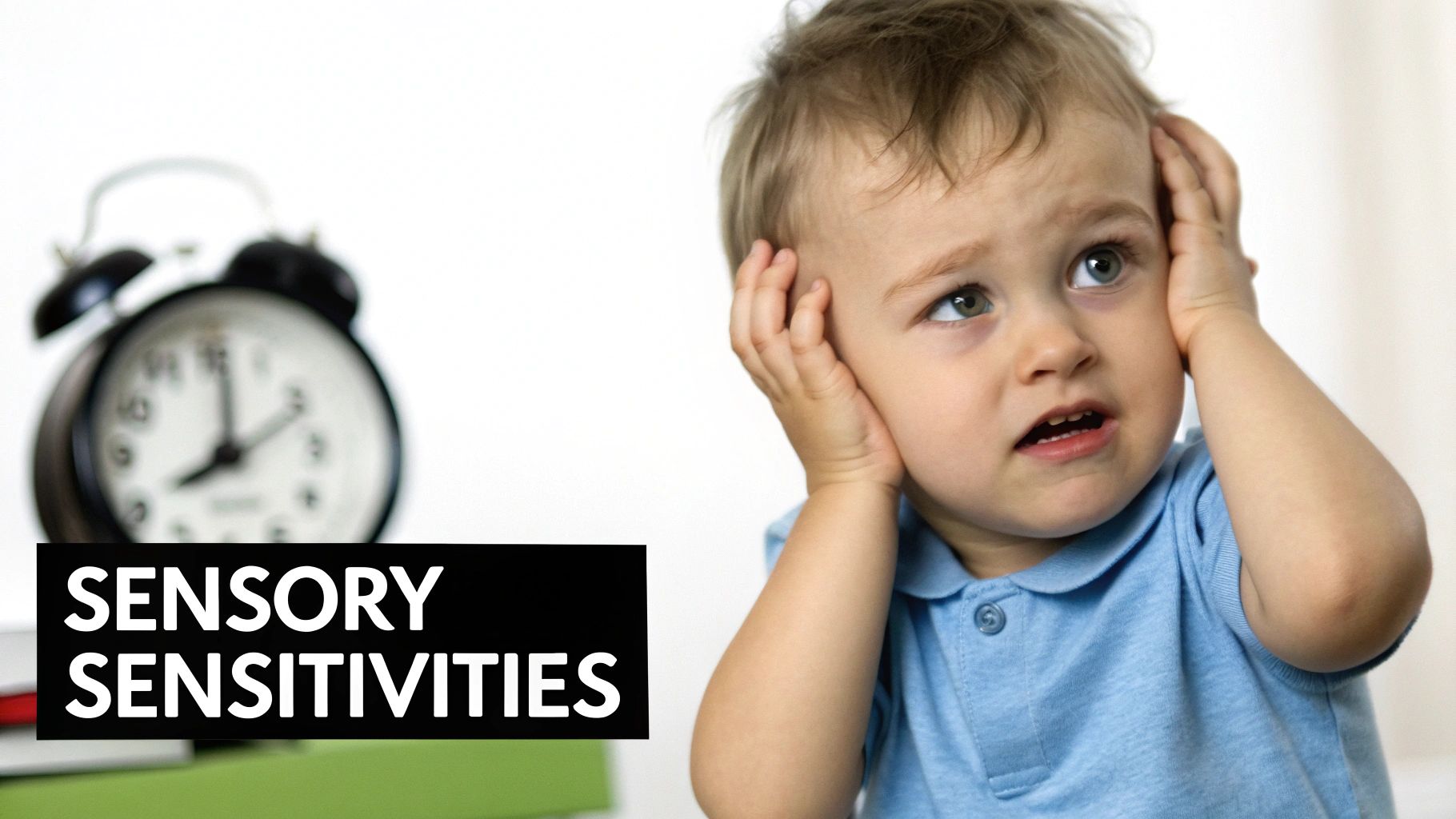
Sensory sensitivities refer to over- or under-reactions to sensory stimuli. Many toddlers on the autism spectrum show atypical responses to sounds, textures, tastes or visual input. These differences can affect daily routines and are key signs of autism in toddlers to monitor.
Understanding Sensory Responses
From the first year, toddlers begin to explore textures and sounds. In neurotypical development, reactions range from curiosity to mild discomfort. For children with autism, sensory processing may be heightened or blunted, shaping their behaviour patterns.
Examples of Atypical Responses
- Refusing foods with certain textures, such as lumpy or slimy items
- Extreme distress during diaper changes or baths
- Covering ears at regular household sounds like a vacuum or blender
- Avoiding clothes with specific weaves or tags
- Licking, mouthing or smelling objects excessively
Why It Matters
Sensory sensitivities can disrupt eating, sleeping and play routines. Early recognition of these patterns aids in tailoring interventions to improve comfort and learning. Addressing sensory needs early can reduce anxiety and enhance engagement across settings.
Actionable Tips
- Observe reactions across different rooms, times and activities
- Create a sensory profile noting triggers and typical responses
- Modify environment with soft lighting or sound dampening
- Offer predictable sensory experiences, like consistent play routines
- Use deep pressure activities, such as gentle squeezes on shoulders
- Work with an occupational therapist to develop customised strategies
- Prepare the toddler for haircuts, doctor visits or transitions in advance
This early warning sign deserves its place in our list due to its impact on daily functioning. For children with sensory sensitivities, tools like explore the benefits of weighted blankets for children can provide calming input.
7. Unusual or Persistent Interests with Limited Variety
Toddlers usually explore a range of toys and activities, shifting interests every few minutes. In contrast, children showing this sign of autism in toddlers often fixate intensely on a single object or theme. Their engagement remains unchanged for weeks, and any attempt to divert attention can trigger resistance or distress.
How This Sign Appears
From around 18 months, most toddlers rotate through toys—blocks one day, puzzles the next. A toddler with autism may:
- Play exclusively with a toy car’s wheels, ignoring the rest of the car
- Stare at ceiling fans for extended periods, dismissing other play options
- Ask the same question about trains or dinosaurs repeatedly over days
- Become upset when an adult redirects them from their chosen focus
Why It Matters
Identifying these rigid interests is a critical sign of autism because it highlights differences in cognitive flexibility and sensory engagement. Persistent focus can limit social interaction, language expansion and play-based learning.
Actionable Tips
- Document intensity and duration: Keep a simple log noting what the child plays with, for how long and their reaction to change.
- Bridge learning through interests: Use their fascination—say with wheels—to introduce counting or colour sorting.
- Gradual variety introduction: Offer a slightly different version of a preferred toy, such as cars in new colours or sizes.
- Visual schedules for transitions: Show pictures of “fan time” then “book time” to prepare them for the switch.
- Validate and expand: Acknowledge their passion (“I see you love this wheel”) then gently present related options (rubber wheels, wooden wheels).
- Leverage as motivators: Incorporate that special interest into therapy goals—reward with five minutes at the fan after completing a task.
By pinpointing these unusual or persistent interests, caregivers and professionals can better tailor interventions and foster more flexible play habits. Learn more about signs of autism in toddlers at georgetownuae.com.
8. Difficulty with Transitions, Changes in Routine, and Cognitive Rigidity
Toddlers with autism often struggle when familiar patterns shift or routines are altered. This inflexibility in thinking and behaviour can trigger distress, resistance or meltdowns as a result of differences in cognitive flexibility and sensory processing.
How Cognitive Rigidity Emerges
Many children rely on predictable patterns to feel secure. When plans change or objects move, a toddler may lack the internal flexibility to adapt, leading to high anxiety.
Examples of Rigidity in Routine
- Having a meltdown when a familiar route to the park is changed
- Showing extreme distress if books or toys on a shelf are rearranged
- Refusing to start a new activity without extended preparation
- Displaying anxiety and resistance on the first day in a new playgroup
Why It Matters
Significant difficulty with transitions is a key sign of autism in toddlers. Early recognition helps families and specialists introduce strategies that support adaptability and reduce stress in daily life.
Actionable Tips
- Create clear, predictable routines and follow them consistently
- Use visual schedules or picture cards to outline upcoming activities
- Give advance warning (for example, “Five minutes until tidy-up time”)
- Prepare new situations with social stories or photo walkthroughs
- Maintain consistent language and placement for daily tasks
- Gradually introduce small, planned changes within a structured framework
- Celebrate and reinforce successful transitions with praise or stickers
- Keep a log of specific triggers to anticipate and prevent distress
This symptom deserves its place in our list because helping toddlers manage transitions early can greatly improve their emotional regulation and engagement. Learn more about supporting routine changes on georgetownuae.com.
8-Point Comparison: Signs of Autism in Toddlers
| Sign | 🔄 Complexity to Assess | ⚡ Resource Requirements | ⭐ Expected Diagnostic Value | 📊 Ideal Use Cases | 💡 Key Advantages / Tips |
|---|---|---|---|---|---|
| Limited or Absent Joint Attention | Low–Moderate: observable in natural interactions but needs repeated checks | Low: caregiver observation + brief screening (AOSI, SCQ) | High ⭐: early, reliable indicator when consistent | Early screening (12–18 months); parent-reported concerns | Document across settings; assess gaze-following, pointing; rule out hearing issues |
| Delayed Speech and Language Development | Low–Moderate: tracked via milestone checks and vocab counts | Moderate–High: speech-language evaluation and therapy common | High ⭐: prominent sign; responsive to intervention | Concerns at 18–24 months; referral for SL evaluation | Track vocabulary monthly; use visual supports and gestures; limit screen time |
| Repetitive Behaviors and Interests (Stimming) | Low: readily observable but common in typical development—context matters | Low–Moderate: behavioral observation; possible ABA/OT support | Moderate ⭐: diagnostic when intense, frequent, or injurious | When repetitive actions are rigid, frequent, or impede learning | Observe triggers; allow safe self-regulation; teach gradual replacement behaviors |
| Lack of Pretend Play and Imaginative Play | Moderate: requires structured play-based assessment; cultural factors affect interpretation | Moderate: play-based assessment, parent modeling, speech/OT input | Moderate–High ⭐: clear developmental milestone for social-imaginative skills | Monitor 12–36 months; guides social and language interventions | Model and scaffold pretend play using concrete props; celebrate small attempts |
| Atypical Social Responses and Reduced Social Interest | Moderate: multi-context observation needed; temperament can confound | Low–Moderate: screening tools (M-CHAT, STAT), clinician observation | High ⭐: strong indicator when consistent across settings | Early screening, especially when social reciprocity is limited | Note initiation vs. response; document comfort-seeking and quality of smiling/eye contact |
| Sensory Sensitivities and Atypical Sensory Responses | Low–Moderate: often obvious but variable across environments | Moderate: sensory profiling, occupational therapy, environmental modifications | Moderate ⭐: common and actionable for daily management | When feeding, dressing, sleep, or routines are disrupted by sensory issues | Create sensory profile; adapt environment; consult OT for tailored strategies |
| Unusual or Persistent Interests with Limited Variety | Low: observable pattern but may emerge over time | Low–Moderate: documentation and use in therapy; occasional specialist input | Moderate ⭐: distinctive when intense and inflexible | When interests limit learning, play diversity, or cause distress at transitions | Use special interests as motivators; gradually introduce variety and visual schedules |
| Difficulty with Transitions, Routine Changes, Cognitive Rigidity | Moderate–High: often longitudinal pattern; linked to anxiety and sensory factors | Moderate–High: visual supports, structured teaching (TEACCH), OT, caregiver planning | Moderate–High ⭐: significantly impacts daily functioning if severe | When routine changes cause meltdowns or impede school/community participation | Use visual schedules, advance warnings, gradual exposure and consistent language |
Empowering Your Next Steps
Summarizing Key Insights
Recognizing the signs of autism in toddlers is your first proactive step. From joint attention to sensory sensitivities, each early warning sign provides a clear signal to act.
“Early detection and intervention pave the way for stronger communication skills and social confidence.”
Key takeaways:
- Limited or absent joint attention often appears before age two
- Speech delays can be subtle, such as a lack of babbling or pointing
- Repetitive behaviors (stimming) and restricted interests deserve careful observation
- Atypical social responses may include minimal eye contact or reduced shared play
- Sensory sensitivities can impact feeding, dressing, and bedtime routines
Actionable Next Steps
Partner with Specialists
- Reach out to a local early intervention team, like the Georgetown Early Intervention Center.
- Discuss observation notes, video clips of behavior, and your family history.
Schedule a Comprehensive Assessment
- Arrange speech and occupational therapy screenings by age two.
- Ask about an educational psychologist evaluation for cognitive rigidity concerns.
Adapt Home Routines
- Introduce visual schedules to ease transitions and reduce anxiety.
- Offer sensory-friendly tools, such as noise-canceling headphones or textured toys.
Leverage Tailored Therapies
- Explore Applied Behavior Analysis (ABA) sessions to build communication skills.
- Integrate play-based speech therapy for language development.
Engage in Creative Supports
- For parents seeking supportive strategies and adapted approaches, consider exploring inclusive art activities for children with special needs.
- Use simple craft prompts that reinforce turn-taking, joint attention, and fine motor skills.
Why Mastering These Signs Matters
Understanding these early signals allows you to intervene when the brain is most adaptable. Timely support improves long-term outcomes in language, social connection, and daily living skills.
Final Encouragement
By acting on the signs of autism in toddlers, you’re not just monitoring milestones—you’re championing your child’s unique path. Each step you take today builds the foundation for confident communication, joyful interactions, and lifelong learning. Keep pressing forward with curiosity and compassion. You have the knowledge, resources, and resilience to empower your family’s journey.