
Welcome to our comprehensive guide on empowering early intervention learners through targeted play. Fine motor skills, the small, precise movements of the hands, wrists, and fingers, are the foundation for countless daily tasks, from writing and drawing to buttoning a coat and using utensils. For children in early intervention programmes, developing these abilities is not just about play; it is about building the independence and confidence needed to navigate their world successfully. A delay in these skills can impact academic performance, self-care, and social participation.
These foundational movements are a critical part of a child’s overall physical progress. For a deeper dive into how these small actions contribute to broader development, explore resources on the science of baby motor development and milestones, which outlines key stages and how to support growth from the very beginning. Understanding this progression helps contextualise the importance of the activities we will cover.
This article provides a detailed collection of 10 evidence-based fine motor skills activities specifically designed for early learners. We will move beyond generic suggestions to offer practical, actionable steps for parents, occupational therapists, and educators. You will find clear instructions and unique approaches for everything from playdough manipulation and scissor cutting to buttoning practice and using tweezers. Let’s explore how purposeful play can unlock a child’s full potential.
1. Finger Painting and Hand Art
Finger painting is a powerful, tactile activity that allows young learners to explore art using their fingers, hands, and palms. This sensory-rich experience is fundamental for developing a range of fine motor skills. As children press, smear, and swirl paint, they are actively strengthening the intrinsic muscles in their hands and fingers, building the foundation for more complex tasks like holding a pencil or using scissors.

This method directly enhances hand-eye coordination and spatial awareness as children learn to control their movements to create specific marks. The process is just as important as the product, making it an excellent choice for learners who may feel pressure from outcome-based activities. It’s one of the most accessible fine motor skills activities for early intervention.
How to Implement Finger Painting
Many educational approaches, such as the Reggio Emilia philosophy, integrate finger painting into daily routines to foster creativity and self-expression. To adapt this for therapeutic or home use, focus on the sensory input and motor practice.
- Start Simple: Begin with primary colours on a large, easily accessible surface. This reduces visual overwhelm and encourages exploration.
- Focus on Action Words: Use prompts like “press,” “pat,” “swirl,” and “spread” to guide movement and build vocabulary.
- Vary the Texture: Add sand or rice to the paint for a different sensory experience that encourages varied finger pressures.
Actionable Tips for Success
To maximise the benefits and minimise the mess, thoughtful preparation is key.
- Safety First: Always use washable, non-toxic paint to ensure the activity is safe, even if fingers find their way to the mouth.
- Protect Your Space: Lay down a plastic tablecloth or old newspapers to protect floors and tables, allowing the child to feel free to explore without fear of making a mess.
- Document the Process: Take photographs of the artwork. This values the child’s effort and creates a memory, especially if the physical piece cannot be kept.
2. Threading and Bead Stringing
Threading is a classic activity that involves passing a cord, such as yarn or string, through objects like beads or pasta. This focused exercise is a cornerstone of fine motor development, requiring precision, hand stability, and bilateral coordination, as children must use both hands together for different tasks. It directly targets the pincer grasp, a crucial skill for holding pencils and manipulating small items.
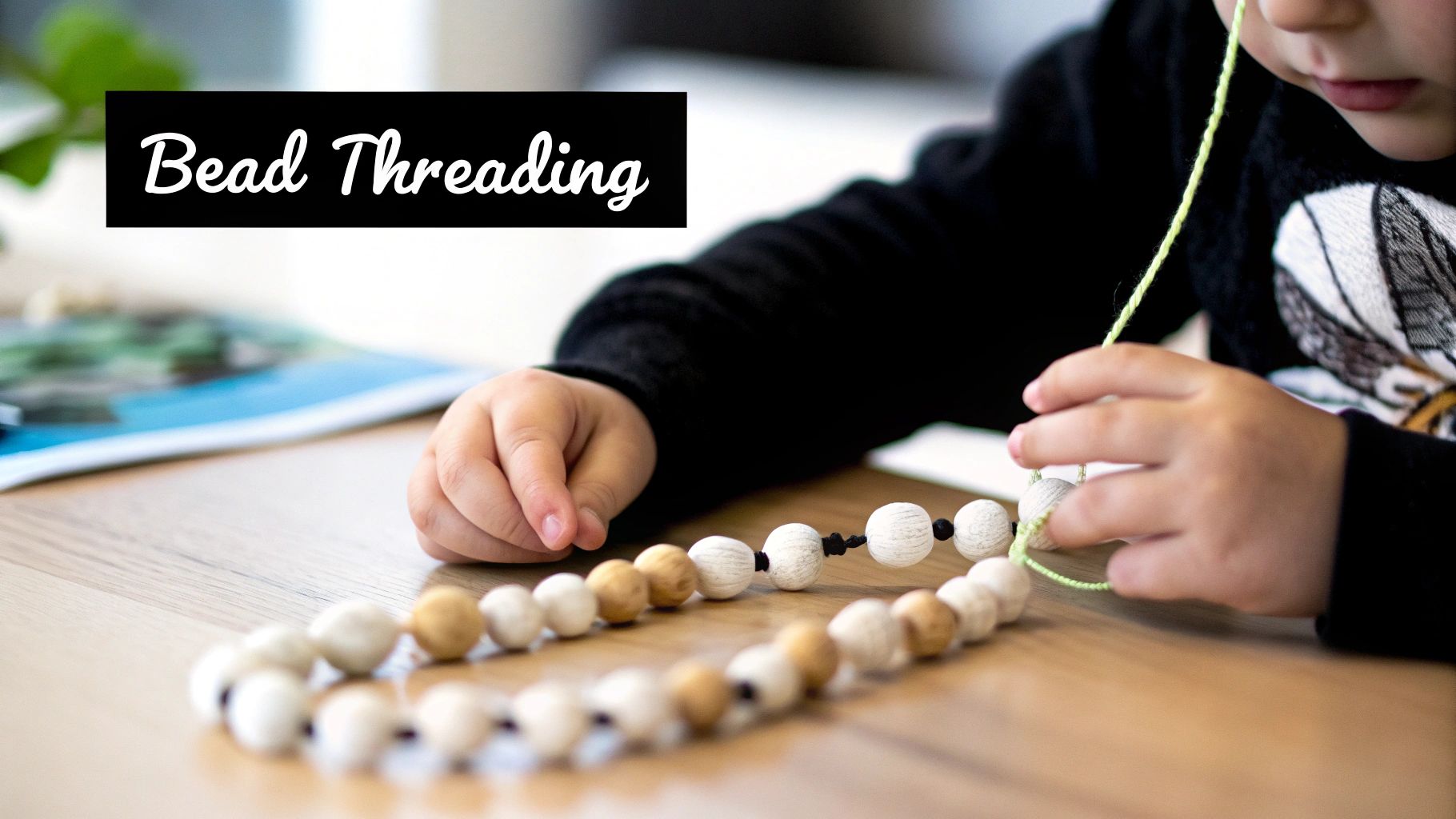
The task enhances hand-eye coordination as children align the string with the small hole in each bead. The repetitive nature of threading builds hand strength and improves concentration, making it one of the most effective fine motor skills activities for preparing children for academic tasks. It’s a structured yet creative way to build foundational motor control.
How to Implement Threading
Threading activities are central to many educational and therapeutic settings, from Montessori classrooms to occupational therapy sessions. The key is to adapt the difficulty to the child’s skill level to ensure it remains engaging and not frustrating.
- Start with Large Objects: Begin with large beads (over 1 cm) or even cut-up paper towel rolls to make the task more achievable for beginners.
- Create Patterns: Introduce simple patterns (e.g., red bead, blue bead) for the child to replicate, which adds a cognitive challenge involving sequencing and planning.
- Vary the Materials: Move beyond beads to threading pasta shapes, buttons, or natural items like leaves with holes punched in them for sensory variety.
Actionable Tips for Success
Proper setup can significantly influence a child’s engagement and success with threading tasks.
- Prepare the String: For beginners, use a thick, sturdy cord like a shoelace or pipe cleaner. Dipping the end of a yarn string in glue and letting it dry creates a firm “needle” that is easier to handle.
- Incorporate Sorting: Before threading, have the child sort the beads by colour or shape. This pre-activity warms up fine motor muscles and increases engagement with the materials.
- Focus on the Process: Celebrate the effort and concentration, not just the finished product. A completed necklace is a great reward, but the skill-building happens during the threading itself.
3. Playdough Manipulation and Sculpting
Playdough manipulation is a classic and highly effective activity for developing hand strength and coordination. The simple actions of squishing, rolling, pinching, and shaping the dough build the intrinsic muscles in the hands and fingers. This process improves bilateral coordination as children use both hands together to work the material, laying a crucial foundation for skills like buttoning a shirt or using utensils.
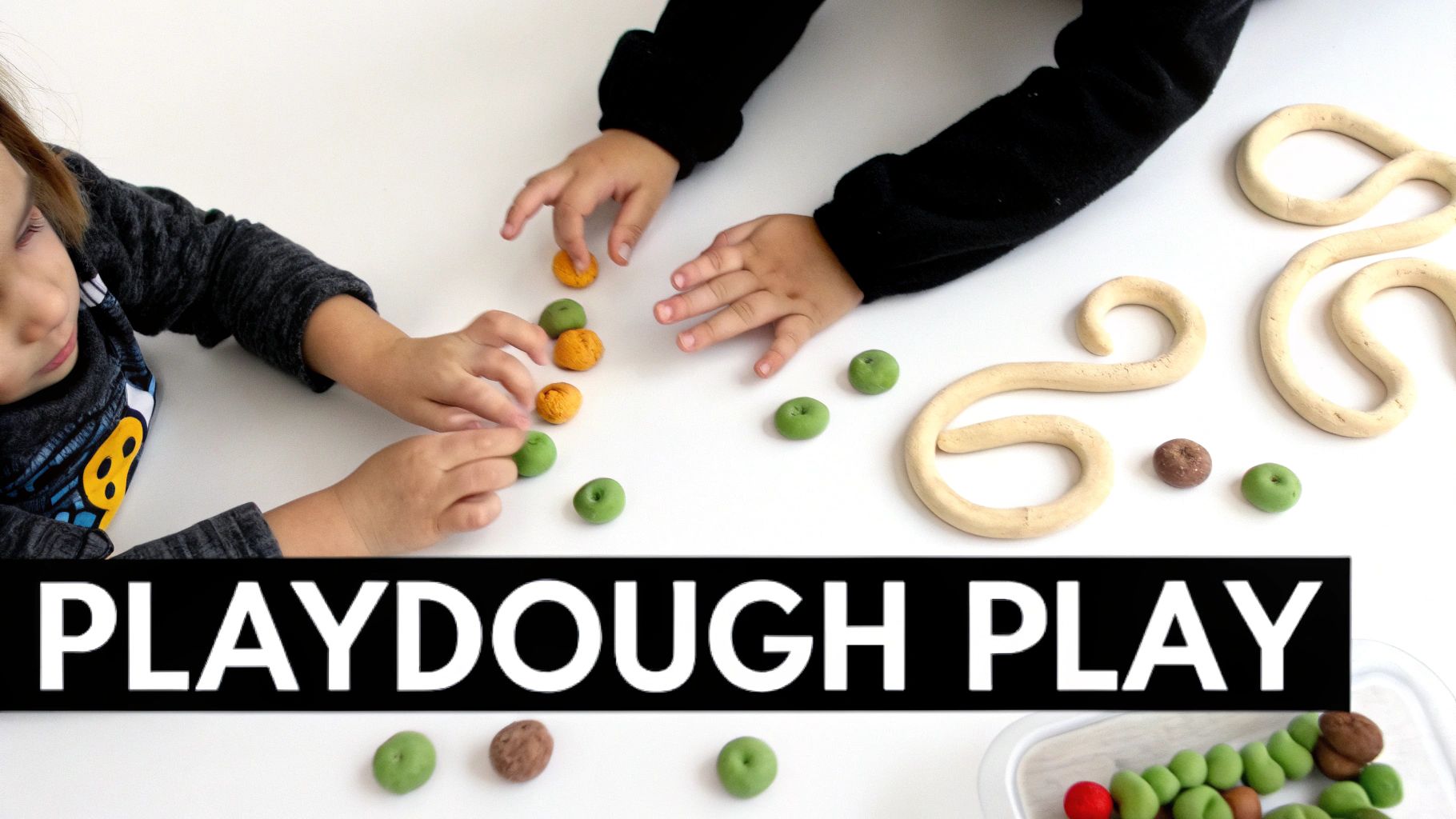
This sensory-rich experience provides valuable proprioceptive feedback, helping children understand pressure and control their force. As one of the most versatile fine motor skills activities, it allows for open-ended, creative expression without the pressure of a specific outcome. This makes it a staple in preschools, sensory rooms, and occupational therapy sessions, where the focus is on process over product. Explore some creative ideas for occupational therapy activities to see how professionals use it.
How to Implement Playdough Manipulation
Integrating playdough into a routine is simple, whether at home or in a therapeutic setting. The key is to provide tools and prompts that encourage a variety of hand movements.
- Offer Simple Tools: Provide child-safe tools like plastic knives, cookie cutters, and small rolling pins to encourage different actions such as pressing, cutting, and flattening.
- Encourage Pretend Play: Introduce themes like making food, creating animals, or building a garden to inspire imaginative sculpting and more complex finger movements.
- Vary the Dough: Use different textures or homemade recipes, such as salt dough, to offer a new sensory challenge and keep the activity engaging.
Actionable Tips for Success
A few simple strategies can enhance the developmental benefits and overall experience.
- Store Properly: Keep playdough in an airtight container to prevent it from drying out, ensuring it remains pliable and easy for little hands to manipulate.
- Make Your Own: Create a simple salt dough using flour, salt, and water. This is a cost-effective and safe alternative, allowing you to control the ingredients.
- Add Scents: Incorporate a few drops of calming essential oils like lavender or invigorating peppermint to add an olfactory sensory dimension to the play.
4. Scissor Cutting Activities
Cutting with scissors is a milestone activity that significantly builds fine motor precision and strength. This task requires children to isolate finger movements, coordinate both hands (bilateral coordination), and apply appropriate hand pressure. As children progress from simple snips to navigating complex shapes, they are mastering the hand-eye coordination and muscle control essential for handwriting, dressing themselves, and other critical self-care tasks.
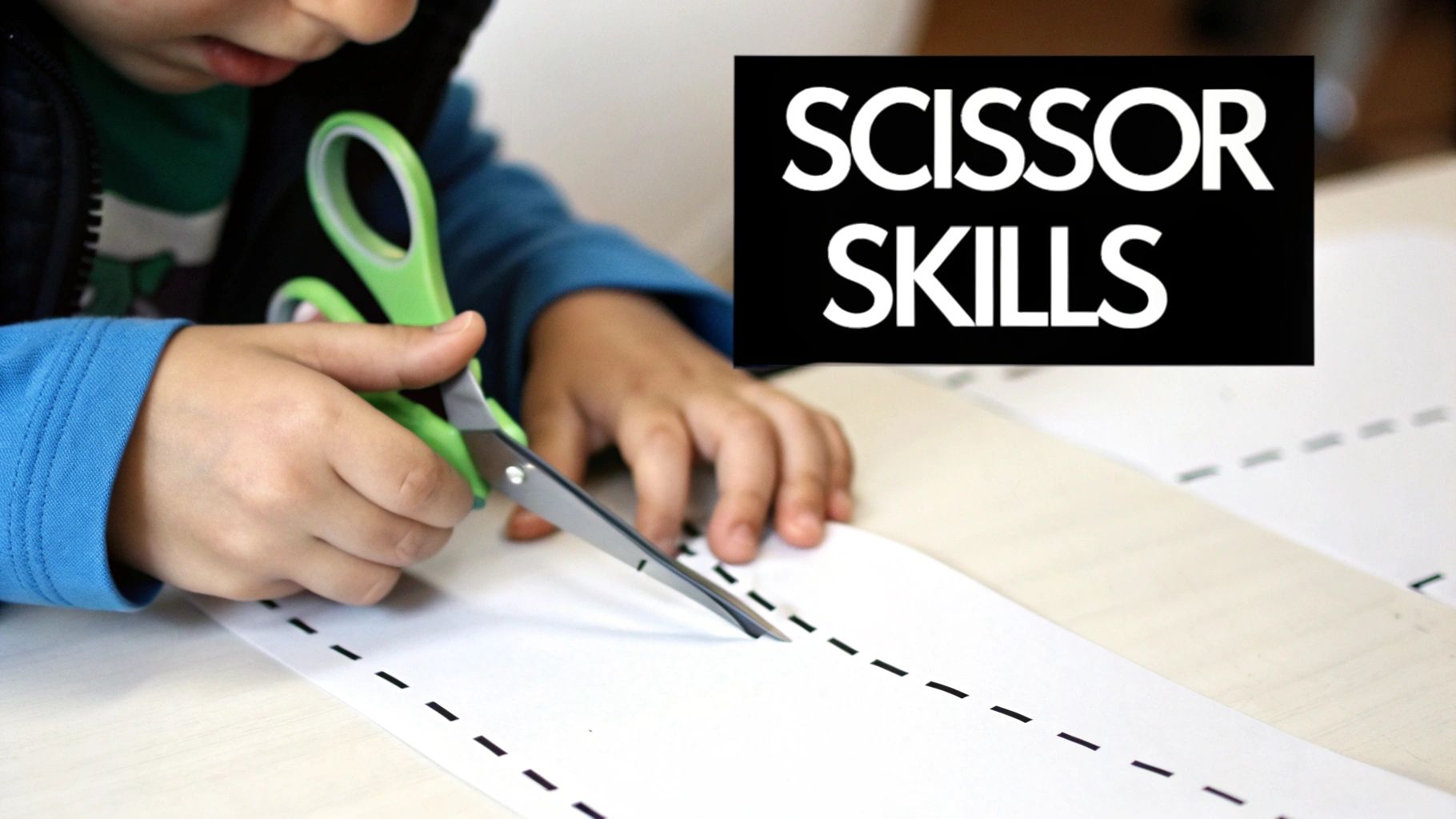
The open-and-close motion of using scissors strengthens the same small muscles in the hand needed for a stable pencil grasp. This makes scissor skills a foundational component of many preschool and kindergarten programmes. It’s a purposeful and engaging way to prepare a child’s hands for the demands of formal schooling and is frequently used in therapeutic interventions for motor delays.
How to Implement Scissor Cutting
Integrating scissor activities into a child’s routine can be done through art, crafts, and structured practice. School-based occupational therapy often uses progressive cutting tasks to build skills incrementally.
- Start with Snips: Begin by having the child make single cuts, or “snips,” on the edge of a piece of thick paper or a drinking straw.
- Introduce Lines: Provide worksheets with wide, straight lines for the child to cut along, gradually moving to curved lines and simple angles.
- Move to Shapes: Once line cutting is mastered, introduce simple shapes like squares and circles before progressing to more complex figures.
Actionable Tips for Success
Safety and proper technique are paramount to building confidence and skill. These tips help create a positive and effective learning experience.
- Choose the Right Tools: Start with blunt-tipped safety scissors. Spring-loaded scissors can also be helpful as they automatically reopen, reducing the effort required.
- Guide Hand Placement: Use coloured tape or stickers on the scissors to show the child where to place their thumb and fingers correctly.
- Provide Assistance: Initially, offer hand-over-hand guidance to help the child understand the cutting motion. For more intensive support, you can explore options by researching occupational therapy near me.
5. Tracing and Drawing Activities
Tracing and drawing are structured activities that build the foundational motor patterns essential for handwriting. By following lines, shapes, and letters with a writing tool, children develop crucial pre-writing skills, including hand-eye coordination, pencil grip, and precise muscle control. This deliberate practice helps establish the neural pathways and muscle memory needed for legible and fluent writing.
These focused tasks guide a child’s hand movements, providing a scaffold for learning how to form letters and numbers correctly. Unlike free-form art, tracing offers a clear goal, which can be highly motivating for learners who thrive on structure. It is one of the most effective fine motor skills activities for preparing children for academic demands in school readiness and occupational therapy programmes.
How to Implement Tracing and Drawing
Curriculums like Handwriting Without Tears have popularised tracing as a key component of early literacy. To apply this in a therapeutic or home setting, the focus should be on building confidence and motor control gradually.
- Start with Large Movements: Begin with large, simple shapes or patterns on a vertical surface like an easel to engage shoulder and arm muscles.
- Introduce Multi-Sensory Tracing: Let children trace shapes in a tray of sand, salt, or shaving foam before using a pencil. This tactile input reinforces the motor pattern.
- Use Themed Content: Incorporate a child’s interests, such as tracing their favourite cartoon characters or the letters in their name, to increase engagement.
Actionable Tips for Success
Proper setup and tools can significantly enhance the effectiveness of tracing and drawing activities.
- Provide Proper Tools: Offer thick, triangular crayons or pencils that are easier for small hands to grip comfortably and correctly.
- Begin with Dotted Lines: Start with clear, dotted or dashed lines before progressing to solid lines to provide guidance without being restrictive.
- Celebrate Effort, Not Perfection: Praise the child’s focus and effort rather than the precision of their lines. This fosters a positive attitude toward learning and reduces anxiety.
6. Buttoning and Fastening Practice
Manipulating buttons, snaps, zippers, and other clothing fasteners is a functional activity that directly links fine motor development to practical self-care. This task builds independence and requires a high degree of finger dexterity, bilateral hand coordination, and visual-motor integration. As a child learns to align a button with its hole or guide a zipper, they are strengthening the small muscles in their hands and refining the pincer grasp.
This process enhances problem-solving skills and patience as the child navigates the intricate movements. For learners in special education programmes or occupational therapy, mastering these skills is a significant milestone that boosts confidence and autonomy in daily routines. These dressing skills are a cornerstone of many fine motor skills activities focused on life skills.
How to Implement Fastening Practice
Buttoning and zipping can be integrated into play and daily routines to make learning feel natural rather than like a chore. Specialised practice boards are common tools, but everyday items work just as well.
- Start Large: Begin with oversized buttons (around 1.5 inches) and large buttonholes on a loose piece of fabric. This makes the target easier to see and manipulate.
- Use High Contrast: Place a light-coloured button on a dark fabric to improve visual tracking and help the child focus on the task.
- Isolate the Skill: Practice with dressing frames or fastening puzzles before moving on to clothing the child is wearing, which adds complexity.
Actionable Tips for Success
To support the child effectively, break down the task into manageable steps and provide a positive learning environment.
- Try Backward Chaining: Do most of the buttoning yourself, leaving the very last step (pulling the button through) for the child to complete. This ensures they finish with a sense of accomplishment.
- Offer Guided Support: Use hand-over-hand assistance to guide the child’s fingers through the motion, gradually reducing support as their skill improves. Many techniques are explored in Occupational Therapy In Dubai.
- Celebrate the Effort: Enthusiastically praise every small success, whether it’s simply holding the button correctly or attempting to push it through the hole.
7. Tweezers and Tongs Grasping Activities
Using tools like tweezers, tongs, or even chopsticks to pick up and move small items is a fantastic way to develop precise hand control and coordination. These activities specifically target the pincer grasp, finger isolation, and the development of the hand’s arches, which are all crucial for tasks like writing, buttoning, and using utensils.
This method requires a different grasp pattern than holding a pencil, strengthening a diverse range of intrinsic hand muscles. By varying the size and resistance of the tongs and the objects being moved, these fine motor skills activities can be easily adapted to a child’s specific developmental level, making them a staple in Montessori classrooms and occupational therapy sessions.
How to Implement Grasping Activities
These activities are highly versatile and can be incorporated into play-based learning or structured therapy. The focus is on the repetitive action of grasping, transferring, and releasing objects with control.
- Start Large: Begin with bigger, easy-to-grip items like pom-poms or cotton balls and larger tools like kitchen tongs.
- Create Themes: Turn the task into a game. For example, use tweezers to “feed” small animal toys with beads or sort “berries” (pom-poms) into coloured bowls.
- Incorporate Sensory Bins: Hide small objects within a sensory bin filled with rice, sand, or water beads and have the child use tongs to find and retrieve them.
Actionable Tips for Success
Proper setup ensures the child is challenged but not frustrated, promoting engagement and skill development.
- Progress Gradually: As the child’s skill improves, introduce smaller tweezers (like those for threading beads) and smaller objects like dry beans or peas.
- Provide Clear Targets: Use ice cube trays, egg cartons, or marked circles on a piece of paper as specific targets for placing the items. This enhances precision and hand-eye coordination.
- Add a Timer: For children who enjoy a challenge, introduce a timed element to see how many items they can move in a minute. This builds speed and fluency.
8. Stamping and Printing Activities
Stamping and printing offer a structured yet creative way to build crucial hand and finger strength. This activity involves pressing down with stamps, sponges, or even fingers to create prints, which directly develops a child’s ability to control pressure and force. As learners grasp the stamp and press it onto paper, they are strengthening their palmar arches and finger muscles, which are essential for tasks like writing and using cutlery.
The repetitive motion of stamping enhances hand-eye coordination and teaches cause and effect as children see the immediate result of their actions. It also supports sequential planning as they decide where to place stamps to create patterns or scenes. This makes it one of the most effective fine motor skills activities for combining motor development with cognitive skills like planning and organisation.
How to Implement Stamping and Printing
Stamping can be easily integrated into art centres in preschools, home craft time, or inclusive special education programmes. The focus should be on the physical action of pressing and lifting to build motor control.
- Offer Variety: Provide different types of stamps, from traditional rubber stamps with handles to sponges, leaves, or even cut vegetables like potatoes. This encourages different grips.
- Guide Pattern Creation: Start with simple patterns like a single row of stamps. Gradually introduce more complex sequences to challenge planning skills.
- Incorporate Both Hands: Encourage the child to use one hand to hold the paper steady while the other hand stamps, promoting bilateral coordination.
Actionable Tips for Success
Proper setup ensures the activity is both engaging and developmentally beneficial.
- Safety First: Exclusively use washable, water-based inks to ensure easy clean-up and safety for young children.
- Create DIY Stamp Pads: Make your own ink pads by placing damp sponges or folded paper towels in a shallow container and adding liquid paint. This controls the amount of ink and is less messy.
- Theme Your Collections: Organise stamps by themes like animals, shapes, or letters. This adds a layer of learning and can be tied to other educational goals.
9. Puzzle and Peg Board Activities
Puzzle and peg board activities are classic tools for developing fine motor precision, hand-eye coordination, and spatial reasoning. These cognitively engaging tasks require children to use a controlled pincer grasp to pick up small pieces or pegs and accurately place them into a designated spot. This repetitive, focused action strengthens finger muscles and improves dexterity, laying crucial groundwork for handwriting and other complex skills.
The problem-solving nature of puzzles also enhances cognitive development, making these excellent fine motor skills activities for building concentration and fine motor endurance. Completing a puzzle or a peg board pattern provides a clear sense of accomplishment, boosting a child’s confidence and motivation to engage in similar goal-oriented tasks.
How to Implement Puzzle and Peg Board Activities
These activities are staples in Montessori, occupational therapy, and early childhood settings due to their versatility and clear developmental benefits. They can be easily adapted for home or therapeutic use to target specific skill deficits.
- Start with Large Knobs: Begin with chunky puzzles where pieces have large knobs, which are easier for small hands to grasp.
- Use Frame Puzzles: Introduce puzzles that fit into a frame or tray first. This provides a visual boundary and makes the task less overwhelming than loose jigsaw puzzles.
- Pattern Following: Use peg boards with pattern cards to guide the child’s placement, which helps build visual scanning and sequencing skills.
Actionable Tips for Success
Proper selection and setup can significantly increase engagement and developmental outcomes.
- Safety First: Ensure all puzzle pieces and pegs are large enough to not be a choking hazard, especially for very young children.
- Sort for Success: For more complex puzzles, sort the pieces by colour or edge vs. middle pieces beforehand to reduce frustration for young learners.
- Offer Hand-over-Hand Support: Initially, provide gentle hand-over-hand guidance to help the child understand the required motion of grasping, turning, and placing pieces.
10. Fine Motor Tool Use and Kitchen Activities
Engaging children in the kitchen with child-sized tools offers a functional and highly motivating way to enhance fine motor skills. Activities like scooping flour, whisking eggs, or spreading butter require precise hand and finger movements, strengthening the same muscles needed for writing and self-care. This approach combines skill development with practical life skills, sensory exploration, and cognitive learning.
Kitchen tasks naturally build hand-eye coordination, bilateral coordination (using both hands together), and hand strength. Following a simple recipe also supports sequencing and listening skills, making these fine motor skills activities a comprehensive developmental experience. The tangible, and often delicious, result provides powerful positive reinforcement.
How to Implement Kitchen Activities
Many therapeutic and educational models, including Montessori practical life and special education functional skills programmes, use cooking to teach valuable skills. The key is to adapt tasks to the child’s current abilities and make the experience enjoyable.
- Start with Simple Actions: Begin with one-step tasks like stirring a pre-mixed batter or pouring measured ingredients into a bowl.
- Focus on Tool Use: Introduce tools like tongs to transfer soft items, a masher for bananas, or a small whisk for liquids to practise different grasps.
- Create a Sensory Experience: Allow the child to feel different textures, such as dry flour, sticky dough, or smooth batter, to integrate sensory learning.
Actionable Tips for Success
Proper setup and realistic expectations are crucial for turning kitchen time into a successful learning opportunity.
- Safety First: Always use child-safe knives and utensils, and supervise closely, especially around heat or sharp objects.
- Prepare the Environment: Provide a sturdy step stool so the child can comfortably reach the counter. Pre-measure ingredients to reduce complexity and focus on the motor task itself.
- Praise the Process: Celebrate the effort and participation, not just the final product. Let the child help plan the activity to increase their engagement and sense of ownership.
Fine Motor Skills: Comparison of 10 Activities
| Activity | 🔄 Complexity | ⚡ Resource needs | 📊 Expected outcomes | ⭐ Ideal use cases | 💡 Quick tip |
|---|---|---|---|---|---|
| Finger Painting and Hand Art | Low — simple setup but messy; high sensory input | Minimal — washable paints, paper, protective cover | Sensory exploration, color recognition, basic hand strength & bilateral coordination | Toddlers, sensory play, early creative expression, group art sessions | Use washable non‑toxic paint; photograph art before discarding |
| Threading and Bead Stringing | Medium — adjustable difficulty; requires patience and prep | Low cost — beads, string/yarn, large-bead options for beginners | Pincer grasp, fine motor precision, sustained grip, patterning | Montessori lessons, OT sessions, craft projects, fine‑motor progression | Start with large beads (1cm+); stiffen string tip with glue |
| Playdough Manipulation and Sculpting | Low–Medium — easy to start; needs maintenance (storage) | Inexpensive — storeable dough, basic tools (rollers, cutters) | Rapid hand strength gains, sensory regulation, bilateral coordination | Sensory rooms, free play, therapeutic activities | Store airtight; provide simple tools and thematic prompts |
| Scissor Cutting Activities | Medium — progressive skill development; safety required | Scissors (safety/spring), paper, adaptive options | Isolated finger control, pre‑writing muscles, endurance | Preschool/kindergarten lessons, OT, prep for writing | Begin with blunt or spring scissors and pre‑drawn lines |
| Tracing and Drawing Activities | Low–Medium — structured with clear progression | Very low — pencils/crayons, tracing sheets, tactile options | Pencil grip refinement, hand‑eye coordination, pre‑writing patterns | Handwriting prep, classroom practice, focused skill building | Use dotted lines and thick crayons; celebrate effort over perfection |
| Buttoning and Fastening Practice | Medium — repetitive practice; can be slow to progress | Low — button boards, garments, zipper/snap samples | Practical dressing independence, precise finger coordination | Life‑skills training, OT, preschool self‑care routines | Start with large buttons and use backward chaining |
| Tweezers and Tongs Grasping Activities | Low–Medium — scalable difficulty; needs concentration | Low — child tweezers/tongs and objects (pom‑poms, beads) | Finger isolation, hand arches, varied grip strength, dexterity | Montessori practical life, sensory bins, fine‑motor stations | Begin with large objects and larger tools, then reduce size |
| Stamping and Printing Activities | Low — immediate success; potentially messy | Minimal — stamps, washable ink/paint, paper or pads | Controlled pressure, bilateral use, pattern recognition, color mixing | Early art centers, inclusive activities, confidence‑building | Use washable, water‑based inks and damp sponge pads for cleanup |
| Puzzle and Peg Board Activities | Medium — cognitive + motor demands; progressive levels | Moderate — puzzles, peg boards, storage solutions | Spatial reasoning, placement precision, persistence, attention | Montessori, OT, problem‑solving sessions, home learning | Start with chunky pieces and sort pieces beforehand |
| Fine Motor Tool Use and Kitchen Activities | Medium–High — multi-step, safety‑sensitive | Moderate — child utensils, ingredients, close supervision | Functional hand strength, bilateral coordination, life‑skill independence | Practical life curriculum, family cooking, OT functional tasks | Use child‑sized tools, supervise closely, start with simple recipes |
Putting It All Together: Your Next Steps in Fine Motor Development
We have explored a comprehensive collection of evidence-based fine motor skills activities, from the foundational sensory experience of finger painting to the more complex, tool-based challenges found in the kitchen. Each activity, whether it’s threading beads, manipulating playdough, or mastering scissor cutting, serves a vital purpose: to build the intricate muscle control, hand-eye coordination, and dexterity that are fundamental for a child’s independence and academic success. The journey from a whole-hand grasp to a precise pincer grip is paved with these engaging, playful experiences.
Key Takeaways for Lasting Impact
The most important insight is that progress is not about perfection; it is about participation. The goal is not a perfectly cut circle or a flawlessly threaded necklace. Instead, success lies in the effort, the engagement, and the small, incremental improvements seen over time. Consistency and a positive, encouraging environment are the true catalysts for development. Remember to celebrate every small victory, whether it’s holding a crayon correctly for the first time or successfully buttoning a shirt without assistance.
Your primary role is that of a facilitator, not a director. Observe the child’s interests and readiness, and adapt the activities accordingly. If a child loves dinosaurs, use dinosaur stamps. If they are fascinated by cooking, let them stir and pour. This child-led approach transforms practice from a chore into a joyful exploration.
Actionable Next Steps for Parents and Professionals
To effectively integrate these concepts, consider the following structured approach:
- Create a “Fine Motor Kit”: Assemble a box with various materials from our list, such as playdough, beads, child-safe scissors, tongs, and paper. Having these items readily accessible makes it easier to incorporate a quick activity into your daily routine.
- Establish a Routine: Dedicate 10-15 minutes each day to a chosen fine motor activity. This consistency is far more effective than longer, infrequent sessions. Link it to an existing part of your day, such as before snack time or after outdoor play.
- Track Progress and Adapt: Keep a simple journal or use a notes app to jot down observations. Is the child’s grasp improving? Are they showing less frustration with challenging tasks? This information will help you know when to introduce more complex variations or when to simplify an activity.
As children master these foundational skills, they may show an interest in more sophisticated crafts that further refine their dexterity. For those seeking to expand their fine motor repertoire, understanding needlecrafts can open new avenues. Learn more about a popular option by exploring What Is Cross Stitch?, a beginner’s guide that details how this relaxing hobby builds precision and focus.
While these ideas provide an excellent starting point, remember that every child’s developmental journey is unique. If you have concerns about your child’s fine motor progress or need a more structured, individualised approach, professional guidance is invaluable. The activities in this guide are powerful tools, and by using them with patience, creativity, and a focus on play, you are building a strong foundation for your child’s future, one small, masterful movement at a time.